.webp)


.webp)


.webp)


.webp)


- トップページ/
- ZUTTO Journal/
- 選び方・使い方/
- An original jubak...

An original jubako (tiered box) made rectangular for convenience. Its shape and finish make it easy to use both on special occasions and in everyday life, updated to suit modern living.
There are truly countless everyday tools that have been used since a time before today's technology developed, and at the same time, as ways of living have changed, some of these tools have quietly faded from view. Perhaps the jubako is one of them. And yet, the time spent filling a jubako with food, the anticipation before opening the lid, and the slightly indulgent feeling of seeing beautifully arranged dishes look even more delicious—these are experiences that only a jubako can offer. I think this is precisely why jubako still exist today, even when there are plenty of convenient dishes and containers to choose from instead.
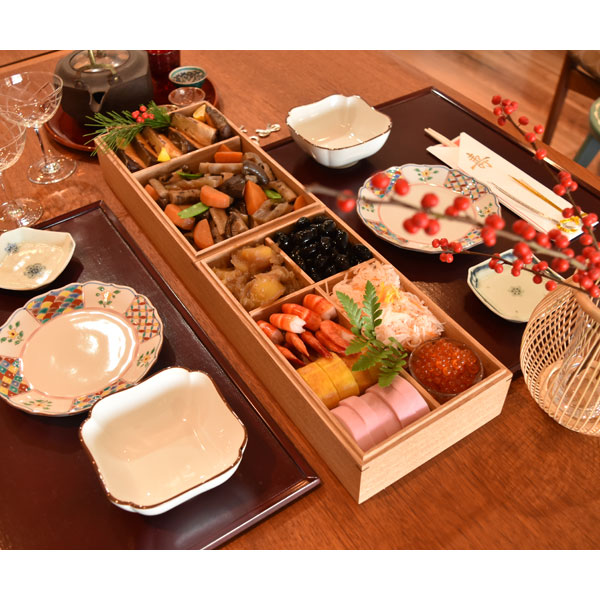
At this time of year, heading into the year-end and New Year season, several ZUTTO customers were actually looking for a jubako. Wanting to respond to their wishes, we thought about what an "easy-to-use jubako" would look like, and asked a kijiya (woodworking specialist) in Fukui Prefecture to make it for us. The result is the rectangular two-tiered jubako. It's a piece we're truly proud of—a shape designed to be easy to use not only on special occasions but in daily life too, carefully brought to life by a skilled craftsman.

What a jubako should be today. Our answer: a "rectangular jubako"
This rectangular two-tiered jubako was born from the standard ZUTTO holds dear: "things you want to keep using forever." Most jubako are square, but our staff noticed that when you place a square box in the middle of the table, it becomes hard for the people sitting in front of it to place their trays or plates nearby. That observation led us to have the piece made in a rectangular shape, so it would be easier to use on a compact tabletop and so that everyone could reach it comfortably.


▲The divider can be removed.
When you think of a "jubako," many people probably picture one finished in urushi (Japanese lacquer). This time, however, we chose a urethane finish that lets you enjoy the natural texture of the wood grain while also being easy to care for. Because the surface is coated, it doesn't offer the humidity-regulating properties of bare wood, but it does become resistant to water—one of wood's weak points—so it's less prone to deterioration, and you don't need to worry about oil stains when packing food into it.
When it comes time to wash it, you simply use a soft sponge with a neutral detergent, so this jubako can be used as casually as the everyday plates you already reach for.

▲The body is made of tamo (Japanese ash), while the corner wedges are walnut. These wedges serve a functional purpose, but by using a different material for them, we've also added a touch of design flair.
Prioritizing ease of use, for a jubako you'll want to keep using forever.
Another major feature of this original jubako is that although it's rectangular, it can also be used as a square. You can switch between the two depending on the occasion, and this comes in handy not only when eating but also when carrying it around.
CASE 1. When using it at the dining table, place the two tiers side by side

Dining tables are often rectangular and wider than they are deep, so placing a square jubako on one can leave little room for other dishes. With this jubako, you can line the two tiers up side by side, securing plenty of space while still arranging the food so that everyone at the table can reach it easily, no matter where they're sitting.
And because it has two tiers, you can also choose to use just one at a time. This makes it easy to pick out when you want to use it alone, and it's handy for serving sweets to guests or for holding a small amount of side dishes.
CASE 2. When eating on a picnic sheet, place the tiers front to back to form a square

When eating on a picnic sheet, placing the tiers front to back turns the shape into roughly a square. When a group gathers outdoors, people often sit in a circle around the food, and this is a convenient shape for exactly that kind of situation. Depending on the circumstances, it can sometimes be easier to reach the food when the tiers are side by side instead—and being able to adapt flexibly like this is one of the great things about the rectangular two-tiered jubako.
What's more, the rectangular shape has the advantage of being easy to carry. When taking it out for leisure activities, you'll likely carry it in an eco bag or backpack, but a square jubako needs a bag with plenty of depth to fit, which sometimes made it inconvenient to bring along. The rectangular shape solves this problem.

▲With our original azuma bukuro (traditional Japanese wrapping bag). It's a size that fits easily into an everyday bag as well.
The body has a depth of 15 cm, so it fits without any trouble into a tote bag or backpack that has a reasonable amount of depth. When you want to gather around a jubako outdoors—for a picnic, a school sports day, cherry blossom viewing, and so on—please take the rectangular two-tiered jubako with you. You can use it just as casually as you would carry your everyday bento box.
Natural wood grain you can use without formality
The material we chose is domestic tamo (Japanese ash), prized for its bright, natural, and beautiful grain. Known as a hard and durable material, its appeal lies in the beauty of its uniform grain. Touch it with your hand and you'll feel a slight roughness, letting you enjoy the character of the wood.

Another reason we chose this material is that it doesn't lean too heavily into a Japanese aesthetic, so it feels perfectly at home on an everyday dining table too. Use it not only for New Year's and other special occasions, but also at your everyday table—for a slightly more elaborate weekend meal, or when friends and family come to visit. Use it whenever you like, in whatever way suits you best.

The rectangular two-tier jubako box features what is known as an inro-buta (flush-fitting lid) style, also called awaguchi-gata. By carving the box to create a raised inner rim, the lid sits flush with the box's sides when closed, giving it a clean, streamlined appearance. Because the lid stands slightly taller than the box itself, it also has the added benefit of keeping food from touching the underside of the lid.
Delivered from Fukui, a region famous for its lacquerware
We asked Inoue Toku Mokkou, based in Fukui Prefecture, to make this piece. Fukui is well known as a production center for kakumono (square and rectangular) lacquerware, and the region turns out many jubako boxes, bento boxes, and trays. While kakumono production is typically divided among specialized workshops, Inoue Toku Mokkou is the kijiya, or woodworker, that shapes the box before the urushi (Japanese lacquer) is applied.

The craftsmen alternate between machine work and handwork to complete each piece. Even when machines are used, the final adjustments are always made by eye. The simpler the shape, the more precision it demands, and Inoue Toku Mokkou produces many such simple box forms.
We also plan to share, on a separate occasion, an article featuring our visit to Inoue Toku Mokkou. We were able to tour the actual workshop while hearing their story, so we hope you'll look forward to that as well.
>>Read the behind-the-scenes production report here

This rectangular two-tier jubako box carries ZUTTO's own thoughts and lets you feel the spirit of Japanese craftsmanship. We would be delighted if you use it for many years to come. If you have any questions, please feel free to reach out to our customer support team.
▼You can find the rectangular two-tier jubako box here

GUIDE »
CATEGORIES »
- + Gifts by recipient
- + Gifts by scene
- + Clothing
- + Bags / Backpacks
- + Wallets / Card cases
- + Jewelry
- + Shoes
- + Rainy day outfits
- + Kitchen
- + Home
- + Babies / Kids
- + Japanese products
Earn Miles


Payment & Security