

.jpg)


.jpg)

.jpg)
.jpg)

- トップページ/
- ZUTTO Journal/
- 選び方・使い方/
- PETARI Shallow Po...

The essence of clay-plate cooking, discovered through use. PETARI's Shallow Pot
What is PETARI?

PETARI's Shallow Pot was inspired by "toban ryori," a style of cooking using ceramic plates that originated in Yokkaichi, Mie Prefecture. There are so many carefully considered details that explaining them all in paragraph form would make for a very long read, so here they are in bullet points instead. This is a shallow pan whose shape was unraveled from a long-standing tradition.
Beautiful to look at and to use
・The lid is designed to sit upside down, allowing for flat, stackable storage.
・The beautiful, handle-free rim and shallow shape make it a vessel that can be brought straight to the table.
Makes delicious food
・An item that expands your cooking possibilities—steaming, simmering, sautéing, and more.
・The small bubbles produced when boiling help prevent ingredients from breaking apart during simmering.
・The rim where the body and lid meet forms a tight seal, increasing airtightness inside the pot and locking in the natural flavors of the ingredients.
Convenient to use
・Made with high-quality petalite, offering outstanding heat resistance.
・Features excellent heat retention, durability, resistance to odors and stains, and ease of care.
・Contains no lead or cadmium, substances that can pose risks to human health.
・Can be used in the oven with the lid on, as well as in the microwave.

PETARI is manufactured by Ginpo Toki Co., Ltd., a long-established maker founded in 1932. The company holds such a high market share that it accounts for roughly 80% of domestic donabe (clay pot) production in Japan. From selecting raw materials and preparing the clay to formulating the glaze, shaping, glazing, and firing in the kiln, every step is carried out in-house at their own factory. For raw materials, they use high-grade petalite selected from sources around the world for its excellent heat resistance, achieving high heat resistance, heat retention, durability, resistance to odors and stains, and ease of maintenance. Each piece is also finished by hand. For shaping, they use both machine power (a roller machine) and pressure casting, achieving a form that resists chipping easily. This robust construction is durable enough to withstand roughly 20 years of hard use even in restaurant settings.
What our staff discovered about the greatness of PETARI after actually using it
One of our staff members, who has a keen interest in Japanese craftsmanship, had long been curious about PETARI because it's a shallow pan modeled after the toban (ceramic plate) cooking of Yokkaichi, Mie Prefecture. This review shares what she discovered about the appeal of PETARI's Shallow Pot after actually using it—perfect for enjoying a variety of dishes even in small kitchens with limited storage, such as those found in single-person households or apartments.
Staff member M: "Since I live in a small apartment in the middle of the city, even though I'm interested in all kinds of everyday tools, it's hard to fit everything I want into my limited storage space. That's why I try to choose items that can be used in multiple ways, or ones that have been updated to fit modern life. I wanted a versatile pot that I could use for everyday cooking, but that would also come in handy for special occasions—like gathering around a nabe hot pot made with fresh local ingredients ordered online or received through furusato nozei (hometown tax donation), or hosting a home party for friends. That's when PETARI caught my eye. While I was drawn to its stylish appearance and the many chic, elaborate recipes associated with it, I did wonder whether I could really make it fit into my daily life—including my usual cooking repertoire and the upkeep it requires.
First, how do you choose the color and size?
It all starts with choosing a color and size.The first thing that catches your attention is the color. Mie Prefecture, blessed with abundant nature from the sea to the mountains and known for its thriving agriculture and fishing industries, is rich in natural resources thanks to its proximity to the coast. In fact, PETARI's colors are original hues developed to reflect the colors of the rocks found in Mie Prefecture.

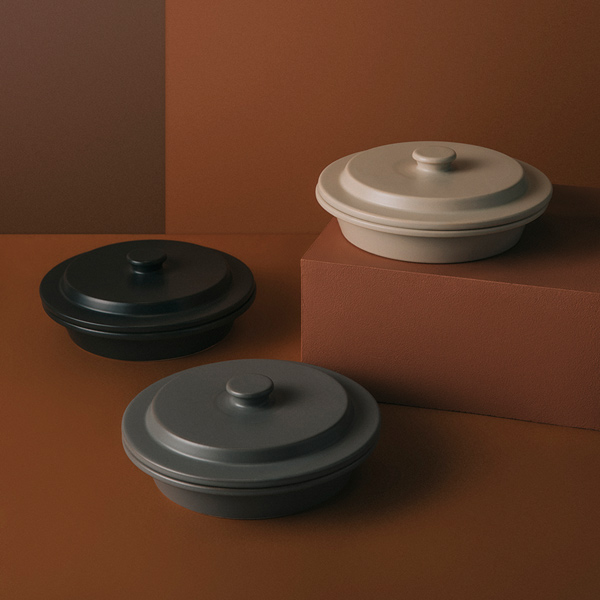
From top to bottom: kaseigan (igneous rock), sumiguro (charcoal black), and deigan (mudstone)
Colors
・Sumiguro (charcoal black): A chic black that recreates the rugged rock face at the foot of Onigajo, located at the edge of Shichirimihama in Kumano City. It's a deep, layered black reminiscent of well-charred charcoal.
・Deigan (mudstone): A soft gray. The Suzuka Mountains in the northern part of the prefecture contain terrigenous clastic rocks such as volcanic material and mudstone, which forms mainly from mud that accumulated and hardened at the bottom of the sea or lakes. This color aims to capture that moist, mysterious quality reminiscent of the deep sea.
・Kaseigan (igneous rock): A cream-like beige. This color and texture are modeled after the igneous rock formed by a massive caldera volcanic eruption approximately 15 million years ago, visible in the Higashi-Kishu region. Recreating its rich, multilayered depth of color proved difficult, and this shade was the result of repeated trial and error.
Sizes
24cm: sumiguro, deigan, kaseigan
30cm: deigan, kaseigan
At ZUTTO, the colors available currently differ depending on the size. Sumiguro is less prone to showing scorch marks or stains, while deigan and kaseigan offer that quintessential PETARI look that doesn't feel heavy even when left out on the kitchen counter. If you'd like sumiguro, it's available only in the 24cm size, but if you choose deigan or kaseigan, you can select from either size.

24cm: A recommended size for meals serving 1 to 2 people

30cm: A recommended size for meals serving 3 or more people

Since I prefer warm color tones, I chose kaseigan this time. I went back and forth between the 24cm and 30cm sizes, but since it's currently just the two of us at home, I settled on the 24cm.

The slim silhouette and the cream-beige color are truly lovely! It has an atmosphere reminiscent of a white Japanese donabe (clay pot), yet it also seems like it would suit Western-style cooking really well. As soon as it arrived, I decided to try using it right away.
The first thing I tried was making breakfast

PETARI offers so many stylish recipes, but the first thing I wanted to test was whether it could also be used for a simple everyday breakfast. Out of curiosity, I wondered what would happen if I cooked French toast, scrambled eggs, and sausages together in it. It didn't take too long to heat up once placed on the stove, and it gave the impression of warming gently and evenly. As a pot, it performed wonderfully—it browned nicely, and the sausages came out crisp.

It didn't look very elegant, but I was impressed that everything stayed warm the whole time I was eating!
What impressed me most of all was the heat retention when serving. When I brought it to the table and said "here you go" to my family, it made a sizzling sound just like the hamburg steak at a popular restaurant.The appetizing aroma and sound raised our satisfaction even more than I had expected. Personally, I think this would be wonderful for busy parents who tend to neglect their own breakfast, or for families with junior high and high school students.
Junior high and high school students are often so busy getting ready and attending morning club practice that the whole family can't always sit down to breakfast together, and when both parents work and come home late, it's common to prepare food ahead of time. Food warmed on a ceramic plate stays fluffy and warm all the way through, with a crisp surface, and tastes noticeably better than food reheated in the microwave. Incidentally, PETARI can also be used in the microwave, so if you're still a bit nervous about using a flame, you could start there instead.

Depending on the room temperature, but in this case, steam was still rising from the food even about 10 minutes after I finished photographing it.
What about scorch marks after using butter?
It's a pot with such a lovely color, so the next thing I was curious about was whether burn marks would ruin its beautiful appearance. Here's what it looked like after I actually used it and washed it. I ended up scorching it while using butter, but just a light scrub with a sponge got it this clean. It came off so easily that, coming from someone used to scrubbing burnt spots off an iron skillet with a scouring pad, I was genuinely surprised. They say it's due to the special glaze used, and it really is impressive.

Honestly, for everyday use, I felt it would be fine to just leave the stuck-on scorch marks as they were, but for the sake of this column, I decided to try removing them with baking soda. I added one tablespoon of baking soda per one cup of water, brought it to a boil, and once it cooled, without discarding the water, washed it with a neutral detergent and a sponge. Doing this brought it back to looking just like new.


The last thing I tried was seeing how it could be used as a cooking pot. I used the 30cm size for hot pot dishes, starting with sukiyaki. First, I grilled the sukiyaki beef, and it cooked up tender—without needing a lot of oil, the meat didn't stick, which was great. (I think it's best not to turn the heat up too high, so oil doesn't splatter around.)


Having tried it this time, I'm truly glad to have discovered that this pot isn't just beautiful to look at—it's the kind of pot you'll want to use in all sorts of everyday situations. PETARI comes with plenty of official recipes, and using it sparks new ideas, like thinking "maybe I'll make this dish next weekend" or "maybe I'll serve this at my next home party." It's the kind of tool that enriches daily life.」

▽You can find PETARI here

GUIDE »
CATEGORIES »
- + Gifts by recipient
- + Gifts by scene
- + Clothing
- + Bags / Backpacks
- + Wallets / Card cases
- + Jewelry
- + Shoes
- + Rainy day outfits
- + Kitchen
- + Home
- + Babies / Kids
- + Japanese products
Earn Miles


Payment & Security