.webp)


.webp)


.webp)


.webp)


- トップページ/
- ZUTTO Journal/
- 選び方・使い方/
- Grooming essentia...

Small Tools for Grooming, Worth a Second Look
The Japanese word for grooming, "midashinami," is written with characters meaning "to cultivate one's appearance."
Since the word "tashinamu" carries the nuance of "mindfulness" or "conscious care,"
midashinami refers to the mindful attention we give to keeping ourselves presentable.
The small tools we use for grooming aren't things we show to others, but
when they're functional and suited to their purpose,
even the time spent checking our appearance becomes enjoyable.
This time, we'd like to introduce items that are truly useful for grooming.

People with beautifully cared-for nails give off a refined impression.
Essential for nail care are nail clippers and nail files.
These tools carry on techniques passed down by craftsmen since long ago.
Before the Edo period, scissors were a luxury item,
so people apparently used blades such as swords to trim their nails.
It's a bit surprising to think that swords were once used for something as simple as cutting nails.
Then, in the 15th year of the Taisho era, in response to the demand for housing reconstruction after the Great Kanto Earthquake,
Suwada Seisakusho, founded in Sanjo City, Niigata Prefecture,
created a nail clipper called "kuikiri" for carpenters.
A kuikiri is a tool used for cutting hard materials such as nails and wire.
The way its two blades meet precisely made the kuikiri well suited for use as a nail clipper.
Suwada Seisakusho shaped the handles of the kuikiri to fit the fingers gripping them,
giving birth to what is now known as the nipper-style nail clipper.


Suwada Seisakusho continues to make nipper-style nail clippers today under the brand name SUWADA.
While the common up-and-down style nail clipper is widely available,
it tends to leave the cut edge of the nail pointed and prone to splitting.
By contrast, SUWADA's nipper-style nail clippers
cut the nail as if shaving it away, leaving a smooth edge.
By using a cylinder spring to open the blades firmly on both sides,
they're able to cut through even thick nails.
In this way, as the times changed, the nail clipper
evolved from a carpenter's tool into an indispensable part of daily life.
■Caring for Your Nail Clippers
Due to the nature of their materials, SUWADA nail clippers
may become harder to cut with or begin to rust with use over time.
To keep using them for years to come, wipe them with a soft cloth after use,
and occasionally apply rust-preventive oil.
Also, for SUWADA products,
the manufacturer offers a paid maintenance service.
If you'd like to have a chipped blade repaired or sharpened, please inquire using the link below.
>>Information on SUWADA's Maintenance Service
Now, about the nail file used after clipping your nails—the file, too, has its origins as a tool. Originally made for working with wood and metal, it was a tool used to shape materials. Because it required the skill of casting fine teeth into the blade, it was crafted by swordsmiths.
wataoka is a nail file manufacturer founded by its first-generation owner, a swordsmith, in Nigata, Kure City, Hiroshima Prefecture—an area now known as a center for file production. Since the late Edo period, they have continued making various files for use as tools, as well as nail files and heel files.


A charming gourd-shaped file.
What sets wataoka's files apart is their excellent cutting quality and the thinness of the small blade edge. In the case of nail files, moving the finely crafted blade—which has teeth set in three directions—allows you to file nails without damaging the cells within them. For heel files, the blades are made flat, and by combining blades of differing depth and shape, the file resists clogging and provides a pleasant filing experience. Both files are small enough to fit in the palm of your hand, yet they reflect the skill of craftsmen passed down through generations.
■Caring for Your File
With use, a file's teeth can become clogged. When this happens, rinse it with water and be sure to wipe away any moisture thoroughly. wataoka files are made of stainless steel and are resistant to rust, but please be careful, as rust can occur if the file comes into contact with other metals.

Just as important to grooming as the state of our nails is our hair.
Long hair that flows smoothly and beautifully, or short hair kept neat and clean—simply having well-groomed hair can convey a sense of ease and composure, which is why, regardless of gender, it's a part of ourselves we want to keep looking beautiful.

The hairbrush and comb are the representative tools for grooming hair.
A hairbrush smooths out tangles, and if it's made with natural bristles, it can also give hair a beautiful shine.
A hair comb has teeth arranged in a single row, making it useful for smoothing the flow of hair, and convenient for those styling their hair or with permed hair. By using a hairbrush and comb wisely for their respective purposes, you can keep your hair looking beautiful.


REDECKER is a brush maker founded in Germany in 1936. REDECKER brushes are made from natural wood and animal hair, which makes them resistant to static electricity and gentle on the scalp. The bundled bristles remove dust clinging to the hair and help smooth out tangles.
Their brushes use boar bristle. Boar hair is firm with good spring, allowing it to catch the hair firmly, making it a good choice for those with long hair.
The standard Olivewood Hair Brush is a shape you'll want to use for everyday grooming. The Olivewood Roll Hair Brush is a type suited to styling, such as adding curls to the hair while blow-drying. Both are compact, sized to be easy to handle even for women with small hands.


Also well known as one of the leading brush makers is G.B.Kent.
ZUTTOでは、G.B.KENT(ジービーケント)の作るヘアコームを取り扱っています。
At ZUTTO, we carry hair combs made by G.B.KENT. These combs are crafted from cellulose acetate sheet, a resin derived from cotton. The amber-colored teeth are rounded at the tips, making them gentle on the scalp as well.

Men's Folding Pocket Comb 20T

Men's Pocket Comb (with Leather Case & Nail File)
One of the joys of G.B.KENT combs is that they're just as easy for men to use as they are for women. The Men's Folding Pocket Comb 20T, which folds up to fit in a pocket, and the Men's Pocket Comb (with Leather Case & Nail File), which comes with a chic leather case and even a nail file, both convey the gentlemanly spirit of this British-born brand.
■Caring for Hairbrushes and Combs
Since hairbrushes are a care item, dust and debris caught in the bristles tend to cling to the brush itself. Whenever you notice buildup, brush it off right away. For combs, wipe them clean with a cloth. A hair comb is ideal for removing dust from a brush. The hair remover shown below is convenient for clearing dust from the base of the bristles.
>>REDECKER Hair Remover

When it comes to giving your appearance one final check, a mirror is indispensable.
It's handy to have one in a spot you can glance into quickly before heading out.
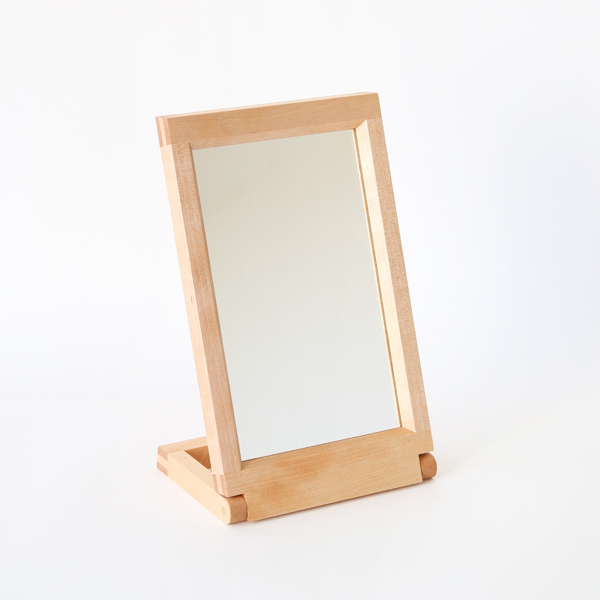
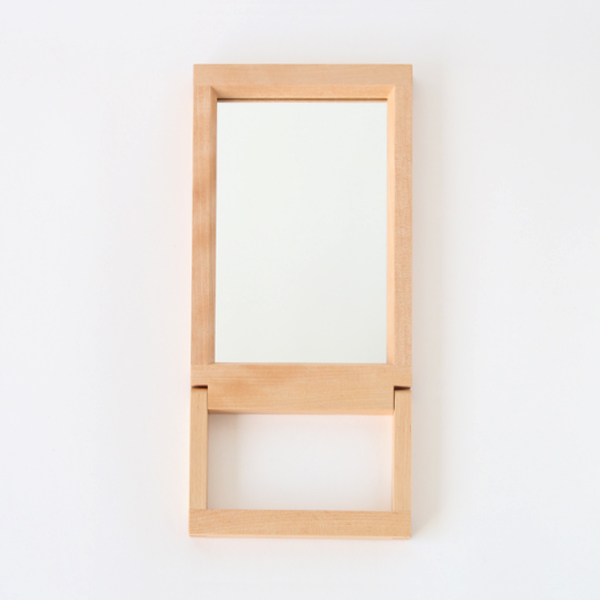
The two-way mirror from Oak Village can be placed on a desk or hung on a wall. The natural wood grain shows through as it is, and the way it gains luster and deepens in color with use is a charm unique to natural materials. Placed on a desk, it tilts to a convenient angle for checking your reflection, while when hung on the wall, a simple hanger attached to the mirror lets you hang a towel or similar item. Having one near your entryway is handy for a last look before heading out.


Now, a compact mirror is also handy after you've gone out, for touching up your makeup and the like. It's reassuring to keep a palm-sized compact mirror tucked away in your bag.
The Wajima Kirimoto makiji urushi (Japanese lacquer) compact mirror has a natural urushi finish on the back, giving it a wonderfully refined look. Lacquer mirrors have even been unearthed from Japanese archaeological sites, and they carry a quiet, old-fashioned elegance.
Its size is compact enough to fit unobtrusively in its dedicated case, making it perfect for checking your appearance while out and about.
■Caring for Mirrors
Dust and grime tend to collect easily on the surface of a mirror.
Wipe it periodically with a soft cloth, or dust it off, to keep it clean. Please be careful not to let water touch any wooden or urushi-coated parts. Also, since wooden parts tend to dry out, rubbing in a small amount of naturally derived oil will help them last longer.
We hope you've enjoyed learning about these small items for personal grooming.
As we've shown, even the things we use casually in our daily care routines are often full of both functionality and beauty.
Why not try using tools suited to their purpose, and refine both your appearance and your state of mind?
GUIDE »
CATEGORIES »
- + Gifts by recipient
- + Gifts by scene
- + Clothing
- + Bags / Backpacks
- + Wallets / Card cases
- + Jewelry
- + Shoes
- + Rainy day outfits
- + Kitchen
- + Home
- + Babies / Kids
- + Japanese products
Earn Miles


Payment & Security