Welcome to ZUTTO
Free shipping for newsletter subscribers (some areas excluded)
- トップページ/
- ZUTTO Journal/
- 選び方・使い方/
- 【Special Order】Th...
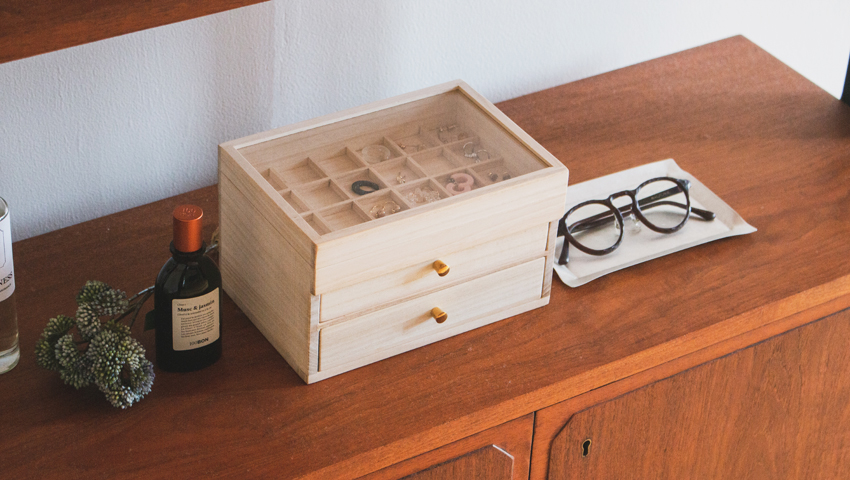
【Special Order】The best way to store your accessories. A kiri (paulownia wood) jewelry case with finely divided compartments, easy to see and easy to take things out of.
Where do you store your jewelry?
Earrings, rings, necklaces, watches—jewelry and accessories come in so many different shapes and types. How do you all store yours? Even if you keep just your favorite, most-used pieces in an easy-to-reach tray, before you know it the tray fills up and gets cluttered, leading to frustrations like "I can only find one earring" or "the necklace and earrings are all tangled together."
To solve these small everyday frustrations, Masuda Kiribako-ten in Fukuoka Prefecture and ZUTTO worked together to create the 【Kiri 3-Tier Jewelry Case】. This is a completely custom-order item, with ZUTTO specifying every detail of the design—right down to the size and the number and type of compartments.
Please also take a look at our staff's favorite items column >>
Based on customer feedback, we've made some changes to the specifications
(Added: October 16, 2025)
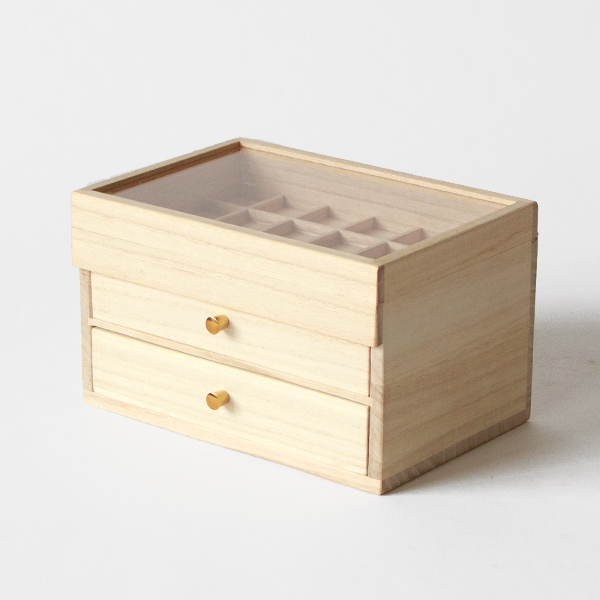
Some time after launch, we asked a number of customers about their experience using the case. Based on their feedback, we consulted once again with Masuda Kiribako-ten and made some changes to the specifications. We added brass pulls to make the drawers easier to open, and made the bottom drawer a bit deeper so that taller items like watches would be easier to store. See details here >>
The craftsmanship of a specialist shop that knows kiri inside and out
Since its founding over 90 years ago, Masuda Kiribako-ten has been a specialist shop devoted to kiri, honing its box-making techniques with this single material.
Kiri absorbs moisture from the air and releases it as it dries, so even in humid conditions, the air inside a kiri box stays comfortably regulated—and it also has anti-mold properties. Because of these qualities, kiri has long been cherished in Japan as a material for storing kimono and other treasured belongings. Kiri's natural characteristics have made it an ideal storage material for Japan's humid climate.

A gift arriving in a kiri box gives off a certain air of luxury—and with good reason. Kiri boxes are truly the best choice for transporting and storing valuable items in optimal condition.
As proof of this, Masuda Kiribako-ten also makes kiri boxes for Important Cultural Properties held by national museums, for works of art and craft created by Living National Treasures, and boxes bearing the certification inscriptions of tea ceremony grand masters.

When we approached them about creating a jewelry case out of kiri, they explained—drawing on the material's properties—just how well kiri and precious metals go together, and offered ideas like, "In that case, this kind of construction would work well," or "For easier access, this kind of specification might be better." These true professionals of kiri and box-making helped bring our vision to life.
A custom-order 3-tier jewelry case, designed to find the ideal solution
Let's hear first from the staff member who led the planning of this custom 3-tier jewelry case, about the thinking behind it.
Yes, exactly. I love earrings and have quite a lot of them, and I'd always struggled with how to store them.
I kept everything in a glass tray, loosely zoned—earrings here, rings there—but when I was rushing to get ready to go out, I could never find what I was looking for. And even when I did find something, it was often just one earring instead of a pair. Or I'd lift up a necklace and several earrings would come up tangled with it, making them a hassle to untangle. This kind of thing happened all the time.
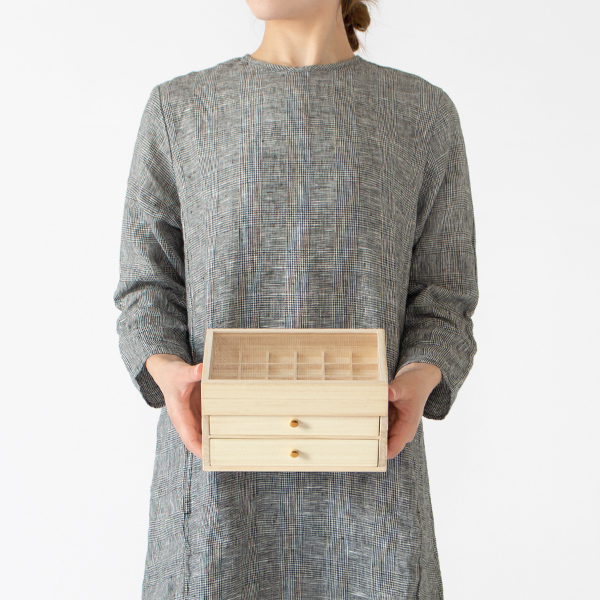
I looked around quite a bit, but most of the commonly available cases had things like cushioned inserts specifically for rings, or hooks on the inside of the lid for hanging necklaces—in other words, the space was implicitly designated for a specific type of item. I worried that this wouldn't match the quantity of items I actually owned, and I didn't like the idea of ending up with unusable space. So I never got around to buying one.
When we worked with REN on the【Special Order】Gamaguchi Jewelry Pouchproject, I had a similar thought—I wanted something that would let you store items with a certain amount of freedom, and that's what got this project started.
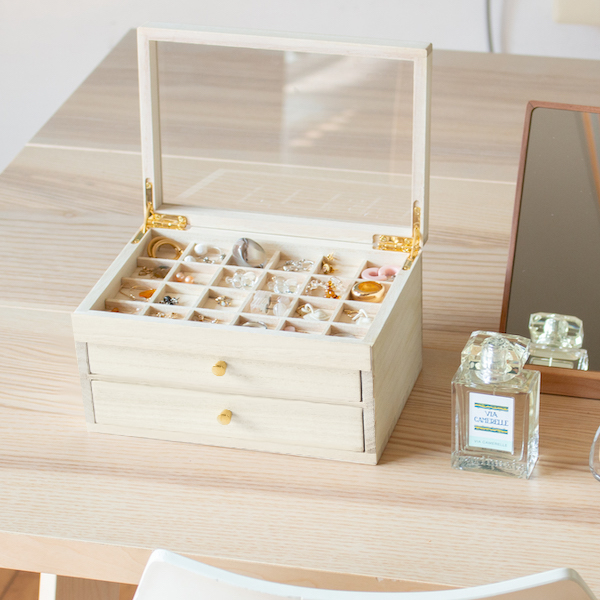
When I thought about what the ideal way to store jewelry would really be, I realized that it wasn't just about a user-friendly design or specification—the material itself mattered just as much.
I'd always had the image of kiri as the material used for kimono chests, specialized for storage since long ago, but researching it this time, I discovered that it's not just ideal for clothing—it's perfect for storing jewelry too.
The characteristics of kiri are as follows:
Lightweight: Kiri is extremely light, making it easy to carry.
Humidity control/airtightness: Because it doesn't trap moisture inside, it helps prevent discoloration of precious metals. (It's not completely airtight, so this doesn't mean discoloration will never occur.)
Softness: Among woods, kiri is quite soft, so you can place jewelry directly on it without needing to line it with fabric. It's also easy to clean.
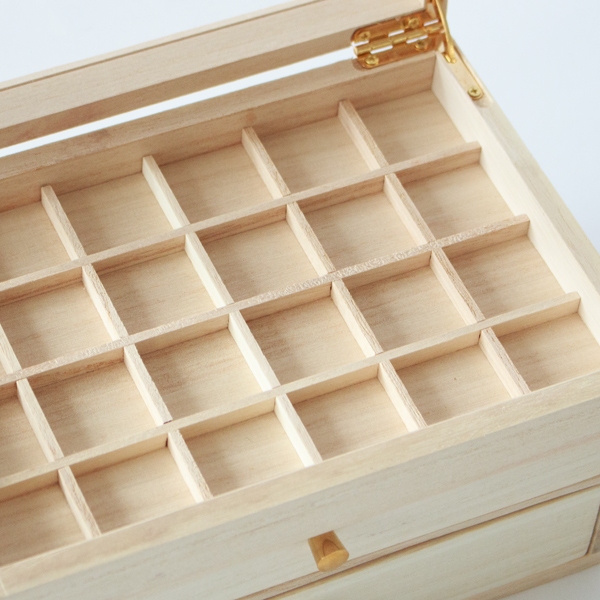
The specifications of each of the 3 tiers.
While allowing for freedom of use, the dividers are combined in sizes that accommodate each item.
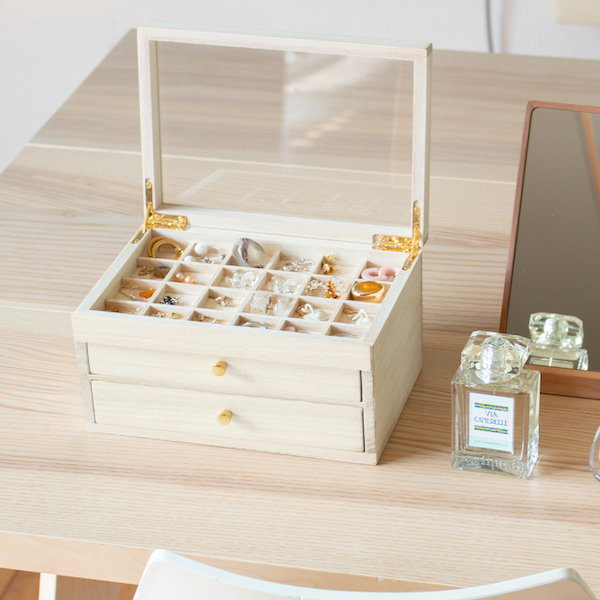
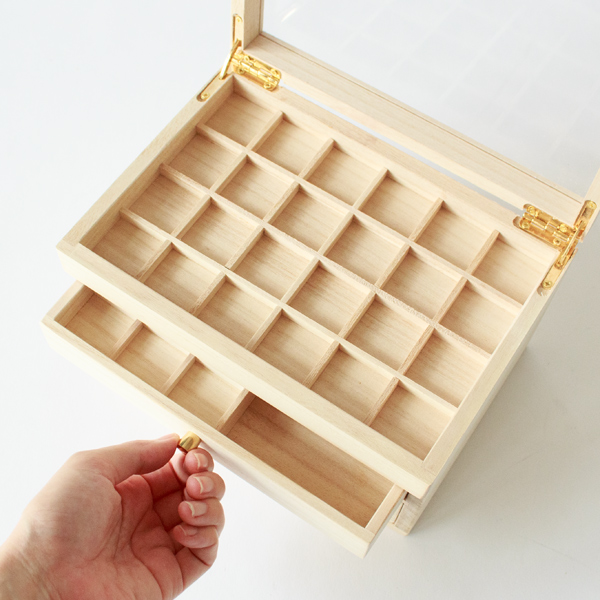
▼ Tier 1: 24 compartments. Keep your most-used "first-string" pieces here—earrings, rings, necklaces, and the like.

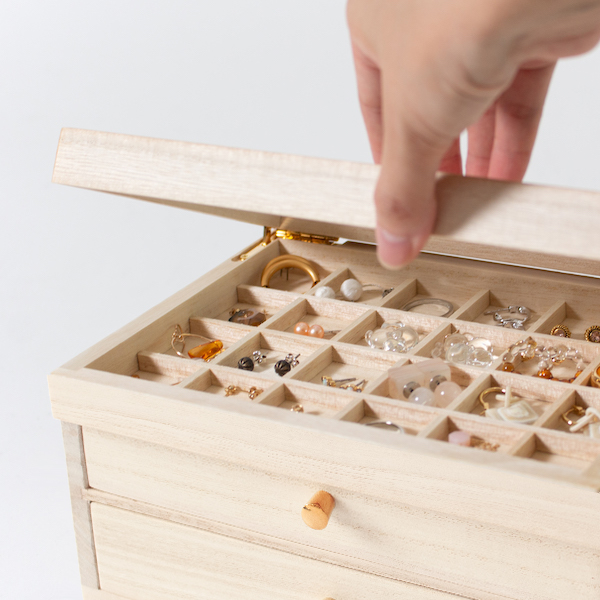
24 small compartments, each measuring 3cm x 3cm inside. Whether it's earrings, rings, or necklaces, you can store one item per compartment. Since they won't mix unless you turn the case upside down, you can glance in from above and quickly grab whatever you're looking for. The dividers stand 7mm tall—a height we adjusted repeatedly to find the sweet spot where items are properly separated yet still easy to pick up with your fingers.

We deliberately avoided dividing tier 1 into varied sizes because we wanted the space to be usable without favoring any particular item. For example, if we created a space specifically for rings, it would simply be wasted space for someone who doesn't own any rings. By keeping the dividers a uniform size, you're free to arrange your earrings, ear clips, rings, and necklaces however you like.

The lid is another point of care. We used an acrylic panel so the contents are visible, giving the case a role as a display case as well. Whether it's a splurge-worthy pair of earrings you bought for yourself, or a ring passed down from your grandmother, gazing at your treasured jewelry becomes a richer moment of its own.
The lid section is about 1.5cm tall, designed so that even oversized rings or earrings won't bump against it.
With 24 compartments in tier 1, you might find yourself thinking, "do I really own that much jewelry?" as you count your pieces—but once you tally up your earrings, rings, and necklaces separately, you may be surprised how much you actually have. What's more, as tastes shift with age and mood, jewelry collections tend to grow to include various genres and styles over time, so it's nice to have some breathing room now, with enough capacity to welcome new pieces in the future.
▼ Tier 2: 12 compartments. The right side offers space for bracelets or larger necklaces.
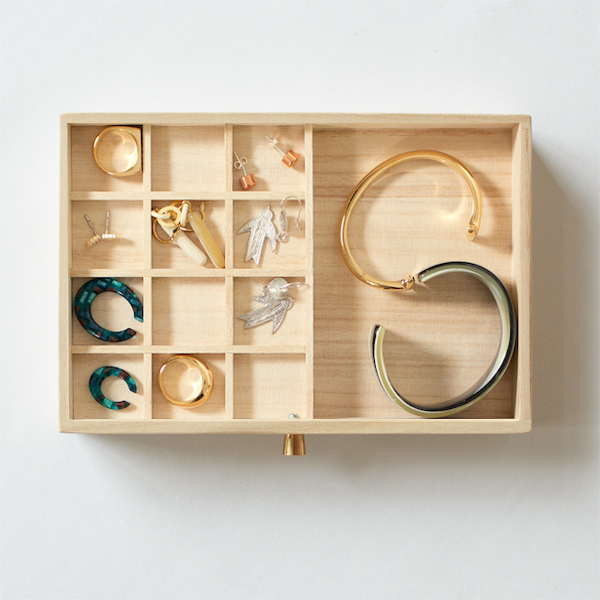

Tier 2 has different dividers on the left and right sides. The drawer's depth is about 2.5cm.
The left side has small 3cm x 3cm compartments, just like tier 1, while the right side is left as an open, undivided space. The depth differs between left and right—the taller right side is even able to hold thicker bangles.
▼ Tier 3: 3 vertically-elongated compartments. The right side is an open space.
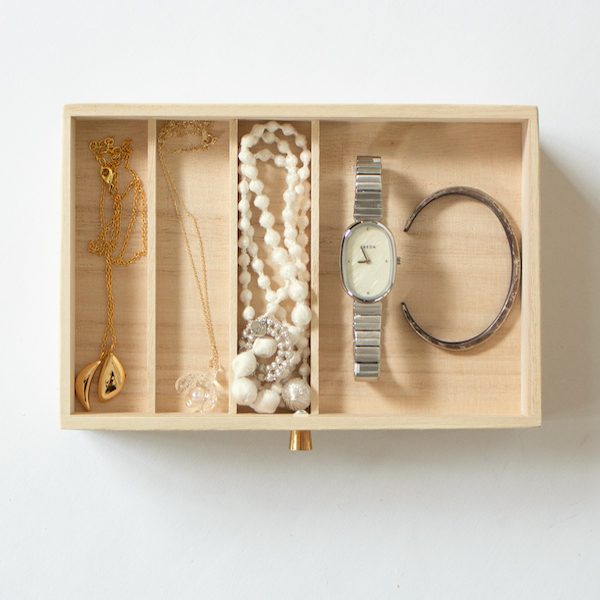
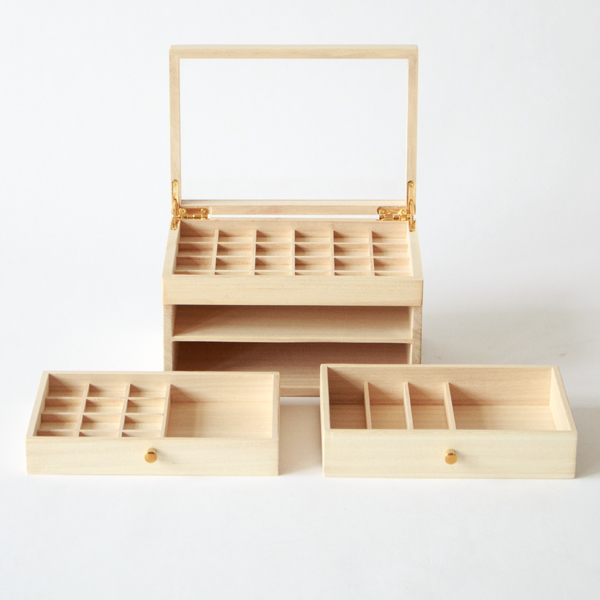
For tier 3 (right side of image), we changed the depth based on customer feedback. This drawer is 1.5cm deeper than tier 2, at about 3.5cm.
Here too, the dividers differ between left and right.
The left side has vertically-elongated compartments designed to hold necklaces, bracelets, watches, and the like with ease. Even necklaces with larger pendant tops can be stored here. Because this tier is deeper than tier 2, taller bracelets and wristwatches are easier to store, and just as easy to take back out.
UPDATE: Brass knobs make the drawers easier to pull out
We also changed the specification so that the tier 2 and tier 3 drawers now come fitted with brass knobs.
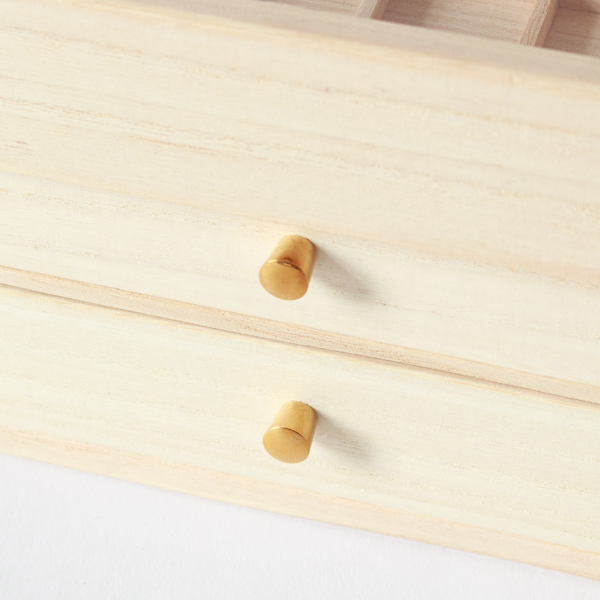
Originally, the drawers had a half-moon-shaped notch you'd hook your finger into to pull them out, but with the brass knobs, they now open much more easily.
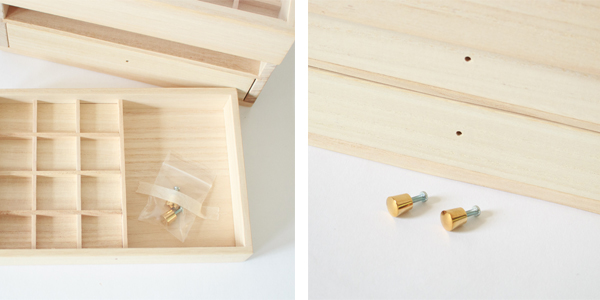
The parts are shipped inside the top drawer, so please attach them yourself (no tools required). Turning the knob allows you to separate the knob from the screw portion.
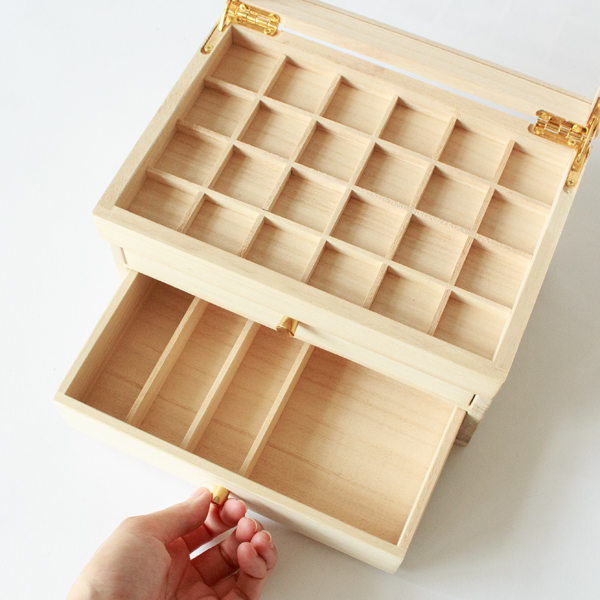
With the addition of the knobs, the drawers have become much easier to use—making even those hectic moments of getting ready feel a bit smoother.
This three-tier kiri (paulownia wood) jewelry case began with a simple wish: to have something that lets you store and display your jewelry beautifully, while making it stress-free to take out and put away all kinds of items.
The maker brought that vision to life, with careful attention to both materials and usability. We hope you'll welcome it as a place for your treasured jewelry to call home.
▼ [Custom Order] Go to the product page for the Kiri Three-Tier Jewelry Case
GUIDE »
CONTENTS »
CATEGORIES »
- + Gifts by recipient
- + Gifts by scene
- + Clothing
- + Bags / Backpacks
- + Wallets / Card cases
- + Jewelry
- + Shoes
- + Rainy day outfits
- + Kitchen
- + Home
- + Babies / Kids
- + Japanese products
Earn Miles


Payment & Security