.webp)


.webp)


.webp)


.webp)


Welcome to ZUTTO
Free shipping for newsletter subscribers (some areas excluded)
- トップページ/
- ZUTTO Journal/
- 選び方・使い方/
- Limited Quantity,...

Limited quantity, members only: PRAS striped sneakers
Made using Japanese Kojima canvas and produced with the vulcanized
manufacturing method, PRAS sneakers.
Usually the upper comes in a single solid color, such as unbleached or black, but
this time we introduce a special, limited-quantity edition: the "unbleached and sumi-ink striped sneaker."
*This is a members-only introduction, so you will need to log in to view the product page.


The limited-quantity SHIMA (stripe) sneaker was born from a collaboration
between PRAS and Hanneruka.
Hanneruka is a brand that, like PRAS, plans and produces travel bags and other
items using Kojima canvas, and this collaboration brings Hanneruka's signature
SHIMA (stripe) design to PRAS sneakers.


The canvas used for the upper is Kojima canvas, made in Kurashiki, Okayama
Prefecture, which produces 70% of all domestic canvas in Japan.
Canvas is a thick, plain-woven fabric made from twisted cotton thread,
known for being breathable and durable, developing character the more it is used.
This Kojima canvas, with use as a sneaker upper in mind,
has a slightly lower warp and weft thread density than standard No. 10 canvas (12.6oz),
giving it a fabric thickness optimized for sewing.

On this original canvas, a striped pattern is drawn in a textured sumi-ink color.
It is dyed entirely by hand at a Kyoto dye workshop with over 100 years of history.

1. Once the dye color is decided, materials are measured out by the gram, mixed, and blended.
2. The canvas is stretched onto an inclined table. Great care is taken to ensure
it lies flat without wrinkles and that the weave of the fabric is not distorted.
3. Like a stencil, a template with the pattern cut out is placed on top,
and dye is applied with a scraping spatula.
The dyeing is done in one continuous motion to avoid unevenness or missed spots.
This process is called nassen (stencil dyeing), and when drawing a continuous pattern
on a long piece of fabric, the template is shifted slightly each time and the process
is repeated so the pattern connects seamlessly.
This is a technique that absolutely requires the presence of a skilled craftsperson.
4. After dyeing, heat treatment is applied to fix the printed pattern onto the canvas. 

The dyed sumi-ink color is not pure black but appears faded in places,
resulting in a lovely dye with rich texture.
While the design makes a strong visual impact, it blends well with the natural
unbleached color of the canvas, pairs beautifully with standard denim,
and for women, it can also look great peeking out from beneath a long skirt.

Shoes: PRAS / SHIMA SHELLCAP LOW BLACK
Knit: Letroyes / Turtleneck LTW910
Backpack: STANDARD SUPPLY / DAILY DAYPACK NAVY

Shoes: PRAS / SHIMA SHELLCAP LOW OFF WHITE
Knit: C.T.plage / YAK Turtleneck (coming soon)
Bag: TRICOTÉ / Pineapple Bag (coming soon)
Because the wide-striped pattern is used, the way the pattern appears differs between
the left and right shoe of each pair, making every pair one of a kind. Please look forward
to seeing which combination of stripes arrives for you.
The rubber comes in two colors: off-white and black.
Off-white brings out the gentle color and texture of the unbleached canvas,
while black gives a crisp, sharp look to the feet.
Both colors are available in sizes from 22cm to 27cm,
making this a design recommended for both women and men.

The biggest feature of PRAS sneakers is their manufacturing method.
Known as the vulcanized construction method, this refers to the way the upper
and sole of the sneaker are bonded together.
The upper and sole are shaped using raw rubber that has not yet hardened,
then placed in a special kiln where high temperature and pressure are applied,
causing the rubber to react with vulcanizing agents such as sulfur and harden,
bonding the parts firmly together.
This allows the canvas upper and rubber sole, two different materials,
to be strongly fused into a single, unified piece.

"Shoes" require materials and components with the appropriate durability.
Raw rubber kneaded with the correct blend, outer fabric with a lining glued on
using rubber adhesive, and rubber tape reinforced with canvas sandwiched inside
for added strength—each component is carefully crafted.

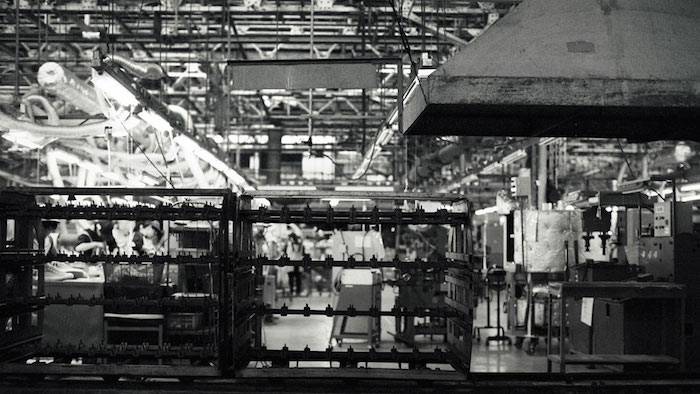
It is skilled craftspeople who take the flat-cut pieces of each part and sew them
into three-dimensional shapes. Through a multi-skilling approach, in which a single
craftsperson masters the techniques of various processes, the workshop improves
production efficiency and passes on its skills.


The sewn upper is stretched over a foot-shaped last and lasted into place,
the sole is attached, and rubber tape is wrapped around the entire shoe.
This process requires such delicate control of pressure that it is said the finished
product is affected if it is not done by hand.

Each shoe is set individually onto the lasting machine.

The process of placing the shoes in a special kiln and applying high heat and pressure
at 120°C for 70 minutes is called "vulcanization."
From the state of raw rubber before entering the kiln, it transforms into a resilient,
comes out of the kiln with the properties of rubber.


Since the upper is made of unbleached canvas,
dirt will become more noticeable the more you wear them.
Some people think it looks cool to let canvas sneakers
get a little dirty and wear them with a worn-in,
broken-in look, so it really comes down to personal taste,
but more often than the shoes actually breaking,
it's reasons like "they've gotten dirty" or "they've lost their shape badly"
that end up making shoes unwearable.
So if you're aiming to wear a pair for a long time,
it's better to be mindful of keeping them clean.
【After wearing them】
・Use a shoe brush to easily remove dust
・If the rubber part at the toe is dirty, wipe it with a damp cloth
【When there's noticeable dirt】
Vulcanized sneakers can be washed with water.
1. Remove the laces and soak the shoes in water or lukewarm water.
2. Wash with shoe detergent or a neutral detergent, and for heavily soiled areas,
use a brush or toothbrush to scrub them clean.
3. Rinse thoroughly.
4. After spinning out the water, reshape the shoes using newspaper and let them dry in a shaded, well-ventilated area.
The key point is step 3, rinsing. If detergent isn't fully rinsed out,
it can cause stains, so be sure to rinse thoroughly.
For step 4, always dry the shoes in the shade.
When we asked the maker, they said it's basically fine to wash them vigorously without worry.
And apparently, the key to making them last long is simply to wash them.
Since the upper is canvas, washing it once it gets dirty from wear
tightens the weave of the canvas, making the shoes last relatively longer
than if you kept wearing them without washing.


GUIDE »
CATEGORIES »
- + Gifts by recipient
- + Gifts by scene
- + Clothing
- + Bags / Backpacks
- + Wallets / Card cases
- + Jewelry
- + Shoes
- + Rainy day outfits
- + Kitchen
- + Home
- + Babies / Kids
- + Japanese products
Earn Miles


Payment & Security