.webp)


.webp)


.webp)


.webp)


Welcome to ZUTTO
Free shipping for newsletter subscribers (some areas excluded)
My page
Information
- トップページ/
- ZUTTO Journal/
- 選び方・使い方/
- Getting to know w...

Getting to Know Wood Products by Following Their Grain
Wood products—you can feel the warmth that only nature provides.
Once you hold one in your hands, you notice the gentle texture, and the distinctive colors and grain patterns nurtured over time.
Wood products could be described as a concentration of the many characteristics woven by nature.
This time, we'll trace the grain of these wood products and explore the unique character each one holds.

Wood has long been favored as a material for buildings, furniture, and everyday items.
In Japan, blessed with abundant forests, wood has been indispensable to daily life because of how easy it is to source and process, its lightness,
and above all, its durability that allows it to be used for many years.
Even today, wood products can be found throughout our daily lives,
and the grain we're focusing on this time differs from tree to tree, and even among trees of the same species.
The type of grain that appears in a wood product differs depending on how it is processed.
When wood is cut toward the center, the parallel grain that appears is called "masame" (straight grain),
and when the outer part of the wood is cut, the mountain-shaped grain that appears is called "itame" (cathedral grain).

Masame has the advantage of being less prone to warping and shrinkage,
but only a limited amount can be obtained from a single tree.
Itame, on the other hand, can be milled in greater quantities than masame.

There is also "fushime" (knots) within the grain, known through the phrase "fushime" as in a turning point in life.
A knot is the part formed when the base of a branch is absorbed into the trunk,
and it is characterized by high density and extreme hardness.
How easily knots appear depends on the type of wood and the way it's processed,
but they can be said to be a characteristic unique to wood products, offering a glimpse into the tree's growth process.

When it comes to trees familiar to Japanese people, sakura (cherry) comes to mind.
Wood products made from cut sakura wood have a fine-grained texture and show a beautiful luster when polished.
Since it has high strength and water resistance, it is often used as a material for interior items and kitchen accessories.


SONOBE's Meiboku Bowl is made using domestic sakura wood,
carefully crafted piece by piece by Japanese artisans.
By patiently polishing the cut wood, it achieves a smooth, gentle texture.
The bowl type, with thickness added to the rim, is designed with a gentle curve that makes it comfortable to hold.
Each piece differs in color and how the grain appears, but the grain, which draws gentle circles,
seems to enhance its soft impression.
The deep bowl is great for serving salad or as a stew dish.
Because of its thickness, you don't need to worry about burns even when holding hot food,
and it's gently made so the heat is transmitted slowly.


This is Owan Yauchida's color-wiped urushi (Japanese lacquer) bowl, made by applying urushi to a sakura wood bowl.
Urushi has long been known as a reinforcing material that prevents cracking and chipping, making items durable and long-lasting,
adding not only strength but also a beautiful luster.
Yet it still gives off a somewhat rustic impression, perhaps because of the brand's wish for it to be used
not just on special occasions but at the everyday table.
From the vivid urushi finishes in black, red, gray, navy, yellow, and green,
the faintly visible grain of mizumezakura (birch cherry) wood warms the heart.

This piece, with a different atmosphere from the bowl mentioned earlier, is also born from sakura.
Fujiki Denshiro Shoten has continued making kabazaiku, a traditional craft passed down in Akita Prefecture, for generations.
Kabazaiku is a technique in which the bark of yamazakura (mountain cherry) is peeled off, dried, and then glued onto a cylindrical core.
The bark of yamazakura, with its excellent breathability, moisture resistance, and durability,
has historically been prized for tea caddies and boxed items where dryness is essential.
Fujiki Denshiro's series called "Mujihi" features bark polished to a fine sheen.
The knots, peeling, and coloring inherent to yamazakura appear just as they are.


Next is walnut, known in Japan as "kurumi."
It is a wood prized for furniture and fittings due to its excellent durability and resistance to warping.
Its beautiful grain and deep coloring are also part of its appeal.
Because it contains oils, it gradually develops a sheen as it's touched and used.

With gentle angles forming an octagonal shape,
this is Takahashi Kogei's Kakudo Dish.
The dish, with its soft curves, is made from a single walnut tree.
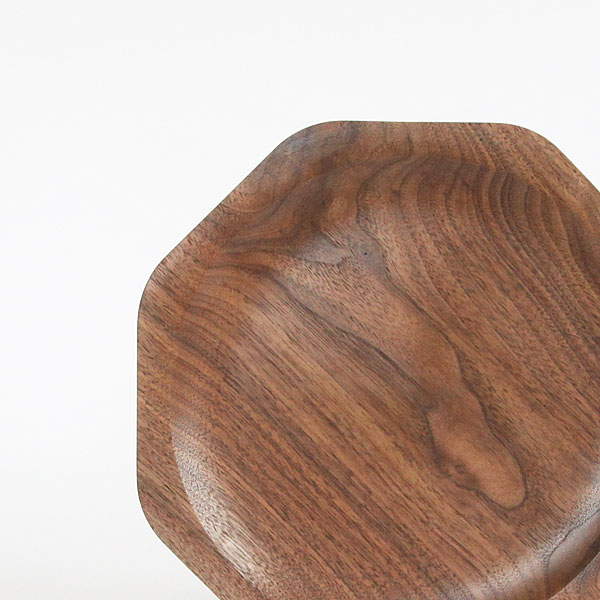

Dark brown grain lines run straight through the brown wood base,
and the occasional knot visible here and there is also characteristic of walnut.
Both the Kakudo Dish and Plate come in S and M sizes,
and are recommended not only as plates for breakfast or snacks but also for one-plate lunches.
It's nice that these are wooden plates that suit Western-style dishes.


Saito Wood's Paper Basket is
made by layering thinly milled wood and shaping it into a cylindrical form.
The technique of slicing wood to a thickness of 0.2 to 1mm and carefully crafting it
is highly regarded not only in Japan but around the world.
This method is also characterized by how it makes the wood's grain and coloring shine.
You can fully enjoy the substantial, characteristic grain of walnut.
The clean, simple design without excess works in any setting.

Oak (nara) is known as a wood that is hard and resistant to splitting.
Its strength has made it well known as a material for high-quality furniture.


Carefully assembled from domestic nara (Japanese oak),
this is the Step Up Box from Oak Village.
Against a pale brown background, beautiful grain patterns emerge, and within the straight grain, a pattern known as "torafu" (tiger stripe)
sometimes appears as streaked markings—a feature unique to nara.
The technique known as "arare-gumi," in which the sides are joined without using nails, and
removable dividers that can be taken out one by one showcase the delicate skill that only handwork can achieve.
Finished with plant-based oil, another highlight is how beautifully the nara grain is brought out.
Straight grain and cross grain, along with parts of varying color depth, are combined together. It is truly a product "made of nature."

The Nara Sewing Box from Kurashiki Ishō Keikakushitsu is also made from domestic nara.
When the top opens to either side, storage space also appears in the lower section,
and details like the rounded handles and the joinery technique called "ishidatami kumitsugi" (cobblestone joint) show the care and effort
that craftsmen put into making this sewing box.


Finished with natural oil so as not to interfere with the nara's ability to breathe, this sewing box
may feel "stiff" or "loose" on different days when opening and closing the lid or moving the upper section,
but this is simply a characteristic of wood, which expands and contracts depending on the surrounding temperature and humidity.
Crafted with attention to every detail, this sewing box
also benefits from the excellent durability of nara, making it a companion that will last for many years.

Olive, a tree known throughout the Mediterranean region.
Grown in a warm climate, olive wood has a distinctive grain unlike any other,
and because it contains plenty of oil and drains water well,
it is favored for use in kitchen items.
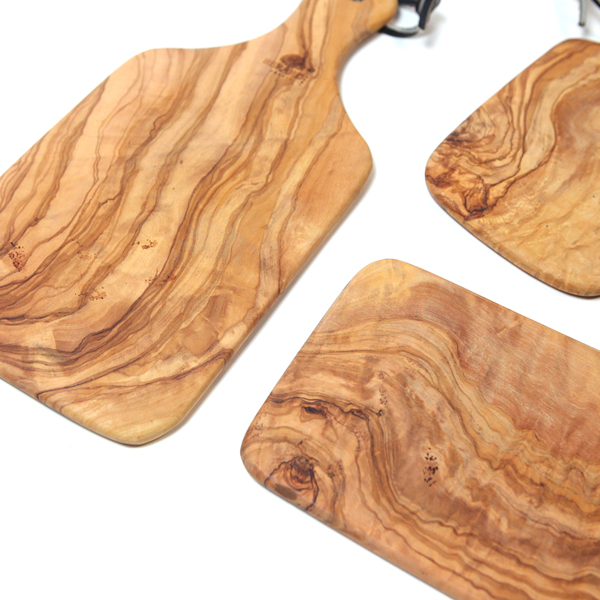

Olive trees grown in the Mediterranean have endured decades, even centuries, of harsh conditions,
so their grain comes in a variety of widths, with many showing curved patterns.
Complex grain patterns, no two ever the same, are truly a gift of the passing years.
The BERARD Olive Cutting Board is made by shaping a single piece of olive wood
directly into the form of a cutting board.
It's an item where you can glimpse the history of the olive tree within a compact cutting board.
With good drainage and a size that's easy to carry, this olive cutting board is useful
not only in the kitchen but also when brought to the table.
It's also lovely used in place of a plate, for serving cheese or vegetables.

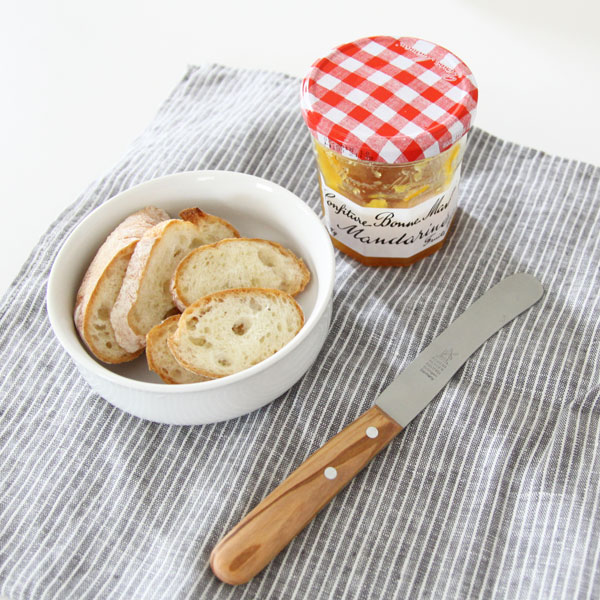
This rounded knife also uses olive wood for its handle.
The Robert Herder Old German Knife is known as
one of Germany's leading knife brands, with blades sharpened entirely by hand.
The Old German Knife is compact in size, useful for cutting small vegetables and fruits, or for spreading butter and jam.
The olive wood handle feels gentle against the hand, and having just one on the table brings a wonderful atmosphere to any meal.


■Water and Wooden Products
Prolonged exposure to water can cause mold and rot.
Always wash kitchen items immediately after use and dry them thoroughly.
For interior items as well, if they get wet, be sure to wipe them dry right away.
■Dryness and Wooden Products
Wooden products have the ability to regulate humidity through the material's natural breathing,
but during dry seasons, the surface can sometimes become excessively dry.
As excessive dryness can also lead to cracking,
if you notice dryness on interior items, please rub in an oil made specifically for wooden products.
For kitchen items, occasionally applying food-grade oil
will help maintain smoothness and shine.
For polishing wooden products: Kendrinnger Möbelpolitur


GUIDE »
CATEGORIES »
- + Gifts by recipient
- + Gifts by scene
- + Clothing
- + Bags / Backpacks
- + Wallets / Card cases
- + Jewelry
- + Shoes
- + Rainy day outfits
- + Kitchen
- + Home
- + Babies / Kids
- + Japanese products
Earn Miles


Payment & Security