.webp)


.webp)


.webp)


.webp)


Welcome to ZUTTO
Free shipping for newsletter subscribers (some areas excluded)
- トップページ/
- ZUTTO Journal/
- 選び方・使い方/
- Comparing How It ...

The Wearing Experience of 4 Different People: ZUTTO's "Original Sweater" Edition
In an age overflowing with countless things, what you own and what you use is up to you—but there's always a reason behind choosing the same item as someone else. This is our "Comparing the Experience of Two Users" series, where we introduce how different people feel about using the same item. This time, instead of two people, we spoke with four people who love ZUTTO's original sweaters from the 2018 autumn/winter collection.
Four Different People, Each Choosing the Same Sweater—and Why
Two types of ZUTTO original sweaters went on sale in November: the "Mock Neck Sweater," with its slightly raised collar, and the "Waffle Knit Sweater," loved for its light feel. Let's hear from two staff members about each sweater's fit and wearability—four people in total.
Here are the four people wearing them.
【Currently Wearing the Mock Neck Sweater】
 : Planning staff
In charge of planning special-order items and trunk shows. Not limited to original items, she tends to choose clothing sold at ZUTTO in general. She wears the Mock Neck Sweater in "LIGHT GREY."
 : Product planning staff
In charge of selecting new brands and products to carry. An all-around player who also handles model shoots and newsletter production. She wears the Mock Neck Sweater in "MUSTARD."
【Currently Wearing the Waffle Knit Sweater】 *Staff members wearing the Waffle Knit Sweater have a "#" mark on their icon.
 : Customer service
In charge of responding to customer calls and emails. Another recent ZUTTO purchase of hers is the COLDBREAKER wool room shoes. She wears the Waffle Knit Sweater in "White."
 : Editorial staff
In charge of editing reading content, feature pages, and gift pages.She loves Japanese goods and everyday tools. She wears the Waffle Knit Sweater in "Mocha."

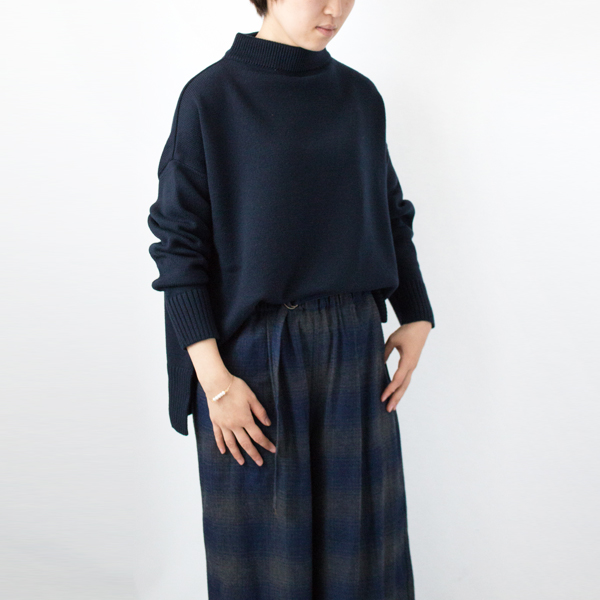
: Actually, I'd already decided I would buy this Mock Neck Sweater once it went on sale, back around spring when it was still in production and the sample had just been completed. Just throwing on one piece gives you a well-defined silhouette, and I thought the balance was really good. When we're checking samples, we sometimes have several staff members of different heights try them on, and this sweater was popular even at that stage.
: Already at the sample stage! For me, it started when the product was finished and I wore it for the photoshoot for the product page. I'm not good with the itchiness of wool, so I usually have a hard time buying sweaters every year, but the reason I chose this Mock Neck Sweater is that even though it's 100% wool, it's smooth and doesn't itch.
: True, it's nice that it doesn't itch much. Of course, sensitivity varies from person to person, but even I can wear it fine with just a short-sleeved inner layer. Also, a fabric that doesn't itch easily is important for a mock neck design where the collar stands up. The neck has thinner skin, so itchiness tends to be more noticeable there.
: I really agonized between this and the Mock Neck Sweater, but in the end I went with the Waffle Knit Sweater for its "lightness." I get cold easily, so I often layer with inner wear and shirts, and I feel like my shoulders don't get as tired if each layer is as light as possible (laughs).
: Let's compare it with the Mock Neck Sweater for a moment. According to the listed weights, the difference is about 180g. When you actually hold both, you can really tell how light the Waffle Knit is!
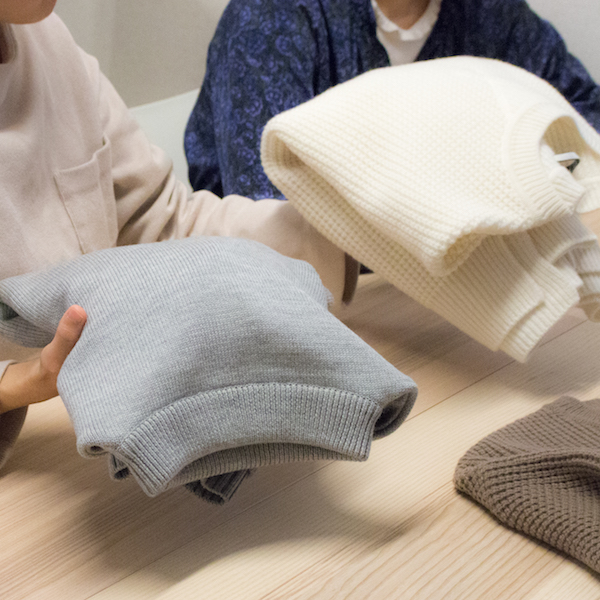
: With the Mock Neck Sweater, you can really tell it uses a lot of yarn since the stitches are so tightly knit.
: The lightness of the Waffle Knit makes it feel like it "moves with your body."
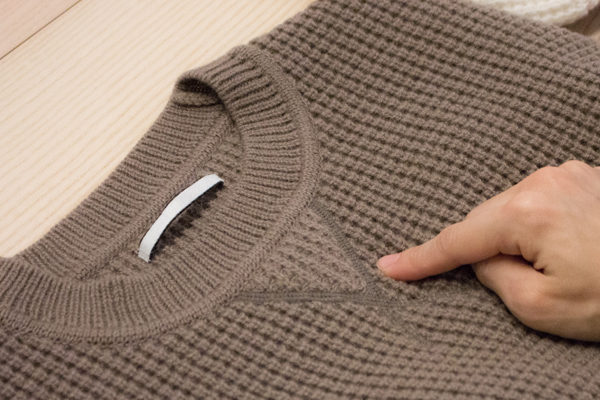
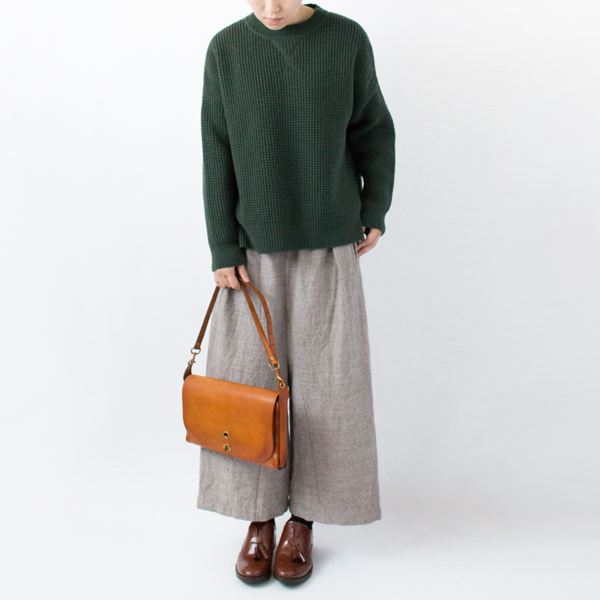
The reason I chose the Waffle Knit Sweater is this V-shaped gusset! I usually like casual outfits, so I was drawn to the design that mimics a V-gusset at the neck, like a sweatshirt.
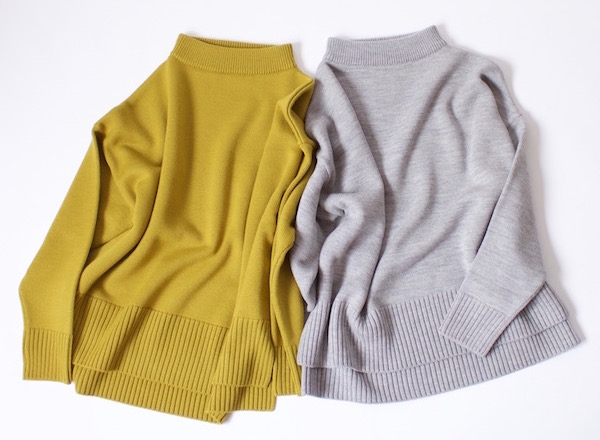
: I chose MUSTARD. I fell in love at first sight with this rich, deep yellow that's perfect for the season. It felt like a bit of a challenge color, since I thought it might limit what bottoms and other pieces I could pair it with, but surprisingly it went well with things, maybe because it's not too bright. M-san, you have LIGHT GREY, right?
: Yes, on the contrary, I chose LIGHT GREY because it looked "easy to use." I don't usually take many risks and find comfort in classic colors. People often say to me, "Don't you already have that color?" (laughs), but since the details and silhouette are different, I consider it fine.

I also chose OFF WHITE because I thought it would be easy to pair with other things. I didn't own a white sweater, but when I looked at the colors of the other sweaters and cardigans I already had, they were mostly navy, gray, and other colors that tend to pile up in winter. So I figured white would be a color I didn't have yet but that would be easy to coordinate with.
: MOCHA is a color that feels like it should already exist but somehow doesn't—I thought it was really nice. I wear denim a lot, and when I pair it with this sweater it doesn't end up looking too youthful, which is reassuring.
: I think it's the subtle way the neck stands up. Turtlenecks and conventional mock necks cling right against your throat, and I always felt a little suffocated by that, so it's a design I hadn't chosen much before. But this one sits at just the right distance from the neck—it doesn't feel tight, yet it's warm because there's no draft around the neck either. It really strikes the best balance.
: I also love the silhouette when you look at it from the side. The back panel is a bit longer, and it has a longer slit, so when you view it from the side it forms a slight A-line shape. There's something stylish about this silhouette that I really like.
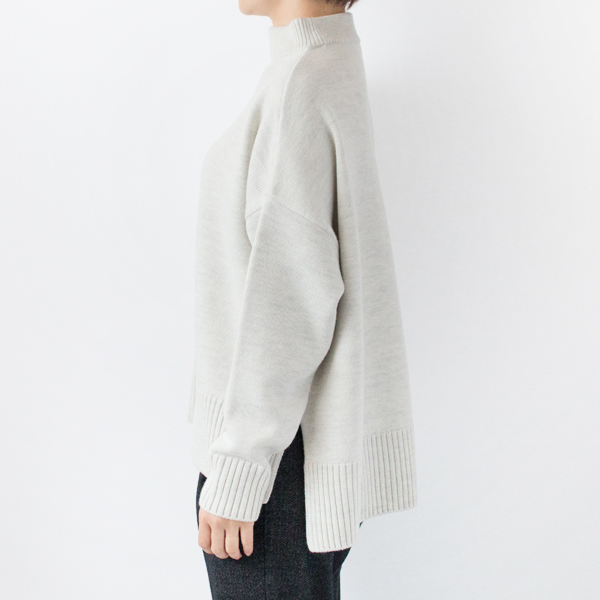
: Sweater hems are often ribbed and gathered in, so a design like this that flares out slightly a bit seems rather rare. I asked the staff member who planned this sweater about it, and apparently this silhouette comes from knitting it with a tighter gauge, which increases the amount of yarn used and creates that beautiful drape.
: The surface of the fabric has this cute, bumpy texture. Knit patterns like this give off such a cozy impression, and it feels like a garment that's distinctly suited to winter—I really like that about it.
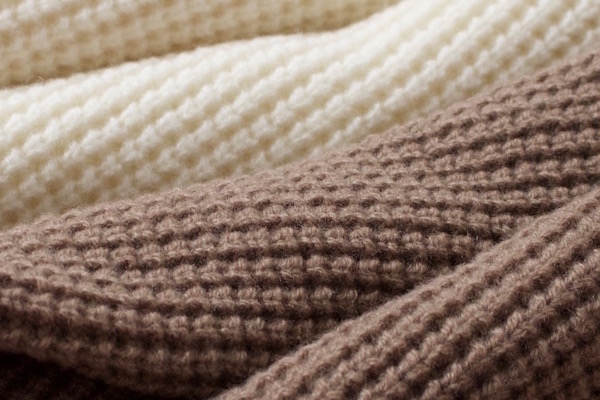
: Also, it's obvious, but it's genuinely warm. Since it's lightweight, I assumed the fabric must be thin, but that's not the case—apparently the waffle knit itself is what creates the thickness. And because it uses a special wool material called Airy Spun, you get this seemingly contradictory quality of being thick yet light.
: I hang it on a hanger to let the moisture out between wearing it and putting it away, and maybe because it's so light, it doesn't seem to stretch or get pulled out of shape on the hanger. I think it holds its shape well.
: Hmm, compared to the mock neck sweater, it does have a slightly more wool-like texture. But since it's merino wool, it's not scratchy to the point of being uncomfortable. It's fine for me, but people with sensitive skin might notice it.
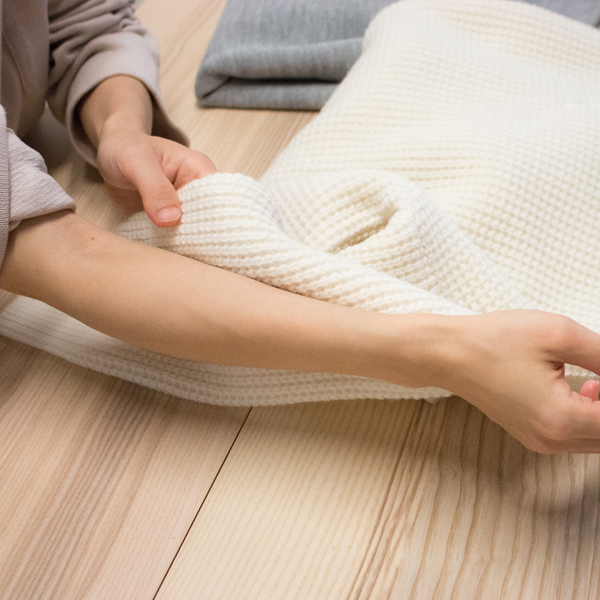
: I've heard that if you wear a cotton or silk long-sleeved inner layer, you're less likely to feel the scratchiness of the sweater layered on top. Apparently synthetic-fiber inner layers cause dryness, which makes the skin more sensitive.
*Note: The scratchiness of wool largely depends on the thickness of the fibers. It's generally said that if fibers thicker than 30 microns make up more than 5% of the total, the fabric will feel scratchy. ZUTTO's mock neck sweater measures 19.5 microns, and the waffle knit sweater measures 23 microns.
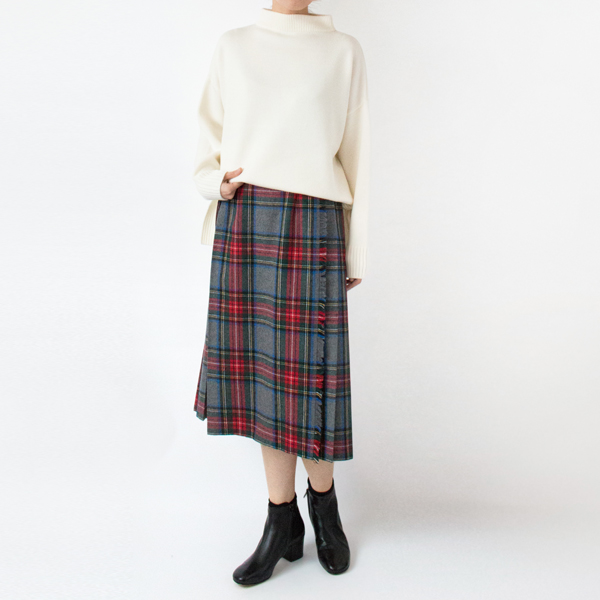
: I wear the mock neck sweater with both pants and skirts. Maybe because the silhouette feels grown-up, even pairing it with denim doesn't make the look too casual, and I can adjust the vibe with accessories.
: Since the neckline is open rather than clinging tight, once we get into the depths of winter, I think it would look lovely to wear a shirt underneath and show a bit of the collar, or tuck in a scarf.
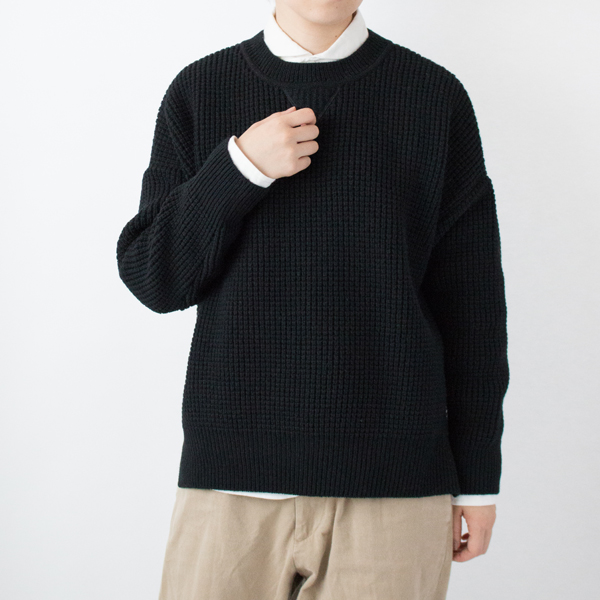
 : I'd like to try wearing a collared shirt underneath the waffle knit sweater too. I saw it styled that way during the photo shoot and thought I wanted to copy it.
: Both the mock neck sweater and the waffle knit have slits on the sides, which makes it easy to tuck them into bottoms and gives the outfit a polished look. They really do go with both pants and skirts.
Something we'd love to quietly ask fellow enthusiasts: "How do you handle this?"
① Do you do anything to take care of your sweater after wearing it?
: I haven't worn it that many times yet, but I make a point of taking it off as soon as I get home. I don't really think of it as clothing for lounging around the house in, and I'd hate to stain it while cooking or get pilling from friction when sitting on the sofa...
: That's admirable! But you're right, if you want to wear it carefully for many seasons, that's probably a good approach. I lightly brush mine with a clothes brush. It hasn't pilled yet, but I've heard that brushing to smooth the nap helps prevent pilling. I do this every season, not just for this sweater but for coats and scarves too. I keep a clothes brush by the front door, so the routine is: come home, then brush.
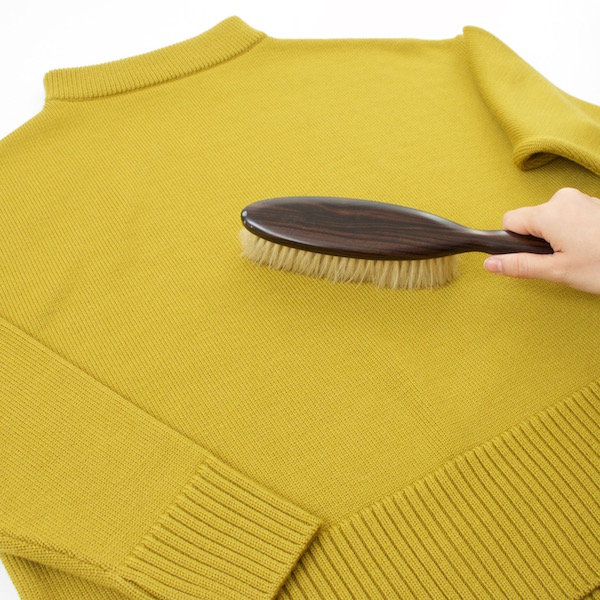
: It seems like the material used for this sweater is designed to resist pilling relatively well, but even so, we still need to be careful ourselves, don't we…
*Both sweaters use a yarn called somoushi (worsted yarn). Somoushi is yarn spun by removing short-fibered wool and gathering together only the longer fibers. Because of this, it has less fuzz and a smoother texture, and is said to be less prone to pilling compared to boumoushi (woolen yarn).
②How should you store them so as not to spoil their texture and feel?
: I fold both sleeves inward, then fold the sweater in half around the chest area for storage. Until now, I used to fold things compactly to add thickness so they could stand upright in a storage case, but I've started to feel that favorite or good-quality pieces shouldn't be squeezed so tightly.
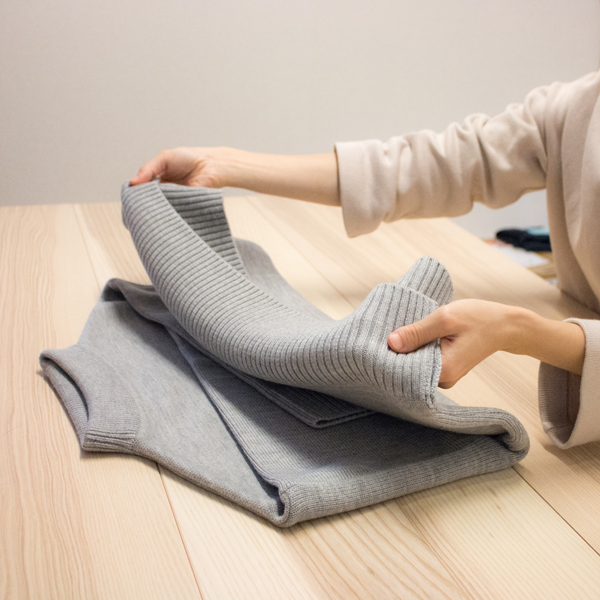
△M demonstrating how to fold.
: The more you fold something, the more wrinkles it gets, right? But if you're not storing it upright, does that mean you place other sweaters on top of this one?
: Yes, that's actually a point I've been a bit unsettled about. Ideally, I'd like to store each piece alone with nothing on top, but storage space is limited, so that's not always possible…. So I've divided my drawers into a "first string" and a "second string." For the first-string drawer, I fold things like this sweater in a larger fold and stack them on top of each other. But I don't think too much weight is good, so I try to keep it to about 3 or 4 pieces.
: I can really feel how much you want to take care of it (laughs)
③We have four people of different heights—how does the sizing feel?
Mock Neck Sweater
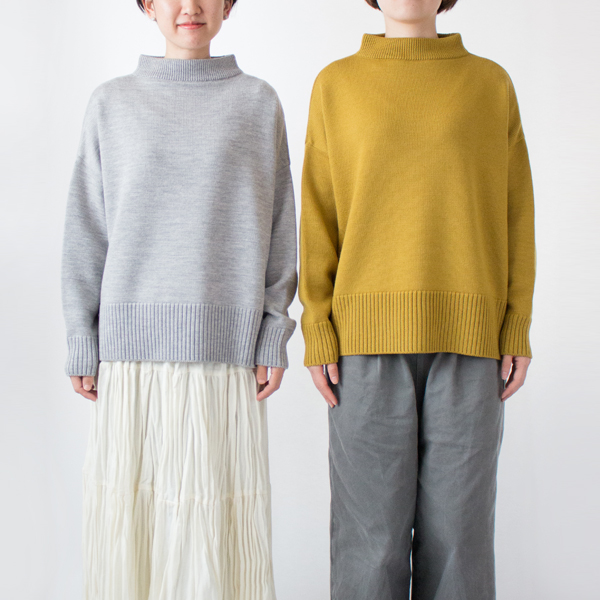
Left: Height 158cm / Right: Height 163cm
: I'm 158cm tall, and while the sleeves feel slightly long, there's no discomfort wearing it, and once deep winter arrives, longer sleeves are actually a plus, so no problem there! The length and body also have some room, which gives it that classic sweater feel.
: At 163cm, I also have absolutely no issue with the sizing. The sleeves reach just to the back of my hand—neither too short nor too long, just right.
Waffle Knit Sweater
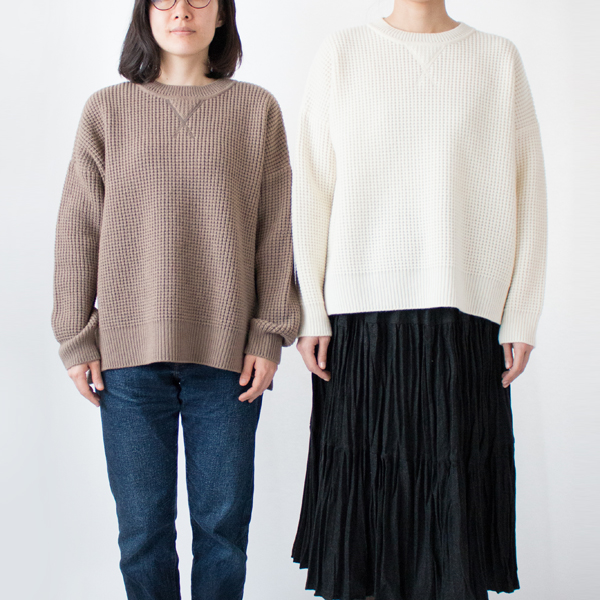
Left: Height 152cm / Right: Height 166cm
: I'm on the smaller side at 152cm, but I don't feel like "the sweater is wearing me" because it's too big. Maybe because the hem of the waffle knit sweater is ribbed and tapers in slightly, it doesn't look overly long. The sleeves are a bit long, but since they're also ribbed and stop right at the back of the hand, they don't feel bothersome, and I love how the cuffs get a little loose and puffy around the hands.
: At 166cm, I also have no concerns about the sizing. Since it's a dropped-shoulder design, the shoulders aren't tight at all, and both the width and length feel just right.
: I think unless you want to wear it tight-fitting, the sizing is fairly forgiving for most people. Among ZUTTO staff, there are people of all different heights, and no one has said it doesn't fit them.
The two original ZUTTO knit styles introduced here were produced by a knitter in Gosen City, Niigata Prefecture, known for Gosen knit. The town of Gosen is said to be a place blessed with five abundant springs, and by making use of its rich water resources, industry flourished there. By the Showa era, Gosen had established itself as one of Japan's leading knitwear-producing regions, and within the knitting industry it came to be called "the trade fair of knitting machines." In addition to introducing a wide variety of knitting machines from overseas, dyeing factories were also established, making it possible to complete the entire process—from dyeing to knitting—within a single town.
The mock neck sweater was made in collaboration with a knit maker who serves as a leading figure in this historic Gosen knit tradition. Turning a flat design into a three-dimensional form, freely manipulating yarn, and giving shape to what people seek in their everyday clothing—this knitwear is truly packed with the skill of craftsmen.
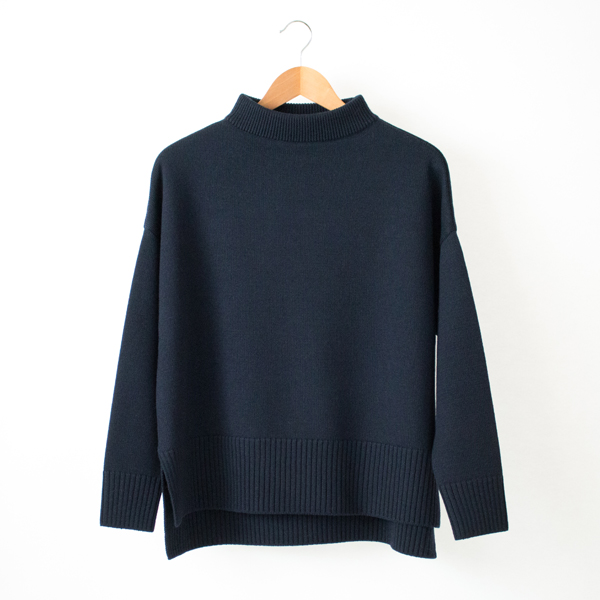
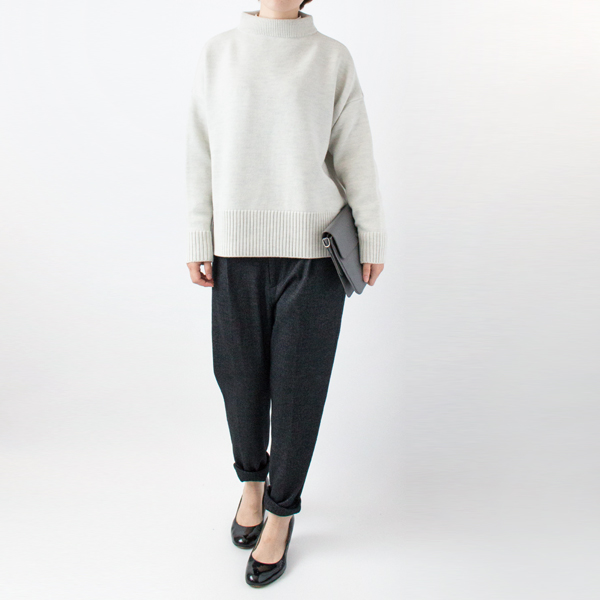
▼Mock Neck Sweater (5 colors available) Product page here
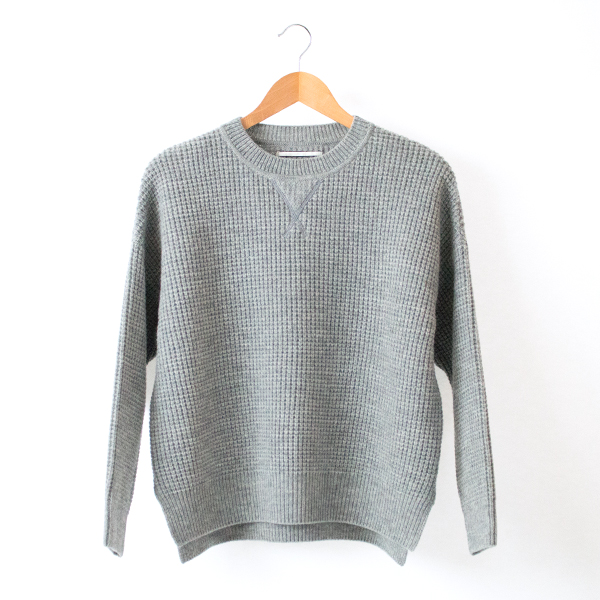
▼Waffle Knit Sweater (5 colors available) Product page here
GUIDE »
CATEGORIES »
- + Gifts by recipient
- + Gifts by scene
- + Clothing
- + Bags / Backpacks
- + Wallets / Card cases
- + Jewelry
- + Shoes
- + Rainy day outfits
- + Kitchen
- + Home
- + Babies / Kids
- + Japanese products
Earn Miles


Payment & Security