.webp)


.webp)


.webp)


.webp)


Welcome to ZUTTO
Free shipping for newsletter subscribers (some areas excluded)
- トップページ/
- ZUTTO Journal/
- ブランドストーリー/
- MAITO×ZUTTO Natur...

MAITO×ZUTTO Wearing Flowers and Plants: The Natural Dye T-Shirt
ZUTTO, dedicated to making "clothes you'll want to wear forever," has teamed up with MAITO, experts in kusaki-zome (plant dyeing), to create a natural dye T-shirt perfect for the coming spring and summer season.
Natural dye refers to what is commonly known as kusaki-zome, or plant dyeing. This ancient dyeing method uses natural pigments extracted from the flowers, leaves, roots, and branches of plants such as indigo, pomegranate, chestnut, and cherry, without relying on chemical dyes. (In Japan, it's said that plant-based dyeing techniques date all the way back to the Jomon period.)
The gentle colors and textures of natural dyes have a special charm—wearing MAITO's clothing and socks always brought a warm, happy feeling. This time, we're thrilled to bring you a project where ZUTTO's T-shirts are dyed using natural materials like sunflower and indigo. Wear these plants on your skin, and let both your mood and your T-shirt shine bright and fresh through the spring and summer.


ZUTTO's "T-Shirt You'll Want to Wear Every Day"
The project began with creating the base T-shirt itself. We had in mind the feel of old-school American casual T-shirts—fabric with a bit of thickness and a slightly rough texture that feels good against the skin. Rather than something soft and supple, we chose fabric with enough structure to hold a clean silhouette.

We chose a fabric with enough thickness that it won't cling to your skin even when you sweat. It's not see-through.

The fabric is knit in a tubular construction, so there are no seams running from the underarms to the hem, giving it a clean look. It also doesn't bunch up inside the shirt, so tucking it into bottoms won't create an unwanted bulge at the sides.
MAITO's Dyeing: "Bringing Out More Charm with Nature's Colors"
We shared our vision for how we wanted this white T-shirt dyed with MAITO, and through several rounds of color adjustment—with suggestions like "this material would work well for that"—we refined the final colors together.
There's even a behind-the-scenes story: during one of our meetings, someone said, "Let's try dyeing with this," using a material that happened to be on hand at the time, and the resulting color turned out beautifully—so it was added to the lineup. Moments like these reminded us that dyeing with plants and other natural materials is truly about encountering colors as they come, in their own time.

While we were at it, we asked Komuro-san, the representative of MAITO, all sorts of questions about natural dyeing.
Are the materials for dyeing truly limitless?
"Any kind of grass, flower, branch, or fruit can be used for dyeing, so in that sense, yes, it's limitless. Because of the nature of my work, all sorts of materials come my way, and I experiment with dyeing many of them just to see what happens. Recently someone sent me birch tree bark, and I'm still thinking about how best to dye with it. If the only goal were to achieve a certain shade of brown, for example, other materials might get you there too. But I believe there's meaning in using a specific material harvested from a specific place to produce that color. I want to honor the special feeling of wearing something connected to its local origins and to the story behind its color."
What is the appeal of natural dye?
"Don't you think there's something special and appealing simply in wearing the colors of nature? Chemically dyed fabrics have their own merits, but those are merits felt mainly by the maker—being able to produce items quickly, with no color unevenness, all in the exact same shade. Those are advantages for mass production and low-cost sales. But the appeal of natural dye is something felt by the wearer. There may be unevenness in color, or the color may fade over time, but there's real joy and satisfaction in thinking, 'Right now, I'm wearing sunflowers!'"

How does natural dye change over time?
"As you wear and wash the fabric repeatedly, kusaki-zome gradually fades, or the color shifts unevenly in certain areas. Wrinkles can even show up as changes in color, much like leather—it's a dyeing method you can genuinely enjoy watching age over time. When you think of it as the color of a living plant, the way it gradually transforms becomes fascinating, and even the same item will change differently depending on who wears it. Just one thing to be careful of: always use a neutral detergent when washing. If you use an alkaline detergent, the color can shift dramatically, so please be mindful of that."


A T-Shirt Dyed in the Colors of Flowers and Plants, in Kuramae, Tokyo
In February this year, while it was still quite cold, we visited MAITO's workshop in Kuramae, Taito Ward, Tokyo. We had asked to observe and document the actual dyeing of ZUTTO's T-shirts. Stepping inside, we saw tree branches and nuts scattered casually across the worktable—a reminder of what we'd learned before, that virtually any natural material can become a source for dyeing.
On this particular day, two colors were being dyed: "sunflower" and "yashabushi" (alder cone). "First, take a look at the raw materials to see what kind of color comes from each one," we were told, as these were brought out.

"These sunflowers were a gift from a farmer in Hokkaido, and we dry them carefully to preserve them for use. Some dried materials can last for several years, but with others, you have to use them fresh to get the color at all—the handling really depends on the material, and that's part of what makes natural dyeing so interesting."

"This one is yashabushi (alder cone), which looks like a pinecone. When you actually see the raw materials like this, doesn't it really make you feel that the dye truly comes from natural materials? Even with natural dye items, you don't feel this so much when you only look at the finished product, but colors really do come from things like these petals, fruits, branches, and roots."
Here are the steps for natural dyeing the T-shirts.
1. Boil the materials in water to extract the pigment

There's no measuring of how many petals or fruits to add, or how much water. Komuro-san boldly tosses them into a large pot while saying, "About this much, I think~"
When asked if it's done by eye, he said, "That's right. How the color comes out changes depending on the material, the season, and how much time has passed since the raw material was harvested, so I judge the amount and timing each time."
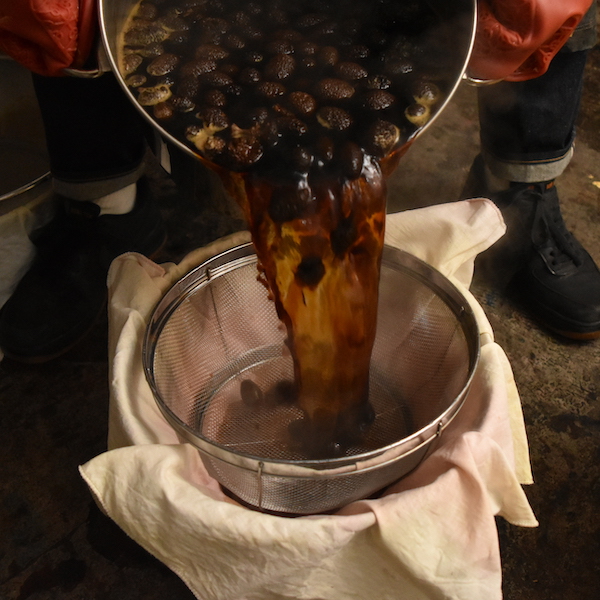
The sunflowers are boiled for 20 minutes, and the yashabushi a bit longer, then strained. Looking at the pots and colanders being used, it really looks just like cooking.
2. Dyeing the T-shirts
Here, the T-shirts made by ZUTTO make their appearance. "To fix the color, they've been soaked beforehand in an alum aluminum mordant," he explained. "The material of this T-shirt has a nice rough texture~" Komuro-san seemed to take a liking to it as well.

Hot water is added to the extracted sunflower and yashabushi pigments to adjust the color, and the T-shirts are dipped in a few at a time. They are continuously stirred with a stick to prevent unevenness, so that color is absorbed evenly across the whole shirt.

"I dye while checking that the seams and thread are properly colored too."
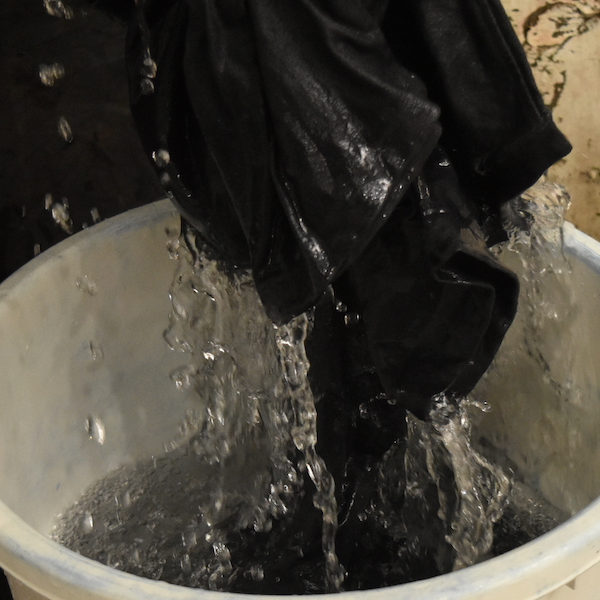
3. Wash → Spin-dry → Dry

Once dyed, the shirts are washed with water to remove excess dye, then spin-dried in a washing machine and hung out to dry.
"While wet, the color looks darker, but once it dries the color settles down, so we check that state and repeat the dyeing a second and third time as needed."

"We match the color intensity by eye once again, aiming for the depth of color decided in our earlier meeting for each shade, so this is really where experience matters."
By repeating this dyeing process, the T-shirts created together by MAITO and ZUTTO were completed. While dyeing, Komuro-san happily said, "That's turned into a nice color~", and I could really feel how much he enjoys creating colors using natural materials and his own sense of adjustment.
Now, let's wear flowers and plants
We've prepared five colors in all, including the two we watched being dyed. Usually you'd choose based on the shade alone, but with this T-shirt, it's also fun to think, "Which plant should I go with?"

Mulberry + Green Leaf Dye (MINT GREEN)

This mint green was a color that came about by chance during our meeting. Don't you think it's a refreshing, easy-to-wear color?
Chestnut + Yakusugi Dye (BEIGE)

This is a color that MAITO tried repeatedly to get just right. It's calm without being dark, and would go well with bright accessories and small items.
Ai-zome (Indigo Dye) (NAVY)

When it comes to summer plant dyeing, indigo dye is essential. We've included "navy" as a color name for clarity, but this is truly a subtle shade that deserves to be called "ai-zome."
Sunflower Dye (YELLOW)

The finished shade of sunflower dye. Wear this color, bathed in summer sunlight, and head out for the day.

*The sunflower dye tends to show the color unevenness characteristic of plant dyeing quite noticeably, so please also check the images on the product page.
Yashabushi Dye (GREY)

Of the five colors, this might be the most versatile. As you continue wearing it, it will develop a nice worn look, with the color fading out beautifully over time.
▼Natural Dye Round Body Crew Neck Short Sleeve T-Shirt, product page here (tap/click the image)

GUIDE »
CATEGORIES »
- + Gifts by recipient
- + Gifts by scene
- + Clothing
- + Bags / Backpacks
- + Wallets / Card cases
- + Jewelry
- + Shoes
- + Rainy day outfits
- + Kitchen
- + Home
- + Babies / Kids
- + Japanese products
Earn Miles


Payment & Security