.webp)


.webp)


.webp)


.webp)


- トップページ/
- ZUTTO Journal/
- ブランドストーリー/
- Designed with las...

Built to last with a repair guarantee that keeps it wearable for years. A closer look at Waffle Midneck, Jackman's signature piece with many longtime devotees.
Have you ever noticed that the clothes you love most are the ones you reach for again and again? And precisely because you love them, the frequency of wear means they wear out faster than the rest of your wardrobe. That's why "built to last" has become such an important criterion when choosing clothes for me—even if it means paying a bit more, I've come to want to choose pieces made this way.
Jackman is a factory brand that originated in Fukui Prefecture. With generous support like a free repair service, and garment-making that is careful and built to last thanks to their own in-house factory, every item the brand creates traces its roots back to baseball—American baseball, to be exact.
"Waffle Midneck," a long-selling series from Jackman with many longtime fans, is a staple item that ZUTTO has carried for years. Beyond the original standard colors, our staff also look forward to the limited seasonal colors that give the same shape a different expression each season.

Standard color: IVORY
Last year marked the first time a past color was produced as a limited reissue. The response from customers was so positive that this year we've expanded the lineup and picked out two more colors.

Two colors reissued for 24AW. (Left: BUTTER, Right: SOLID GRAY)

This year, Smoky Pink and Smoky Blue have arrived as the brand's seasonal colors.
To learn more about Waffle Midneck ahead of the reissue, we spoke with Mr. Tago of Hit Union, who has attended the brand's exhibitions and worked at the storefront in Ebisu, as well as visiting the factory in Fukui Prefecture to see the garment-making process up close.
The brand's roots lie in baseball. Waffle Midneck was inspired by an undergarment.
Mr. Tago:
"To talk about how the brand began—today the company is called Hit Union, but it originally started as Tanabe Meriyasu Seisakusho, a small company with just three flat-knitting machines. That company went on to become the first in Japan to make stirrup-style stockings.
Shortly after the war, GHQ's MacArthur brought over a baseball team from America (the San Francisco Seals) to play against a Japanese team, and it just so happened that our founder, Mitsugu Tanabe, went to watch that game. He was a huge baseball fan, and that experience was part of what led him to establish Tanabe Meriyasu Seisakusho.
At that game, he took notice of the stirrup-style stockings the American baseball team was wearing and thought his company could make them too. He actually started production, and eventually was supplying them to high school baseball players competing at Koshien.

'Jackman' means 'home run hitter,' and the brand was founded by Tanabe himself more than 60 years ago. It's the only original brand that remains, and the company's DNA has always been rooted in American baseball. That's why every Jackman item is created with baseball as its inspiration."
"The design is based on the undershirts worn by American baseball players in the late 1800s. It's a thermal-material inner layer worn under the uniform for warmth.


The raised collar was originally designed for warmth. (【Limited Reissue】BUTTER)
Given its role as an inner layer, the original that inspired this piece was thin, but as you can feel when you hold it, Waffle Midneck is thick. This series was created by taking that inner-layer inspiration and making something that looks great worn on its own."

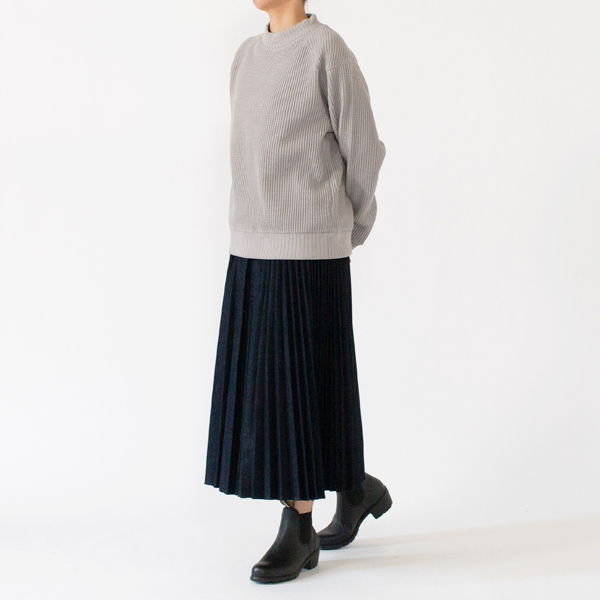
【Limited Reissue】SOLID GRAY
Yes. Even when there are difficult points in the design, being able to work them out in consultation with our own factory in Fukui Prefecture is a big advantage that lets us take on these projects. There are a lot of labor-intensive processes involved."
The reason it stays sturdy and holds its shape even after years of wear
"First, we use raffee (fallen cotton fiber) as our raw material. Raffee refers to the thread-like scraps that fall off during cotton processing; we gather these and spin them into yarn for knitting. The reason we choose this material is that, being random and uneven, it creates bumps and irregularities once spun into yarn. That gives the knitted fabric a rich texture with a three-dimensional feel.

Taupe
And once the fabric is finished, it's rolled up. This means the fabric at the center of the roll ends up compressed. To prevent this, we unroll the entire large piece of fabric and let it rest overnight, allowing the whole fabric to relax. This process is called houtan (relaxation resting), but the effort of unrolling such a large roll of fabric, the time needed to let it rest, and the space required to store it—these are conditions that are quite difficult unless you're doing it in-house.
What this houtan process leads to is resistance to losing shape. Even after repeated washing and wearing, the fabric becomes less prone to stretching or shrinking.」
「Yes. Also, the biggest characteristic is the rib. We use a distinctive, firm needle-removed rib, which is inherently resistant to stretching, but the important point when it comes to wearing is that it doesn't lose its shape even after repeated washing, right? This rib is also the key to being able to wear it beautifully for years.

For example, in September and October when there are still hot days, people often roll up their sleeves, but when you wash it, the stretched-out part returns, so you can wear it again with a neat shape. Because the yarn used is thick, it has high recovery power.」

Smoky Pink

Smoky Blue
「Yes, they're different. Both the body and the rib use thick-gauge yarn, but the rib yarn is even thicker. It might be easier to understand if you imagine a rubber band—a thicker rubber band has stronger recovery force than a thinner one. It's a similar principle.
Another feature designed to prevent loss of shape is the back section. The upper half of the back has stitches running horizontally, while the lower half has them running vertically.
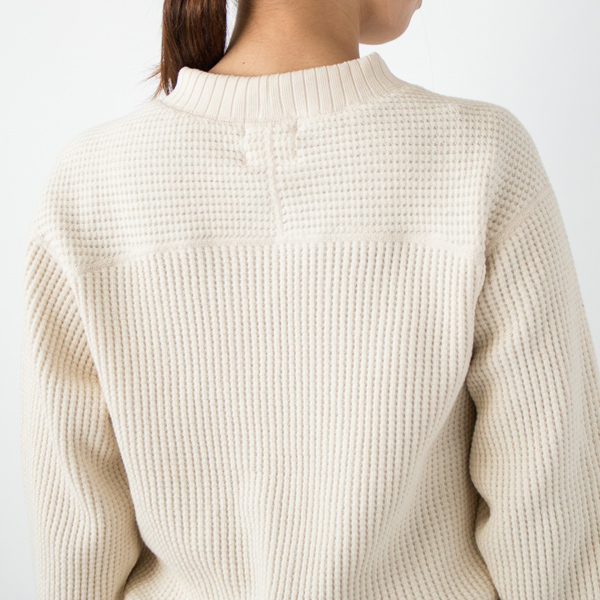
IVORY
It's divided at the center back seam, because the back of a garment is a place that easily receives stress. The shape changes whether you're sitting or standing, and the fabric tends to stretch quite a bit from walking or wearing a backpack. So, to make it more resistant to stretching, we've divided it this way to reduce the size of each panel. It's demanding for the factory, but this pattern makes it more resistant to stretching. It also becomes a design highlight.
「For the Jackman line, it's about 40 people. Rather than making several types of items all at once, we operate on a cycle of finishing about 1 to 2 items per week. Sewing is handled by women, while physical work like carrying fabric is shared with men. For flat seams like the Waffle Midneck, where the stitching doesn't touch the skin, two pieces of fabric are joined side by side and sewn along the seam, which requires skill. The work is done by veteran craftspeople.」

A Waffle Midneck worn lovingly for 5 years, and one for 3 years
Here, we were shown personal Waffle Midneck pieces that have actually been worn and loved.

Washed by machine, dried in the sun. Liquid detergent was used, along with fabric softener.
「The IVORY has been washed about 80 times, and the DARK NAVY about 50 times. The IVORY especially shows an easy-to-see change. It's become whiter than new, from the bleach contained in the detergent. I think it's developed a really nice character.」

Left: brand new, right: borrowed personal item (worn for 5 years)

Top: brand new, bottom: borrowed personal item (worn for 3 years)
「That's right. Also, a key point when washing is to 'reshape the garment after washing and dry it flat.'
After washing, it shrinks a little, so if you dry it without reshaping it, it can end up staying shrunk. It's not that we've received such comments from customers, but if you especially want to keep its shape, we recommend 'reshaping it back to its original form before drying flat.' We don't give particularly detailed guidance about using fabric softener, but since it's a natural fiber, I think it's easier to feel the original softness of the 100% cotton material if you don't use one.
For ordinary wear, if there are any tears or fraying at the sewn seams, there's also a free repair warranty service, regardless of how many years you've owned the item.」

This tag serves as the warranty certificate when requesting the repair warranty service.
「Perhaps because we originally make them to be sturdy, we get inquiries about once a month. Even then, it's mostly wear and fraying that occurs from long-term use, and there's not much unraveling. If you notice anything you're concerned about, please don't hesitate to use the service.」
Special revival colors, "BUTTER" and "SOLID GRAY"
A soft yellow BUTTER, and an elegant gray SOLID GRAY. True to Jackman's style, both colors are tied to baseball.
First, "BUTTER" is a color inspired by the oil (grease) once used on baseball gloves.

Wearing 160cm・size M

a color that becomes the focal point of any coordinate. (Wearing 160cm・size L)
On the other hand, "SOLID GRAY" is a color inspired by the overcast skies at the ballpark, the kind that make you anxious wondering if it's about to rain. It's a perspective only a brand that truly loves baseball could come up with.

Wearing 160cm・size S

A refined gray, adjusted just enough so it doesn't feel too casual. (Wearing 160cm・size L)
There are no plans to reproduce these colors—they're limited to this release only. We hope you'll enjoy them this season.
・・・・・・・
This brand interview offered a glimpse into Jackman's contrarian approach to making clothes—placing importance on garments that "last long" and "resist losing their shape," while drawing hints from American baseball, the brand's very roots, to create pieces meant to be worn alone as an inner layer, in a way that feels distinctly Jackman. Apparently everyone at the company loves baseball, and the fact that the line between their love of baseball and their approach to clothesmaking stays pleasantly blurred may be one reason Jackman's clothes carry such a playful spirit.
▼Jackman brand page

GUIDE »
CATEGORIES »
- + Gifts by recipient
- + Gifts by scene
- + Clothing
- + Bags / Backpacks
- + Wallets / Card cases
- + Jewelry
- + Shoes
- + Rainy day outfits
- + Kitchen
- + Home
- + Babies / Kids
- + Japanese products
Earn Miles


Payment & Security