.webp)


.webp)


.webp)


.webp)


- トップページ/
- ZUTTO Journal/
- ブランドストーリー/
- 【BRAND INTERVIEW】...

BRAND INTERVIEW
Fukuda Orimono|A Light-Filtering Stole Born from Relentless Fabric Craftsmanship.
The first time we touched Fukuda Orimono's light-filtering stole, we were astonished that a cotton stole could feel this light and soft. The delicate, smooth surface of the fabric differs entirely from what you'd expect from a cotton stole—it has an airy, fluffy texture, and is thin enough that you can see a hand through it on the other side. Precisely because the neck area is so sensitive to touch, this was something we truly wanted to wear.

Greige

Sky Blue
This light-filtering stole is crafted by a textile maker in Shizuoka Prefecture, in the Enshu textile-producing region. Along with an introduction to the stole itself, please take a look at the behind-the-scenes story we gathered on a visit to the factory in Kakegawa, Shizuoka.
A Stole Born from a Textile Maker in the Enshu Region
The Enshu region, located in western Shizuoka Prefecture, has been a thriving center of cotton weaving since the Edo period, and is known as one of Japan's three major cotton textile-producing regions.
Fukuda Orimono, based in Kakegawa, Shizuoka in the Enshu region, was founded in 1964. Through countless rounds of trial and error, it has become a textile maker specializing in delicate, sheer fabrics. The company's signature product, the "light-filtering stole," took three years from development to completion.

・Weighing just 45g, it's so light and soft you barely notice you're wearing it
・A silk-like sheen
・A smoothness reminiscent of cashmere
・Washable at home for easy hygiene
These qualities, among others, give the light-filtering stole a comfort unlike any other stole.
Staff Reviews of the Light-Filtering Stole

Apricot
Staff member who loves this item:
"When I first put on this stole, I was struck by a lightness and comfort of fabric unlike any other stole. Even though it's thin, it doesn't lack volume—it's fluffy, and if you wrap it up, it gives you plenty of volume too. What's more, it resists wrinkling, so it's easy to carry around.
I assumed that with fabric this thin, washing it at home would be difficult, but it can be hand-washed with water, which is great for care. With silk or cashmere, sometimes you can't wash them with water at all and have to rely solely on dry cleaning, so being able to care for it myself is a real relief."
*Drying it slowly in a spot away from direct sunlight apparently helps preserve its soft texture.
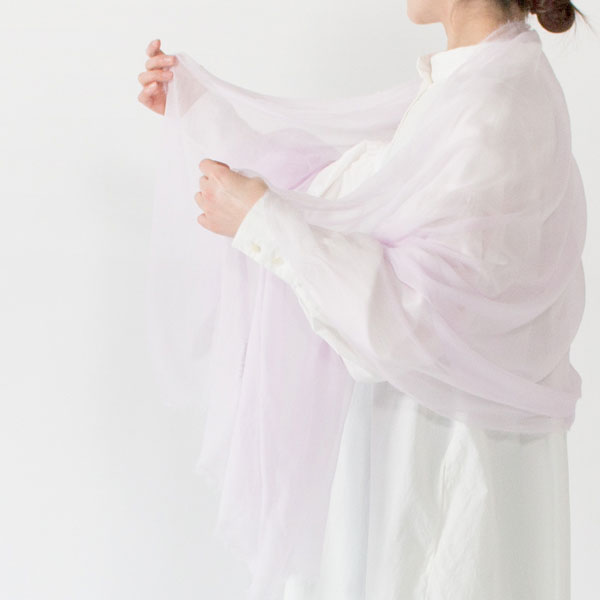
Lilac
"With fabric this soft, you'd normally expect some trade-off—wrinkling easily, being hard to care for, that sort of thing—but this light-filtering stole didn't have any of that. The surface coating uses plant oils and silk protein rather than anything chemical, so even I, with sensitive skin, could use it comfortably."
Lightness and Portability Make It Easy to Use

Sakura
"Because the light-filtering stole is light and thin, it folds up compactly, and it doesn't feel heavy even tucked into a bag. Being able to put it on or take it off depending on the situation is something I really appreciate in everyday use.
Its resistance to wrinkling also makes it that much easier to carry around.
A stole that lets you easily adjust your body temperature is a travel essential. Rather than bringing a jacket, a thin stole that's compact and fits easily into a bag is sure to come in handy. Since I tend to pack basic-colored clothes for travel, to make outfits easy to mix and match, I'd also recommend adding a splash of bright color with a stole."

The most distinctive feature of the light-filtering stole is the fineness of its thread. To learn the story behind how this stole came to be and how it's made, we visited Fukuda Orimono's workshop.
A Visit to Fukuda Orimono's Factory in Kakegawa, Shizuoka.

About a 30-minute bus ride from Kakegawa Station, in a spot with a pleasant sea breeze, stands Fukuda Orimono's office and factory. We were welcomed for the interview by company president Fukuda Yasushi and managing director Fukuda Masako.
"We wanted fabric made with fine thread to become our own particular strength. My father founded the weaving mill in 1964, and I'm the second generation. When I took over, the weaving mill business had a strong division-of-labor structure—the finished fabric would be delivered to customers by a separate company entirely. Even though we were the ones making it, it felt as if we weren't really making anything at all. So what we aimed for was 'weaving fabric using fine thread,' something that demands a high degree of technical skill."

「Above all, it was about studying first. When I actually joined the company and saw my father's back at work, I was overwhelmed by his skill and knowledge, so at first I was desperate just to catch up with him. Then, once I'd developed a certain level of skill and started pursuing what makes a 'good fabric,' I got a hint from Tango chirimen, a type of silk crepe fabric.」
「Yes. Tango chirimen is known for its distinctive shibo, or textured surface. That texture comes from combining S-twist (right-hand twist) and Z-twist (left-hand twist) yarns, and I wondered if the same thing could be done with cotton.
The thing is, cotton yarn is basically Z-twist. Since cotton yarn was originally twisted by hand, it's easy to imagine twisting it with your right hand. Because of that, S-twist yarn—the opposite direction—was almost nonexistent on the market. So we started by having S-twist yarn custom-made for us.」

「By weaving in S-twist and Z-twist yarns alternately for both the warp and weft, we discovered that we got a fluffiness different from Tango chirimen, and the fabric also became less prone to wrinkling. We were simply driven by the desire to make good fabric, and in weaving something with no precedent, we arrived at this soft texture.」
Here, Managing Director Fukuda showed us the precious fabric before dyeing.

▲Fabric for the light-transmitting stole. From left: kibata (raw woven fabric), kinari (unbleached), and sarashi (bleached).
「The pink fabric on the far left, called 'kibata,' has just been woven with no further processing. Only one of the warp or weft yarns is pink, which is why it looks this color—the reason being, it lets us tell during weaving which yarn has broken. The thinner the yarn, the more likely it is to break, so this is a way of working around that.」

「Then, to remove that pink color, we soak it in hot water, which gives us the 'kinari' fabric next to it—the yarn's natural color. Since oil from the yarn still remains in the kinari state and makes it hard for dye to take, we have it bleached white, into sarashi, before it goes to be dyed.
For the light-transmitting stole, before settling on 120-count yarn, we first tried a slightly thicker 80-count. Even 80-count is fine, so it took quite a while just to get the fabric into shape. Weaving itself is difficult to begin with, and then on top of that, with ordinary dyeing methods, the fabric would end up ragged and damaged.」

▲Made using extra-long staple cotton, selected for its long fibers even among cotton yarns. The 80-count yarn is also extra-long staple, but 120-count surpasses even that.
「To give you an idea of just how fine 120-count yarn is: compared to the commonly used 40-count, it's about a third the thickness. If extra-long staple cotton makes up roughly 5% of all cotton yarn, then 120-count would account for maybe around 1% of that. It's a fabric that was finally realized using such precious yarn. But because we prioritized the theory behind it, the fabric turned out too thin to be used for clothing, and we struggled with what form to give it.
Still, we had confidence in the fabric, so we decided to let people see it first—we displayed it at a trade show in a size about like a stole. The response was beyond anything we expected. I'd never seen our own booth get that crowded, so I was genuinely happy that it came through to people. From there, several companies reached out to us, and things moved forward toward making it into an actual stole product.」
「Yes. I kept pushing myself toward something higher, and it came together thanks to the support of people—the dye workshop included—who responded to that passion.」


▲The texture that makes you feel "there's nothing else like this stole" was born from this passion.
「Another feature not found in typical cotton stoles, I think, is how the fabric edges are finished. Rather than sewing them with a machine, we prevent fraying by intertwining the oppositely twisted S-twist and Z-twist yarns together.」

▲It was only after being told that I noticed the edges aren't actually sewn.

▲The short sides have fringe and the long sides don't, and while the finishing method differs between them, neither is sewn.
「This came about because, while developing the stole, a customer who actually wore it told us, 'It's such a pleasant fabric, but I find myself bothered by how the sewn edges feel against my skin.' That feedback led us to this design.
Some customers have used the light-transmitting stole for over ten years, and others buy one for themselves and then choose it as a gift as well. Seeing how carefully they treat it makes me very happy.」

▲Since a stole touches your neck and face, the feel against the skin matters especially, so this kind of thoughtful design is very welcome.
Because it's such a delicate, soft fabric, we're particular about the dyeing
「That's right. The light-transmitting stole is dyed after weaving (piece-dyed), but rather than the common method of dyeing everything at once in a large vat, we have each piece dyed gently, one at a time.

Gray
When making this stole, I truly realized firsthand that dye factories in areas with clean water produce more beautiful colors. At first we worked with a dye factory in Kyoto, but unfortunately it closed down, and now we have our dyeing done at a factory in Tokyo.
When we turned the stole into an actual product, it was a real struggle just to decide where to have it dyed. Sometimes we were turned away, with factories saying, 'This fabric can't be dyed.' Other times we sent it out for a trial dyeing, and when it came back, the fabric had fallen apart completely."

▲Even dyeing specialists who see all kinds of fabrics were reportedly surprised, asking, "Isn't this silk?"
"The reason the color variations increased is actually partly because dyeing was so difficult. When a color came back slightly different from what we intended, we would sell it as a separate color option."

"Every color is beautiful, so I hope people can enjoy even the process of choosing one.
Also, so that even people whose skin reacts badly to fabric softeners used on clothing can pick this up with confidence, we use plant oils and silk protein for the fabric coating. Since nothing chemical is used, please feel free to use it with peace of mind."
A Stole That Can Be Called a "Masterpiece"
President Fukuda repeated several times during the interview, "I believe this stole is our masterpiece."
"120-count thread is extremely fine, but that doesn't mean thinner thread would always be better. This softness and lightness, combined with a silk-like texture, while still being something customers can wash themselves—I believe 120-count is the optimal thread thickness for maintaining this balance while still making it into a viable product.
I can say with confidence that we were able to create something truly excellent as an everyday-use stole."

"We even had a custom sizing agent made specifically to suit the thread, which makes this a luxurious material in that respect too. Every single step of the process of making this stole has been a challenge, and it came about through our relentless pursuit of what I consider 'good fabric.' I'd be delighted if people could experience this texture, lightness, and ease of handling for themselves."
We were actually shown the factory where the fabric is woven, and amid rows of machines all running at once, we saw a craftsman carefully watching over the fabric in front of him.

"After weaving begins, it takes roughly three to five hours before the loom can run steadily even without anyone watching over it. Right now, we're in the middle of that adjustment process. The finer the thread, the more easily it breaks, so it takes longer to adjust—and for stoles like this one, which let light through, it takes even longer. We keep an eye on the loom and make adjustments for about a full day."

"When a thread breaks, that person finds it and ties it back together to reconnect it. This work also requires intense concentration.
On top of that, we handle all the inspections ourselves. Since this fabric is woven with such great care, we make sure to check it thoroughly all the way through before it reaches our customers."


▲Fabric that has finished inspection. From here, it will be sent to the dye factory.
"Many factories had declared it 'impossible' to weave thread this fine, but by never accepting that it couldn't be done and trying again and again, we finally became able to weave this fabric. I pursued my research with real rigor, and I believe this is the finest stole we could make, born from the cooperation and effort of many people across our industry who responded to that dedication."
・・・・・・・・・
This is a truly exceptional stole, crafted over years by a textile maker. Knowing that this one-of-a-kind texture is the result of continuous challenge and perseverance made me feel even more attached to it. I hope you'll choose your favorite color and enjoy using it for many years to come.
▼Here is the product page for the light-permeable stole

GUIDE »
CATEGORIES »
- + Gifts by recipient
- + Gifts by scene
- + Clothing
- + Bags / Backpacks
- + Wallets / Card cases
- + Jewelry
- + Shoes
- + Rainy day outfits
- + Kitchen
- + Home
- + Babies / Kids
- + Japanese products
Earn Miles


Payment & Security