.webp)


.webp)


.webp)


.webp)


Welcome to ZUTTO
Free shipping for newsletter subscribers (some areas excluded)
- トップページ/
- ZUTTO Journal/
- ブランドストーリー/
- # Why BRAUN, "Old...
Why BRAUN, "old yet new," is drawing attention now: innovation and design loved across generations
Centered on the younger generation, the culture of the Showa and Heisei eras has become a trend across every field, from music to fashion. For us adults, this retro boom also creates a gentle moment of sharing something nostalgic with Generation Z. As we look back fondly on the nostalgic sundries and everyday life of the Showa era, we found this to be a good opportunity to reintroduce BRAUN, a brand born in the same era, whose appeal doesn't fit neatly into the "retro" category and instead feels perfectly suited to our own time.
Born in 1921, BRAUN is a long-established brand with roughly 100 years of history.
At a time before the word "sustainability" even existed, this brand was already practicing environmental consideration and designing for longevity. In our current age overflowing with things, it quietly teaches us the knack of choosing things that are truly good, unswayed by passing trends. This time, we'll unravel the innovation and design behind those 100 years.

▲This was made by BRAUN about 70 years ago, yet its design looks as though it could be the latest Scandinavian home appliance.
From its founding to the present day, BRAUN has continued making things with an unchanging philosophy. It's said to have sent more than 500 iconic works into the world, from audio equipment to furniture, and continues to inspire designers around the globe to this day.

▲In 1956, this record player was designed by Dieter Rams, an in-house designer at BRAUN.
During his roughly 40 years at the company, Dieter Rams sent more than 500 iconic works into the world, and BRAUN products from the 1980s are still chosen by many people today as classics. The ten principles he set forth at the time, which read almost like conditions for good design, remain something many designers still aspire to.
Dieter Rams' Ten Principles of "Good Design"
-
Good design is innovative.
Good design is not about merely copying other products or pursuing novelty for its own sake. True innovation is something whose purpose the user can clearly understand—it's obvious why the product is the way it is.
-
Good design makes a product useful.
A product is bought to be used. Its main function, as well as its supplementary functions, should each have a clear purpose. The most important thing in design is to make the product as easy to use and as helpful as possible.
-
Good design is aesthetic.
This is because the products we use every day directly affect whether our lives feel comfortable or not.
-
Good design makes a product understandable.
Design makes visible how a product works. Better still, it lets a user understand how to use the product just by looking at it. The best design is a product that can be used without any instructions at all.
-
Good design is unobtrusive.
A good product does its job simply as a tool, without drawing too much attention to itself. It doesn't need to resemble a decoration or a work of art. Ideally, it is understated, leaving room for the user's own individuality to come through.
-
Good design is honest.
Good design does not make a product appear better than it actually is. It does not deceive buyers by promising things it cannot deliver.
-
Good design is long-lasting.
Products that chase only trends quickly become dated. Products with truly excellent design, unlike disposable goods, are made to be used for a long time.
-
Good design is thorough down to the last detail.
-
Good design leaves nothing confusing or unpredictable. Carefully crafting even the smallest details is an expression of respect and care for the people who use the product.
-
Good design is environmentally friendly.
Design should be kind to the environment and avoid wasting materials. This means not only reducing actual pollution, but also valuing beauty in appearance.
-
Good design is as little design as possible.
-
This is because it allows focus on what truly matters, without getting bogged down in unnecessary details.
*Note: The supplementary explanations for the ten principles have been rephrased for clarity.
A History of Innovation
BRAUN, loved by people around the world for its unchanging approach to making things—one that has bettered daily life through the power of design—traces its history back to 1921, when Max Braun started a small workshop. Beginning with the manufacture of electrical components during an era of war and international financial crisis, the company went on to create household electrical appliances, and by the 1930s had grown into one of Germany's leading radio manufacturers. After World War II, it went on to produce one innovative kitchen appliance after another, including juicers and cooking mixers.

In the 1920s, when home appliances were first developed in Germany, vacuum cleaners and refrigerators were also spreading in America. In Japan, however, things came a bit later—the first washing machine wasn't manufactured until 1930, and it would take another 30 years, until the 1960s, for such appliances to become widespread. Looking back, the appliance designs of that era now feel like nostalgic retro pieces, but BRAUN had already laid the groundwork for its design philosophy by then, which shows just how deeply the ideals of the Bauhaus had permeated German manufacturing.

▲The brand logo, unchanged since 1934. Its distinctive design—with a rounded curve on the letter "A" in the middle—is recognized by many.

▲In Japan, the brand is practically synonymous with shavers, yet its very first model dates back to 1950, roughly 80 years ago.

▲Dieter Rams joined BRAUN in the 1950s at the age of 23. Soon after being appointed as an industrial designer, his outstanding design skills made him a pioneering figure in modern home appliance design.
In the 1970s, as everyday appliances continued to evolve, BRAUN brought superior design to products like juicers, hair dryers, and coffee grinders—making them simple and easy to use.
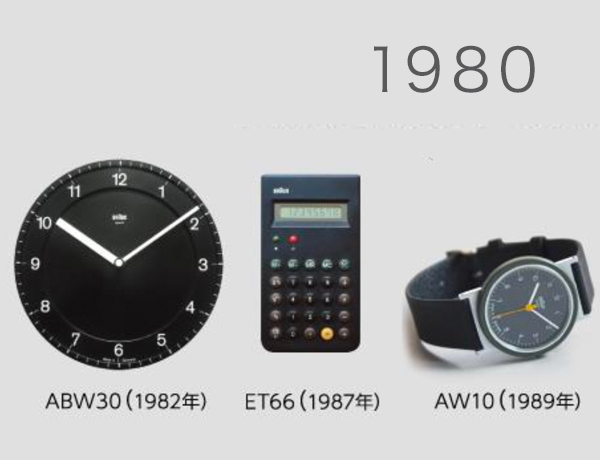
▲1980—The beloved masterpieces still cherished today—wall clocks, table clocks, wristwatches, and calculators—were all born in the 1980s.
A boldly simple, ultimate monotone design of squares and circles, with every button and color placed as if nothing more could be added or removed. As one book described, at the time, great care was taken with such small household items to ensure they wouldn't grow tiresome, since they were things people saw and touched every single day. The result is a simple design that grows on you—one that becomes more beloved the more you see and use it day after day.
Timeless Products, Loved Across the Generations
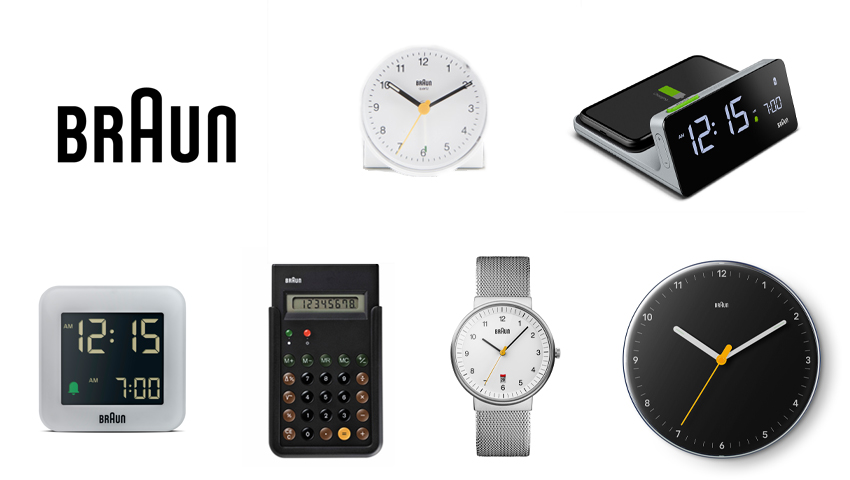
The watch collection features highly practical pieces that can be worn by anyone, in any setting—but this is the most basic model of them all. Drawing on the mid-century modern movement, the BNH0032 wristwatch has a simple, rational design that prioritizes readability and ease of use. With a minimal form that suits both suits and casual outfits and an easy-to-read dial, it offers a stress-free experience—whether you're discreetly checking the time in a business setting or quickly glancing at your wrist when you're in a hurry. The yellow second hand, a charming accent against the minimal design, strikes a perfect balance that makes this piece stand out.

Because these are items used every day, BRAUN never compromises. With easy readability and a minimal design that quietly blends into any space—whether a traditional Japanese room or a modern living room—these clocks embody practical design that has made them long-selling favorites, thanks in part to the fact that the time can be clearly read even from across the room. The lineup ranges from the classic alarm clock to the BC06 wall clock, which has kept the same design since 1981, to the functional digital clock. The collection also includes the travel alarm clock, handy for trips with a world time chart tucked inside its folding lid, and the clock with wireless charging pad—a collection of craftsmanship that has never grown stale, continuing right up to the present day.

▲Left: digital clock, right: alarm clock (the item on the right is not currently available)

▲Clock with wireless charging pad


Embodying the philosophy of "less but better," this timeless collection has earned numerous design awards. This calculator is another product that has kept its design unchanged for over 30 years, prioritizing function—so much so that it has been selected for the permanent collection of the Museum of Modern Art (MoMA) in New York.
These are masterpieces recommended for anyone who cares about the stationery on their desk. Since it comes with a portable pocket size and a sleeve-style case, it's also convenient to carry along in your bag.

The BRAUN products introduced here on ZUTTO are just a small selection, but they are long-sellers dating back to the 1970s. That era in Japan was also a time of remarkable growth and spread in home appliances, which makes it all the more rare for products born in the same period to still be around today in this form. Because BRAUN pursued universal designs with an eye toward the future even back then, the brand has become the foundation for appliance design that is simple, never grows tiresome, and still fits naturally into modern life—the kind that people grow attached to.
GUIDE »
CATEGORIES »
- + Gifts by recipient
- + Gifts by scene
- + Clothing
- + Bags / Backpacks
- + Wallets / Card cases
- + Jewelry
- + Shoes
- + Rainy day outfits
- + Kitchen
- + Home
- + Babies / Kids
- + Japanese products
Earn Miles


Payment & Security