


.webp)


.webp)


.webp)


.webp)


Welcome to ZUTTO
Free shipping for newsletter subscribers (some areas excluded)
- トップページ/
- ZUTTO Journal/
- ブランドストーリー/
- Feel the history ...

Feeling the history and beauty of form. The charm of Asahi, the vulcanized deck shoes from Kurume
Looking at people walking down the street, it feels like the number of people wearing sneakers has increased significantly.
The simple, functional beauty that sneakers offer has come to be embraced as a fashion choice by people of all ages and genders, more so than before. Some people may find that their lifestyle has changed as they go out more often in sneakers. Sneakers, which fit comfortably and place little strain on the feet even when worn for long periods, seem to remind us of the joy of walking.
This time, among sneakers, we're picking up deck shoes, which have been loved around the world for their comfort. We'll take a closer look at the appeal of Asahi's deck shoes, vulcanized deck shoes born in Kurume, Fukuoka Prefecture.


Asahi, a sneaker brand from Kurume
The brand we're introducing, Asahi, was born from Asahi Shoes, a company famous for manufacturing indoor shoes used in schools and other institutions.
Asahi Shoes traces its origins back to when founder Tokujiro Ishibashi established "Shimaya," a tailoring (sewing) business that would become the predecessor of the current company. He later passed the business on to his two sons. Feeling that the tailoring business, which made various products such as shirts, underpants, and tabi (traditional Japanese socks), was inefficient, they changed Shimaya's business to focus exclusively on tabi in 1907.
The company grew by introducing electric motors and integrated production starting from cotton fabric, eventually establishing its own factory. The rubber-soled tabi (jika-tabi, work shoes with rubber soles attached) they developed gained a strong reputation and brought the company further into the spotlight. Since purchasing rubber from outside suppliers for processing was financially disadvantageous in this production process, the company began integrated in-house production starting from raw rubber—a practice that laid the foundation for the integrated production system used today.

Asahi's factory is located in Kurume, Fukuoka Prefecture. Kurume has long been home to two major factories famous for shoe manufacturing: the "Moonstar Factory" and the "Asahi Factory," both well known locally. This time, our focus is on the Asahi Factory, which has the atmosphere of an old, all-white Western-style building. In fact, this factory has a deep connection to a certain famous brand that originated in America as the world's first deck shoe brand.
In a movement that began on the West Coast of the United States in the 1970s, deck shoes gained explosive popularity around the world. In the 1980s, the Asahi Factory also began producing "BigBen," a Japanese-made deck shoe. Its precise craftsmanship was said to be of a quality that even surpassed that of the original American-made deck shoes, which were at the forefront of the deck shoe scene at the time.
Eventually, as the global production base for deck shoes shifted from the United States to overseas, the beautiful domestic craftsmanship was at one point in danger of being lost. There was a desire to revive the beauty of those Japanese deck shoes once again. The Asahi Factory was chosen for this purpose. Having inherited Japan's high level of craftsmanship and become a certified factory for Asahi, the Asahi Factory is said to still retain the beautiful wooden shoe molds from that era to this day.
The secret behind the walking comfort of Asahi's deck shoes

Fukuronui (bag-sewing method)
When discussing the comfort of Asahi's deck shoes, the first thing to mention is the fukuronui, or bag-sewing, method. Typically, glue is used to bond the outer and inner materials of a shoe's upper. Asahi's deck shoes, however, forgo this method entirely, instead sewing the canvas fabric directly into a bag shape. This creates a distinctively soft, supple texture in the canvas that conforms comfortably to the foot. As a result, when you put your foot into Asahi's deck shoes, you get the reassuring feeling of your foot being wrapped, almost like wearing a sock.

Vulcanized construction
Vulcanized construction is used to bond the sole to the upper. This method, known in Japanese as "kaoryu-gama seiho" (sulfur-curing kiln method), refers to the process of bonding the upper and sole of a sneaker. Before vulcanized construction was established in the 1840s, there had been attempts to use rubber for soles, but durability issues prevented any of them from becoming viable products. Once vulcanized construction became widespread, rubber gained greater versatility, and shoe manufacturers began producing rubber-soled sneakers in pursuit of both comfort and durability.

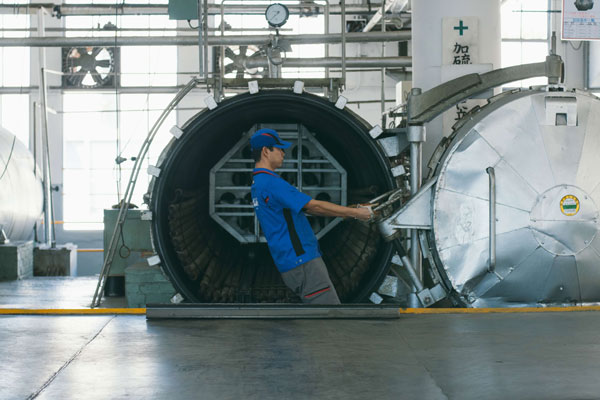
In the vulcanized construction process, the upper and sole are shaped using raw, uncured rubber, then placed in a special kiln and subjected to high heat and pressure at 120°C for 70 minutes. Through this "vulcanization" process, the raw rubber, which was not yet cured before entering the kiln, gains the elastic properties of cured rubber, and the upper and sole are firmly bonded together as one unit.
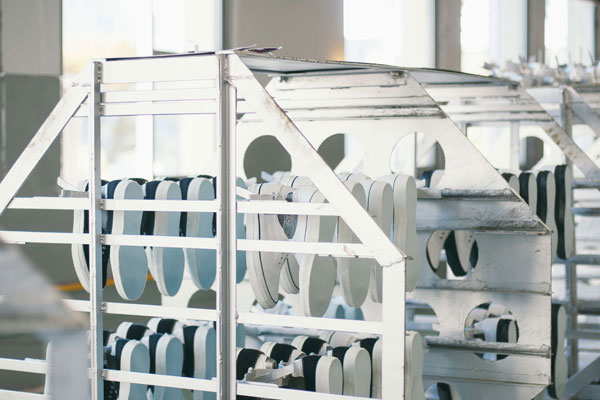
Have you ever noticed the rubber near your big toe or little toe peeling away as you wear in your canvas sneakers? With typical manufacturing methods, since the materials are only bonded with glue, rubber peeling is common, and many such shoes cannot be washed. However, shoes made with this vulcanized construction method are strongly bonded from raw rubber using high heat, which dramatically reduces peeling and also makes it possible to wash the shoes themselves.
波型にカットされたアウトソール

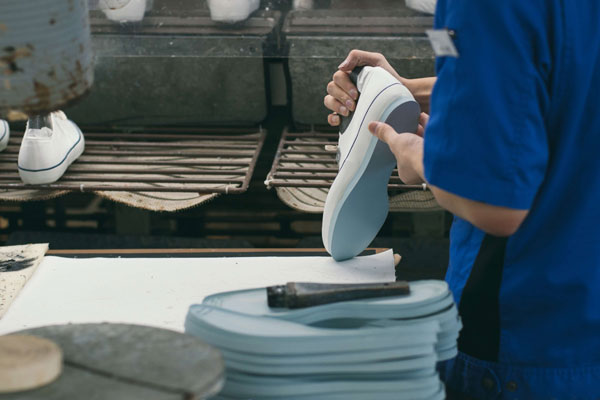
The "Sperry sole" has been used on the soles of countless deck shoes. It's also used on the soles of Asahi's deck shoes.
Paul Sperry, who developed the Sperry sole in 1935, was himself a sailor. After long trial and error trying to solve the problem of slipping on wet decks—something that could even prove fatal—he found inspiration one winter day watching his own dog run effortlessly across the ice. He noticed the distinctive grooves on the pads of the dog's paws, and succeeded in developing the wave-cut Sperry sole based on that design. The fact that so many deck shoe brands beyond his own went on to adopt the Sperry sole is proof of just how effective it is.
The Sperry sole is distinguished not only by its cut pattern but also by the softness of its rubber. The rubber used for deck shoe soles is far softer than that used in ordinary shoes. This is because softer rubber soles flex more easily and grip the ground better, making them less prone to slipping, compared to harder ones. For deck shoes, the softness of the sole can be said to matter even more than the pattern itself.


Care has been taken with all sorts of other details, too. The insole, for example, is 8mm thick, chosen with cushioning in mind. It resists compressing over time, allowing for long-lasting comfort.
The rubber tape wrapped around the side of the sole also varies in width from heel to toe, creating a subtle curve that lends the shoe both a classic and a sharp feel. Asahi's deck shoes are packed with all the know-how of the Asahi factory.
Which shape and color should you choose?

Left side, from top:
・WHITE × low-cut: Deck Shoes LO11 WHITE
・MONOCHROME × low-cut: Deck Shoes LO11 MONOCHROME
・BLACK × low-cut: Deck Shoes LO11 BLACK
Right side, from top:
・WHITE × high-cut: Deck Shoes LO12 WHITE
・MONOCHROME × high-cut: Deck Shoes LO12 MONOCHROME
・BLACK × high-cut: Deck Shoes LO12 BLACK
The Asahi lineup carried by ZUTTO comes in two shapes—low-cut (LO11) and high-cut (LO12)—and three colors: white, monochrome, and black.
Low-cut and high-cut deck shoes

Both the low-cut and high-cut deck shoes have a simple, uncluttered, refined look.
What's great about the low-cut shoes is how easy they are to wear and the fact that they show off the ankles. Showing a bit of ankle makes an outfit look more stylish, and in cold weather you can also enjoy layering them with socks.

The high-cut shoes are easy to walk in since they hold the ankle in place, and because they cover the foot just the right amount, they let you show a moderate bit of ankle during the warm spring and summer months, while also being easy to wear from early autumn through the depths of winter, coat season included. The word "deck shoes" might bring summer to mind, but because Asahi's deck shoes are soft and comfortable right from the start, they can be worn all year round.
Monotone deck shoes
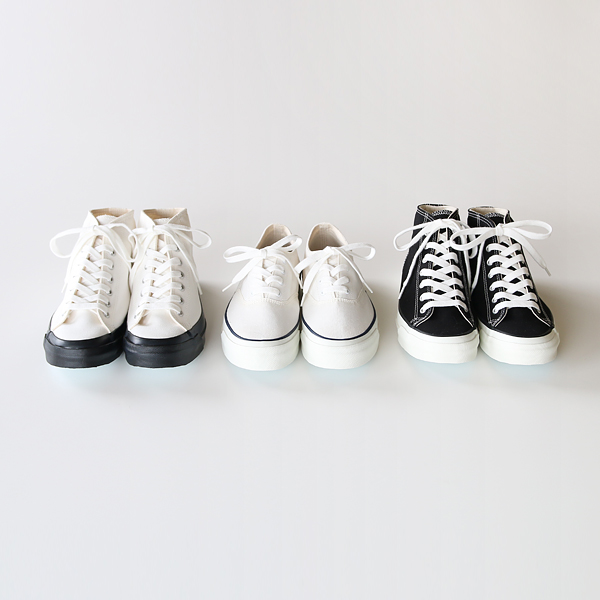
From left: MONOCHROME × high-cut: Deck Shoes LO12 MONOCHROME, WHITE × low-cut: Deck Shoes LO11 WHITE, BLACK × high-cut: Deck Shoes LO12 BLACK
There are three colors available: WHITE, MONOCHROME, and BLACK.
WHITE is a stylish pair with navy lines set against pure white canvas. When you think of a canvas sneaker, this is the color that comes to mind. It has a cool, summery image, but it's also versatile enough to use as an accent against more chic colors during the cooler months.
MONOCHROME has a crisp look, with black tape set against white canvas. Compared to WHITE and BLACK, it has more of a fashion-forward impression. It works well both with monotone coordinates and casual outfits alike. White canvas sneakers can be a worry when it comes to dirt, but since Asahi's sneakers can be washed, there's no need to worry.
BLACK is a black sneaker you'll want to wear all year round. Since it uses white tape, it has a slightly more casual impression compared to MONOCHROME, and it goes with anything, from denim pants to dresses and skirts.
Don't forget the care routine
Everyday care
Since these are sturdy canvas sneakers, they don't require time-consuming care, but brushing them with a shoe brush after wearing will help prevent dirt from building up. Also, if they get wet in the rain, be sure to dry them in the shade, and if they become dirty, wash them right away.
About washing
Asahi's deck shoes can be washed by hand.
1. Avoid hot water, and hand-wash gently in lukewarm water below 40°C. *Using a washing machine may damage the fabric.
2. Use a neutral detergent. Do not use bleach.
3. Rinse thoroughly. Insufficient rinsing may cause discoloration or fading.
4. Dry in a well-ventilated, shaded area.
About Storage
When storing for a long period, please be careful of mold.
Before putting them away, brush off any dirt and store them in a well-ventilated place.
▽Click here for Asahi's vulcanized deck shoes

▽Looking for other sneakers? Click here

GUIDE »
CONTENTS »
CATEGORIES »
- + Gifts by recipient
- + Gifts by scene
- + Clothing
- + Bags / Backpacks
- + Wallets / Card cases
- + Jewelry
- + Shoes
- + Rainy day outfits
- + Kitchen
- + Home
- + Babies / Kids
- + Japanese products
Earn Miles


Payment & Security




