.webp)


.webp)


.webp)


.webp)


Welcome to ZUTTO
Free shipping for newsletter subscribers (some areas excluded)
My page
Information
- トップページ/
- ZUTTO Journal/
- ブランドストーリー/
- KOMIYA umbrellas:...

KOMIYA umbrellas, made to be used for generations
Even on rainy days, when not just the sky but our spirits tend to grow gloomy, there are umbrellas that brighten the heart the moment you open them. Perhaps this isn't only because of their beautiful shape, but because the maker's thoughts and care have been poured into each one.
Komiya Shoten has been crafting umbrellas in Nihombashi for more than 80 years. No matter the era, the company has upheld the tradition it was founded on: making quality goods within a scope they can personally oversee. In every umbrella, shaped by hand from carefully selected fabrics and parts, lies the craftsman's wish that it be used for years to come, along with skills nurtured over a long history.
This time, we'd like to introduce how KOMIYA, the umbrellas made by Komiya Shoten, are actually made.

A Western-style umbrella born in Nihombashi
Founded in 1930 in Higashi-Nihombashi, Tokyo, Komiya Shoten began by producing Western-style umbrellas and shawls. Even today, the shop stands in the same location, retaining much of the atmosphere it had when it was founded.
At the time of the company's founding, the umbrellas commonly used by ordinary people in Japan were "bangasa," made with bamboo ribs covered in oiled washi paper. "Western-style umbrellas," with metal ribs covered in silk or cotton fabric, were luxury accessories that only a limited segment of society could afford. Amid this landscape, Komiya Shoten began making Western-style umbrellas using koshu-ori, a woven textile from Yamanashi.

Komiya Shoten, still based in Nihombashi and continuing its umbrella-making tradition
Over its 80-year history, Komiya Shoten has weathered no small share of social upheaval—wartime chaos, the oil crisis, the bursting of the economic bubble—yet has continued making Japanese-made Western-style umbrellas throughout. After the war, more than 70 umbrella shops once lined the streets around Higashi-Nihombashi; today, only a handful remain. Despite being tossed about by the turbulent waves of the times, Komiya Shoten has continued making umbrellas in much the same way as it did at its founding.


Step inside the directly-run shop in Higashi-Nihombashi, and you'll find umbrellas of every shape and color lined up in rows—a space that fills you with excitement as you're surrounded by such colorful pieces. Since the shop also handles customization and repair of not just the umbrellas themselves but also handles and tassels, various umbrella parts are on display as well. At Komiya Shoten, each component—the fabric, the ribs, the handle—is commissioned from specialized craftspeople, while the final assembly and finishing are done in-house. Because of this, you might even catch a fabric maker dropping by the shop with freshly completed bolts of cloth. A single umbrella truly comes together through the hands of many people.
Where an umbrella is born
At Komiya Shoten, craftsmen finish each umbrella by hand, drawing on a wealth of knowledge and skill. This time, we were given special access to peek into the place where these umbrellas come to life.
An umbrella begins with fabric
Umbrella-making at Komiya Shoten begins with cutting fabric produced in various regions, including Koshu. As you can tell from the triangular shape of the fabric panels between each rib, the material is cut into triangles. For this cutting process, craftsmen use a triangular wooden tool that serves as a ruler. Since each craftsman has their own sense of fabric tension and sewing pressure, each one files and shapes this tool by hand to suit themselves.

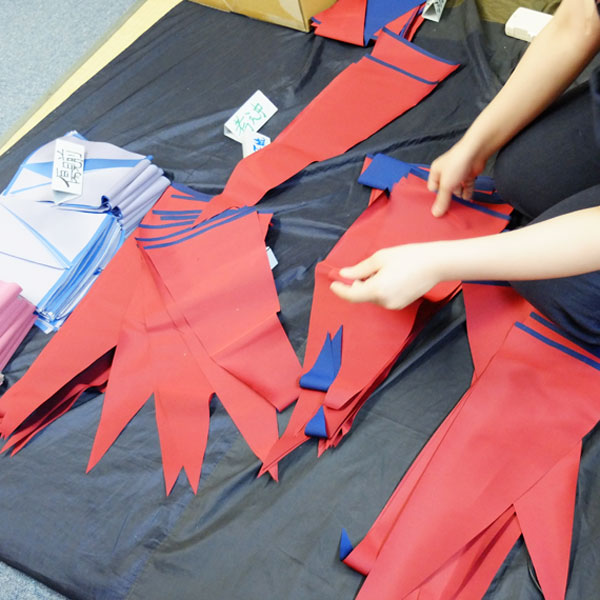
The fabric, cut cleanly and without hesitation using a dedicated knife, is then carefully inspected. Since the fabric sits directly in front of you when the umbrella is opened, this inspection process is extremely important. It goes through two stages: "kizumi," where the surface is checked for scratches and stains, and "sukimi," where the fabric is held up to the light to check for loose threads and other flaws.
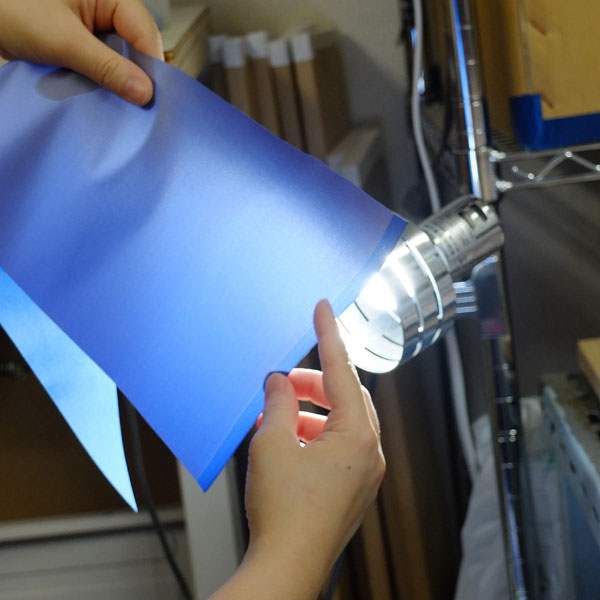
Sewn on machines passed down through generations
Once inspection is complete, the process moves on to "nakanui," where the fabric panels are sewn together. One thing that stood out in particular was the sewing machine used for this process. Though well-worn with age, its dignified, beautiful presence speaks to the fact that it has been passed down from craftsman to craftsman over generations. Carefully maintained, this machine is used to sew the cut fabric panels together, one by one.
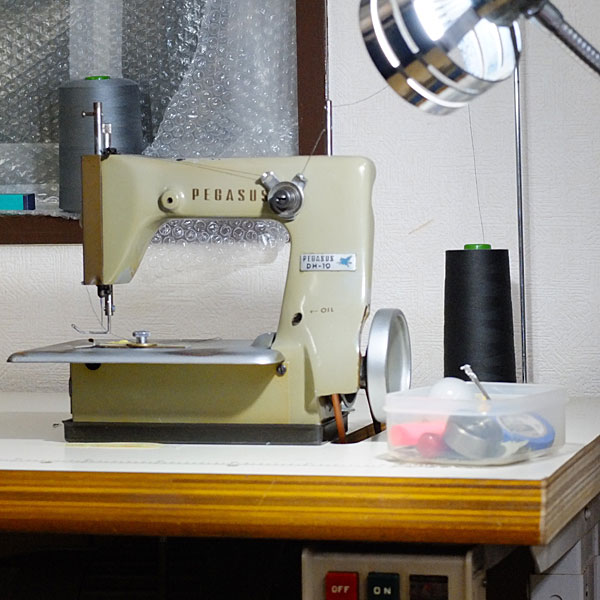


During this sewing process, the thread is stitched quite loosely on purpose. This is because, when the fabric is later attached to the ribs, it needs to be pulled from top to bottom, so just the right tension is required—loose enough not to break the thread, but not so loose that it slackens. Since the machine can't tell you what that perfect tension is, getting it right is where a craftsman's true skill shows.
Attaching the fabric to the ribs
Next comes the process of attaching the fabric to the ribs. Starting from the ferrule at the tip of the umbrella, the fabric is fitted over the ribs, and three stitching steps follow: "tenkagari" (joining the fabric to the ribs near the ferrule), "nakatoji" (joining the fabric to the ribs on the inside), and "kuchitoji" (joining the fabric to the rib tips). The word "sewing" might bring to mind a light, quick stitching motion, but umbrella fabric is far stiffer than ordinary clothing fabric, and the special thread used is thick and coated in wax—so pushing the needle through takes real force. It's surprising to learn that the needle sometimes even snaps under the strain.
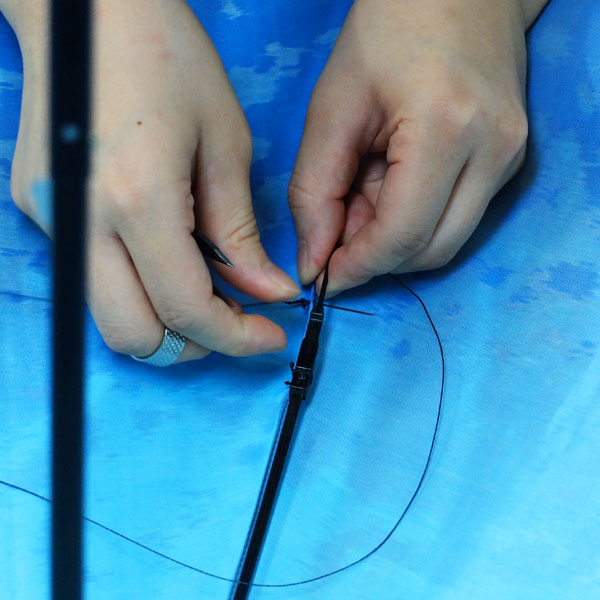

One phrase that came up again and again during the sewing process was "three times." At Komiya Shoten, when performing tenkagari, nakatoji, and kuchitoji, the thread is wound three times before being knotted off. This step is typically done twice elsewhere in the industry, but wrapping it three times strengthens the joint between the rib and the fabric, making it more resistant to fraying. This three-wrap technique has been passed down through generations of craftsmen, and it's said that "Komiya Shoten wraps it three times" is a phrase known even within the industry. Thanks to this careful, meticulous stitching, there's no need to worry about leaks.
The fine attention to detail that only handwork can achieve
Throughout the process, meticulous finishing touches are applied. One of the features that defines a KOMIYA umbrella is what's known as "rokuro-maki" and "daboo-maki" (winding techniques used at the hub and rib joints).

The part of the umbrella called the "rokuro" (the runner that gets pushed up with a finger when opening the umbrella) has fabric sewn into it (rokuro-maki). This rokuro-maki is a sign of thoughtful consideration—so that opening the umbrella doesn't strain the finger, and so that hair doesn't get caught while using the umbrella.

The fabric attached at the tips of the ribs (dabo-maki) exists for the reason of not damaging the fabric. For both rokuro-maki and dabo-maki, the fabric pieces used are cut out by craftsmen using a small mallet, then sewn in by hand, one by one. This kind of meticulous construction is only possible through handwork.
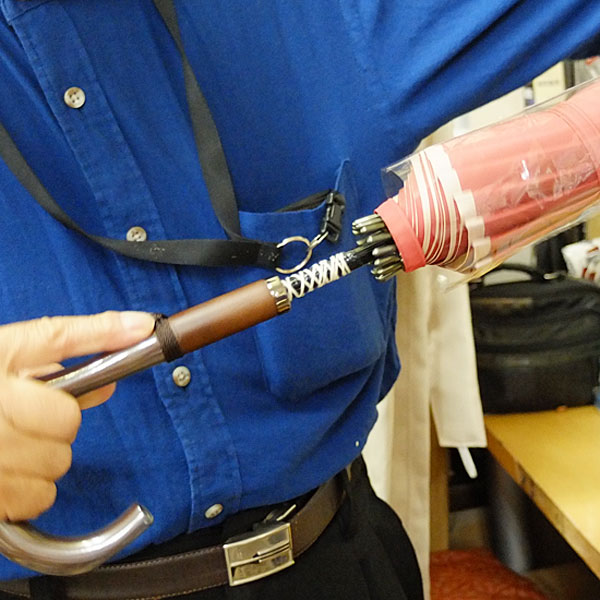
And in the final stage of umbrella-making at Komiya Shoten, a veteran craftsman performs the temoto-zuke (attaching the handle) and the final inspection. While many umbrellas are made with the handle simply inserted into the shaft as a simple construction, at Komiya Shoten, thread coated with adhesive is wound around the handle to eliminate any gap between the shaft and the handle, resulting in a sturdier design where the handle is much less likely to come loose. The number of times the thread is wound is determined based on the craftsman's seasoned experience, tailored to each individual umbrella.

This is how a KOMIYA umbrella comes into being. Made using extraordinary technique, these umbrellas have a beautiful form that could almost be mistaken for a work of craft art, and they are extremely durable. When you hold one in your hands, you truly feel it is a piece that will last a lifetime. The oldest craftsman at Komiya Shoten is currently 84 years old. As the number of elderly craftsmen increases, in recent years the company has also worked on training young craftsmen, and we caught a glimpse of this effort to pass on the skill and tradition in Komiya Shoten's umbrella-making.
The Bamboo Handle, exuding an air of elegance

The long umbrella Bamboo Handle, where the bamboo handle, tassel, and beautiful fabric come together to create a refined, adult umbrella.

Compared to umbrellas with fewer ribs, 16-rib umbrellas take on a more circular shape, so even at the same size, they cover a larger area. They also have the advantage of pairing well with traditional Japanese clothing.

This is a simple piece that highlights the excellent materials and craftsmanship of KOMIYA umbrellas.
The elegant "Kasane" umbrella
The "Kasane" series is also popular at ZUTTO.
This series, whose beautiful color combinations catch the eye, uses Koshu-ori—yarn-dyed fabric woven in Koshu (Yamanashi Prefecture)—which boasts a quality and beauty said to rival Nishijin-ori. Even when closed, this umbrella conveys the refined character unique to Koshu-ori, but its beauty becomes even more striking when opened.


The fabric uses different colored threads on the outside and inside, which is the origin of the name "Kasane" (meaning "layering"). This layering of colors, where the thread on the reverse side subtly peeks through to the front, produces a depth of color different from a single-color weave.
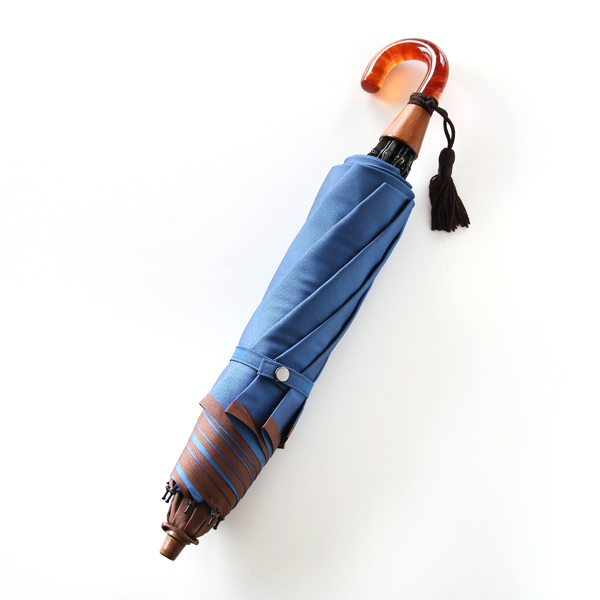
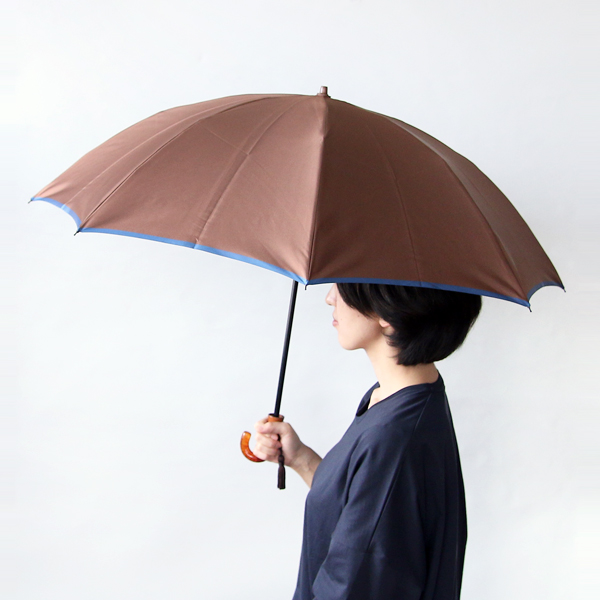
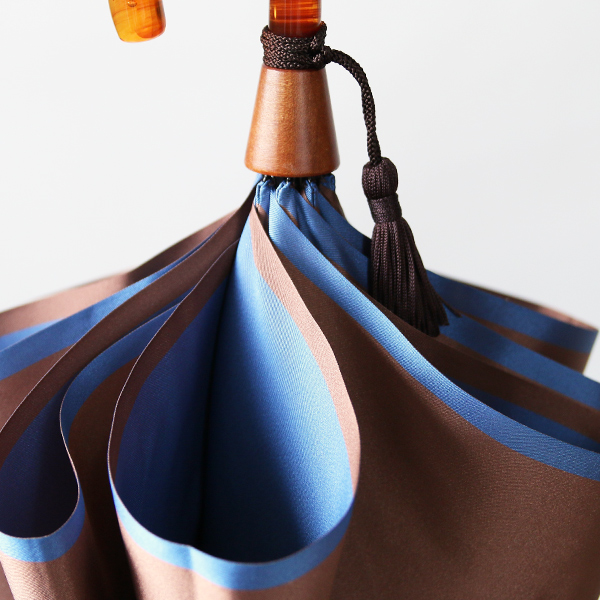
The folding umbrella version of Koshu-ori Kasane features a tortoiseshell-like handle as its highlight. Despite its compact size, it retains the fine quality of Koshu-ori fabric, and it has the convenient feature of allowing the tsuyusaki (ferrule tip) to be tucked away at the base of the handle. The 16-rib Kasane series uses carbon and aluminum for the rib material to reduce weight. It's a beautiful umbrella representative of KOMIYA, one that will make you look forward to picking it up.
The practical "Miratore" umbrella
The series named "Miratore" places even greater emphasis on practicality.


The fabric of the Miratore is a high-density weave of fine denier. It sheds water well, so you won't need to worry about water droplets when folding up the umbrella. The surface of the Miratore fabric has minute, nearly invisible protrusions created by its fine weave, which contain air. These protrusions catch falling water droplets and hold them intact, so the droplets form into rolling beads rather than spreading flat. As a result, just a light shake when closing the umbrella causes the water beads to fall away, reducing the hassle of putting it away.


We also offer a men's size Miratore, which has a diameter of about 98cm when opened.
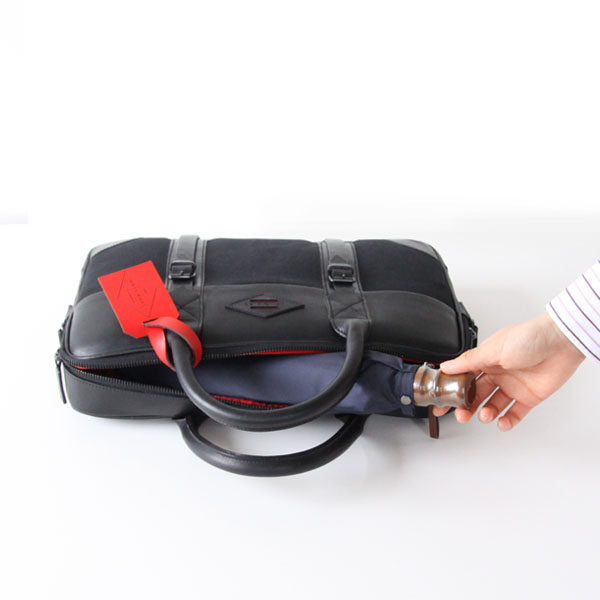
The Miratore series also has a compact handle, small enough to fit in a bag, making it an easy umbrella to use for business occasions or on days when the weather looks uncertain.

A compact women's size is also available.
To Use Your KOMIYA Umbrella for a Long Time
To make long-lasting use of a KOMIYA umbrella, which has been carefully crafted by hand, please keep the following points in mind.
When Opening the Umbrella
Umbrellas need a warm-up too. Before opening, gently shake it to loosen up the fabric before use. In the case of a folding umbrella, it's smoother to first fully extend the shaft before opening it.
When Closing the Umbrella
It's tempting to shake a rain-soaked umbrella vigorously, but doing so places a heavy strain on the ribs, the rokuro, and the fabric. Please shake off water gently.
After Use
Don't leave a rain-soaked umbrella closed as is—always let it dry in the shade. Leaving it wet can cause discoloration, mold, rust, and a decline in water-repellent effectiveness. Also, wiping the fabric hard with a cloth is not recommended, as this too can reduce the water-repellent effect.
Precautions During Use
One thing that's surprisingly easy to overlook is touching the fabric with hands that have oily substances on them, such as hand cream or sunscreen. Doing so can diminish the fabric's water-repellent effect or cause color fading, so please be careful.
▽You can find KOMIYA umbrellas here

GUIDE »
CATEGORIES »
- + Gifts by recipient
- + Gifts by scene
- + Clothing
- + Bags / Backpacks
- + Wallets / Card cases
- + Jewelry
- + Shoes
- + Rainy day outfits
- + Kitchen
- + Home
- + Babies / Kids
- + Japanese products
Earn Miles


Payment & Security