.webp)


.webp)


.webp)


.webp)


Welcome to ZUTTO
Free shipping for newsletter subscribers (some areas excluded)
- トップページ/
- ZUTTO Journal/
- ブランドストーリー/
- Captivated by Vin...

Captivated by Vintage Watches That Travel Through Time: A GS/TP Brand Interview
How well can we imagine an era when there was no concept of a clock at all, and time was measured only by the movement of the sun and stars? A second, an hour, a day—these are treated as a universal standard shared by all, but our sense of a second or an hour is something confirmed only by the timepiece, a tool of civilization.
This time, we're exploring the world of vintage watches. In an age when smartphones can tell us the exact time, we wanted to know more about why we're still drawn to the item called the "wristwatch," so we visited the showroom of L.F.C Co., Ltd., the wholesale distributor of the watch brand GS/TP, to hear their story.

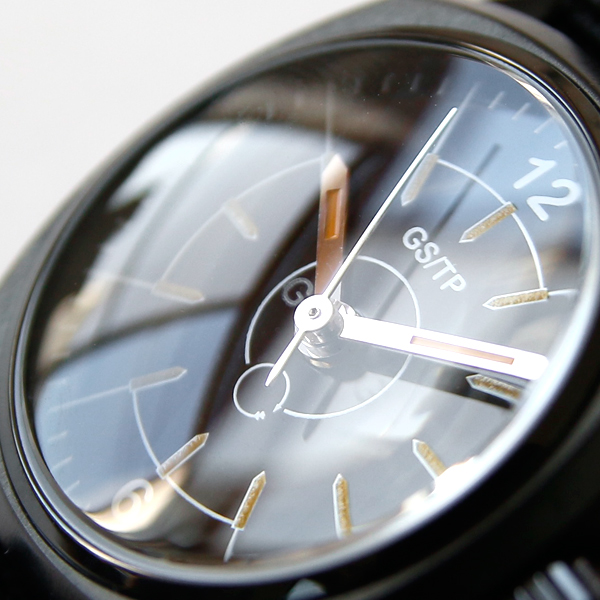
Tokyo's Kita-Sando area, where showrooms of various fashion makers line the streets. The showroom we visited this time also stands quietly in this area. We spoke with Masaki Takahashi, who has been involved in planning watches for GS/TP (GS/TP). Takahashi is a true vintage watch professional—he has maintained countless vintage watches, introduced them to select shops across the country, and personally stood at events to share the joys of vintage watches.


The History of Wristwatches, and the Appeal of Vintage Watches
When we visited the showroom, we found a mountain of vintage watches lined up neatly—mostly overseas-made pieces from around the 1960s, all selected by Takahashi.
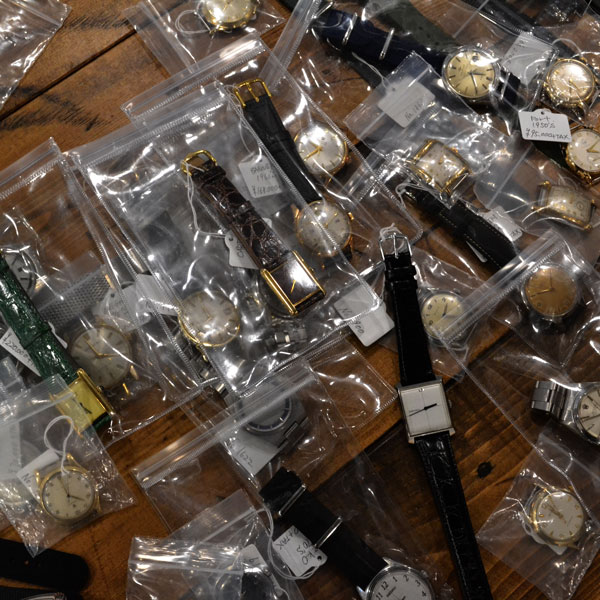
That's right. Every vintage watch is one of a kind, so you can classify them in various ways based on era or design. It can be tricky to decide which criteria to use, but the biggest difference lies in the movement of the watch itself—whether it's "mechanical" or "quartz."
The technology of a watch with hands that rotate to indicate the time was born some 400 years ago. Since then, the elements of watches—both in design and in technology—have changed only gradually. Amid that slow evolution, it's no exaggeration to say the biggest change of all was the birth of the quartz watch. At the time, the basic mechanism of a watch was what's known as "mechanical"—winding a mainspring and using the energy released as it unwinds. Then, in the 1960s, the Japanese watchmaker SEIKO famously introduced a precise, battery-powered watch.

When it comes to precision, mechanical watches are measured in terms of daily rate, while quartz watches are measured in terms of monthly rate. In other words, quartz watches are so precise that daily deviation is almost negligible. Mechanical watches, on the other hand, have the characteristic that their daily rate changes with the seasons. Since the inside of a watch is essentially a cluster of iron parts, it contracts in winter and runs a bit fast, while in summer it expands and runs a bit slow. It really does feel like a mechanism, doesn't it? But this very need for care makes it seem less like a machine and more like a living thing. As my mentor used to say, "A watch is the only piece of art you can wear." You can't wear a painting or a sculpture, but on a dial this small, the intricate and beautiful world depicted is truly on the level of art.
Whether You Can "Appreciate the Inconvenience"
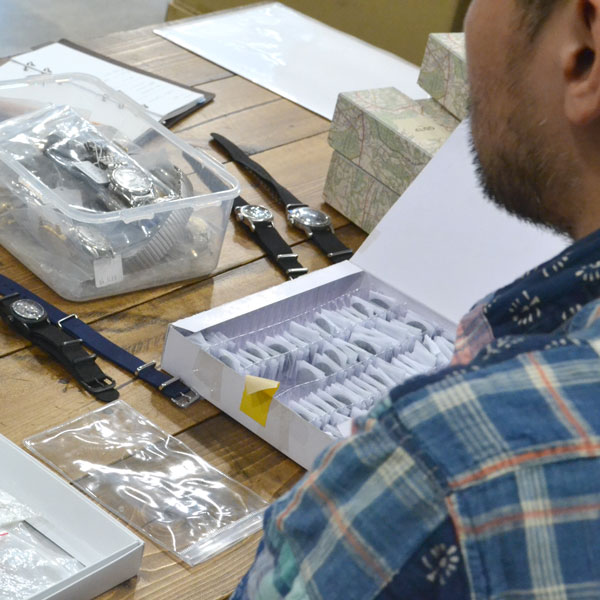
One reason might be how attachment develops. Mechanical watches are certainly inconvenient. In terms of running costs, they take both effort and money. It's blunt, but that much is self-evident, yes (laughs). But whether you can enjoy that inconvenience, whether you can appreciate it—that's where a kind of hobbyist sensibility comes in. Rather than being a purely practical tool, I think something that requires a bit more care actually fosters more attachment. Quartz watches are easier and more precise. You can tell the time with just a smartphone. In an age like that, choosing a mechanical watch—especially a hand-wound one—might make people think you're a bit eccentric, but I don't think that inconvenience is necessarily a bad thing.
Before we know it, we're surrounded by new, convenient things (laughs). But there are areas where mechanical watches are actually superior as machines. It's easy to assume quartz beats mechanical simply because it's precise and easy to understand, but in fact, mechanical watches are the ones that last longer as timepieces. A typical quartz movement is said to have a lifespan of about 30 years, whereas mechanical watches can be repaired or have parts replaced individually, allowing them to remain in practical use for 50 or even 60 years. People often talk about passing a watch down from parent to child, and it's mechanical watches that make this possible. With a quartz watch, you'd end up saying, "Dad gave me this, but it doesn't even work!"
Even with a quartz watch, you can keep using it if you replace the entire movement, but if the insides have become something completely different, can you really call it the same watch as before? It's a fair question. What's more, because a quartz movement requires replacing the whole unit, once the manufacturer discontinues that particular movement, repairs become difficult. Mechanical movements, on the other hand, can be repaired gear by gear, screw by screw, which is why they last so long. There's a certain romance in a watch made more than 50 years ago still ticking away today. This is something only a mechanical watch can achieve.
What makes a watch a wristwatch is the power of the strap
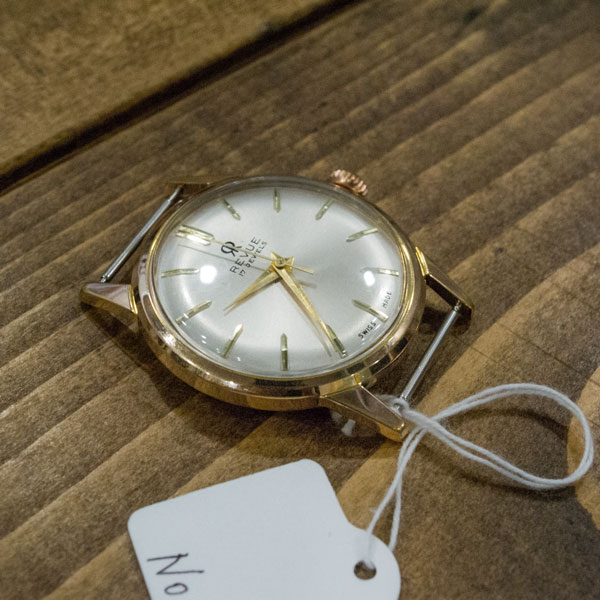
While a mechanical watch itself can last for decades with proper maintenance, the strap, being an accessory, inevitably becomes a consumable item. I'd recommend casually switching it out to suit the season—stainless steel in summer, a leather strap once winter comes—and enjoying it that way. As long as you choose a "genuine" watch with solid craftsmanship as the base, simply swapping out the strap lets you enjoy a wide range of variations. That's one of the pleasures of wearing a wristwatch, don't you think?
Personally, I also like pairing a well-known luxury watch with a deliberately casual strap. It makes you think, "Oh, is that from that trendy brand?"—only to look closer and realize it's actually a Rolex from the 1960s! That kind of playful twist is fun, I think. "Cool" is fleeting, but "beautiful" is universal. A fleeting kind of coolness turns into something "uncool" once time passes, but beauty—like the existence of the "Mona Lisa," for example—never fades no matter how many hundreds of years go by. In the same way, you really see how a beautiful watch tends to match with just about any strap.
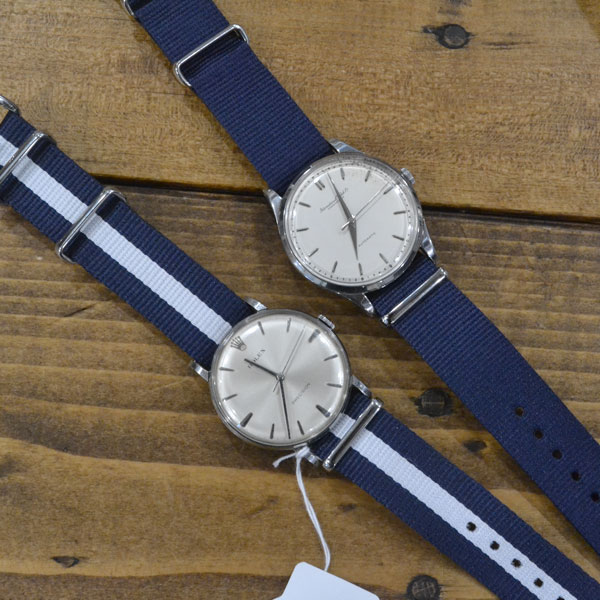
A vintage Rolex, deliberately paired with a cheap-looking strap.

The same movement from a GS/TP (brand new), fitted with different straps. The second from the top has a JB Gray strap.
By the way, this one (second photo from the top) is modeled after the watch strap that Sean Connery, who played the original James Bond, wore in the films—it's known as the "JB Gray."
This was during the era of black-and-white films. On the black-and-white silver screen, it looked like a gray striped pattern, but when I recently rewatched the film in its digitally remastered version, I discovered that the band actually wasn't gray at all—it was khaki with a red accent color. This became a bit of a topic of conversation in the watch industry, which I think is a rather charming episode. And Daniel Craig, who has recently played the same James Bond, appeared in the films wearing a watch fitted with this "JB Gray" strap as a tribute to the original Bond. It's a rather stylish touch, don't you think? I think it's a good example of how wristwatches are part of fashion, and of how they can be loved across generations.
The formative experience of wearing a wristwatch
That's right. I belong to the generation whose formative fashion experience came in the 1990s, when CASIO's G-SHOCK was exploding in popularity. Because of my line of work, I of course love the vintage watches I find at antique markets and the like, but I love brand-new watches just as much, without any distinction.
Back then, fashion and wristwatches, as objects, were very close to each other. People of the same generation might nod along with this, but it wasn't unusual to see a display case of wristwatches sitting right alongside shirts and pants at select shops. It wasn't a matter of going to a watch shop with the mindset of "alright, I'm going to buy a watch"—rather, you'd go to a clothing store to buy a T-shirt, and in the natural flow of things, your eye would land on a wristwatch. As times have changed, fewer stores display wristwatches on the same shelf as clothes, shoes, and bags, and it's become harder to have that kind of experience with watches. That is a bit sad, both as a seller and as an enthusiast.

Left: GS/TP's quartz black dial QMD03B / Right: Mr. Takahashi's personal watch
I usually keep around five in rotation, choosing one depending on my mood. The watch I have on today is from a Swiss brand that supplied watches to the German military in the 1960s. It's a bit hard to tell what time it is at a glance, but actually, it's displayed in a 24-hour format—one full rotation exactly per day. It's from a brand that no longer exists, but that's part of the appeal of vintage watches: they're scattered with details that could never come about with today's sensibilities. It's a real shame that so many watch brands were weeded out from the 1960s onward, triggered by the quartz shock, but there's something a little ironic about how that's precisely what makes these watches feel special.
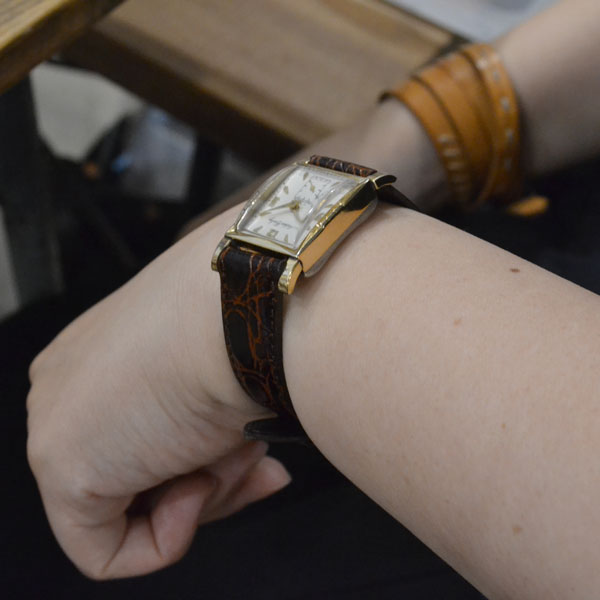
"Would you like to try it on?" — spontaneously picking out a vintage watch that would suit a ZUTTO staff member.

I think this type of item generally suits men better, but we actually get customers of both genders. Older-generation watches tend to have relatively small faces, which means even men's watches often fit comfortably on a woman's wrist. Also, from what I've observed in the shop, women tend to buy based on that first "how cute!" impression, while men tend to place more importance on the accumulated history behind a piece—the so-called "trivia." I call it the "strap-hanger battle"—on the train, I can't help but glance at people's wrists as they hold the straps (laughs). When I spot someone wearing a watch that catches my eye, I think, "this person really knows their stuff."
Building up knowledge about watches and deepening your interest that way is certainly rewarding, but I also think there's value in the more casual approach of simply picking up a watch that catches your eye without overthinking it. As long as you observe a few basic precautions, vintage watches aren't difficult to handle, so I'd be happy if people of any gender could enjoy the unique world that only vintage watches offer.
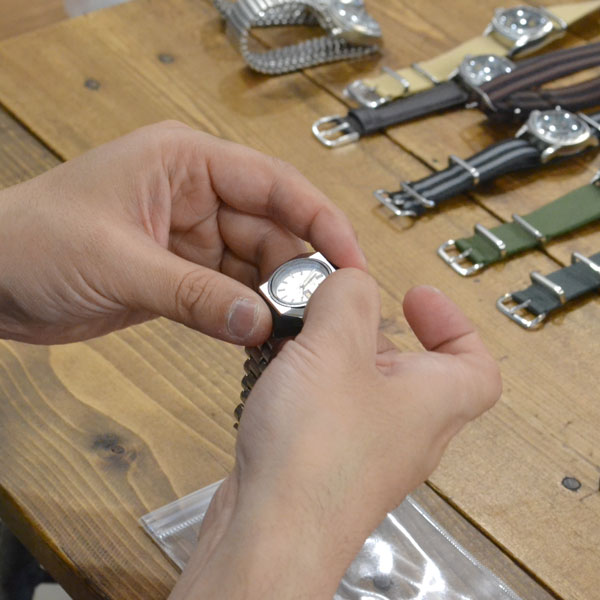
The Heart of the Watch: Peering Into a Small Universe
Here, he showed us the movement—the heart of the watch. While a watch's overall impression is shaped by the dial design, watches passed down across decades reveal differences even in the mechanism that actually drives the hands. He showed us three watches from roughly the same era, made by different manufacturers.
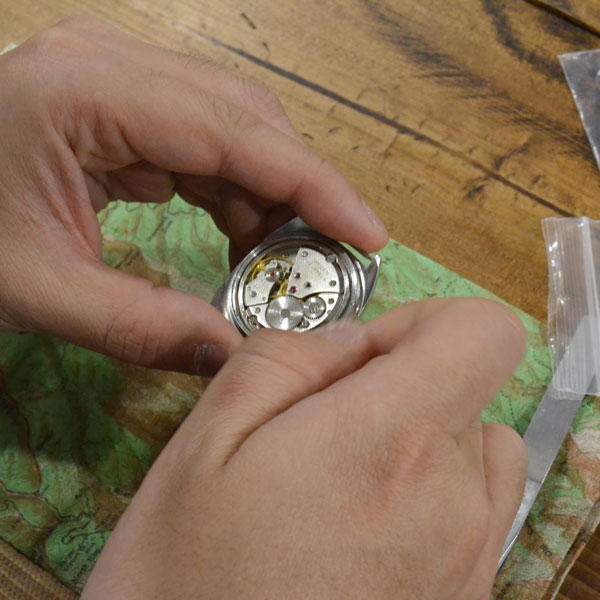
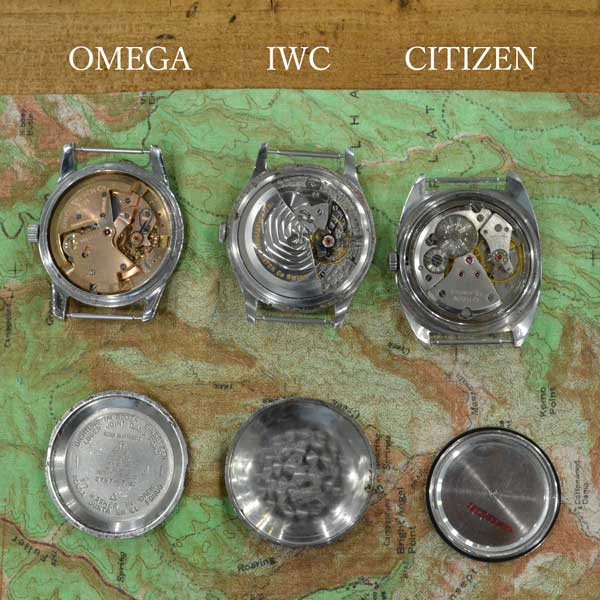
Let's open up a watch from around 1960. Here we have OMEGA, a name recognizable even to those who aren't watch fans; IWC (International Watch Company), regarded as top-tier in both name and substance; and CITIZEN, a Japanese brand that's approachable and offers a good balance of price and performance. Looking at them this way, you can really see that brands considered high-end have meticulous craftsmanship even in the parts you can't see, and each individual part has a different heft to it—differences show up everywhere.
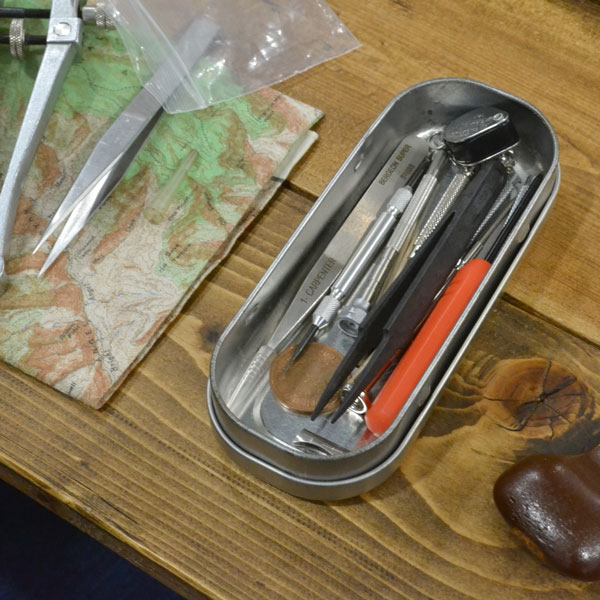
That's right—even after seeing this many watches, every encounter still feels like a once-in-a-lifetime meeting. Also, vintage watches are things that accumulate repairs and maintenance over time, so it's interesting that someone who knows what to look for can tell what kind of maintenance previous repairers have done. Take this OMEGA watch, for example. Aside from the manufacturer's engraving, can you see these faint scratch marks? These are like a signature left by the repairers who have serviced this watch over the years.
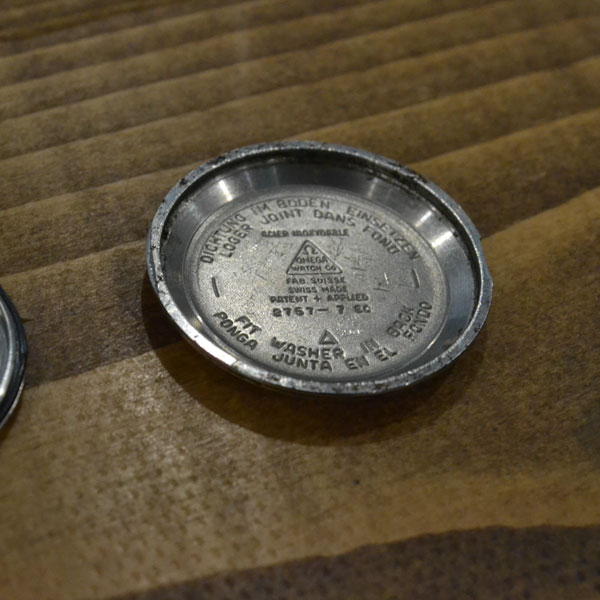
The case back of a vintage OMEGA watch. The scratch marks around the brand logo are actually a repairer's signature.
Just like signing a painting, it's a way of leaving a mark that says "I serviced this watch." Since it means adding a mark to a finished product made by the manufacturer, opinions on this practice vary, but I personally think this kind of playfulness can be counted as part of the enjoyment of vintage watches. Even without seeing each other's faces, if I can tell that the person who opened this watch before me did very careful work, it motivates me too. And conversely, if some years later another repairer sees the marks I've left and nods in approval of my work, that makes me happy as well. In this way, vintage watches literally grow along with time.
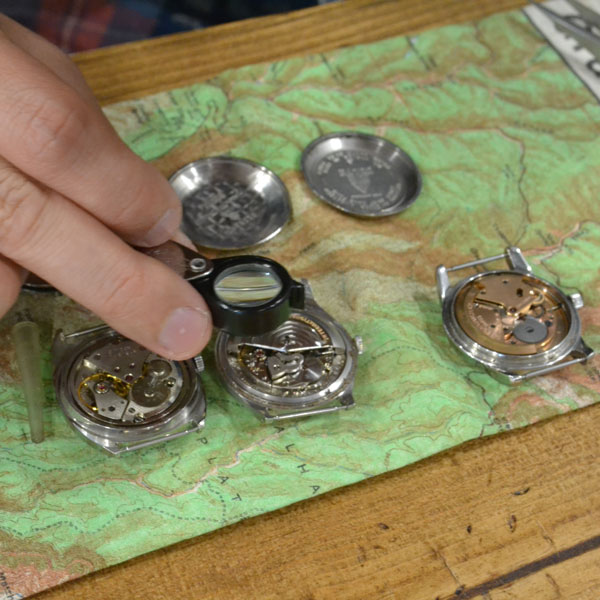
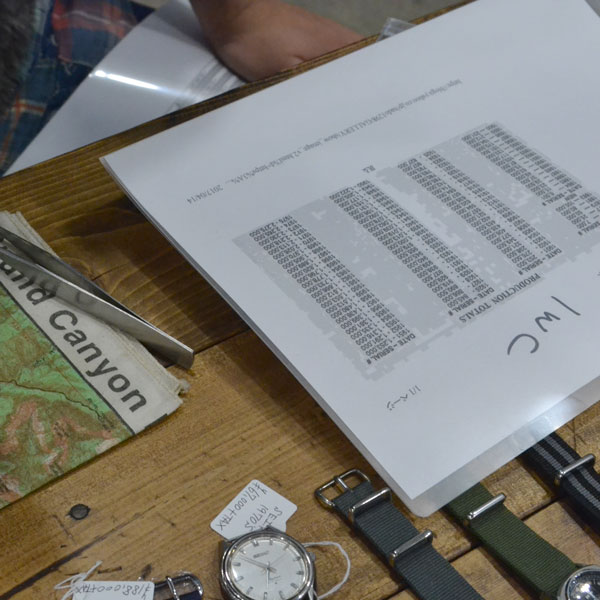
Each brand has a reference table matching serial numbers, which lets you tell what era a piece was made in.
Having Mastered Vintage, Now Picking Up a GS/TP Watch
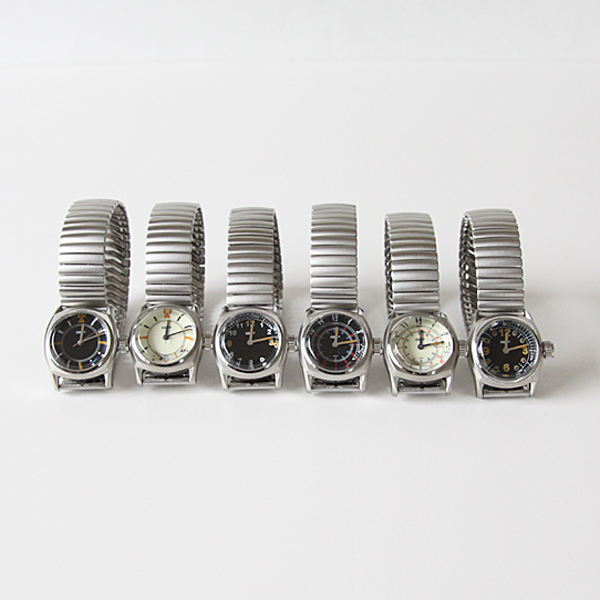

We designed it as a watch that could be worn as an extension of fashion, while also being something people could cherish and use for years, with the kind of affection people feel toward vintage watches.
When we first released it, we got some feedback saying "the dial is too small," but honestly, it's modern watches that tend to be excessively large. There's a tendency to physically enlarge watches to create a sense of presence, since that makes them look impressive more easily. That's precisely why we adopted the small-face style seen in vintage watches, and scattered in details reminiscent of early aviation instrument watches. There are so many details packed in that I could talk about them endlessly, so I'll leave the finer points to ZUTTO's catalog page (laughs)—but I hope users can feel that we aimed to create a new watch that can be cherished and grown with, in the same spirit as loving something old.
I think this would also be a great recommendation for people who are interested in vintage design but feel that handling old mechanisms is a bit of a high hurdle. We also offer both mechanical (hand-wound) and quartz models, so even those who think, "mechanical is nice, but quartz is just more convenient!" can certainly enjoy using this watch too.
「不便を楽しむ」という視点で熱く語ってきましたが、最後は直感で楽しむというのが正解だと思います。あまり難しく考えずに、シャツを買う、パンツを買う、バッグを買う。その並びに腕時計という選択肢が広がれば嬉しいですね。 Translation: I've been speaking passionately about "enjoying inconvenience," but in the end, I think the right answer is to simply enjoy things on instinct. Without overthinking it, you buy a shirt, you buy pants, you buy a bag—I'd be happy if a wristwatch could find its place among those everyday choices.
Advice for Those Who Want to Start Wearing a Mechanical Watch
—What are the key points for using a mechanical watch for a long time?
Vintage mechanical watches in particular are vulnerable to two things: "impact" and "moisture." The metal used in watch cases expands and contracts with temperature, creating gaps just a few microns wide. Even though these gaps are invisible to the eye, moisture entering through them can affect the internal parts, so care must be taken to keep the watch dry. Also, if you subject the watch body to impact, these gaps can widen, or the internal parts can become distorted.
—What about maintenance?
An overhaul—a full disassembly and cleaning—is needed roughly once every three years. Since the parts inside a watch are constantly moving and rubbing against each other, they are lubricated with oil. Removing the old, degraded oil and applying fresh oil helps prevent parts from wearing down or breaking.
—What about everyday use?
I think there are two things: don't leave it tucked away—wind the mainspring and let it run as part of your daily routine, and treat it as a watch you genuinely care about.

▶︎About GS/TP

This original watch collection was born from a collaboration between William Kroll, designer of the British menswear brand TENDER—a brand deeply trusted for its craftsmanship—who oversaw the design, and the skilled hands of Japanese artisans who bring antique watches back to life.
The name GS/TP comes from an inscription found on the backs of military pocket watches that the British Army commissioned from makers such as Burlington, Omega, and CYMA between 1939 and 1945, stamped alongside the broad arrow (the mark of the British military). GSTP stands for "General Service Time Piece," meaning a watch issued by the military. This is a bold new collection that revives, in the present day, the very world of vintage watches introduced here.
GUIDE »
CATEGORIES »
- + Gifts by recipient
- + Gifts by scene
- + Clothing
- + Bags / Backpacks
- + Wallets / Card cases
- + Jewelry
- + Shoes
- + Rainy day outfits
- + Kitchen
- + Home
- + Babies / Kids
- + Japanese products
Earn Miles


Payment & Security