.webp)


.webp)


.webp)


.webp)


Welcome to ZUTTO
Free shipping for newsletter subscribers (some areas excluded)
- トップページ/
- ZUTTO Journal/
- ブランドストーリー/
- Technique Experie...

Technique Experience Laboratory #4: Edo Kiriko, the Beauty of Glass Expressed Through Transparency and Pattern
Japan's traditional techniques carry a beauty that has delighted people's eyes throughout the ages, and even inspire a sense of admiration. There are many traditional crafts, but this time we're focusing on "Edo Kiriko" (Edo-style cut glass). Originating in the late Edo period, it has since been passed down and continually developed without interruption by the hands of craftsmen in and around the Kanto region. The image that comes to mind when hearing "Edo Kiriko" is of glass with intricate cutting that shines as it catches the light.
Wanting to learn more about Edo Kiriko, we visited the workshop of Mitsuwa Glass Crafts, the company behind the Edo Kiriko brand "Glass Studio Saiho." With the concept of creating "one-of-a-kind pieces, made by hand, that bring joy every time you see them and enrichment every time you use them," they protect the tradition of Edo Kiriko while also creating new Edo Kiriko suited to modern times.

Visiting the Workshop Where Edo Kiriko Is Born
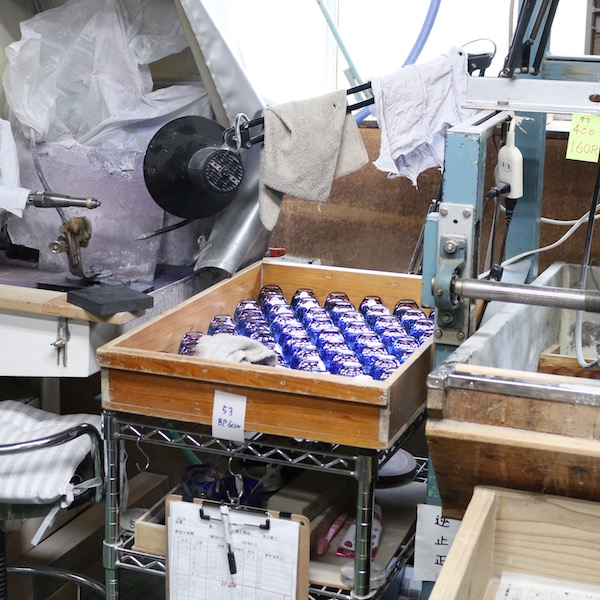
The moment you step into the workshop of Glass Studio Saiho, the sound of machinery echoes throughout—a high-pitched whirring and grinding. Peering among the wooden pallets lined up with barely any space between them, you find rows of red and blue glasses and sake cups. Inside the workshop, alongside the machines used for the work, stools are placed, and each craftsman was working in silence, deeply focused on their task.
We spoke with Mr. Ishizuka, a traditional craftsman. With 13 years in this trade, he was certified as a Traditional Craftsman—a national qualification—in 2018.
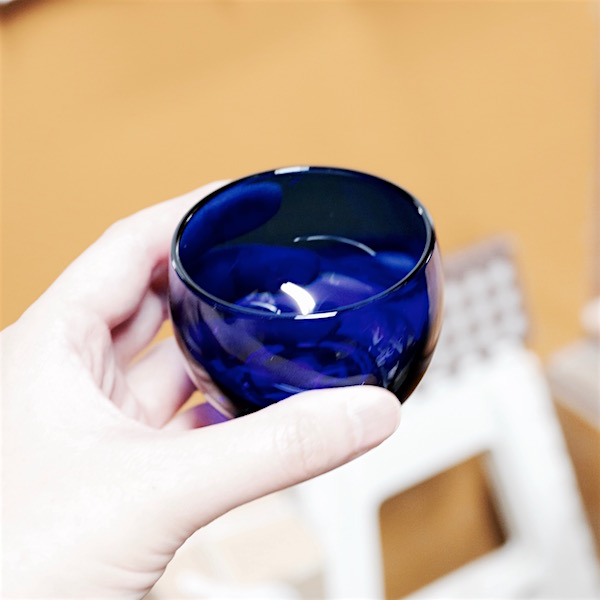
The starting point on the way to becoming Edo Kiriko is plain glass, with no engraving or pattern whatsoever. The defining feature of colored Edo Kiriko glass is its "double-layered" structure—transparent on the inside, colored on the outside. Because two different colors overlap, when kiriko cutting is applied to the colored outer layer of glass, the transparent inner layer is revealed, and that revealed portion becomes the pattern.
The process of kiriko cutting—the very identity of Edo Kiriko—can be broadly divided into four steps. To introduce them briefly:
1. Waridashi (marking out)
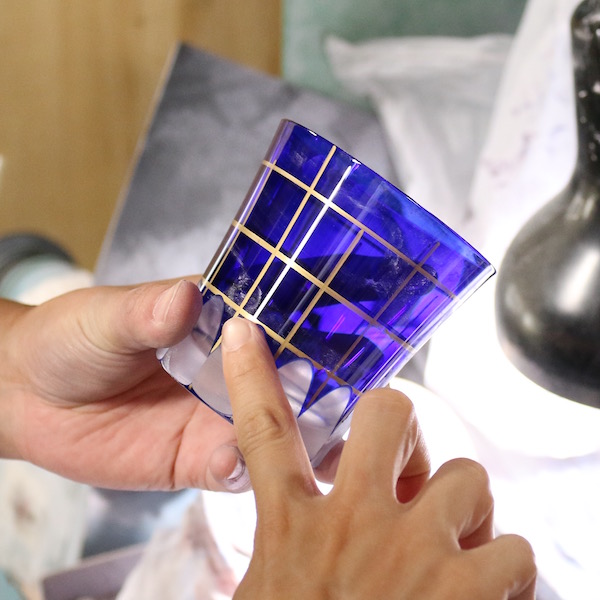
This is the process of drawing guide lines on the surface of the glass with an oil-based gold pen. Fine lines are not drawn; only rough vertical and horizontal lines are added.
2. Arazuri (rough grinding) and Nakazuri (medium grinding)
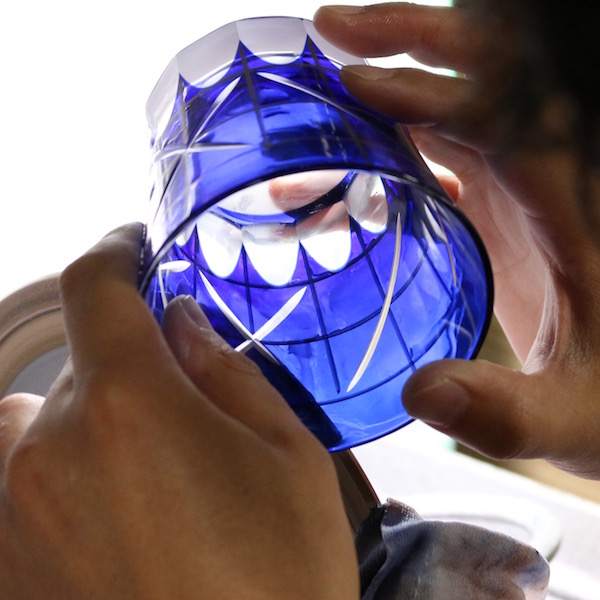
To perform the kiriko cutting, the surface of the glass is pressed against a vertically rotating wheel and moved along it. First, a wheel with a rough blade is used to carve the outline of the kiriko pattern. After the rough carving, the wheel is switched to one that brings out sharper cutting. Incidentally, the blades of these wheels are said to be made of diamond.
3. Ishikake (whetstone finishing)
Using an artificial whetstone, this process flattens and evens out the uneven surface left from the medium grinding. "This step determines the ultimate beauty of the kiriko pattern, so it requires the most concentration," he explained.
4. Migaki (polishing)
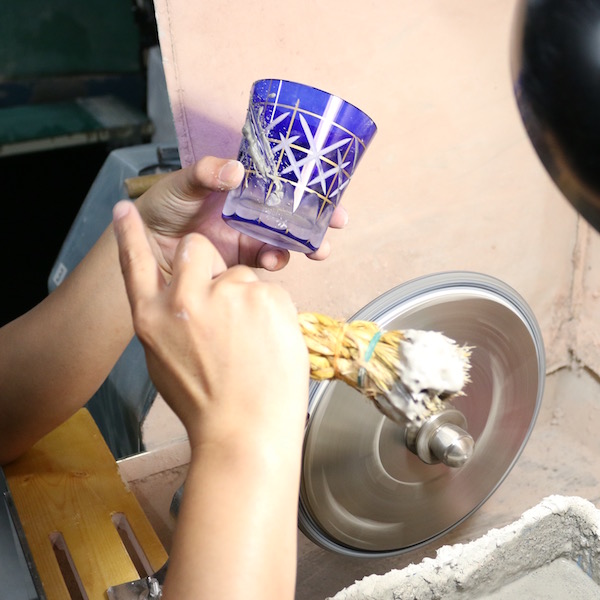
A polishing powder made from sand is mixed with water to form a clay-like paste. Heat is applied while polishing, melting the surface of the glass slightly in the process. Through this step, the gold pen lines drawn during the initial waridashi stage disappear, and as the whole piece is polished, it emits the clear, brilliant glow of light unique to Edo Kiriko.
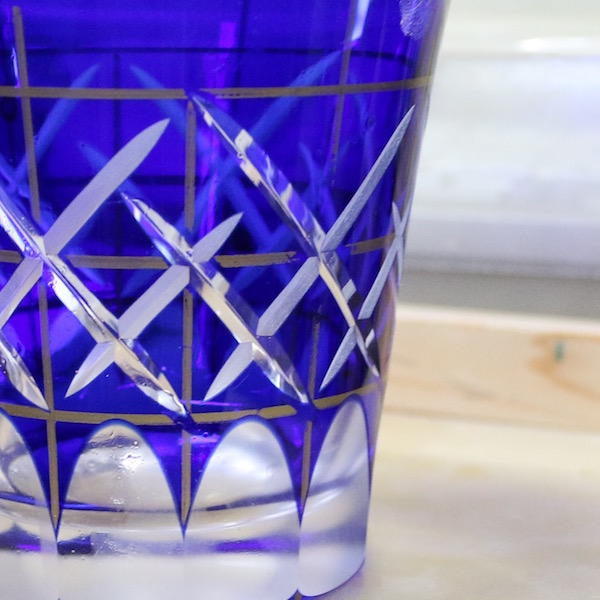
In the image above, the diagonal line running from upper right to lower left shows the piece as it looked after the nakazuri (medium grinding) stage, while the line running from upper left to lower right shows the piece after the final migaki (polishing) stage. The line that only went through nakazuri remains white like frosted glass, while the line that has been polished shows a clear transparency and shine.
We were told that the manufacturing process for Edo Kiriko is similar across other workshops, so we asked what makes Glass Studio Saiho distinctive.
"We use Edo glass as the base glass. Even though it's called Edo Kiriko, some workshops these days apply the cutting to imported glass as a base. But at Glass Studio Saiho, we use blown 'Edo glass' made in Edogawa Ward for all of our products. The reason is clear: the texture of its color has a Japanese quality—a gentle tone that suits Edo Kiriko perfectly. Imported glass is not a problem in terms of quality, but perhaps due to differing senses of color, we feel that the vivid, distinct colors typical of overseas glass don't suit Edo Kiriko," he explained.
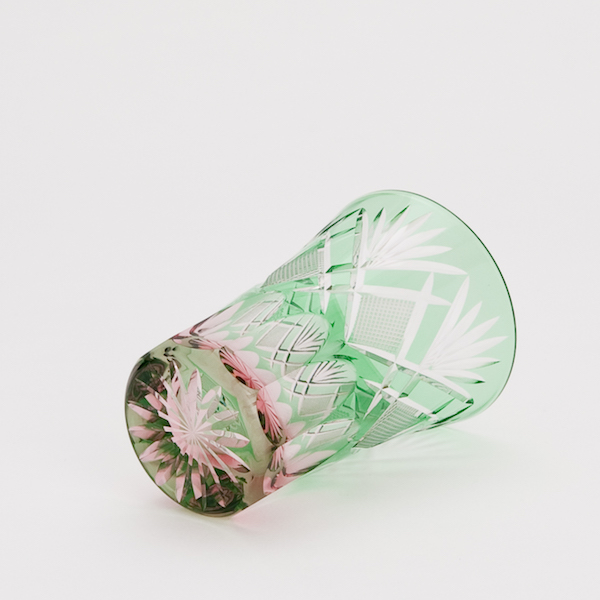
He continued, "As a new proposal for Edo Kiriko, Glass Studio Saiho is expanding the variety of glass color combinations. Edo Kiriko brings out its patterns by using different colors for the outer and inner glass layers, and traditionally, these combinations have mostly been 'red + clear' or 'blue + clear.' In addition to these, we're also experimenting with more contemporary color combinations, such as 'blue + pink' and 'green + pink.'"
Could This Change Your Idea of Glass? An Edo Kiriko Experience
This time, the ZUTTO staff also had the chance to try their hand at Edo Kiriko. Overwhelmed by the craftsman's flawless, unhesitating handwork, we tried our hand at the "grape" pattern. As Edo Kiriko developed after the Edo period, its patterns were centered mainly around flowers and fruits. This grape pattern is also said to be the first one newcomers to the workshop learn, packed with fundamental techniques—so we tried it out, feeling like beginner craftsmen ourselves.
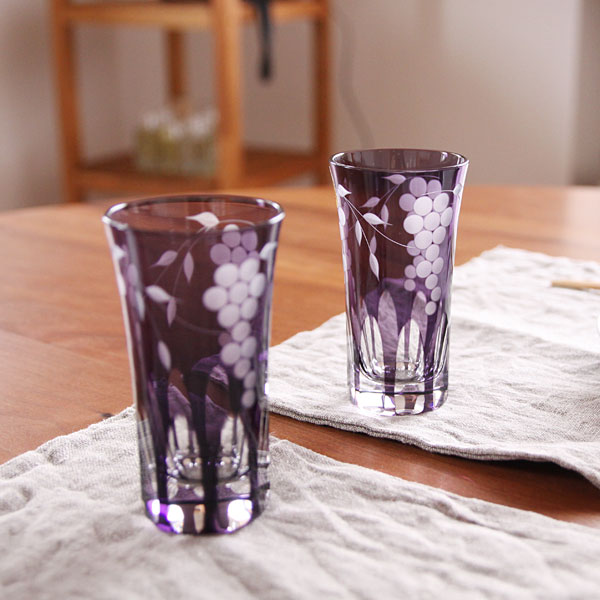
The "Grape Pattern Small Beer Glass Pair," featuring the same grape motif
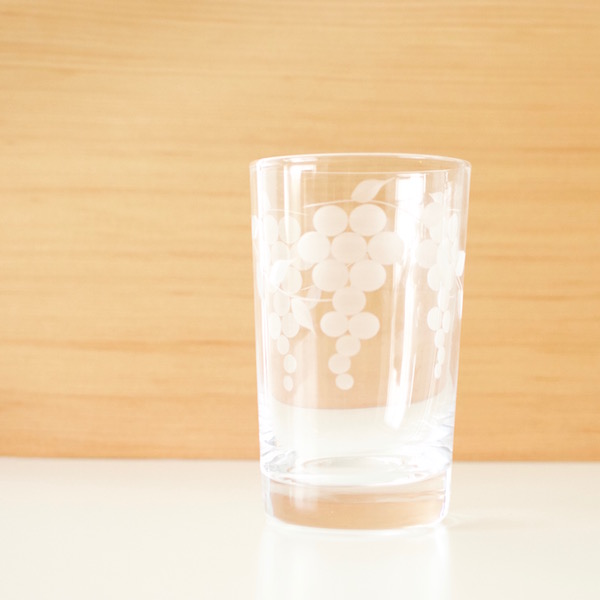
This is a sample piece made by Mr. Ishizuka, the traditional craftsman. It's beautiful. This is what we're aiming for.
The process consists of the following:
1. Carving circles connected together to form the grape pattern
2. Drawing curved lines for the branches, connecting the clusters of grapes together
3. Growing leaves out from the branches
These three steps. Each step requires a different set of skills.
First,
1. Carve grapes by connecting circles
"Carving the circles is actually the easiest part," says Ishizuka-san. "You just press the curved surface of the glass against the round wheel, and a round pattern appears on its own. To make it into a grape, all you have to do is connect them."
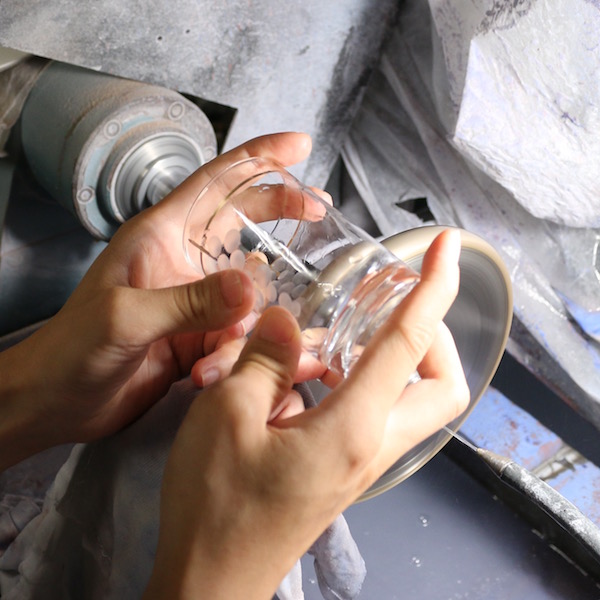
At first, I was hesitant. Not knowing how much pressure to apply, I felt like the force of the wheel would push the glass away from me. Even when I aimed the blade at the spot where I thought the cut would appear, the pattern ended up in a completely different place, which threw me off.
I also wanted to connect the circles together to form the grape pattern, but sometimes they ended up too far apart to join, and other times they overlapped so much that the circles got crushed...
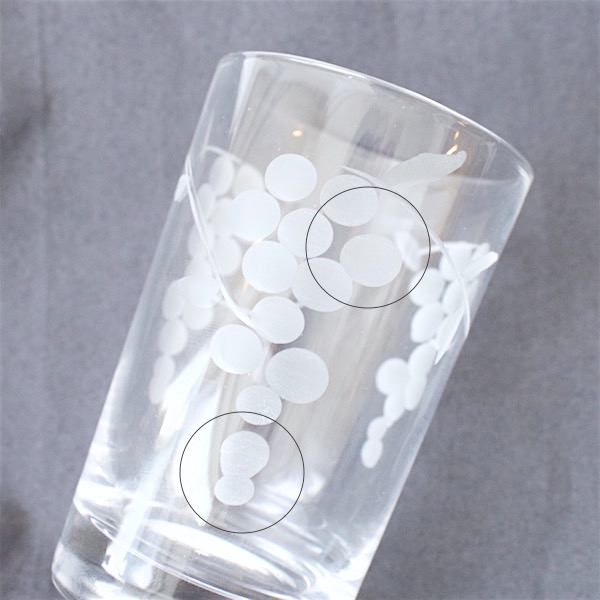
The circles ended up too far apart, or overlapped so much that they got crushed...
2. Draw curved branches to connect the bunches of grapes
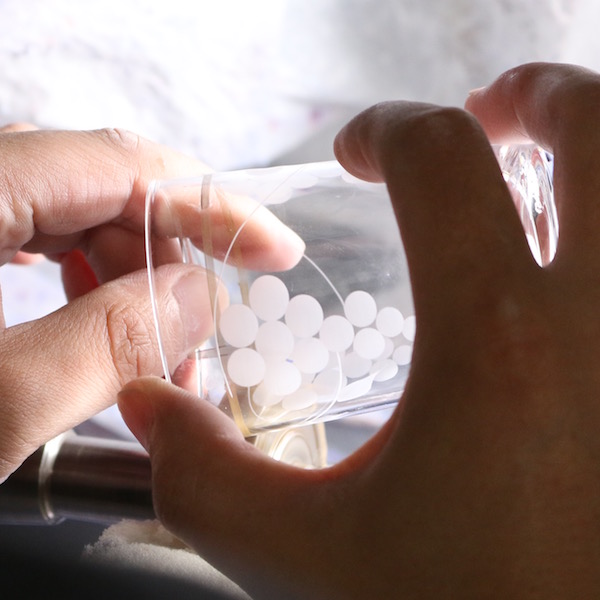
*This is Ishizuka-san's model example
With three bunches of grapes now complete, the next step was to carve branches between the bunches. Unlike the previous step, which was simply a matter of pressing the glass against the wheel, this process actually required moving my hands.
The key is to roll the glass along the curve of its surface. The idea is to keep the start and end points in mind and connect them with a curved line. Understanding this in theory was one thing, but pressing firmly while rolling the glass at the same time turned out to be extremely difficult, and the glass wouldn't move the way I wanted. My first branch came out almost perfectly straight, just heading downward. It wasn't until the third branch that I finally managed a (somewhat crooked) curve.
3. Grow leaves from the branches
Finally, I carved the grape leaves. The pattern is made to look as if it's growing out of the branch: starting from the thin line of the branch, you press the wheel in the same way as making a circle, and once it reaches the size of a leaf, you quickly roll it to the other side to taper the tip of the leaf.
As you can see in the image below, Ishizuka-san's leaves have a vein line running down the middle, but when I actually tried it myself, I ended up producing one lopsided leaf after another that looked more like a circle with a tail attached.
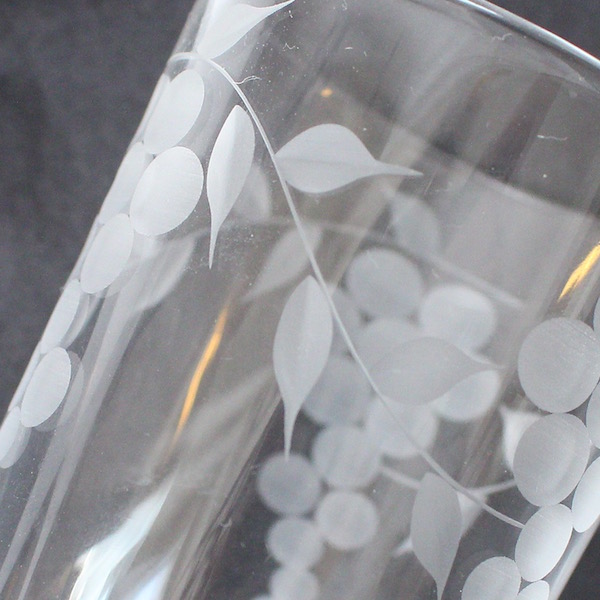
Here is the finished Edo kiriko glass with a grape pattern, made through the steps above.
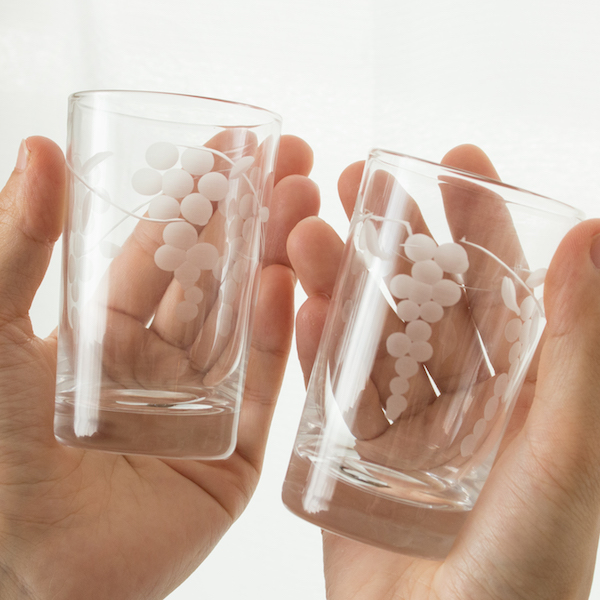
Both of these "grape" designs were made by ZUTTO staff.
Whether it's circles or lines, achieving uniformity is genuinely difficult, and I came away with a renewed sense of respect for how the distinctive patterns of Edo kiriko—created where lines intersect—are the product of a precision far beyond what I had imagined, achieved entirely through skilled handwork.
What struck me most from trying it myself was that I didn't feel much fear about "cutting" the glass—rather, the surprising thing was that if you don't apply enough force, the pattern doesn't come out cleanly. If you press the glass against the wheel timidly and with too little force, you get a sense of being pushed back, so applying firm pressure is actually key. It was an experience that revealed a new side to glassware, which I had always thought of as "fragile and weak."
Also, since the glass I worked with this time was clear, I was able to check the exact spot being cut from above as I worked. But if the glass were colored, you'd need to look in from the inside instead, and if it were a completely opaque black glass, applying the pattern would be entirely dependent on the craftsman's intuition and experience. There, I discovered manufacturing processes and methods that would be completely unimaginable to someone simply using a kiriko glass as an everyday item.
Edo kiriko, meant not just for special occasions but for everyday use
Edo kiriko, with its delicate patterns and refined impression, isn't meant to be a work of art—it's meant to be used in daily life. It's only through everyday use, not just on special occasions when guests visit, that you can truly enjoy its crystal-clear beauty. What I learned from experiencing part of the production process myself is that there's no problem at all in handling it just like an ordinary glass or tumbler. The glass isn't extremely thin or fragile, so please feel free to use it as an everyday glass without hesitation.
Also, most Edo kiriko patterns are auspicious motifs that express celebratory feelings and gratitude. Since noshi (decorative gift wrapping) can be added, they make wonderful gifts for occasions like weddings or moving into a new home, so I highly recommend them as presents too.
Edo Kiriko Grape Pattern Mini Old Fashioned Glass

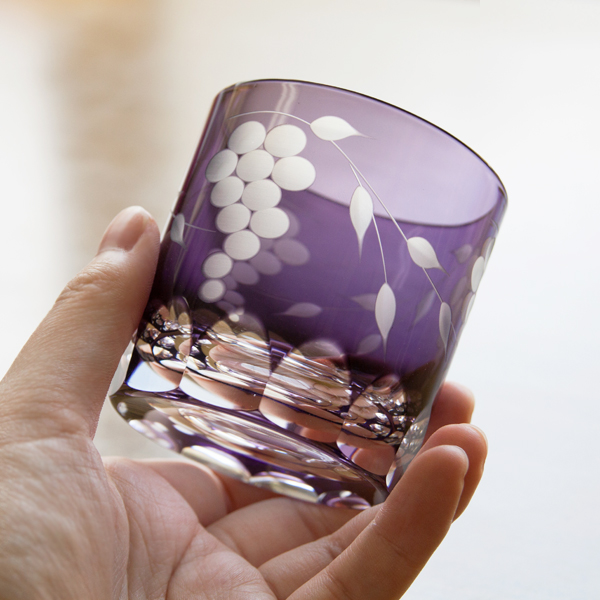
This is the "Edo Kiriko Grape Pattern Mini Old Fashioned Glass," featuring the grape design I got to try carving myself. Viewed from different angles, light reflects off the sculpted pattern as if you're looking into a kaleidoscope. As the name suggests, it's small in size, so it works well as a sake vessel too.
Edo Kiriko Nandina Pattern Mini Old Fashioned Glass

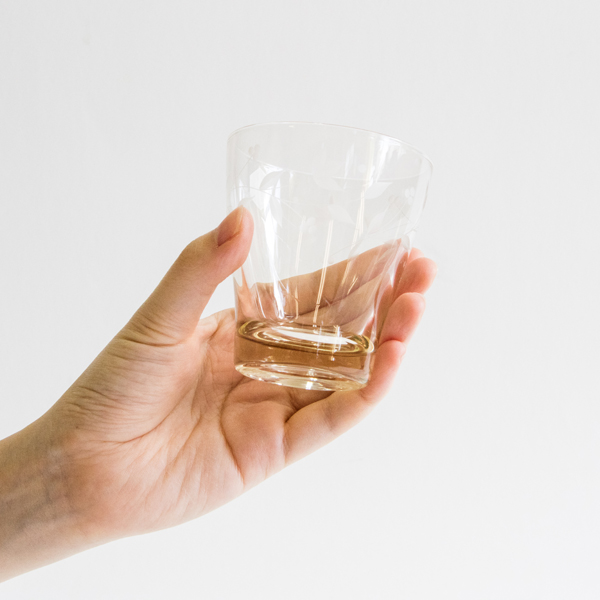
The "Edo Kiriko Nandina Pattern Mini Old Fashioned Glass" wraps nandina berries and leaves around an amber-colored glass. Kiriko glasses often come in bold, vivid colors like blue or red, so this calm amber shade offers a fresh new impression. The color fades in a gradient from the base of the glass toward the rim, and the translucent coloring only enhances its beauty further—an Edo kiriko piece you'll never tire of looking at. It adds a subtle elegance to the table without ever overpowering it.
Edo Kiriko Layered Yarai Pattern Sake Cups, Pair Set
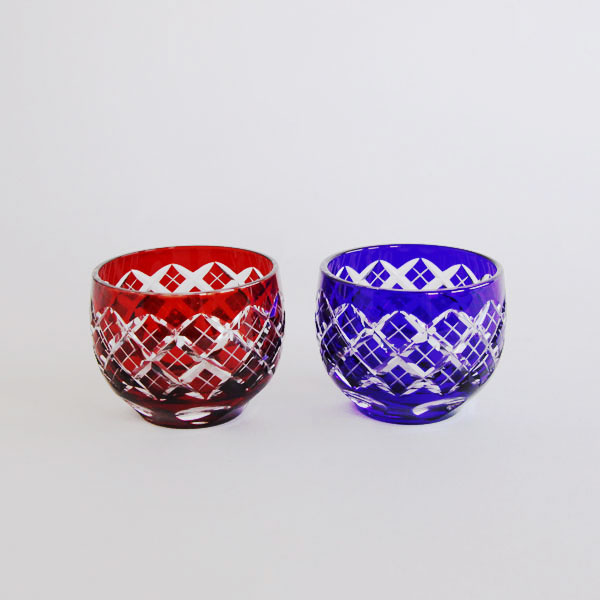
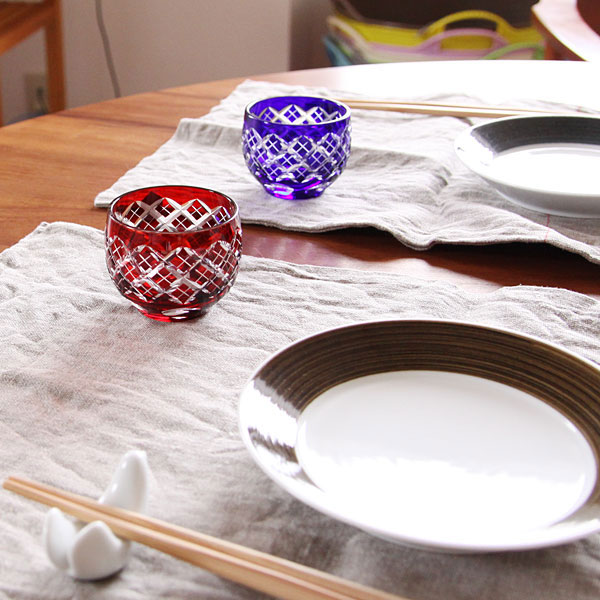
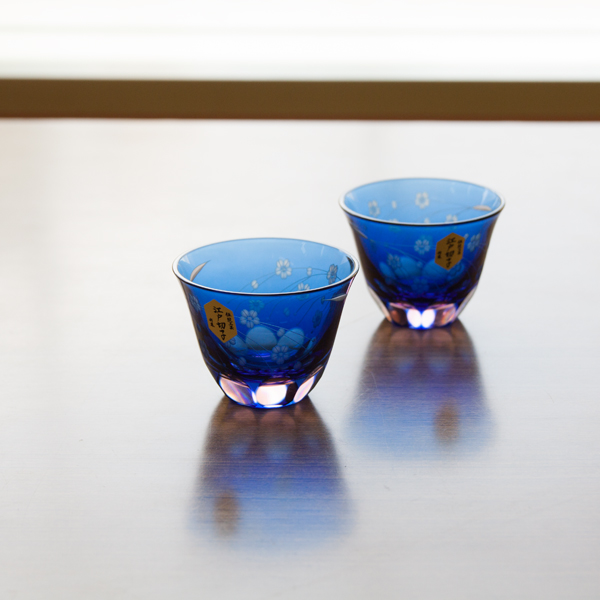
These are Edo kiriko sake cups in the classic colors of blue and red. Their gently rounded, plump form is charming, and the size fits neatly in the hand. Since they come as a two-color pair set, they make a perfect gift for a wedding celebration. Their look alone seems to make sake taste even better.
▼ See the full lineup of Edo kiriko from Glass Studio Saihou here
▼ See past issues of the Skill Experience Laboratory here
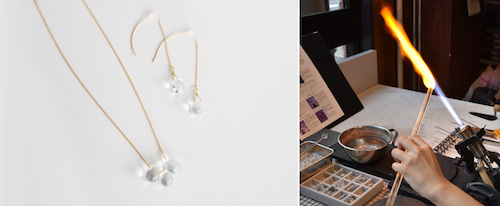
The beauty of cold glass, shaped by flame: A lampworking experience at HARIO LWF
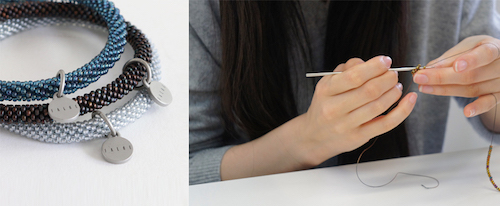
FALBE: Beaded crochet that shines when it catches the light
GUIDE »
CATEGORIES »
- + Gifts by recipient
- + Gifts by scene
- + Clothing
- + Bags / Backpacks
- + Wallets / Card cases
- + Jewelry
- + Shoes
- + Rainy day outfits
- + Kitchen
- + Home
- + Babies / Kids
- + Japanese products
Earn Miles


Payment & Security