.webp)


.webp)


.webp)


.webp)


Welcome to ZUTTO
Free shipping for newsletter subscribers (some areas excluded)
- トップページ/
- ZUTTO Journal/
- ブランドストーリー/
- Customize freely ...

Customise Freely with Patches and Brooches. Embroidery So Fine You'll Fall for It, on Knits and Bags Alike
Today we're looking at the patches and brooches of Macon & Lesquoy. Look closely at the work, made with the cannetille technique - the word means goldsmith's work - and the delicacy of the craft and the eye behind it will win you over completely.
The brooches are hand-embroidered by artisans and the patches are machine-embroidered, a balance of methods and cost that puts them within reach of all sorts of people. But one thought runs through every piece: that the things you love should stay the things you love, for a long time.

Character for the plain, affection for the damaged
Macon & Lesquoy, a French brand, was born in 2009. Two women who met at design school founded it, wanting to make something special - practical, and yet the kind of thing you'd treasure.
They had no interest in making things purely to dress oneself up. In a society already overflowing with objects, one that arguably needs nothing new at all, they thought hard about what it means to make a new product - and what they chose, as things that would be genuinely useful and genuinely worth having, were brooches and patches.
Behind that choice was this idea.
A stain on the trench coat you inherited from your mother.
A moth hole in the cashmere knit you saved up for.
Stains, holes and damage on the clothes we love or want to pass down: everyone has that problem. If you could rescue the feeling of having given up on wearing something, that really would be worth having.
A brooch or a patch hides the stain or the hole, yes - but it does more than that. It makes the garment underneath look better than before. There's a story hidden in these small pieces of jewellery.
And even where there is no stain or hole, a Macon & Lesquoy brooch or patch gives a simple garment a focal point and an elegant finish. Many of the motifs are poetic, full of humour, and cheering just to look at.

△ The Macon & Lesquoy shop in Paris
The artisan embroidery of Macon & Lesquoy
The brooches and the patches are embroidered by quite different methods, so let's start by unpicking the difference between the two.
[Brooches]
It is in the brooches that the artisans' skill shines brightest.
Look closely at one and you may notice that the motif is drawn not in embroidery thread but in a fine, coiled metal wire.


Soft copper wire is finished in gold, silver, red, blue and other colours, then hand-embroidered onto felt using the traditional French technique known as cannetille.
Cannetille is a technique in which metal wire is bent freely, cut to the length required, and embroidered into a motif. It is said to have been developed in France after the Industrial Revolution, when the price of gold rose and jewellers needed to make pieces using less of it. Hence the original meaning of the word: goldsmith's work. Because the result looks as though it were stitched one needle at a time, it is also called metal embroidery.

Macon & Lesquoy's hand-embroidered brooches are worked stitch by stitch by artisans at the brand's own atelier in Pakistan. The skill of these artisans is remarkably high, and the knowledge and technique handed down through the generations there is said to reach back as far in history as it does in France.
The grandfather of Adnan, who runs the atelier, was an embroiderer of military uniforms in the days when Pakistan was a British colony. His work was well regarded, and the craft passed from grandfather to father to son, refined at each step.
Cannetille is a technique for producing a sumptuous piece of jewellery from very little metal, and one of its virtues is lightness. Embroidered onto felt, the finished brooch is lighter still.
Light means gentle on the cloth it is sewn to - which fits exactly with what Macon & Lesquoy set out to do: repair a garment, or give a simple one a focal point.

[Patches]

The patches, by contrast, are embroidered by machine, in rayon and nylon threads rather than gold or silver. Gold and silver thread cannot be used on a patch that is bonded with the heat of an iron, so the choice of material is more or less inevitable - but machine embroidery does not mean the brand's skill has no part to play.
Every Macon & Lesquoy patch is made in a factory in Portugal, where the apparel industry is well developed and small ateliers specialising in the embroidery and decoration that finish a garment exist in great number.
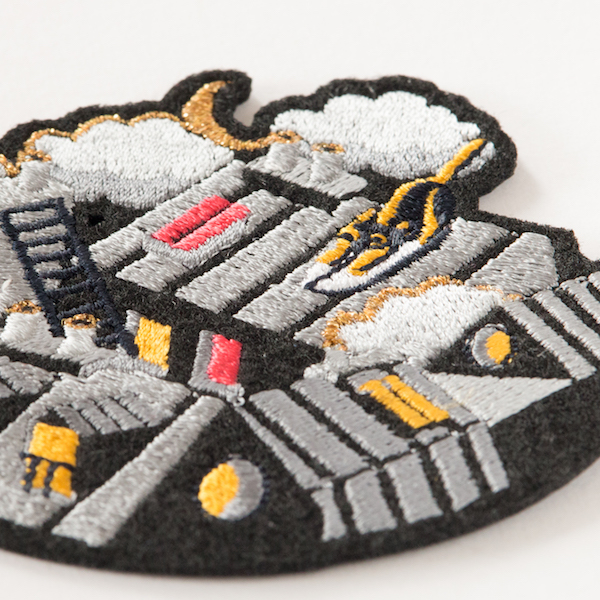
Even in machine embroidery, human skill and judgement matter enormously. Reproducing Macon & Lesquoy's small, intricate, richly coloured patches faithfully from the original drawings takes a seasoned embroidery programmer, and the work of placing the needle exactly, however small the model, is carried out to perfection.
The Portuguese embroidery machines can lay far more stitches into the same area than an ordinary machine, which is how the pieces capture the character each design calls for - the coat of an animal, a smooth surface, and so on.

Trying a little customising with a patch
Having heard about the brand's lovely concept and how the pieces are made, one of our staff said, "I'd really like to try customising something with a patch." So she put a Macon & Lesquoy patch on a favourite top.
These are the two she chose.

The marmot from Patch CLASSIC, and cat on the roof from Patch HIVER18. Animals both times.
First, a good long look at the embroidery.
"The motifs and the colours are so endearing. The marmot has headphones on, listening to music, and the cat is stretching on a rooftop - the details are lovely. It's exciting just wondering what to put them on."
After much deliberation, she decided to put one on a favourite Le minor striped top.
Step 1: check the fabric
This top is 100% cotton, so it can be attached with an iron.
For delicate materials - wool, cashmere, silk, nylon, leather - sew the patch on by hand instead of ironing.
Step 2: decide where to put it

· Le minor Basque Shirt 115 MARINE/BLANC
"The usual places for a patch are the chest or near the shoulder, but I've decided on the hem so it doesn't shout. There's something nice about only the people who notice noticing."
Step 3: attach it with an iron

△ Do use a pressing cloth when you actually do this.
Set the iron to high, place a pressing cloth over the patch and press for 20 seconds. Turn the garment inside out and press from the reverse for another 20 seconds. Check that the edges of the patch are properly bonded. If it lifts, check that the iron is hot enough and press again.

"That was easy. I love that the striped top I've worn for years now looks completely different. And because I put it on myself, I think I'll grow even fonder of it. I'll think a bit longer about the cat one - maybe a bag, or a pair of canvas trainers."
- - - - - - -
Which raises a question: can you wash a garment with a patch on it?
According to the maker, patches can go in the washing machine, but always turn the garment inside out so the patch faces inward. That keeps the patch from being abraded in the wash.
And of course, only put patches on garments that are machine washable in the first place.
- - - - - - -

Macon & Lesquoy's patches and brooches. The methods differ, but both embody the brand's concept properly, and both are enormously appealing - you're drawn into a design world that reads almost like a story. Combining two or three to build a story of your own is a lovely idea, and they make a fine gift for a friend as well.
▼ The Macon & Lesquoy brand page is here

GUIDE »
CATEGORIES »
- + Gifts by recipient
- + Gifts by scene
- + Clothing
- + Bags / Backpacks
- + Wallets / Card cases
- + Jewelry
- + Shoes
- + Rainy day outfits
- + Kitchen
- + Home
- + Babies / Kids
- + Japanese products
Earn Miles


Payment & Security