.webp)


.webp)


.webp)


.webp)


Welcome to ZUTTO
Free shipping for newsletter subscribers (some areas excluded)
- トップページ/
- ZUTTO Journal/
- 選び方・使い方/
- Choosing My Bento...

Choosing My Bento Box: Comparing Popular Bento Boxes
From children to adults, lunchtime is a welcome break in the middle of work or study. Even when you're adjusting to an unfamiliar new environment, or during a change of season when it's easy to feel under the weather, having your usual bento box with you can bring a sense of calm and reassurance.
The bento box that accompanies you through this lunchtime comes in so many types and sizes that finding the one that's truly right for you can be surprisingly difficult. The ideal bento box also depends on how you plan to use it: someone who uses one every day wants something that's as stress-free as possible to clean, while someone who only brings one occasionally—say, on a day out—might enjoy one that makes preparing and arranging food more fun.
This time, we selected eight popular bento boxes from ZUTTO and actually packed them with rice and side dishes. We hope this will help as a reference when choosing size and material, and that it leads you to a wonderful bento box you'll enjoy using for a long time to come.
|Table of Contents|
・Wood, stainless steel, plastic. What are the characteristics of each material?
・A reference for choosing the right size. We actually packed rice and side dishes into each one.
Characteristics by Material
[Wood and Bamboo]

Wood and bamboo bento boxes are prized for their smooth texture and beautiful grain. It's precisely because they're made of natural materials that food looks so appealing once arranged inside. Many are finished with urushi (Japanese lacquer) or urethane coating, which makes them surprisingly easy to care for.
Advantages
・Lightweight.
・Has moisture-regulating properties, absorbing just the right amount of moisture from food and rice so things don't turn soggy by the time you eat.
Disadvantages
・Due to the nature of its construction, the seal between the lid and the body isn't very tight, so liquids can leak out easily.
Recommended for
・Those who can't reheat their bento in a microwave
・Those who enjoy arranging their bento attractively
[Stainless Steel and Aluminum]

Stainless steel and aluminum bento boxes have a somewhat nostalgic feel. Their timeless design never goes out of style, making them easy for anyone to use.
Advantages
・Resistant to absorbing odors, and oil wipes off easily.
・Many come with rubber gaskets or clasps, making them less likely to leak while being carried.
・Dishwasher-safe, making everyday cleaning simple.
Disadvantages
・Stainless steel versions tend to be somewhat heavy.
・Since stainless steel can cause aluminum to corrode, aluminum cups or aluminum foil can't be used inside.
Recommended for
・Those who commute by train or bicycle
・Those who use a dishwasher
[Plastic]
Lightweight, durable, and available in a wide range of colors and patterns—these are the hallmarks of plastic bento boxes. Since they're resistant to cracking or denting, they're easy even for small children to handle.
Advantages
・Many can be placed directly in the microwave to reheat.
・Affordable, with a wide variety of colors and patterns available.
Disadvantages
・Prone to absorbing odors and stains, so not well suited to long-term use
Recommended for
・Bento boxes for small children
・Those who always reheat their bento in a microwave
We Actually Packed Them
This time, we picked out seven bento boxes differing in material and size, and actually packed each one with side dishes and rice. Filling them revealed even more good points about each box.

Size: Width 18 × Depth 11 × Height 5 (cm)
Capacity: 500ml
Material: Akita cedar + urethane coating
Weight: approx. 83g

Size: Width 19 × Depth 12 × Height 6 (cm)
Capacity: 650ml
Material: Akita cedar + urethane coating
Weight: approx. 110g

Size: Width approx. 20 × Depth 7 × Height 9 (cm)
Capacity: 900ml (upper tier 450ml + lower tier 450ml)
Material: kiri (paulownia wood) + fuki-urushi (wiped lacquer)
Weight: approx. 125g

Size: Width approx. 10.5 × Depth 15 × Height 5.5 (cm)
Capacity: 450ml
Material: laminated bamboo + polyurethane resin coating
Weight: approx. 181g

Size: Width 13 × Depth 11.5 × Height 4.7 (cm)
Capacity: 360ml
Material: 18-8 stainless steel
Weight: approx. 208g
*Dishwasher-safe

Size: Width 16 × Depth 13.4 × Height 5 (cm)
Capacity: 670ml
Material: 18-8 stainless steel
Weight: approx. 292g
*Dishwasher-safe

Size: Width approx. 20 × Depth 15 × Height 6.5 (cm)
Capacity: 1l
Material: stainless steel
Weight: approx. 340g
*Dishwasher-safe
Size: Width approx. 18.7 × Depth 9 × Height 5.1 (cm)
Capacity: 450ml
Material: natural wood (hiba side panels / shina plywood base), hand-applied urushi
Weight: approx. 127g
First, to get a sense of my usual portion size, I actually put in one bowl's worth of rice (150g).

A "capacity" figure alone doesn't really give you a feel for the size, but when you put in the same amount of rice, you can roughly picture it against the amount you normally eat. Below, I've arranged them in order of size.
↑Holds plenty
07 (Black+Blum / Stainless Steel Lunch Box)
Even with a full bowl of rice inside, it fills less than half of the lunch box. That's how spacious it is.
06 (Kobo Aizawa / Square Lunch Box (Medium))
02 (Odate Kogeisha / Koban Bento (Medium))
03 (Yamaichi / Kiri Two-Tier Bento Box)
01 (Odate Kogeisha / Koban Bento (Small))
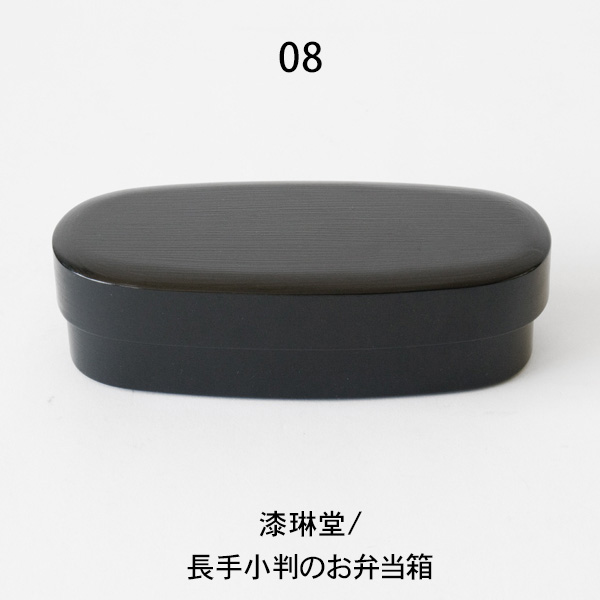
08 (Shitsurindo / Nagate Koban Bento Box)
04 (Kohchosai Kosuga / One-Tier Bento Box)
05 (Kobo Aizawa/ Square Lunch Box (Small))
One bowl of rice fills about two-thirds or more of the lunch box.
↓Less roomy
Next, I actually packed in some side dishes.
This time I packed in the following standard side dishes.

Here's how each one looked once packed.

・07 (Black+Blum / Stainless Steel Lunch Box) and 06 (Kobo Aizawa / Square Lunch Box (Medium)) had such generous capacity that all the side dishes I'd prepared fit inside with room to spare.
・For those who eat a smaller lunch, or for children's lunch boxes, 05 (Kobo Aizawa / Square Lunch Box (Small)), 04 (Kohchosai Kosuga / One-Tier Bento Box), and 08 (Shitsurindo / Nagate Koban Bento Box) are recommended.
Packing the food made one thing clear: "depth" turns out to be a key factor.

With deeper boxes, you can pop in chunky items like karaage (fried chicken) without a second thought, but if there isn't enough height, the box can end up looking half-empty, so you need to layer things a bit. That said, layering also gives the lunch a sense of depth and makes it look more attractive.
With shallower boxes, on the other hand, thick items like this time's karaage require a bit more work—choosing the right size or cutting them down—but since you can simply line things up side by side instead of stacking, the packing process itself went smoothly.
Below, I've arranged them in order of depth.
↑Deeper
07 (Black+Blum / Stainless Steel Lunch Box): approx. 5cm
02 (Odate Kogeisha / Koban Bento (Medium)): approx. 4.8cm
06 (Kobo Aizawa/ Square Lunch Box (Medium)): approx. 4.5cm
01 (Odate Kogeisha / Koban Bento (Small)): approx. 4cm
03 (Yamaichi / Kiri Two-Tier Bento Box): approx. 4cm
05 (Kobo Aizawa/ Square Lunch Box (Small)): approx. 4cm
04 (Kohchosai Kosuga / One-Tier Bento Box): approx. 3.5cm
08 (Shitsurindo / Nagate Koban Bento Box): approx. 3.5cm
↓Shallower
Recommended points for each lunch box that became apparent through use
Actually using each of these lunch boxes revealed even more points worth recommending.
01 (Odate Kogeisha / Koban Bento (Small))
02 (Odate Kogeisha / Koban Bento (Medium))
The oval shape turned out to be far better suited to attractive plating than I'd imagined. Just packing things in order still looks nice, and a small change in arrangement—like placing the rice at an angle—gives it a completely different feel. Recommended for those who enjoy the art of plating.

Top: brand new, Bottom: staff member's, used for 3 years
Another characteristic of this lunch box is how its color changes over time. The more you use it, the deeper and more mellow its color becomes.
03 (Yamaichi / Kiri Two-Tier Bento Box)
With a generous 900ml capacity across the two tiers, this is nonetheless an extremely lightweight lunch box. I wondered whether just rice in one tier might look a bit sparse, but once I actually put in a bowl's worth, there turned out to be plenty of height left over—so you could enjoy arranging things like grilled fish on top, or even make a yakiniku rice bowl. There's room to get creative with the rice.

Another feature of this lunch box is that it works not only as a two-tier but also as a single tier. When you only want a small amount, using just one tier is a nice option. That said, when using it as a single tier, the included band becomes a bit loose, so it's safer to secure it with something else.
04 (Kohchosai Kosuga / One-Tier Bento Box)
With its smooth texture, this was the box I found rice stuck to the least among all those compared, making it easy to drop food into and out of. It also comes with a proper divider, which is great for anyone who doesn't want their rice and side dishes to mix.

There's a line marking exactly where the lid overlaps, so you can pack food in without worrying about it getting crushed.
05 (Kobo Aizawa/ Square Lunch Box (Small))
06 (Kobo Aizawa/ Square Lunch Box (Medium))
The material resists absorbing odors, and thanks to the packing (gasket) built into the design, I felt reassured that I could pack just about anything inside without worry.

The packing was also easy to remove when washing, which made cleanup simple. And since the clasps won't close properly if the packing isn't in place, there's no risk of forgetting to attach it and ending up with a leak—which is a reassuring point as well.
07 (Black+Blum / Stainless Steel Lunch Box)
Achieving a vacuum seal is this bento box's greatest feature, unlike any other bento box, and thanks to it you can casually pack saucier dishes like pasta without worry.

Being able to simply pack the previous night's leftover dinner for the next day's lunch without having to think too much is a wonderful feature for busy mornings. Made of sturdy stainless steel with a vacuum structure, it does have some weight to it, but it's a reassuring bento box for those who want to carry it around without worrying about tilting.

Another notable point is that the boundary between the bottom and sides has a gentle curved (R-shaped) form, making it easy to wash even into the corners.
08 (Shitsurindo / Nagate Koban Bento Box)
It's just the right size for two triangular onigiri, and being an urushi (Japanese lacquer) bento box, even when there are no side dishes and it's simply garnished with cherry tomatoes and broccoli, it somehow still feels like a proper bento and looks a little more presentable.

▽There are still more ZUTTO bento boxes to explore

GUIDE »
CATEGORIES »
- + Gifts by recipient
- + Gifts by scene
- + Clothing
- + Bags / Backpacks
- + Wallets / Card cases
- + Jewelry
- + Shoes
- + Rainy day outfits
- + Kitchen
- + Home
- + Babies / Kids
- + Japanese products
Earn Miles


Payment & Security