.webp)


.webp)


.webp)


.webp)


Welcome to ZUTTO
Free shipping for newsletter subscribers (some areas excluded)
- トップページ/
- ZUTTO Journal/
- 選び方・使い方/
- Welcome ROSENDAHL...

Welcome ROSENDAHL's WALL CLOCK, available in different sizes, into your new home
What kind of wall clock do you use?
When I ask people this question, I'm often surprised to find that many are still using a wall clock they bought "just because" or "for the time being." Since a clock takes up so little visual space, it doesn't dramatically change the atmosphere of a room—but it's actually something we glance at far more often than we realize: before heading out in the morning, while working from home, while cooking, or just before bed. If you actually try switching to a new wall clock, you'll notice something: catching sight of a clock you truly love brings a small moment of happiness every time.
ROSENDAHL: where creative lines meet disciplined silhouettes

ROSENDAHL, a company devoted to honoring and nurturing traditional Danish design, acquired the rights to manufacture the Jacobsen clock—a piece considered a source of national pride in Denmark—and launched a revival project committed to faithfully bringing the original design back to life. They obtained one of the rare surviving original clocks and invited designer Teit Weylandt, one of the successors carrying on the late Jacobsen's vision, to oversee the project, resulting in a true collaborative creation.

Arne Jacobsen is one of the most influential architects and designers Denmark produced in the 20th century. Known as the father of Danish design, he shaped the very foundations of what we now consider modern Scandinavian design. His chairs—the "Ant Chair," the world's first to achieve a three-dimensional curved form uniting seat and back; the "Series 7 Chair" with its beautiful lines; and the "Egg Chair," with its gentle curves that seem to embrace the body—continue to captivate people to this day.
"Don't make something beautiful—make something that is needed." These are Jacobsen's own words. His meticulously calculated products, which embody both the perspective of a creator and that of a user at the highest level, remain highly regarded not only in Denmark but around the world, even more than half a century later.
A clock with a beautiful presence

ROSENDAHL's ARNE JACOBSEN Wall Clock features a dial printed directly onto the stainless steel case, fusing the two into a single form—creating a three-dimensional depth that a flat clock simply cannot achieve.
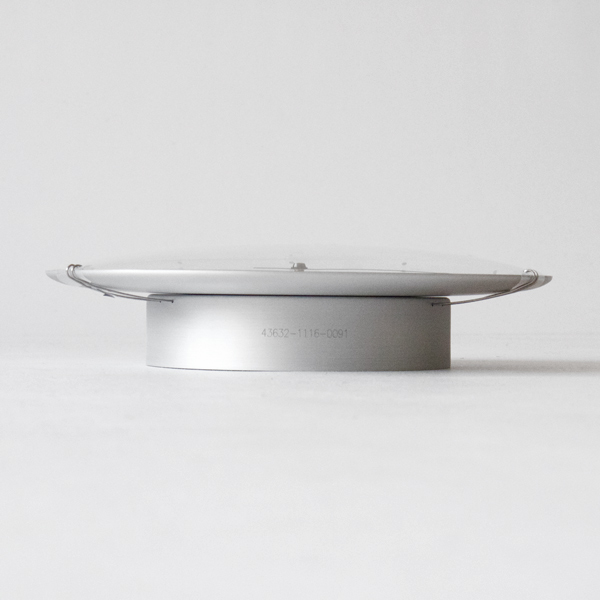
The clock body is also set at a slight distance from the wall, casting a shadow that makes it appear as though it's floating in space.
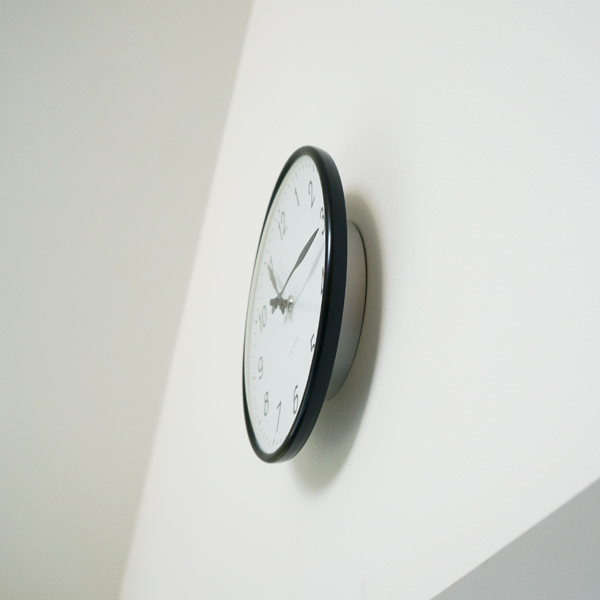
Even when exposed to light, it doesn't become difficult to read due to glare. Another key point is that the curved glass surface makes the time easy to read from angles other than straight-on. Since it's likely to be the only clock in the room, you'll be able to check the time from various angles—whether you're cooking or getting ready in the morning.
ARNE JACOBSEN Wall Clock CityHall

✔︎ A wall clock born during the design of Rødovre Town Hall
✔︎ A beautiful, exquisite contrast with the straight-lined building set within nature
✔︎ A form with absolutely no excess, distinctly of the 1950s
A precise, minimalist, and smart design. The dial and hands, composed of straight lines, make you want to place it in an office or study.
ARNE JACOBSEN Wall Clock Roman
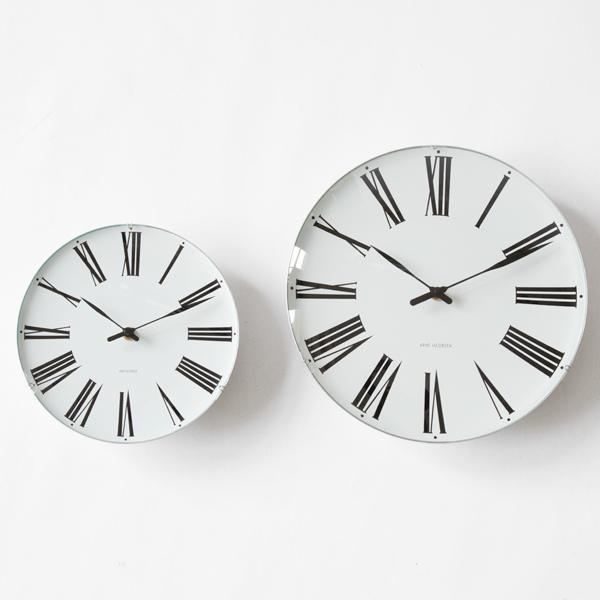
✔︎ A wall clock created while Jacobsen was designing Aarhus City Hall
✔︎ Aarhus City Hall is said to be the building where his perfectionist commitment to total design first began to emerge
✔︎ Arne Jacobsen designed everything used within the town hall—not just the furniture and lighting, but every element that made up the building, down to the ashtrays and door handles
ROMAN is a piece defined by its grand and impeccable elegance. The bold Roman numerals and distinctive hand design leave a lasting impression—when you see it hanging on a wall, it calls to mind the kind of beautiful clock memorably featured in a scene from an old film.
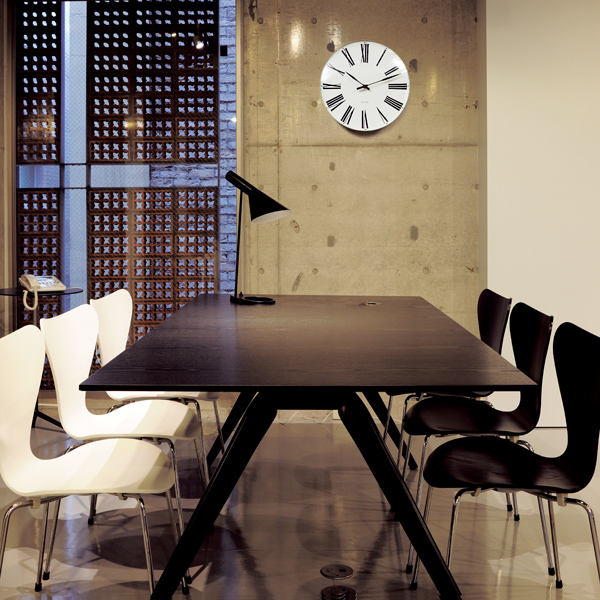
This is the only clock offered in the large 480mm size, big enough to be clearly visible even in an office or a spacious living room.
ARNE JACOBSEN Wall Clock Station

✔︎ A highly legible clock with Arabic index markings, adopted for use on Denmark's railways
✔︎ Uses the simplest possible Arabic numeral font for maximum legibility, so anyone can read the time at a glance
✔︎ Chosen as the clock used in Danish railway stations
Station is a design beloved by the Danish public. Since it's also available as a table clock, you may well have seen it before at a friend's house or in an interior shop. What sets it apart above all is its legibility. It may seem to go against the trend of stylish clocks that omit numerals from their dials, but this clock—with every design element executed 100% perfectly—is both beautiful and easy to read, making it truly one of a kind.
ARNE JACOBSEN Wall Clock Bankers

✔︎A wall clock created when Jacobsen designed the National Bank of Denmark, said to be one of the greatest masterpieces of his later years
✔︎The slender, rod-like indices made up of small blocks graphically express the ceaseless flow of time
✔︎The red at the center of the dial serves as an accent within the monotone design
With a touch of red as its focal point, this highly capable product embodies modernist design and promises to become a key item in any refined interior space.

*Design image of the dial
How to Choose a Size

We offer three sizes: 160mm (Station only), 210mm, and 290mm. Let's take a look at the sense of scale and usage scenes for each size.
160mm: Perfect for rooms where you don't want the clock to stand out, or for placing at a low position in a child's room

The 160mm is a small wall clock, roughly the size of both of an adult woman's palms placed together.
Recommended places includecompact rooms, studies, kitchens, and children's rooms, among others. For homes where you spend a lot of time sitting, or households with small children, it's nicer to be able to see the clock from a closer spot rather than hanging it high on the ceiling. Also, kitchens tend to get dirty, so a wall clock is convenient there too. This is a size chosen by those who don't want their clock to have a strong presence.
210mm: For studio apartments or living rooms

The 210mm size is perfect as the main wall clock for a studio apartment, bedroom, or other rooms that aren't very large. In a living room or larger room, rather than placing it high up, it's a size that won't feel oppressive even when hung at an easy-to-view, lower position. Despite being small, it doesn't look cheap—quite the opposite, it looks stylish, and it's the perfect size to display alongside art or posters without feeling out of place.
290mm: The quintessential wall clock size. Also suits high-ceilinged rooms such as living rooms and offices.

People generally choosing a wall clock tend to pick something around 30cm, and this 290mm size is truly the quintessential wall clock size. It's large enough for a typical living room, and while it might seem a bit small for a very large room, the time is easy to read even when viewed from angles other than straight on, and the dial itself is easy to see.
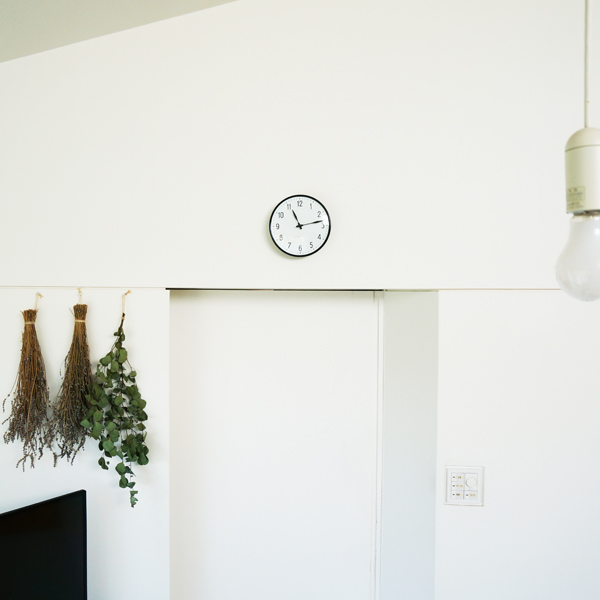
*A scene from a staff member's own use. The 290mm size in the living room. Even with a high ceiling in this living room, it's neither too small nor hard to see.
▼Purchase ROSENDAHL items here

GUIDE »
CATEGORIES »
- + Gifts by recipient
- + Gifts by scene
- + Clothing
- + Bags / Backpacks
- + Wallets / Card cases
- + Jewelry
- + Shoes
- + Rainy day outfits
- + Kitchen
- + Home
- + Babies / Kids
- + Japanese products
Earn Miles


Payment & Security