.webp)


.webp)


.webp)


.webp)


Welcome to ZUTTO
Free shipping for newsletter subscribers (some areas excluded)
- トップページ/
- ZUTTO Journal/
- 選び方・使い方/
- Auspicious Items ...

Auspicious Items to Choose for Special Occasions
Birthdays, weddings, the day a child is born.
On the special, celebratory days of life,
why not choose something auspicious for the occasion?
Items considered to bring good fortune
still carry strong traces of customs passed down since ancient times.
These lucky charms were thought to hold a kind of spell that calls happiness.
Beyond items received from temples and shrines,
things people happened to be carrying when good fortune struck
also came to be regarded as lucky charms.
By entrusting one's own wishes to such an object, and then giving it as a gift,
happiness is passed on to others as well.
Such wishes are woven into every lucky charm.
A Variety of Historic Patterns
Patterns often seen at celebratory occasions.
The motifs we commonly encounter each carry meanings passed down since ancient times.
Plants are one of the motifs most often used in lucky charms.
Among them, "shochikubai" (pine, bamboo, and plum) is a pattern frequently seen.
Pine and bamboo are known as plants that grow over a long span of years,
while plum, known for blooming even in the cold of winter, represents resilience —
and for these reasons, the combination came to be treated as an auspicious pattern.
Today, a hierarchy has spread in which pine is considered the finest, followed by bamboo and then plum,
but it is said that in ancient times no such ranking existed.

>>Shochikubai Hashioki (Chopstick Rest)
The Shochikubai Hashioki is a chopstick rest made through Yamagata imono (cast metalwork).
Iron castware, formed by pouring molten iron into a mold,
allows even three-dimensional motifs to be shaped down to the finest detail,
beautifully expressing the layered plum blossoms and budding pine needles.

>>Kumihanwan (Matched Rice Bowls), Red and Blue Circle Pattern with Shochikubai
These rice bowls, adorned colorfully with shochikubai motifs,
are examples of Kiyomizu-yaki, representative pottery of Kyoto.
The pottery of Kyoto, an ancient capital where diverse cultures flourished,
combines the high skill of its craftsmen with the elegance unique to the city,
and continues to captivate many people to this day.
With these matched rice bowls, you can enjoy both the beautiful use of color and the rich shochikubai motif.
Cherry blossoms and chrysanthemums are also patterns that have long been cherished throughout Japan.
Cherry blossoms have appeared in poetry and paintings since the Heian period,
and are known as an auspicious motif symbolizing a bountiful harvest.
The coexistence of splendor and fleetingness gives them a charm unlike any other plant.
Chrysanthemums, meanwhile, with their petals spreading beautifully in a radial pattern, were originally regarded in China
as a flower of eternal youth and longevity, and in Japan too they have long been prized as one of the auspicious patterns.
A motif featuring a large, dignified chrysanthemum
catches the eye and leaves a lasting impression all on its own.
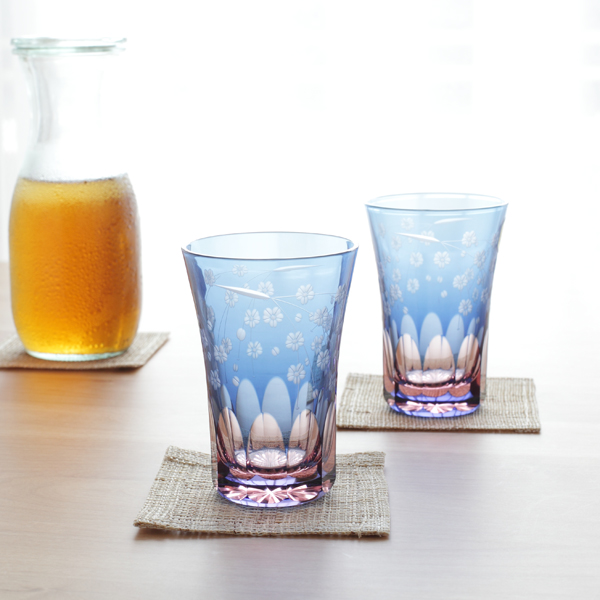
>>Edo Kiriko, Cherry Blossom Pattern, Tenkai Tumbler
This tumbler features beautiful, traditional kiriko (cut glass) work.
The way light reflects off the cut patterns never grows tiresome to watch.
The Tenkai Tumbler with cherry blossom pattern has an elegant design of blossoms in full bloom
as if swaying in the wind,
and it captivates the eye every time you pick it up.
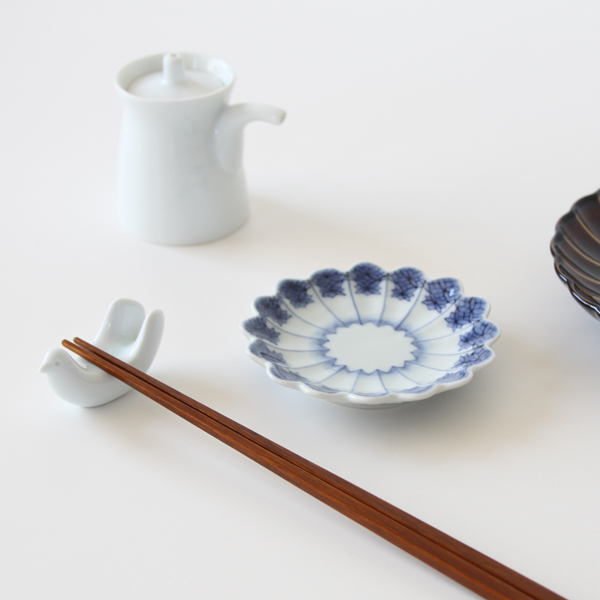
>>Mamezara (Small Plate), Chrysanthemum-Shaped, Shippo Pattern
This small plate is an Arita-yaki mamezara featuring delicate sometsuke (underglaze blue) painting.
With its radial shape resembling a chrysanthemum in full bloom,
the indigo-blue sometsuke characteristic of Arita-yaki catches the eye.
It's a tableware piece that can be used casually at the dining table.

>>Mamorifukuro (Amulet Pouch), Chidori (Plover)
Besides plants, there are other patterns that have long been known as auspicious motifs.
One of the first is the bird motif.
Birds have long been considered auspicious as bringers of happiness.
Chidori, the small, plump-shaped plover with an endearing form,
came to be seen as a lucky charm for calling wealth, since its name can be read as "sen-tori" (taking a thousand).
The "nami-chidori" pattern, in which plovers are depicted alongside waves,
also seems to carry the meaning of overcoming rough waters.
The Mamorifukuro Chidori by ponpindo features a striking design
of charming plovers set against a red background.
This drawstring pouch, which closes snugly with a pull,
is a convenient item that can be used for a variety of purposes.
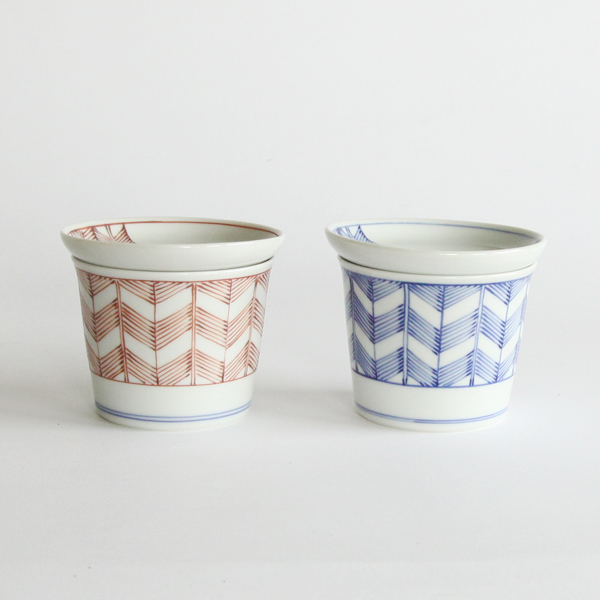
>>Yabane Soba Choko (Soba Cups), Set of 2
The yabane (arrow feather) pattern is also used as a kimono motif.
It came to be regarded as one of the auspicious patterns
by connecting the old belief that arrows warded off evil spirits with the meaning of "hitting the mark" and the idea that an arrow once shot never returns.
It also seems that its symmetrical design made it an easy pattern to render.
These soba choko feature beautiful sometsuke painting that makes striking use of white negative space.
Since a mamezara is included in the set, they're an item that can be used at the dining table
not only for eating soba but for other occasions as well.
The softly rendered yabane patterns, each in a different color, also make a lovely gift for a married couple.

>>Hashioki (Chopstick Rest), Musubi
Mizuhiki, the decorative cord essential to noshi, are used for both celebratory occasions and funerals.
Mizuhiki come in various patterns, each carrying its own meaning.
The "hanamusubi" (flower knot) is a form that can be tied and retied any number of times,
making it a mizuhiki style used for celebratory occasions other than weddings, such as childbirth or New Year's greetings.
The "musubikiri" pattern involves cutting off the ends of the mizuhiki and tying them tightly so they cannot be undone,
carrying the meaning that the event should never be repeated.
For this reason, it is used for occasions such as weddings, as well as funerals and get-well visits.
The "awaji musubi" is a knot that cannot easily be undone,
and carries the same meaning as the musubikiri.
Red Items for Life's Milestones
When it comes to colors often seen at celebrations, red comes to mind.
Though theories vary, red has long been considered a color that wards off evil,
and is said to have been worn to keep illness and misfortune at bay.
You may have noticed red items such as daruma dolls and sekihan (red rice)
appearing at celebratory occasions.
Red is also used in celebrations in China.
Many people are probably familiar with the Japanese custom of
giving a red chanchanko (a sleeveless vest) to someone celebrating their kanreki, or 60th birthday.
Since kanreki, at age 60, marks the point when the zodiac cycle returns to one's birth year,
it symbolizes rebirth, and in the past, the chanchanko was given as the kind of garment worn by a newborn baby—
身につけていたことから、こうした風習が生まれたのだとか。
It's said that this custom arose from the practice of wearing such items. Nowadays, when choosing a gift,
you can select a red accessory that suits the recipient's taste and can be used in everyday life—something that would surely be appreciated as a kanreki (60th birthday) celebration gift.

Having one small coin purse on hand
comes in handy for those quick trips out.
The gamaguchi (clasp-style) design snaps firmly shut,
so there's no worry about coins spilling out.
Made from soft French cowhide with a striped lining fabric,
this coin purse is wonderfully stylish.
The vivid red called Rouge is a color that lifts your spirits just by carrying it.

>>Konairo Shinsha Ladies' Watch
This hanamokko watch features iwa-enogu (mineral pigments used in Japanese painting)
applied to its face.
The deep red called shinsha (cinnabar) is a mineral pigment made by crushing a red stone that has been mined since the Jomon period.
Shinsha stone has long been treated as something highly sacred, having been used in the decoration of ancient burial mounds.
It matches beautifully with the deep maroon strap and gold frame,
creating a color combination that shines on your wrist.

Red is also a color that brings a festive atmosphere to any occasion.
For a celebratory table, why not use tableware that features plenty of red?
Miyamoto Taizando's Red Komon Side Plate expresses the beautiful coloring of Kutani-yaki—red, blue, yellow, purple, dark blue, and white—
all on a single plate.
Fine brushwork depicting plants and classic patterns is applied by craftsmen,
carefully painted one piece at a time.

>>Keyaki Long Life Soup Bowl, Vermilion
Known as Ishikawa Prefecture's Yamanaka lacquerware, Kihachi Kobo's Keyaki Long Life Soup Bowl, Vermilion,
is made by deliberately skipping the undercoat and instead layering black and vermilion lacquer in alternating coats,
finished with a final coat of urushi (Japanese lacquer).
The grain of the natural wood used as the base material shows through faintly,
and this glossy bowl—characteristic of lacquerware—has an elegance that makes it perfect for celebratory occasions.
There is also a bowl set featuring the traditional beautiful vermilion and black colors of Japan,
making it a lovely gift for a married couple as well.
Wishing for Healthy Growth
"Okuizome" is a ceremony held about 100 days after a baby is born.
It refers to the ritual in which the baby tastes food other than breast milk for the first time,
wishing for the child's healthy growth.
Okuizome has been practiced since the Heian period, and
there are various customs depending on the region.
Nowadays, many different types of tableware are used for okuizome, but
traditionally, it is said to have been carried out using a set of lacquerware placed on a lacquered tray.

Jujuu's lacquerware is made by craftsmen in Fukui Prefecture.
Based on the nested design of oryoki bowls, this hand-lacquered set can be compactly stacked together.
Since it comes with five bowls of different sizes,
it's perfectly suited as tableware for okuizome.
Moreover, Jujuu carries the meaning that it can be used not only for the once-in-a-lifetime okuizome ceremony,
but continue to be used for a long time afterward as well.

Of course it can be used as everyday tableware,
but it also serves many other purposes, such as holding small items or accessories.
As something that not only wishes for the baby's healthy growth,
but also stays close by and watches over that growth,
it would make a wonderful gift.
Tips for Use
What did you think of these auspicious items to choose for a special occasion?
The items introduced here may seem like they're meant only for special celebratory occasions,
so you might think they wouldn't get much everyday use.
But just like Jujuu's okuizome tableware, rather than using them for just one event,
trying them out afterward in different ways can make them even more beloved.
Also, if the tableware features auspicious plant motifs,
you can bring it to the table according to the season—for example,
cherry blossom-patterned glasses in spring, or chrysanthemum side plates in autumn.
When giving an auspicious item as a gift,
it's not just about the pattern or color—choosing something functional that matches the recipient's taste is sure to be appreciated.
For example, for someone who feels that red is a bit too flashy, an item in a slightly different shade of red, such as maroon,
or a simple piece with just a small accent of red,
would likely find more occasions to be used.

Also, when storing items away for a long period,
the basic rule for any item is to keep it
in a well-ventilated place free from dust.
For tableware, it's best to wrap it carefully in thin paper, newspaper, or kitchen paper before storing,
and for cloth items, smooth out any wrinkles and
store them in a well-ventilated cabinet as protection against mold.
May your relationship with these auspicious items last for many years to come.
GUIDE »
CONTENTS »
CATEGORIES »
- + Gifts by recipient
- + Gifts by scene
- + Clothing
- + Bags / Backpacks
- + Wallets / Card cases
- + Jewelry
- + Shoes
- + Rainy day outfits
- + Kitchen
- + Home
- + Babies / Kids
- + Japanese products
Earn Miles


Payment & Security