.webp)


.webp)


.webp)


.webp)


Welcome to ZUTTO
Free shipping for newsletter subscribers (some areas excluded)
- トップページ/
- ZUTTO Journal/
- 選び方・使い方/
- Then and now. Dye...

Then and now. Dyed goods that color our daily lives
Dyed textiles are beautiful to look at.
When we think of Japan's dyeing traditions, kimono naturally come to mind.
Kimono, colored with lustrous, vivid hues,
continue to captivate so many people even today.
And if we look toward other countries,
we find similar cultures and techniques for dyeing clothing and fabric.
This time, we'll take a look at the art of dyeing
through the lens of both Europe and Japan.


The act of "dyeing" itself
has, by imprinting colors, pictures, and lettering onto fabric,
served not only to create visual beauty
but also to convey information to others.
Today, machines can dye all sorts of colors and motifs,
but in the past, dyeing was done by soaking fabric in dye liquid
or by pressing a stencil or block against it.
One dyeing technique that has been cherished since ancient times is woodblock dyeing.
Working on the same principle as a stamp, woodblock dyeing
can be done simply with a piece of wood,
which is said to be why it has been widely adopted across the world.


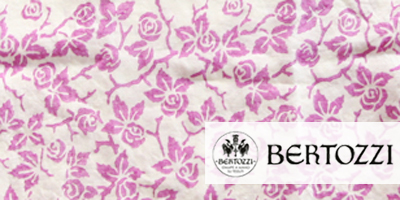
BERTOZZI is an Italian linen brand that carries on
this traditional woodblock dyeing technique today.
Founded in 1920 in a town near Bologna, Italy—a region where
woodblock techniques flourished and spread since the Renaissance period—
the brand produces items made from European linen dyed using woodblock methods.
First, a design or crest is drawn,
and thick pieces of wood are carved according to the design.
Ink is applied to the woodblock, which is then placed on the linen and struck with a hammer to transfer the dye.
Finally, the printed linen is steamed to set the color in place.
Carving the wooden blocks exactly to the design,
and dyeing the linen itself, are all done by hand by skilled artisans.
For designs with length, the artisan applies pressure to the linen
in a balanced way so that the seams don't show, and layering several colors to create a distinctive hue is also part of the artisan's craft.
As you can see in the products, faint blurring and unevenness in color and shading
are characteristic marks of handmade work.
Before the age of movable-type printing,
woodblock techniques were valued as a tool for conveying information.
Woodblock printing, said to have had a great influence
even on the fine art of the Renaissance period,
has conveyed much information through color and stencil motifs.
From BERTOZZI's linen items,
you can feel the warmth of dyed goods crafted by human hands.

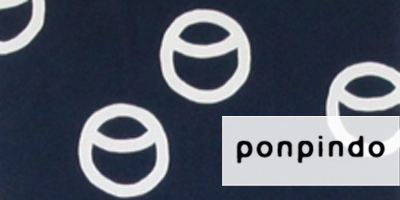
Turning to another example, here we have ponpindo,
whose products are scattered with Japanese-style motifs.
Made by the long-established dye shop Sarakei together with designer
Kosaku Ono, these items use
the traditional Japanese techniques of chusen (hand-poured dyeing) and stencil dyeing
to create vividly colored tenugui (hand towels) and amulet pouches.

Chusen is a dyeing technique that originated in the Meiji era.
A stencil is placed over fabric that has been treated with a resist paste,
and dye is poured over it; the areas covered with paste remain undyed,
allowing the stenciled motif to emerge.
Since both sides of the fabric are dyed at once,
a distinctive feature of chusen is that the same motif appears identically on both the front and back.
Because the thread is dyed all the way through to its core, the color resists fading,
and because the technique produces crisp, clear outlines
with minimal bleeding, it is said to be well suited
to dyeing a wide variety of motifs.
It has long been favored not only for tenugui but also for dyeing yukata.

The amulet pouches are made using the traditional technique of stencil dyeing.
In stencil dyeing, a pattern is cut out of washi paper,
and a paste made from glutinous rice is applied over the pattern,
so that only the areas of the pattern remain undyed
and emerge as the finished motif.
At ponpindo, Mino washi paper is used for the stencils;
by coating the Mino washi with persimmon tannin or urushi and layering the paper,
the stencil becomes more water-resistant and gains greater strength.
In addition, as a finishing touch, the animal-face details and
partial coloring on the amulet pouches are applied using nassen, a stencil-printing technique.
Nassen is a technique in which pigments are mixed to create color,
which is then brushed onto the fabric through the stencil.
Along with stencil dyeing, nassen is also a dyeing technique that has survived from long ago.
In each item made by hand by skilled artisans,
these inherited techniques live on.

The large, boldly rendered auspicious motifs are also
one of the charms of ponpindo.
It's fun to choose based on the meaning
behind each motif.

One of the best things about dyed goods
is how a single piece can brighten up a space in an instant.
Decoration is another role that dyed textiles play.
Vividly dyed fabric pairs beautifully
with white items and glassware,
so you can enjoy all kinds of combinations.
BERTOZZI's linen items come in
a warm red, a yellow reminiscent of yamabuki blossoms, and a green like lush, growing foliage.
These plant-inspired hues, which stand out beautifully against white linen,
seem to conjure the scenery of nature-rich Italy.

Simply wrap the café apron around your waist for an effortlessly stylish look.
Its beautiful coloring gives it a fashionable feel.
Aromi, which means "spices" in Italian,
reflects the very colors of the spice plants themselves.


Simply laying one on a table as a cloth or coaster
can change the whole atmosphere of the space.
Pour a cup of coffee onto a deep green handkerchief and settle in for some quiet reading.
Pair a bright, water-blue one with glassware for a refreshing table setting.
Depending on how you use it, it can bring color and life to your everyday living.

Items from ponpindo (ポンピン堂), made using traditional Japanese colors
The pink of ume blossoms that instantly evokes the season,
the deep green long used in kimono dyeing,
the deep crimson said to invite good fortune…
These exquisite hues, impossible to describe in a single word,
call to mind the rich palette that Japanese culture has nurtured over time.
Mamori-bukuro (charm pouches) are said to have long been
used for holding gofu (talismans).
It's said that mamori-bukuro became widely popular from the Edo period onward.
Decorated with auspicious patterns, they served as good-luck charms
for people wishing for happiness.
Their just-right size, perfect for holding small items,
makes them handy in all sorts of situations.
Carrying a mamori-bukuro in your favorite pattern
gives you a sense of reassurance.


Now, how should you care for dyed items?
You might worry that getting them wet will cause the color to fade,
but as long as you're careful at the very beginning of use, there's essentially
no need to worry about color fading afterward, so please rest assured.
For handkerchiefs, aprons, tenugui, and the like,
please rinse them in water after use.
To prevent color fading or color transfer,
we especially recommend washing each item separately in plenty of water
with a gentle swishing motion when you first start using it.
※Please do not use bleach.
※BERTOZZI (ベルトツィ) products may appear
to darken in color when wet,
but they return to their original color once dry.
After hand-washing, dry the item thoroughly in a well-ventilated, shaded spot.
Once dry, BERTOZZI (ベルトツィ) items
may show the wrinkles and shrinkage characteristic of linen.
Likewise, ponpindo (ポンピン堂) items, which are made of cotton,
will gradually change in surface texture the more they are cared for and used.
Please consider these changes as characteristics of each material.
GUIDE »
CONTENTS »
CATEGORIES »
- + Gifts by recipient
- + Gifts by scene
- + Clothing
- + Bags / Backpacks
- + Wallets / Card cases
- + Jewelry
- + Shoes
- + Rainy day outfits
- + Kitchen
- + Home
- + Babies / Kids
- + Japanese products
Earn Miles


Payment & Security