.webp)


.webp)


.webp)


.webp)


Welcome to ZUTTO
Free shipping for newsletter subscribers (some areas excluded)
- トップページ/
- ZUTTO Journal/
- 選び方・使い方/
- If You're Choosin...
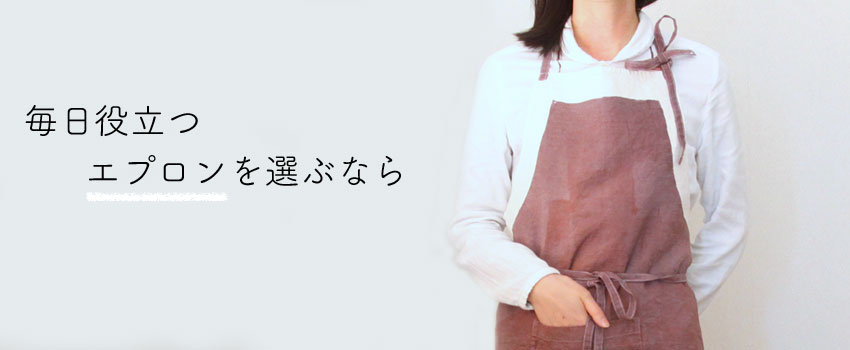
Choosing an apron for everyday use
An apron is, of course, essential for cooking, but it's also useful for gardening, DIY projects,
lessons and hobbies, and even playing with children—it's truly a workwear item suited to many different scenes.
But when you start looking, there are so many types available that you might find yourself wondering which one to choose…
This time, we'll focus on the characteristics of aprons and offer some hints for finding the one that suits you best.
The Role of the Apron

Originally, the apron was known as a decorative item worn by the upper classes.
Many were adorned with lace and jewels, and as they came to be called "decorative aprons,"
they were considered part of one's fashion.
In Japan, the kappogi (a traditional Japanese housecoat) had long been widely used as workwear for cooking and cleaning, but
in the mid-Showa era, aprons imported from abroad emerged as stylish workwear,
and combined with their practicality in preventing stains, they gradually grew in popularity.
The apron is workwear that is often used outside the home as well.
A familiar example would be the uniforms worn by staff at cafes and restaurants.
When waiters and waitresses wear them, they give off a clean and tidy impression.
In fact, the apron known as the "garçon apron"
originally meant "an apron worn by a waiter,"
so it seems natural to think that aprons used by waitstaff gradually made their way into ordinary households.
Beyond that, aprons are also valued as workwear in fishing, farming, and auto maintenance, as well as in childcare and caregiving settings,
where they help protect clothing and skin from stains and injuries.
The apron's primary role is, of course, to prevent stains, but
fitting the body well and allowing ease of movement is also an important point.
When you tie the apron strings properly, the garment fits snugly against your body,
making movements like reaching out your arms or bending your legs much easier.
Many aprons also have pockets at the chest or waist, giving them excellent storage capacity.
Easy to put on, practical for working in, and
available in a wide variety of designs—that's the appeal of the apron.
A Wide Variety of Aprons
Now, we've introduced the apron as clothing perfectly suited for work, but
what points should you pay attention to when choosing one?
The first thing to check is the size and shape of the apron.
The aprons carried by ZUTTO come in the following types:
Full apron, cafe apron, midi apron, waist apron, garçon apron…
From the names alone, it's hard to tell how each differs, but
simply put, a full apron is one that extends from the chest down to the knees,
while the others extend from the waist down to the knees (or ankles)—the main difference being length.
Also, the length of the straps and the position of the pockets differ between them,
so let's take a closer look at these details.
■ The Versatile Full Apron
Since the full apron covers the entire body,
you can use it in a wide range of situations without worrying about stains.


Made with No. 11 cotton canvas, JoBu's
Long Apron (Cotton Canvas) is an apron with just the right stiffness and thickness.
It boasts high durability with no worry of tearing, along with a texture that grows softer and more supple the more you use it.
It's a type where you hang the neck strap and tie the waist strap around the front.
The fabric is generously wide and the straps are made relatively long,
so it's a size that men can wear comfortably too.


This is BERTOZZI's full apron.
The woodblock printing applied by craftsmen gives this apron a rustic, handmade feel.
Like JoBu's full apron, the waist strap ties in front, but
the notable feature here is that you can tie the neck strap yourself.
Since you can adjust the length of the front panel yourself, it's easy to choose whether you're tall or short.
No more worrying about the neck strap being too long and the front panel sagging down—that's a welcome relief.


Yarmo's Bib Apron has waist straps of different lengths depending on the color.
The Indigo comes with longer straps meant to be tied in front, while the Off White is tied in back—giving each a different look and feel to enjoy.
With pockets at both the chest and waist, you can hold a plastic bag or a pen,
providing the storage space you unexpectedly need while cooking or working.
What's more, the Bib Apron weighs only about 150g—remarkably light.
It fulfills the wish for an apron made of tightly woven cotton fabric that is still lightweight and easy to move in.
■ The Versatile Cafe Apron
Next, let's look at the type of apron that extends from the waist down to the knees (or ankles).
The kind that reaches just above the knee, evoking the image of a cafe staff member, is
named the cafe apron or midi apron.
Since it was originally worn as a set with a vest as a cafe uniform,
it extends from the waist to just above the knee.


If you're concerned about stains around the chest, we recommend the full apron, but
If you're concerned about stains from the waist down when doing dishes and similar tasks, a café apron is just the right size.
Best of all, since it simply wraps around your waist, you won't have to worry about wrinkling your top by putting on an apron, and
there's no need for the extra step of tying (or looping) a neck strap, making it a compact and easy option to wear.
The one shown above is the linen midi apron from fog linenwork.
It's made from lightweight linen for an airy finish, and since you can wash it in water without hesitation, it's perfect for everyday use.
Tied in a ribbon knot at the front, it looks just like something a café staff member would wear—very fashionable.


This one is a garçon-type apron, slightly longer than the café apron.
For example, if you accidentally drop an ingredient while cooking,
having length that reaches down to your ankles gives you peace of mind, keeping your clothes from getting stained.
What's more, this size is also easy for men to choose.
The Waist Apron from Yarmo
was originally designed for people working in Britain's fishing industry, and thanks to this background,
it offers excellent lightness, ease of movement, and easy care.
It uses a twill cotton fabric with high insulation and durability, woven in a technique called "twill weave," where the weave lines run diagonally,
resulting in a slightly thick fabric feel with just the right amount of softness against the skin.
Despite being a sturdy fabric, it doesn't feel heavy even for women, making it easy to walk around in.

Also, the waist strap is a long, flat strap with some stretch.
Even wrapped loosely around the waist, it still looks stylish—
a testament to the stylish design that only a workwear brand can achieve.
Even without pockets, you can hang a cloth or similar item from the strap while working,
which broadens the ways you can put the apron to use.


Also from Yarmo, the Trades Apron
is an extremely compact, short size that ends above the knee.
Some of you may wonder how to make use of such a short apron, but
it's recommended for tasks like sewing or knitting, where you want to spread small items such as needles and thread over your lap,
or for gardening, where ease of movement is a priority.
It's so lightweight you might almost forget you're wearing it, just like any other piece of clothing.
Yarmo's aprons, as you continue to use them,
gradually soften in texture, and the indigo color changes over time as well.
These are aprons where you can enjoy both careful sewing craftsmanship and the changes that come with age.
Caring for Your Apron
The aprons available at ZUTTO turned out to have quite a variety, didn't they?
We hope this has been helpful for those of you searching for the apron that suits you best.
Finally, let us also introduce how to care for your apron.
Most aprons can be washed at home,
so we recommend washing them regularly.
For areas where stains are especially noticeable, gently rub them clean first before putting the apron in the washing machine.
When placing it in the washing machine, make sure the stained areas face outward so they get washed properly.
Also, for aprons with long straps, place them in a laundry net,
and for darker-colored aprons, since there's a risk of fading or color transfer, we recommend washing them separately.
Since cleanliness is also important, we recommend having more than one on hand.
An apron that makes you feel "alright, let's do this" every time you put it on.
Please make good use of it in all sorts of everyday tasks.
GUIDE »
CATEGORIES »
- + Gifts by recipient
- + Gifts by scene
- + Clothing
- + Bags / Backpacks
- + Wallets / Card cases
- + Jewelry
- + Shoes
- + Rainy day outfits
- + Kitchen
- + Home
- + Babies / Kids
- + Japanese products
Earn Miles


Payment & Security