.webp)


.webp)


.webp)


.webp)


Welcome to ZUTTO
Free shipping for newsletter subscribers (some areas excluded)
- トップページ/
- ZUTTO Journal/
- 選び方・使い方/
- Understanding How...

Understanding How Fabric Is Made - The Art of Knitting and Weaving -
The clothes we wear every day,
bedding and towels, or even bags and umbrellas—
we come into contact with fabric products constantly in our daily lives,
and fabric products can broadly be divided into woven and knitted goods.
Beyond the materials used, woven and knitted fabrics also vary depending on their production method,
which changes their texture, comfort, and durability.
This time, we're focusing on these production methods to introduce the differences and characteristics of each.
Understanding Woven and Knitted Fabric
The difference between woven and knitted fabric lies in how it's made.
Woven fabric is basically made by crossing vertical (warp) and horizontal (weft) threads,
while knitted fabric is made by looping thread (stitches) and then hooking more thread through those loops.
To give an easy example, a typical shirt or blouse is woven, while a warm sweater is knitted.
As you can tell from how these two garments feel, woven fabric has threads that are
packed tightly together, giving it structure and durability,
while knitted fabric is more stretchy, soft, and fits closely to the skin,
making it well-suited for warmth.
Today, woven fabric is mainly produced by machine using looms, and knitted fabric using knitting machines,
but depending on the maker, some continue to maintain and use old-fashioned machines,
or hand-knit certain parts—each with their own particular approach.
Weaving (or knitting) quickly by machine allows for fast, high-volume production,
but some products intentionally use slower machines or incorporate craftsmanship by hand to ease the strain on the thread,
achieving a softer fabric and richer texture.

Example of a loom: Vlas Blomme's loom, which uses wooden parts
Now let's take a closer look at each production method.
Woven Fabric No. 1: Plain Weave
A representative weaving method is what's called "plain weave."
Plain weave is the simplest production method, in which warp and weft threads cross alternately,
resulting in the same weave pattern on both the front and back of the fabric.
Plain weave is characterized by its resistance to friction and its durability.
Because the threads are packed so tightly together, it's not suited for making thick fabric,
but conversely, it's ideal for creating thin, lightweight fabric.


The Vlas Blomme linen tunic shirt is a simple example of plain weave.
With a design that lets the linen fabric flutter softly from the torso to the knees,
the sheer quality of the weave—which highlights the cool feel of the linen material—is unique to plain weave.
Simply pairing it with your usual bottoms creates an effortlessly
relaxed coordinate.


The kontex throw & blanket is
woven slowly using a loom passed down through generations.
Although plain weave has an image of being sturdy, it's woven slowly
so as not to put strain on the thread, resulting in a soft, fluffy finish.
Made of 100% cotton with high water absorbency,
it can also be used in place of a towel blanket,
making it useful in the bedroom, living room, or even when heading outdoors.
Woven Fabric No. 2: Twill Weave
Next up is what's known as "twill," or "aya-ori" in Japanese.
While plain weave has warp and weft threads crossing evenly,
twill weave is a method in which the warp thread crosses over
multiple weft threads at once.
Plain weave, with its many crossing points between warp and weft,
tends to result in a stiffer fabric,
but twill weave was developed to make the fabric softer,
and because the crossing points of warp and weft gradually shift,
diagonal lines become visible on the surface—this is its defining feature.
This flexibility in the fabric
also gives it the advantage of resisting wrinkles.
Denim is one type of fabric that uses twill weave.


The ZUTTO original cotton wool denim wide pants
are made by adding a small amount of wool to cotton, creating a softly brushed denim with a gentle look and feel.
Through a dyeing method known as rope dyeing, the inner threads of the indigo are left white,
so gradually whiter threads become visible.
You can also clearly see the diagonal pattern characteristic of twill weave.
With the softness of the fabric and its generous width,
this piece is finished in a way that lets you enjoy styling it like a long skirt.
Woven Fabric No. 3: Jacquard Weave
Fabric woven on a jacquard loom equipped with a jacquard mechanism
is called jacquard weave.
The name "jacquard" comes from
the French inventor who created the jacquard loom.
Before the jacquard loom was invented, weaving large, complex patterns
required several people to lift the warp threads while another passed the weft thread through—an arduous task.
But with the invention of the jacquard loom, the warp threads could open automatically,
making it possible for a single person to weave complex patterns, and to repeat the same pattern over and over.
The ability to create large, intricate patterns and detailed, realistic expressions
was a groundbreaking invention in the world of textiles.


HADACHU ORIMONO neckties also
make use of jacquard weave.
While computers are often used to control weaving these days,
HADACHU ORIMONO (羽田忠織物) still weaves the way it did when jacquard weaving was first born
By deliberately passing the thread through by hand and weaving slowly
air is allowed to settle between the threads, making it possible to create soft, flowing curves.
The material used is silk, giving the fabric a lustrous sheen.
These are neckties that let you enjoy a variety of patterns, from stripes and checks to dots.
Weaving Technique No. 4: Seersucker
Seersucker, a type of "shijira weave," is
a technique in which the tension of the warp threads is alternated between loose and tight,
creating a wave-like pattern on the surface of the fabric.
Because the fabric develops an uneven, textured surface and has a light, breezy feel against the skin,
it is often used for fabrics suited to hot weather.


Made using 100% Lithuanian linen,
this is the Spica linen nightshirt by fog linenwork.
By combining linen, which is highly absorbent and quick-drying, with a seersucker weave,
the fabric is finished with an even cooler feel.
Available in two sizes, half-length and long-length, both are easy to use
as pajamas or simply as loungewear.
Knitting Technique No. 1: Plain Knit (Jersey)
Plain knit, also called jersey, is the most commonly used knitting technique for knitwear.
Also known as tenjiku, this technique is characterized by having knit stitches on the right side of the fabric
and purl stitches on the reverse side, giving each side a different texture.
Plain-knit fabric tends to be thin and has a tendency for the top and bottom edges to curl upward,
a quality that is sometimes turned into a design feature at the collar or hem.
With great stretch in the horizontal direction, it is used in a wide range of knitwear,
from innerwear and socks to T-shirts and sweaters.

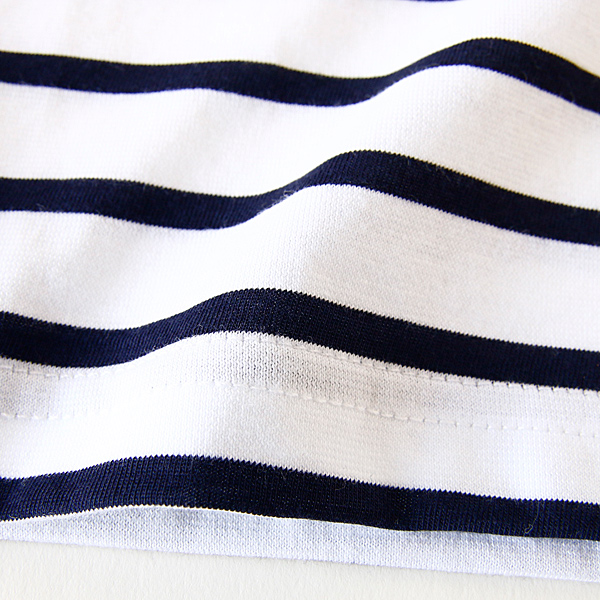

The Armor lux Border Cut-and-Sew BEG MIEL is
carefully plain-knitted from carefully selected cotton thread.
Reflecting the brand's origins as an underwear maker,
this cut-and-sew top is made with material and comfort as the top priority,
resulting in a stretchy, relaxed silhouette that is thin enough to be worn
not only as a top but even as an inner layer.
Knitting Technique No. 2: Waffle Knit
The waffle technique is characterized by its box-shaped textured fabric.
Because the resulting three-dimensional fabric has less surface area touching the skin,
it offers a light feel while also being highly absorbent and quick to release moisture, even when you sweat.


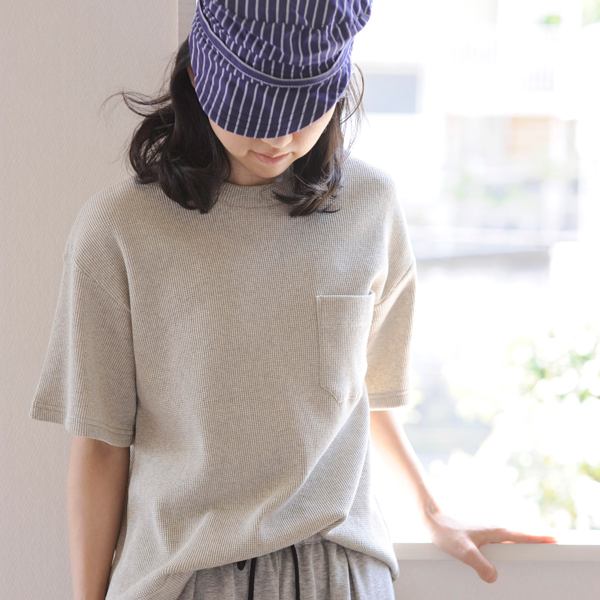
Made at a long-established fabric mill in Wakayama Prefecture, a region known for its thriving knitwear production,
the ZUTTO original waffle half-sleeve cut-and-sew top
uses recycled Supima waffle fabric made from extra-long-staple cotton.
By knitting soft cotton thread into a waffle pattern,
the result is gentle on the skin, with a relaxed fit and excellent breathability.
It's also easy to wash, making it a handy piece to have on hand during the sweatier months of the year.
Knitting Technique No. 3: Rib Knit
Rib knit is characterized by a fabric with ridges that run in vertical lines, like furrows.
With knit and purl stitches alternating, the fabric gains excellent stretch in the horizontal direction
and has the property of not curling easily at the edges.
For this reason, it is a technique often used for innerwear, which requires stretch and a good fit against the body,
as well as for the collar, cuffs, and hem of sweaters.


Dyed with plants long known in traditional Chinese medicine, such as jujube, balloon flower, and ginger,
the herbal-dyed ribbed three-quarter-sleeve shirt from Tenneムホウ (Tenneムホウ)
is also an inner garment made by making the most of rib knit's flexibility.
While the garment itself appears narrow around the torso when laid flat,
it fits gently and comfortably against the body once worn.
It covers the belly and lower back snugly, and the underarm and body width stretch generously,
making it easy to move freely.
Made from organic cotton, it grows softer with every wash,
making it a recommended piece of innerwear to wear all year round.


Also dyed using the colors of plants is
the MAITO plant-dyed WT rib snood.
Even though it's a large snood, the rib knit makes it easy to wrap around,
allowing you to wind it around your neck several times or drape it over your shoulders, giving you a wide range of styling options.
Despite its basic design, the rib knitting running down the center
and along the edges of the snood serves as an accent,
making it suitable for both everyday wear and formal occasions.
◆◆◆
This time, among the various methods of fabric production, we introduced the basic techniques of weaving and knitting.
The appearance of a fabric changes entirely depending on the weaving or knitting method used,
and we hope that by learning about the underlying techniques,
you'll be able to find items that suit you, and that your enjoyment
of choosing clothes and fabrics will grow even further.


GUIDE »
CATEGORIES »
- + Gifts by recipient
- + Gifts by scene
- + Clothing
- + Bags / Backpacks
- + Wallets / Card cases
- + Jewelry
- + Shoes
- + Rainy day outfits
- + Kitchen
- + Home
- + Babies / Kids
- + Japanese products
Earn Miles


Payment & Security