.webp)


.webp)


.webp)


.webp)


Welcome to ZUTTO
Free shipping for newsletter subscribers (some areas excluded)
- トップページ/
- ZUTTO Journal/
- 選び方・使い方/
- The White Shirt o...

The White Shirt We All Dream Of: How to Choose It Well and Wear It with Care
The white shirt—a true wardrobe staple.
Simply slip one on, and it lends an air of quiet elegance.
Seen from behind, it can look almost like the white sail of a ship, so striking it stops you in your tracks.
And yet, it's precisely this kind of everyday classic that proves surprisingly difficult to get right.
Because a white shirt has no flashy decoration to hide behind, the fit and the details specific to each item
can make all the difference.
Crisp and composed without trying too hard, dignified without overdoing it.
This time, we take a deep dive into how to choose the white shirt that's just right for you,
and how to wear it well and make it last for years to come.


Choosing the Right Size Determines 80% of the Impression
You love the design, but somehow it just doesn't feel right when you put it on.
Have you ever had that experience?
When it comes to how a shirt looks once you've put it on, what matters most
is nothing other than whether the size actually fits.
No matter how fine the fabric or how carefully considered the pattern,
none of that quality will show through if the shirt doesn't fit the wearer's body.
On the other hand, once you grasp the key points for choosing a shirt that suits your own body shape,
you'll be able to steadily build up your own collection of true wardrobe staples.

There are many measurements to consider when it comes to tops, but
the three you should check in particular are sleeve length, shoulder width, and body length.
These points apply not just to shirts but to any sleeved top, so they're worth remembering.
■Shoulder Width and Sleeve Length (② and ③)
Shoulder width and sleeve length have the biggest impact on a shirt's overall silhouette.
It's best to check these two points together as a set.
Sleeves that are either too short or too long will never create a beautiful silhouette.
And even if the sleeve length is right, if the shoulder seam sits noticeably off,
the silhouette still won't look clean.
If you can try the shirt on, put it on and feel with your hand whether the shoulder seam lines up properly,
and check whether the sleeves are too long or too short.
If you can't try it on, measure a favorite shirt you already own,
and compare its body length and shoulder width to those of the shirt you're considering.

This is what it looks like when the sleeve length fits just right.
Even with your arm fully extended, there's no excess fabric,
and bending your arm feels completely natural—this is the ideal fit.

That said, with ready-to-wear shirts, it's quite rare for both the shoulders and sleeves to fit perfectly at the same time.
If the shoulders fit, the sleeves end up too long; if you try to match the sleeves, the shoulders feel too narrow—
it can be hard to know which one to prioritize.
Depending on the size of the shirt, it's perfectly fine in such cases to prioritize sleeve length over shoulder width.
In the photo, the shoulder width is slightly narrower than the wearer's actual body
in order to get the sleeve length just right, but it doesn't look at all out of place.
When trying it on, as long as there's no unnatural pulling or wrinkling around the collarbone area (the section outlined in the photo)
and you don't feel any tugging at the shoulders, you should be fine.
As for shoulder width, a difference of about ±2cm from your actual measurement won't
affect the silhouette all that much, so feel free to prioritize comfort and sleeve length instead.
■Body Length (①)
With shirts, since the hem is often tucked into bottoms,
you don't need to be quite as precise about body length. Still,
if it's too short, the hem may come untucked when you move, and
if it's too long, the excess fabric may not suit your height and can make you look untidy,
so it's the point worth checking right after sleeve length and shoulder width.
As a general rule of thumb, you can use the following formula to gauge the right body length.
・Height × 0.42 − 10cm = minimum body length
・Height × 0.42 − 5cm = maximum body length
For example, if you're 160cm tall, a body length of around 57 to 62cm would be a good guide;
around 55cm if you prefer a fitted look, or around 60cm if you'd like to wear it a bit longer.
This gives you a rough sense of the right size,
so it's well worth using as a reference when you can't try something on, such as when shopping at an online store.
That said, this is only a guideline. Clothing is flat, but the body is three-dimensional once you put it on,
so the right fit depends not just on height but also on the thickness and proportions of your body.
As always, it's best to measure a favorite shirt of yours
and judge by comparing whether something is longer or shorter than that.
How Do Imported and Japanese-Made Shirts Compare?

When choosing a size, it's well worth paying attention to whether a shirt is designed in Japan or overseas.
Since patterns differ from brand to brand, and even from one shirt model to another,
it's impossible to generalize completely, but
every brand designs its products around a particular body type,
so it's important to understand that shoulder width and sleeve length can vary depending on the country of origin.
Even shirts labeled the same size tend to differ: those designed in Europe or America
often have narrower shoulders paired with longer sleeves and a longer body length.
Overall, the silhouette tends to be slimmer and more elongated.
Choosing that one perfectly-fitting shirt is certainly important, but
there are also times you'll want to wear a beautiful imported shirt even though its body and sleeve lengths run long—
and that's perfectly natural. Those kinds of encounters with clothing are worth cherishing too.
A shirt with slim shoulders and body but long sleeves, for instance,
When you want to wear a shirt that isn't quite your exact size,
you can still make it fit your body well by adjusting how you wear it.

Shirt: Long Sleeve Shirt, Striped, Round Collar White
Bottoms: Easy Fatigue Pants, Ladies
Shoes: Flat Shoes, JazzShoe White
If the shoulder width and body width are slim but the sleeves are on the longer side,
try opening the collar for a relaxed look while rolling up the sleeves to give the overall silhouette a compact impression.
Not only will this make the fit look more intentional,
but undoing up to the second button also loosens things around the chest, so there's no feeling of tightness.
Adding a scarf around the neck completes the look with an even more refined impression.

Shirt: LADIES BUTTON DOWN SHIRTS
Bottoms: Cotton Wool Denim Wide Pants
Belt: [Special Order] Belt, DOUBLE 3PLY BELT
Shoes: Desert Boots, Greenflex/Stone
When the shirt length is long, rather than forcing it into your bottoms,
blousing it (letting the hem show) can sometimes actually look more tasteful.
Loosely fastening a thin belt to give a cleaner look around the waist
brings expression to an otherwise simple shirt.
A plain white shirt on its own can look too much like office wear and overly formal,
but leaving the hem untucked can make it look too childish—
this styling solves both of these dilemmas unique to white shirts at once.
How to spot careful stitching
When a shirt's size fits your body properly,
wearing it feels comfortable with no unnatural strain.
When it comes to the actual feel of wearing a shirt, there's another point worth checking: the quality of the stitching.
A single shirt is completed by sewing together many parts—
the front panel, back panel, sleeves, cuffs, and collar—
and since all of these seams are located on the inside, sloppy stitching directly affects how comfortable the shirt feels to wear.

One easy thing to check when trying on a shirt is the stitching at the armhole on the inside of the shirt.
・Whether the stitches are fine and carefully done
・Whether there are any loose threads showing on the outside
・Whether the raw edges of the fabric are finished carefully so they don't scratch against the skin
Sewing along a curve neatly is one of the more technically demanding points in the sewing process,
and if the inside stitching is done carefully,
it's proof that the shirt was made with the wearer in mind.
Shirts can vary quite a lot in price even though they're all just "shirts,"
and you might wonder where exactly the difference lies—
but in fact, this is often exactly where the technical differences show up.
Careful stitching also helps the shirt last longer by preventing it from losing its shape or fraying,
so it's well worth taking the time to check the quality of the stitching.
The "collar" and "opening" change the impression
So far we've focused mainly on fit and comfort,
but the details of the "collar" and "opening" also greatly influence a shirt's overall impression.
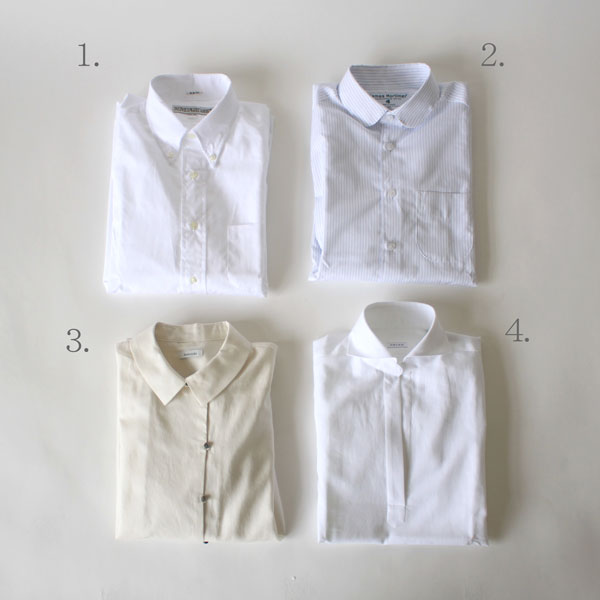
1: Button-down

The button-down shirt, with its collar fastened by buttons,
is a pattern originally devised in America so that the collars of shirts worn by polo players wouldn't get in the way during a match,
and it's now a classic style seen everywhere from business settings to casual everyday wear.
When the top button is undone, the collar doesn't lift and instead forms a beautiful V shape at the neckline,
with the collar button creating an exquisite curved line on either side.
2: Round collar

Whether you button it up all the way to the collar for a classic look,
or undo the buttons for a relaxed, casually styled look, the round collar type never loses its sense of elegance.
The design, with its gently curved collar points,
gives off a pleasantly feminine air while striking just the right balance, never becoming too sweet.
If pure white feels a little too cute for your taste,
we recommend one with fine pinstripes, like in the photo.
3: Shirt blouse

If your closet already has two or more classic shirts on standby,
then when adding one more to the mix, a design with a bit more playfulness might be a good choice.
This is a category sometimes called the "shirt blouse," with a more feminine feel.
Based on classic shirt elements like the collar, buttons, and cuffs,
it incorporates details such as a gently curved, feminine collar or a jacket-like front closure,
packing plenty of carefully considered elements into a simple design that can complete an outfit all on its own.
A pale beige or greige-toned color gives an even softer impression.
4: Skipper


Shirt: Linen Skipper Shirt, white
Sandals: Turban Design Espadrille Sandals BLK
The skipper shirt has no button at the collar and opens in a V shape.
It shows off the collarbone and emphasizes the décolletage, giving a distinctly feminine impression,
and the way your outfit can change depending on what you layer underneath
is part of what makes the skipper style so interesting.
You can of course keep it simple with a solid-color inner layer like black or gray,
but pairing it with a striped tank top or a lace-trimmed tank top
It can be styled to look casual or elegant alike.
For loving your white shirt for years to come
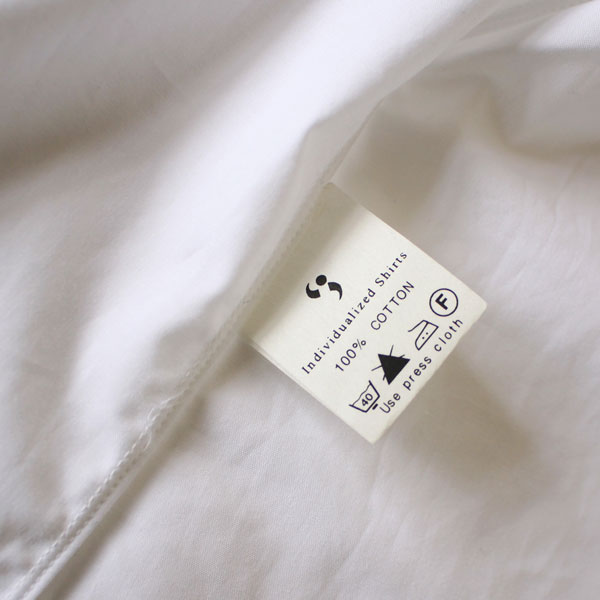

What makes a white shirt so appealing is, above all, its pure white, refreshing impression.
The more you wear and love such a shirt, the more you start to notice yellowing and stains settling in.
【Points to keep in mind when washing】
・Before washing, always check the condition of the shirt carefully.
Look for frayed seams, stains that appeared without your noticing, buttons that are coming loose, and so on.
If you wash the shirt without noticing these, you may end up making the condition worse, so be careful.
・For regular washing, follow the care label for each garment and use the washing machine, dryer, and iron appropriately.
Depending on the fabric, there may be restrictions on water temperature and on the use of the dryer or iron, so be careful.
・To keep the shirt looking beautifully white, check for and care for "stains" and "yellowing (from body oils)" frequently.
Stains from sauces or ink and stains from body oils are different in nature,
so it's best to use a laundry detergent suited to each type of stain.


【Points to keep in mind when ironing】
・When using a steam iron, pour in linen water
that can be added to the iron's water tank. Not only does it make wrinkles easier to remove,
but it also releases a soft, pleasant scent, giving a comfortable finish.
・For parts that shape the overall impression of a shirt, such as the collar and cuffs, a spray-type starch is handy to have.
Laundry starch may bring to mind a sharp, unpleasant smell,
but there are also sprays made with plant-derived ingredients, so do give them a try.

Bottoms: Easy Fatigue Pants, Women's
Like a pure white canvas, or a ship's sail,
the white shirt's charm lies in its crisp, dignified presence.
There is much to consider when it comes to choosing the right size and taking proper care,
but there is also the pleasure of weighing all these points carefully and adding one favorite shirt after another to your collection.
Once you've learned the joy of skillfully choosing what truly "suits" you,
you may naturally find yourself dressing in a way that clothes seem to favor.
▶︎A shirt where craftsmanship dwells in every detail—INDIVIDUALIZED SHIRTS

▶︎Clothes-making that makes the most of Banshu-ori (Banshu weaving)—hatsutoki

▶︎A shirt as a handcrafted work—James Mortimer

▶︎From materials to sewing, everything made in Italy—STEFANO CONTI
▶︎Find your own everyday staple. Browse all shirts

GUIDE »
CATEGORIES »
- + Gifts by recipient
- + Gifts by scene
- + Clothing
- + Bags / Backpacks
- + Wallets / Card cases
- + Jewelry
- + Shoes
- + Rainy day outfits
- + Kitchen
- + Home
- + Babies / Kids
- + Japanese products
Earn Miles


Payment & Security