.webp)


.webp)


.webp)


.webp)


Welcome to ZUTTO
Free shipping for newsletter subscribers (some areas excluded)
- トップページ/
- ZUTTO Journal/
- 選び方・使い方/
- Japanese everyday...

Tools for Japanese Living You'll Want in Your Kitchen
Japan, an island nation.
Shaped by its climate and natural features, each region developed its own distinct culture,
and the traditional crafts rooted in these local communities have enriched the lives of the Japanese people.

Simple, unadorned, and utterly honest—that's what Japanese tools are like.
Though they are everyday objects, they enrich the hearts of those who use them.
Precisely because the kitchen is a place we stand in every day, we'd like to introduce tools
that make you feel a little more upright, and a little more joyful, each time you use them.

・The Unsung Hero Behind Japan's Rice-Growing Regions
Niigata Prefecture is one of Japan's foremost rice-producing regions.
It's said that the foundations of present-day Niigata were laid during the Edo period.
Echigo, the predecessor to Niigata Prefecture, saw no major wars,
and it was an era in which ordinary townspeople played a central role.
Eventually, new rice paddies were developed across this land, industry flourished, and a distinctive culture was born.
By the late Edo period (the Tenpō era), a "sieve-makers' guild" already existed in this region,
actively producing sieves, straining tools, and steaming baskets known as seiro.
In an age before combine harvesters that could handle rice cutting and threshing,
sifting dried rice through sieves, along with straining and steaming tools,
were indispensable for cooking—though demand for them gradually declined over time.
・The Origins of Adachi Mokyu Shoten
Teradomari Yamada, which has flourished as a production center for magewappa (bentwood ware) since the Edo period,
is a place where traditional wooden buildings line the streets against a backdrop of the vast Sea of Japan.
The bentwood-making techniques of Teradomari Yamada have been recognized for their historical and cultural value
and designated as an intangible cultural asset of Nagaoka City.
Yet of all the artisans who once practiced this craft in Teradomari Yamada,
it is said that Adachi Mokyu Shoten is now the only one still making bentwood ware for a living.
・Seiro Steamers for Savoring Delicious Rice
This time, we'd like to introduce the popular wappa seiro steamer from Adachi Mokyu Shoten.
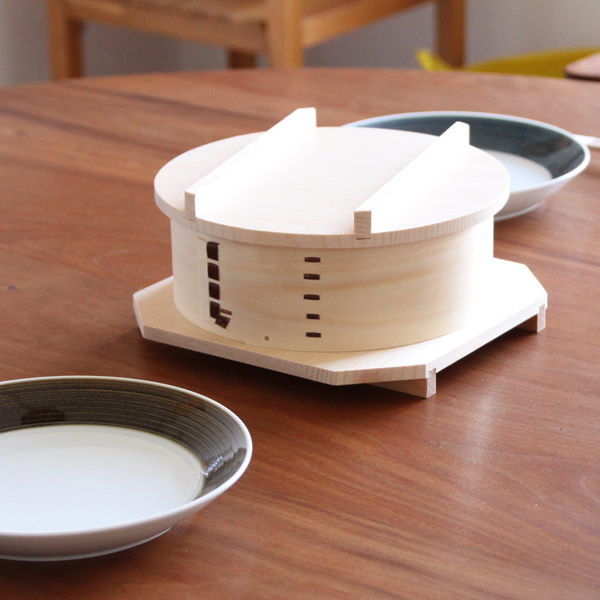
This wappa seiro is utterly charming to look at—but here's what's inside.
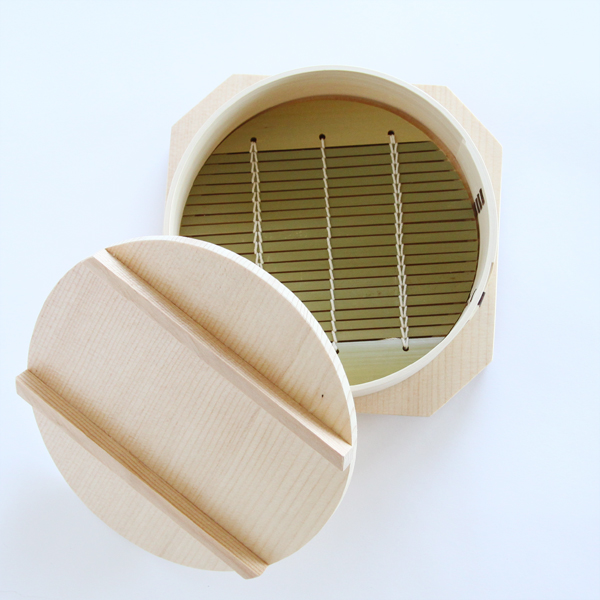
A seiro is a round steamer woven from bamboo or wood—a classic tool for steamed dishes.
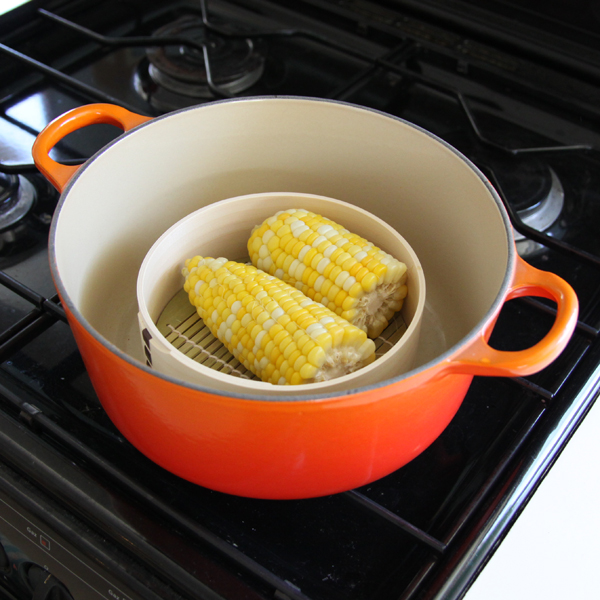
Root vegetables like corn bring out their natural sweetness when heated,
and mushrooms, too, pair wonderfully with seiro steaming.
We also recommend placing vegetables or fish like salmon on top of rice
and steaming everything together, adding just a small amount of water to the pot below—just enough that it doesn't reach the bottom of the seiro.
A Niigata local specialty called wappa meshi
is made by cooking rice with a lightly salted dashi broth,
then topping it with seasonal seafood from the Sea of Japan and steaming it all together.
It can also be used for warming leftover rice, thawing frozen food, and general cooking.
What sets it apart above all is that this is a wappa you can use in the microwave.
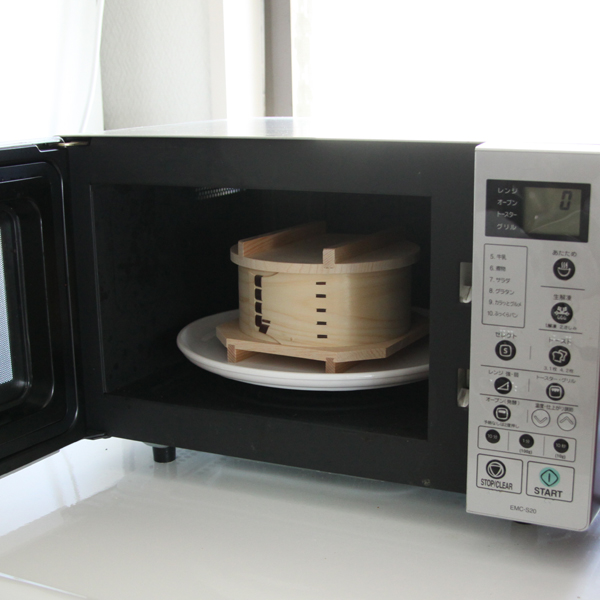
It's a wonderful choice not only for those who want to enjoy vegetables the healthy way, steamed in a seiro,
but also for people living alone.
A batch of frozen rice comes back to life deliciously in a wappa.
The ability to adapt a traditional craft to modern life
may well be the secret to why it continues to be loved across the ages.
▽Other Ways to Use It


・The DNA of the Japanese Sword
Banshu, in the southwestern part of Hyogo Prefecture.
The metalworking industry that has long been rooted in this region
is said to have originated from sword forging.
The origins of forged blades are said to date back to the Nara period (roughly 1,200 years ago),
and afterward, the culture of Edo-period sword smiths brought about a dramatic evolution in blade-making,
leading to a history in which everyday blades such as razors and scissors began to be produced around 230 years ago.
・Aiming for a Brand That Can Compete on the World Stage
This time, we'd like to introduce Banshu Hamono, a blade-making tradition rooted in Ono City, Hyogo Prefecture.
Boasting a sharpness and durability that hold their own on the world stage, Banshu Hamono has a history stretching back more than 250 years in the Banshu region of Hyogo Prefecture.
With a desire to spread this local industry beyond a regional brand and out into the world,
the design studio Coelacanth K&H and the Ono Kanamono Wholesale Cooperative worked together to create a new design, launching this brand with global ambitions.
Banshu Hamono, a traditional industry born of this region and firmly passed down through everyday life,
also offers a paid resharpening service as part of its after-care,
so that customers can keep using their blades in good condition for a long time.
・A Beauty That Overwhelms the Eye
Banshu Hamono also produces flower-arranging scissors and tailor's shears.
This time, let's take a look at the kitchen scissors that shine in the kitchen.
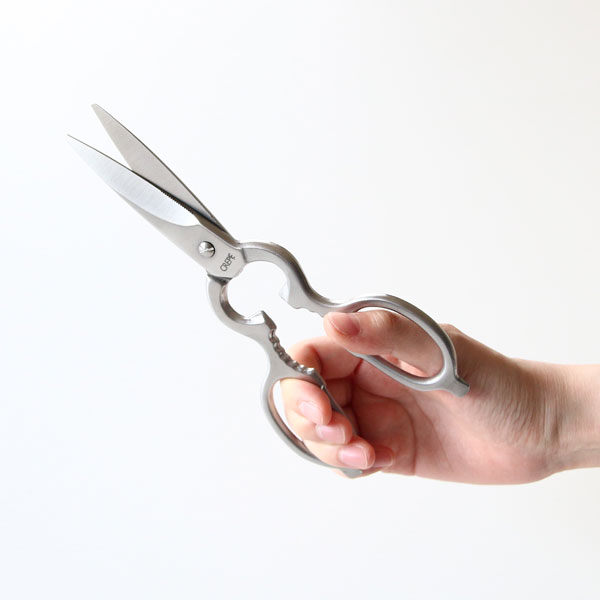
These scissors boast reliable sharpness and outstanding durability,
and you can see that there are two openings between the blade and the handle.
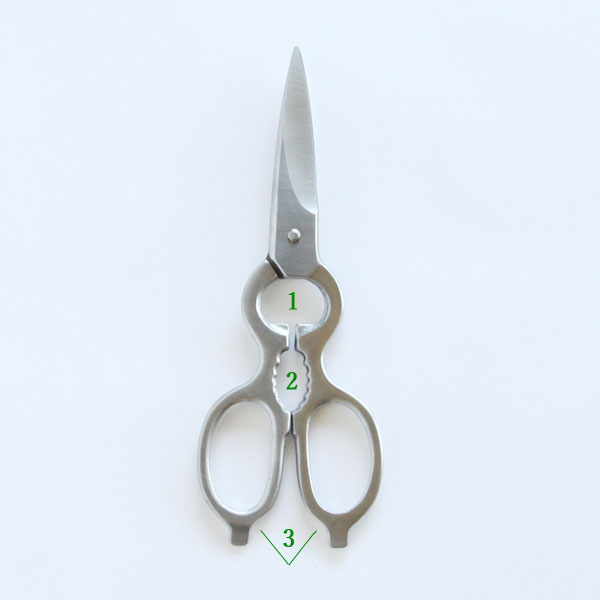
In fact, opening 1 can be used as a bottle opener for beer and the like,
while opening 2 can be used to crack hard items like walnuts,
or to open screw-top lids.
And with the tip of handle 3, you can even open can lids—
making these truly all-purpose scissors.
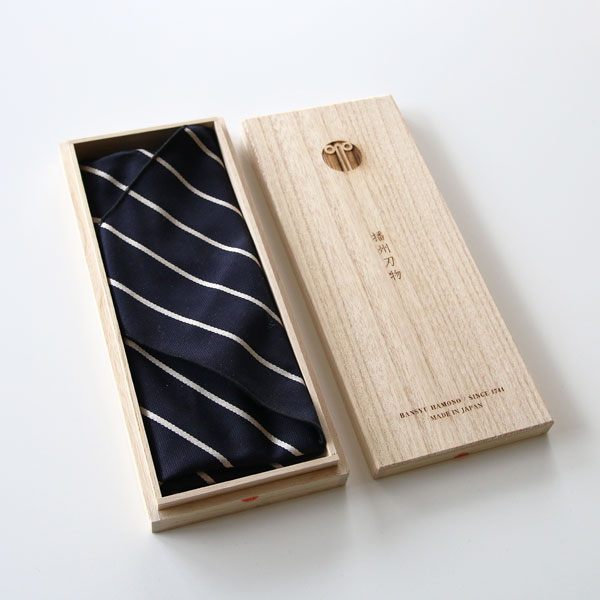
These beautiful scissors come wrapped in Banshu-ori (Banshu-woven fabric)
and nestled in a kiri (paulownia wood) box—a lovely touch.
Pick up these cool, sleek scissors,
and somehow, even in the kitchen, you'll find yourself standing a little straighter, wanting to treat them with the utmost care.
These are kitchen scissors that bring a touch of elegance to your cooking.
*The pattern of the Banshu-ori fabric may change without notice.
▽Related Content

・Nara-zarashi, the Bleached Hemp Cloth That Supported Nara Prefecture's Industry
Nara-zarashi, a bleached hemp cloth produced in the Nara region, traces its origins all the way back to the Kamakura period.
Nara-zarashi (bleached hemp cloth from Nara) is recorded as having been used for the kesa (Buddhist robes) of temples in Nanto, but
it was only after Kiyozumi Genshiro succeeded in improving the bleaching (sarashi) process in the latter half of the 16th century that this name began to appear in historical documents.
In the first half of the 17th century, it received the "Nanto Kai" red seal from the Tokugawa shogunate, was designated as an official goods supplier, and flourished as an industry.
At the time, it was mainly used for samurai kamishimo (formal attire) and monks' hoe (Buddhist vestments).
It seems there was also demand for it as chakin (tea cloths), since it was used by Sen no Rikyu.
The industry reached its peak from the latter half of the 17th century through the first half of the 18th century,
with production said to have reached as much as 400,000 hiki (a unit of cloth measurement).
The prosperity of the time was so notable that it even appears in Ihara Saikaku's "Seken Munesan'yo."
It was in the midst of this golden age that the first Nakaya Kihei began his business dealing in Nara-zarashi,
marking the beginning of Nakagawa Masashichi Shoten, which today holds the Yu Nakagawa brand we introduce here.
・"Kaya fabric (mosquito net cloth)"
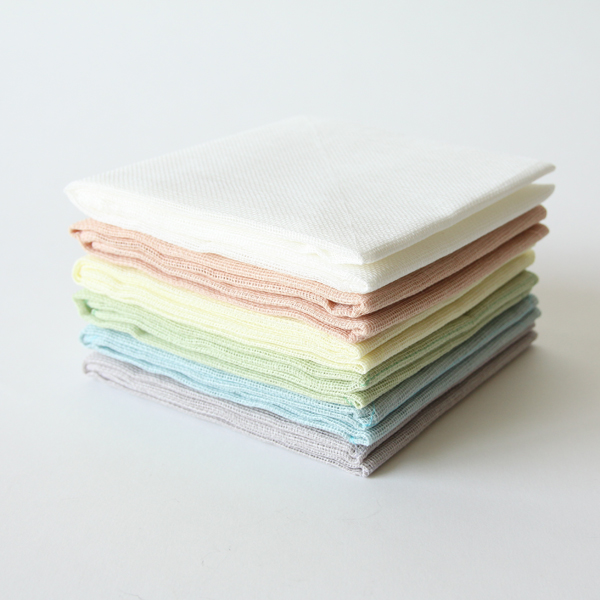
Kaya (mosquito nets) is a seasonal word for early, mid, and late summer.
Mosquito nets, hung over beds on summer nights to keep mosquitoes out,
have become a nostalgic scene of the past now that air conditioning has become widespread.
However, kaya fabric, made with the clear purpose of "letting the breeze through, but not the mosquitoes,"
is a plain-weave cloth made of cotton or hemp,
and is known as a specialty product of Nara Prefecture.
Nakagawa Masashichi Shoten, a long-established hemp weaving business in Nara that has continued for 300 years since the Edo period,
made use of the characteristics of kaya fabric—excellent breathability as well as superior water absorption and quick-drying properties—
to create the "Hana Fukin" (flower dishcloth).
The woven width of kaya fabric is about 120cm, and the size when folded exactly in half
becomes the size of the Hana Fukin.
The loom uses what is called a shuttle, a bobbin wound with weft thread,
which is a shuttle loom that weaves by moving back and forth between the warp threads.
Among looms, it is slow and not particularly efficient,
but this shuttle loom produces a unique, plump texture found only in this method.
The fabric finished in this way then goes through the processes of bleaching, dyeing, starching, cutting, and dyeing again.
All of this is done by hand, and stitching is run not only along the edges but also on the inside to prevent the double layers of fabric from shifting.
・Colorful and fun Hana Fukin
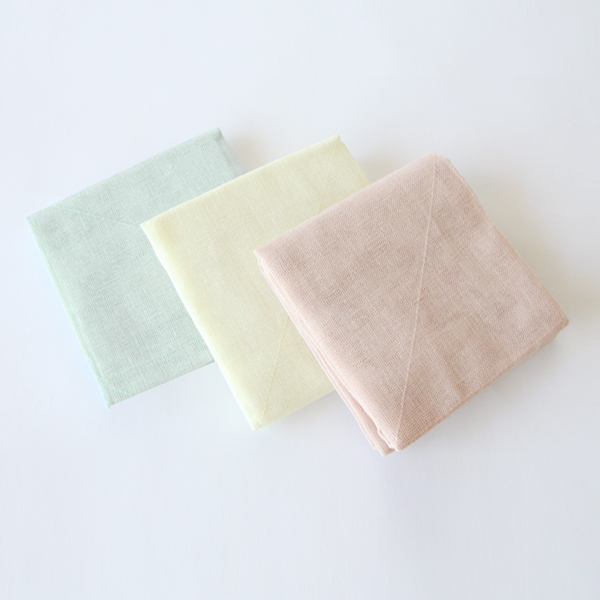
This Hana Fukin is made by layering two sheets of kaya fabric,
and comes in a large size of about 58cm×58cm.
Though it is about four times the size of a regular dishcloth when unfolded,
it is thin and doesn't take up much bulk, while absorbing water surprisingly well,
and dries quickly when left spread out.
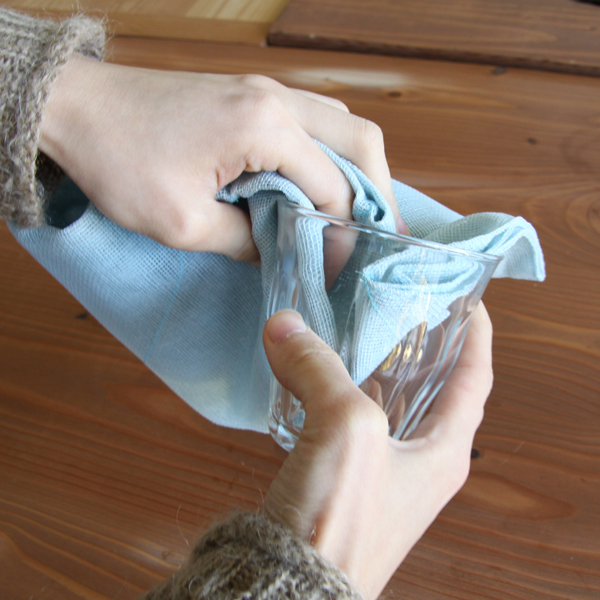
The double-layered fabric has a moderately coarse weave, making it perfect for straining dashi (soup stock).
It's also great for draining tofu, wringing out chakin, and as a cloth for steamed dishes.
Once it becomes soft from long use, it works well as a kitchen cloth.
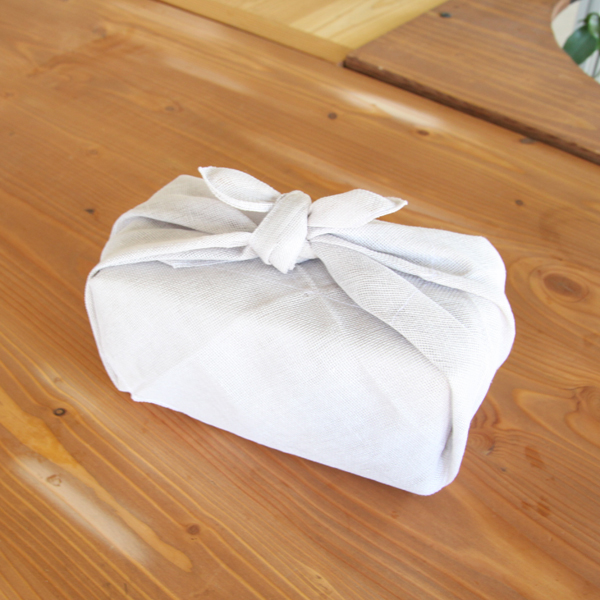
Since it comes in a reassuringly large size, it's also nice to have a set for wrapping bento boxes.
After it has been well-used for quite some time,
it will still faithfully serve its purpose as a cleaning rag right to the very end.
Available in sets of 3 or sets of 5.
Since they come in a gift box stamped with the Nakagawa Masashichi Shoten logo,
they're also recommended as a nice small gift.
The colors of the cloths themselves—sakura, sumire, wakakusa, nanohana, shirayuri, and others—
are named after flowers that bloom in the ancient capital of Nara.
These are cloths you'll want to collect one for every person who uses them.
What Yu Nakagawa values
is Japan's nature and history, its four seasons and culture, and the sense of harmony (nagomi) connected to Japan's spirit of "wa."
Comfortable to use, made from natural materials, and fitting gently with both mind and body,
they treasure "things" and "forms" that bring a sense of harmony, and offer a place where these are passed from hand to hand.

・Nambu tekki (Nambu ironware), with a history of 400 years
It is said that Nambu tekki began in the mid-17th century, when kettle-makers were invited from Kyoto to Morioka in the Nambu domain to make tea-ceremony iron kettles.
In Mizusawa Ward, Oshu City, formerly part of the Date domain, the production of cast iron everyday goods flourished from the late Heian period onward,
and today items are produced using traditional techniques such as baked-mold and dried-mold casting, pattern stamping, surface texturing, and urushi (Japanese lacquer) finishing.
Nambu tekki has two roots: Morioka and Oshu.
The origin of Morioka casting is said to date back to the first half of the 17th century, when the Nambu clan established their castle in Morioka.
As a specialty product of the Nambu domain, tea-ceremony kettles and iron teapots came to be called "Nambu."
Separately, in Oshu City, it is said that the tradition began in the early 12th century, in the late Heian period, when Fujiwara no Kiyohira, who resided at Toyota Palace in Esashi District (present-day Esashi Ward),
invited casters from Omi Province (present-day Shiga Prefecture),
and the tradition developed under the protection of the Sendai domain during the Edo period.
Today, having received designation in the first round under the "Law for the Promotion of Traditional Craft Industries" enacted in 1974,
it became a "traditional craft," and the products made in both regions are now collectively called Nambu tekki.
・Ogasawara Rikucho's modern take on traditional craft
Mr. Ogasawara Rikucho has guided the casting industry in Mizusawa City and made a tremendous contribution to its development.
With over 60 years of experience, he skillfully applies two different techniques for classic Nambu tekki:
"iki-gata" (raw sand molding), which allows only simple shapes but enables mass production, and "so-gata" (traditional block molding), which requires complex processes and skilled craftsmanship,
continuing to create ironware rooted in everyday life.
While carrying on the classic techniques of Nambu iron kettles, he is also a versatile caster capable of producing simple, modern-designed everyday items.
・Ironware you'll want to bring into your daily life
The appeal of Nambu tekki is wide-ranging.
The pattern known as "suname" (sand-textured pattern) that appears during the manufacturing process is created by using what's called a sand
mold during casting. Thanks to the slight indentations left by the sand on this surface,
food becomes less likely to stick.
It's also said that as iron dissolves while heating water or food, it transfers into the water or food,
providing iron that is easily absorbed by the body.
Furthermore, because iron is slow to respond to changes in temperature, once it's heated it doesn't cool down quickly,
and when heating, the heat spreads evenly throughout, so uneven temperatures are unlikely to occur.
◆Sukiyaki Pot
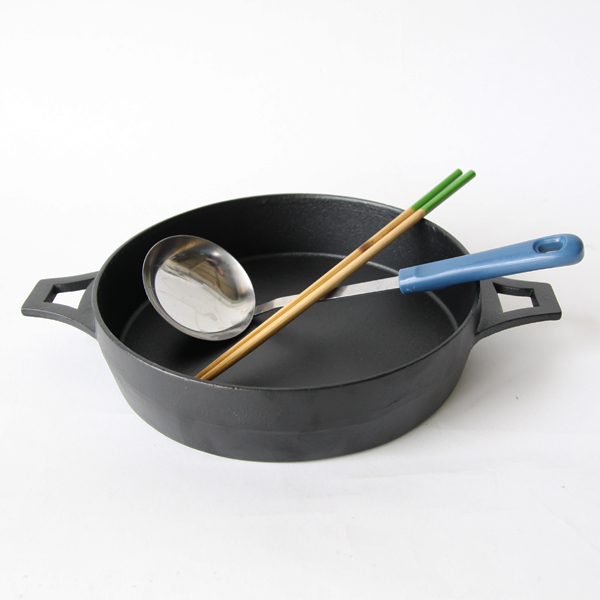
This is a sukiyaki pot. Its substantial heft and modern design are beautiful.
Sukiyaki is a dish that always brings joy when it appears on the table,
and according to one theory, its origins go back to the Edo period, when people would place a farming tool called a 【suki】 (plow) over a fire instead of a pot
to grill fish and tofu—this is said to be how the dish began.
After the Meiji Restoration's wave of Westernization, the beef-based dish we now know as "sukiyaki" became widely known
and has been beloved ever since.
This sukiyaki pot is suited for 3 to 6 people.
Not only for sukiyaki, but also making use of its ability to heat food evenly,
we recommend using it to crisp up the surface of okonomiyaki or to fry gyoza until crispy.
Since it doesn't cool down quickly even when brought straight to the table,
you can enjoy warm food for a long time.
◆Mini Pan
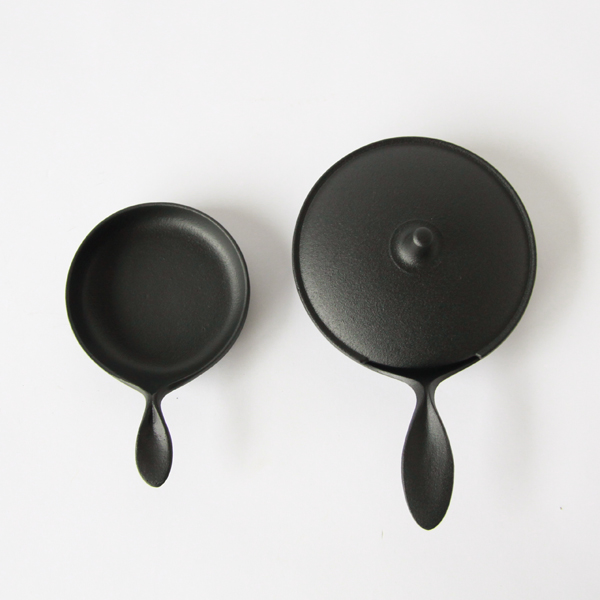
Viewed from directly above, this mini pan looks just like an adorable tadpole.
The small, palm-sized version is perfect for frying a crispy fried egg.
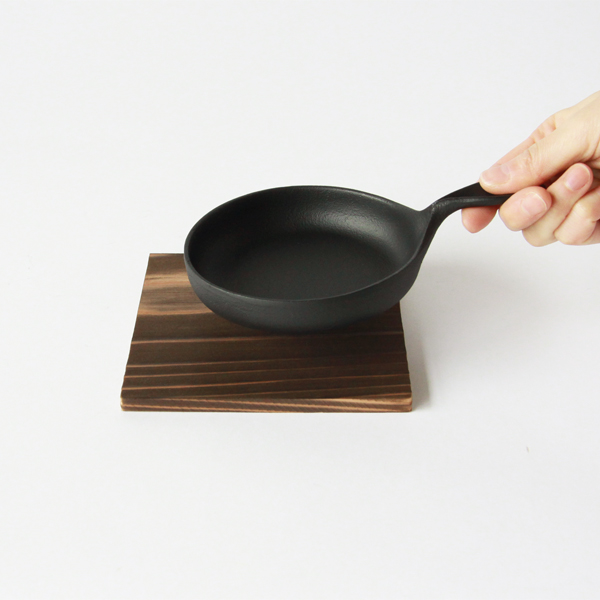
A fried egg cooked in nambu tekki (traditional cast iron from Nambu) is a bit different from one cooked in an ordinary frying pan.
The edges of the fried egg turn wonderfully crispy, so it's nice to serve it straight to the table for a stylish presentation,
or you can place it on top of bread, which is also recommended.
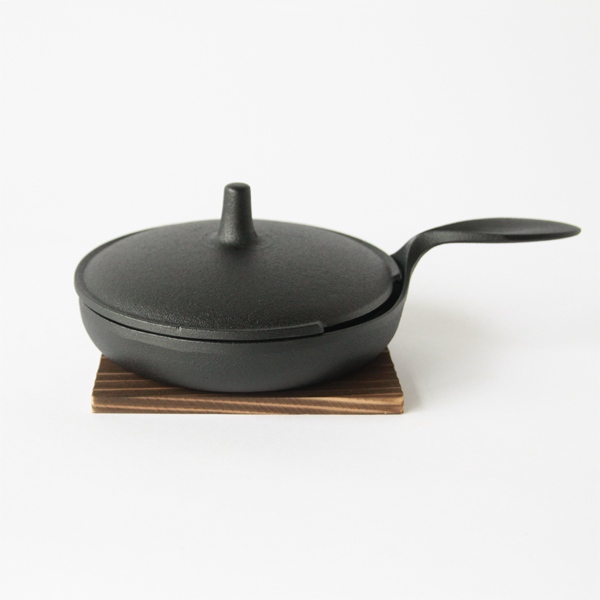
The larger size comes with a lid, and pancakes are especially recommended.
Since heat spreads evenly and uneven temperatures are unlikely,
you get fluffy, delicious pancakes with a nice rise.
For breakfast, a light snack, or dinner,
it might be nice to take your time and try cooking with a nambu tekki mini pan.
▽Related content here
*Currently featuring Ogasawara Rikucho's tetsubin (iron kettle)
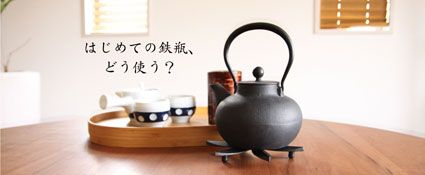
Tools that let you feel Japanese tradition while also sensing a modern breeze.
Sometimes delicious, sometimes fun, and always convenient,
why not gather Japanese tools that you'll want to use and cherish for years to come?
▶︎Japanese everyday tools available here

GUIDE »
CATEGORIES »
- + Gifts by recipient
- + Gifts by scene
- + Clothing
- + Bags / Backpacks
- + Wallets / Card cases
- + Jewelry
- + Shoes
- + Rainy day outfits
- + Kitchen
- + Home
- + Babies / Kids
- + Japanese products
Earn Miles


Payment & Security