.webp)


.webp)


.webp)


.webp)


Welcome to ZUTTO
Free shipping for newsletter subscribers (some areas excluded)
My page
Information
- トップページ/
- ZUTTO Journal/
- 選び方・使い方/
- For delicious ric...

For delicious rice. Japanese tools worth mastering
One of the pleasures of the harvest season is freshly milled new rice. There are so many ways to enjoy rice on its own—steamed until fluffy and warm, mixed with mushrooms for takikomi gohan, or topped with umeboshi for a simple ochazuke. This time, we'd like to introduce some Japanese tools that will help you enjoy rice even more.

While electric rice cookers have become the standard way to cook rice, the traditional donabe (earthenware pot) still holds its own today. Compared to a rice cooker, cooking over an open flame means you can't take your eyes off it, but the flavor of rice cooked in a donabe is truly exceptional. Even if it's not practical every day, why not give it a try on a weekend or a special occasion?

So why does a donabe pair so well with rice? One reason is that heat spreads through it slowly and gradually. This gentle transfer of heat breaks down the starches in the rice, drawing out its natural sweetness and flavor. In addition, the donabe body absorbs excess moisture, balancing the water content of the rice so that it turns out plump and pleasantly chewy. The lid also plays a part in the delicious results: its weight creates a tight seal, building up pressure inside the pot so that each grain of rice cooks up distinct and separate.

Cooking rice in a donabe is also good for the pot itself. The clay used to make a donabe contains a lot of air, leaving the fired body full of tiny gaps. If you start using it in this state, water can leak through or the pot may crack, so donabe require a process called mejime before first use. Mejime involves adding a small amount of leftover rice or katakuriko (potato starch)—something rich in starch—along with water, and bringing it to a boil. Even after this initial treatment, continuing to cook rice in the pot helps fill in the remaining gaps in the clay, gradually turning it into a stronger pot that will serve you well for years to come.
▼Please refer to this article for how to do mejime
Journal: "Mastering Your Donabe"

The TOJIKITONYA Iga-tsuchi Maru Donabe (four-person size) gets its name from the rim encircling the pot, which resembles the traditional Japanese "maruwa" pattern. Made from high-quality Iga clay, it offers excellent heat retention and heat storage. At about 2000g, it's relatively light for a four-person donabe, and its design lets you pick it up from any angle around its 360-degree rim, making it easy and pleasant to handle. Of course, it's not just for rice—it also shines as the star of a nabe hot pot.
▼How to Cook Rice in a Donabe
(Be sure to perform mejime the very first time you use the pot. Suddenly exposing a brand-new donabe to high heat can cause it to crack, so please take care.)
1. Rinse the rice lightly, then let it soak in water for 30 minutes to an hour.
2. Drain the water, transfer the rice to the donabe, and add water in proportion to the rice (as a guide, 440–450ml for 2 go of rice).
3. Place the donabe over medium to high heat. Once it comes to a rolling boil, reduce to low heat and let it cook slowly for 15 minutes. Be sure not to open the lid during this time.
4. Once the rice is cooked, remove the pot from the heat, drape a cloth over it, and let it steam for about 10 minutes.
5. Your warm, freshly cooked donabe rice is ready to enjoy.

If cooking rice in a donabe seems like the ideal way to go, but actually doing it feels like a bit too much trouble…, we recommend the TOJIKITONYA rice pot. At first glance, it looks like a simple deep ceramic vessel with a lid, but it's actually a clever piece that can cook rice either over an open flame or in the microwave.

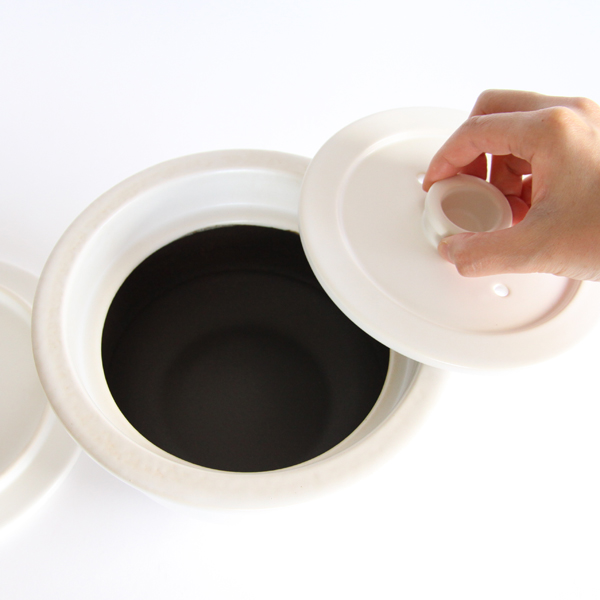

This rice pot has been carefully designed to cook rice deliciously in the microwave. A special glaze is applied to the inside of the pot, which heats up in response to microwave radiation, warming the pot itself from within. This design brings out the same natural sweetness you'd get from cooking rice over an open flame.
Its two-go size also makes it easy to use in daily life. Not only does it fit neatly in the microwave, but leftover rice can be covered with the lid and stored as is in the refrigerator.


Depending on the heat source, cooking two go of rice takes about 8 to 10 minutes over an open flame, or 12 to 15 minutes in the microwave. For those of us living busy modern lives, being able to cook delicious rice in such a short time is truly reassuring.
TOJIKITONYA's rice pot was born in Mie Prefecture, famous as the home of Banko-yaki (Banko ware) pottery. Drawing on generations of accumulated ceramic-making skill and knowledge, the maker continues to challenge itself with new pottery designs suited to modern life.

If you'd like to temporarily store freshly cooked rice, or reheat rice that's been kept in the refrigerator, we recommend trying a wooden wappa. A wooden wappa absorbs and releases just the right amount of moisture, keeping rice at an ideal level of humidity. Steaming rice in one also restores fluffiness to rice that has gone cold, bringing back its delicious flavor.


The wappa made by Adachi Shigehisa Shoten is a seiro (steaming basket) that has been crafted continuously since the late Edo period. It is a magemono—a beautifully bent wooden vessel—made using tsuga (hemlock), bamboo, and hinoki (Japanese cypress) as appropriate. The set includes a base, body, lid, and an inner sunoko (bamboo slat rack).
A ridge on the inside of the body (marked by the red arrow) supports the sunoko, creating a gap between it and the bottom of the vessel. This allows steam to circulate and heat to reach the food evenly. It's a seiro you can easily use not only for rice but also for steaming vegetables.
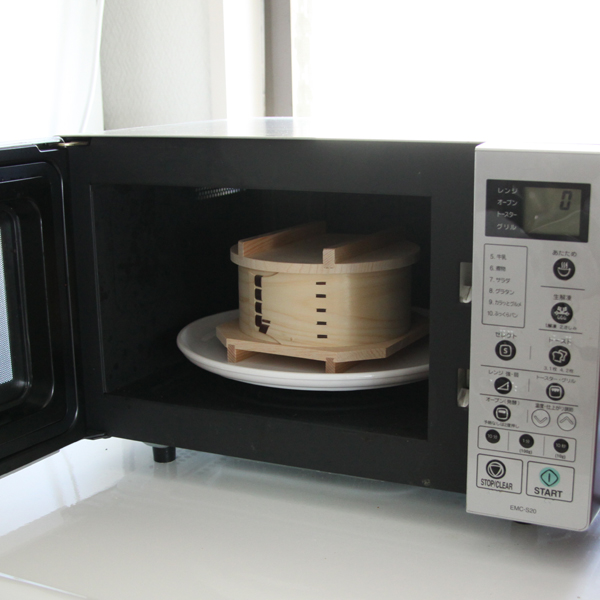
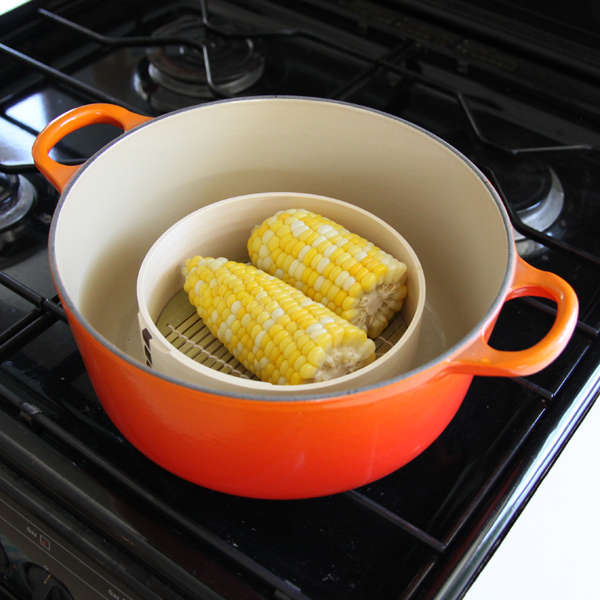
The wappa (bentwood containers) from Adachi Shigehisa Shoten are, above all, appealing for how easy they make cooking. To start, they can go straight into the microwave—for reheating leftover rice, for example, simply place the rice directly on the slatted base, close the lid, and microwave it. Compared to rice wrapped in plastic wrap, the heat spreads evenly through every grain, resulting in beautifully fluffy rice. For root vegetables and other ingredients that take longer to cook through, you can place the whole steamer basket into a larger pot, pour water around it, and steam. Even more elaborate Chinese dishes, like shumai, can be made using a similar method.
It's sized to fit in a microwave, and being light and compact, it's also easy to handle in the kitchen—a welcome feature. It works just as well served straight to the table.

There are other Japanese tools, too, that go beyond just cooking rice, useful for storage and at the table as well. Such tools are filled throughout with age-old wisdom.

Made entirely without nails or any metal fittings, the rice bin from Azumaya is crafted entirely from kiri (paulownia wood). Kiri contains compounds such as tannin, sesamin, and paulownin, giving it strong antibacterial and insect-repellent properties that protect rice from pests and mold. Its porous fiber structure also makes it remarkably light while excelling at regulating humidity. With its smooth, beautiful grain, the kiri rice bin has a striking presence.
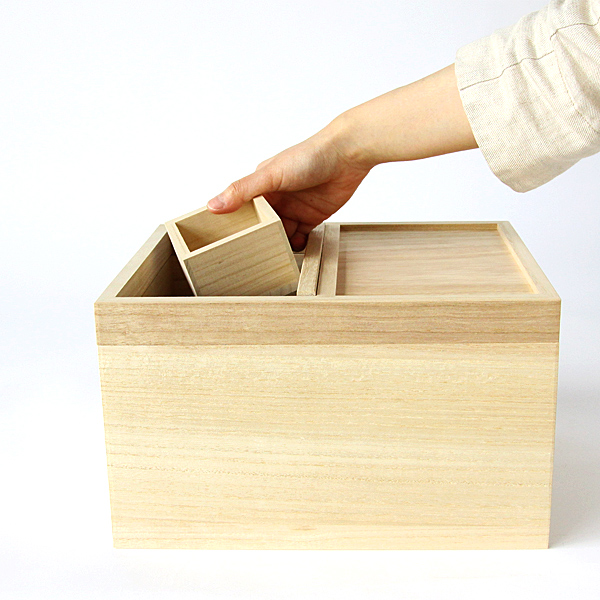
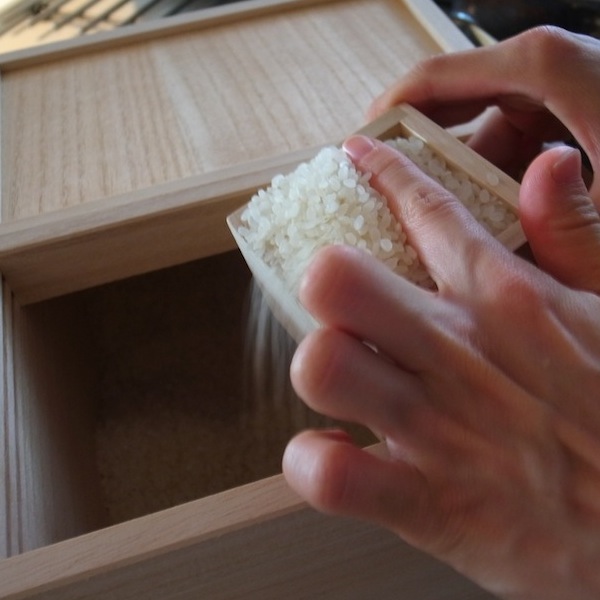
Rice is taken out and put in through a sliding door. This technique, which seals the bin tightly to prevent both drying out and excess moisture, is a testament to the skill of Japanese craftsmanship. The Azumaya rice bin comes with a one-go masu (measuring box), making it a Japanese tool that's also well received as a gift.


The ohitsu is well known as a tool for temporarily storing freshly cooked rice. You've probably seen one at a ryokan before. When storing cooked rice, the key is maintaining a good balance of moisture in the grains. For instance, if you leave rice sitting in a rice cooker with the warming function turned off, the surface can become dry and crumbly. On the other hand, leaving it in a sealed container can make it sticky and damp from the moisture released by the rice itself. For rice that requires this kind of delicate moisture balance, a wooden ohitsu—which absorbs and releases moisture just the right amount—is ideal.
The Edo Bitsu 15C (with rice paddle) from Yamaichi is an ohitsu made from Kiso sawara (Japanese cypress). Sawara naturally contains a good amount of oil, giving it strong resistance to water and acid. This means that when rice is placed inside, it maintains just the right level of moisture and softness. Its relatively compact size is another welcome feature, fitting neatly on a table or in the kitchen without getting in the way. The beautifully curved sawara wood, crafted by skilled artisans, along with the copper used for the hoops, reflects a form that has long been cherished in Japan.

The last item we'd like to introduce is the chawan (rice bowl), an essential part of enjoying a bowl of rice. Though we simply call it a "chawan," there's actually surprising variety in size, from diameter to depth. The Hira Chawan from Hakusan Toki, a maker that continues to produce Hasami-yaki in Nagasaki Prefecture, is a classic among such bowls, easy for anyone to use.

One of the most important qualities in a rice bowl is how easily it can be held with one hand. The Hira Chawan from Hakusan Toki has a height that even women can hold comfortably, and its generous width allows for just the right amount of rice to be served. It's an item that truly embodies Hakusan Toki's dedication to ease of eating and ease of use. With its wide range of colors and patterns, it also adds a bit of fun, making you want to choose a bowl to match your mood.
▼A pottery shop born in Mie Prefecture. TOJIKITONYA

▼Japanese tools, made while continually refining their design. Azumaya

▼Devoted entirely to bentwood craft. Adachi Shigehisa Shoten

▼Blessed by the rich bounty of the Kiso mountains. Yamaichi

▼Continuing to create everyday tabletop essentials. Hakusan Toki

GUIDE »
CATEGORIES »
- + Gifts by recipient
- + Gifts by scene
- + Clothing
- + Bags / Backpacks
- + Wallets / Card cases
- + Jewelry
- + Shoes
- + Rainy day outfits
- + Kitchen
- + Home
- + Babies / Kids
- + Japanese products
Earn Miles


Payment & Security