.webp)


.webp)


.webp)


.webp)


Welcome to ZUTTO
Free shipping for newsletter subscribers (some areas excluded)
My page
Information
- トップページ/
- ZUTTO Journal/
- 選び方・使い方/
- Mufflers and Stol...

Fine mufflers and stoles from a distinguished British brand. How to choose a classic piece you'll cherish for years
When we think of winter essentials, mufflers come to mind first. Compared with clothing, where size and silhouette make a huge difference in whether something suits you, a muffler—simply wrapped around the neck—is an item that's genuinely fun to choose.
At the same time, because it occupies a certain amount of space around your face, the color and pattern of a muffler can dramatically change your overall impression. You might choose one because you love the pattern, only to find it doesn't quite suit you once you actually wrap it on. Or you might pick a wintery color as a gift, only to worry whether it will really suit the recipient. These small dilemmas tend to come up precisely because mufflers are such an easy, approachable item to incorporate into your wardrobe.
With an eye toward enjoying a muffler in a rich variety of colors and patterns for years to come, here are some hints for choosing a piece that suits you perfectly—or one that would make the ideal gift for someone special. We'll be looking at Highland Tweeds, a distinguished British brand renowned for its mufflers and stoles. With such a wide-ranging lineup, you're sure to find a favorite of your own.


Have you ever wondered where a "muffler" ends and a "stole" begins? The names differ depending on size, but the width and length vary from brand to brand, and there doesn't seem to be any clear-cut standard. To put it simply, the general convention is to call something you wrap around your neck a "muffler," and something you can drape over your shoulders a "stole."
A muffler is typically about 30cm wide and 160-180cm long overall—dimensions that work comfortably for both men and women when wrapped in the classic styles, such as wrapping it once around and letting the fringed ends hang down on either side, or folding it in half and threading the fringe through the loop.
Stoles, on the other hand, come in a much wider range of sizes than mufflers. A thin stole can be folded narrower and worn around the neck just like a muffler, while a thicker one can be draped over the shoulders more like a cardigan.


This photo compares two ways of wearing a 25×180 (cm) muffler on a woman who is 158cm tall. If it's too short, your styling options are limited; if it's too long, it becomes harder to balance with your outfit—so finding "just the right length" is key. At 180cm overall, it's easy to wrap it once around and still tie a knot in the fringed ends on either side. And now that winter is truly here, you'll likely find yourself wearing bulky high-neck knits more often. For wrapping a muffler around your neck without it feeling too tight over such a collar, this is about the length you'll want.

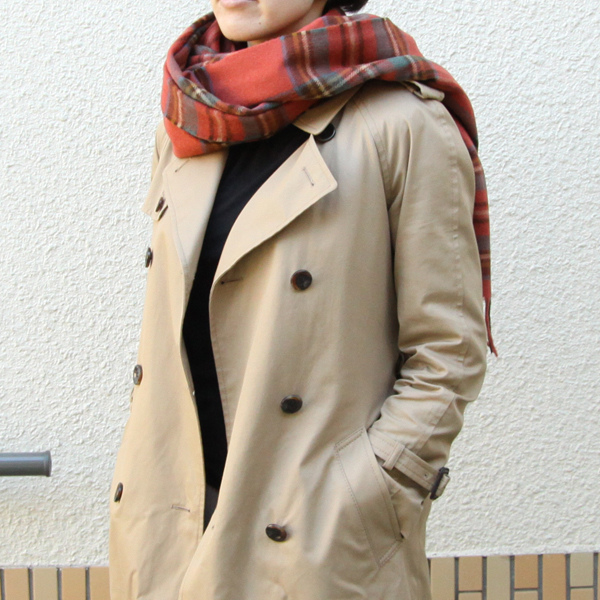
This next photo shows the same woman wearing a 50×185 (cm) stole. It's the same thickness as the muffler above, but roughly twice the surface area. It can be draped generously over a coat as a stole, of course, but when folded narrower, it has enough volume to double as a muffler as well. Since it works for both "draping" and "wrapping," you can style it in countless ways depending on your outfit and how cold it is.

"A navy knit is a must-have," "somehow I keep ending up with more green accessories," "my jewelry hardware is always silver"—without even realizing it, our belongings tend to skew toward certain colors. Ideally, the "color you love" and the "color that suits you" would be one and the same, but it often happens that you buy something in a color you love, only to find it's hard to coordinate with the rest of your wardrobe, and the season ends before you've had much chance to wear it.
After thinking about size, let's now consider mufflers and stoles from the perspective of choosing "color" wisely.

For instance, even something as simple as "a muffler in a red check pattern" can vary enormously—in the tone of the base red, or in the combination of other colors that make up the check. Since both mufflers and stoles occupy a certain amount of space around your face, even a slight difference in color tone can completely change the impression you give. In such cases, it helps to match the piece to your own skin tone, or to adjust the overall look by coordinating with accessories.


What's worth checking here is whether your own skin tone leans "yellow-based" or "blue-based." For women, an easy way to tell is by considering which family of blush colors suits you best: "orange tones" (salmon, coral, apricot, and the like) or "pink tones" (fuchsia, magenta, rose, and the like). Generally speaking, if orange-toned blush suits you, your skin tone is considered "yellow-based," and if pink-toned blush suits you, it's considered "blue-based." Another way to check is by looking at the skin on the inside of your arm: if your veins appear greenish, you're likely "yellow-based," and if they appear bluish, you're likely "blue-based."

For example, blue-based skin tends to look somewhat pale or lacking in color, but a muffler like this one, with red used as an accent color, adds a sense of "warmth" and "brightness," giving the face a livelier impression. The base is a monotone palette of white, gray, and black, but you can see how adding even a small area of red dramatically shifts the overall impression. In addition, the burgundy used alongside it as an accent color has cool blue undertones, which also pairs well with blue-based skin.

If you have yellow-based skin, you're probably among the many people who tend to avoid mufflers and stoles with a blue or purple base, since those colors can clash with your skin tone. This next piece is one we'd love to recommend to exactly that kind of person. Its base is a coral tone that blends beautifully with the skin, with blue and yellow serving as accent colors. Yellow and blue sit directly opposite each other on the color wheel in what's called a "complementary" relationship, and when placed together, they're said to bring out the best in each other more than either color would alone. The overall palette is calm and understated, but with yellow and blue as complementary accents, the whole look takes on a bright, cheerful impression.
Also, since blue occupies a relatively large portion of the pattern, this color combination actually works well with blue-based skin tones too. As the blue harmonizes with the skin, the warmth of the coral and yellow helps create a sense of coziness. Looking at things from the perspective of "color combinations," checked mufflers might be considered an excellent item that lets you enjoy the best of both worlds—colors you love and colors that suit you.

The trick to coordinating a muffler that contains multiple colors also applies to how you pair it with your clothing and other accessories.

Here's an example of matching colors between accessories and a muffler. The bordeaux included in the check pattern matches the body of the bag and the trim of the gloves. A muffler that contains three or four colors in a single item already draws the eye on its own, so if you add mismatched accessories on top of that, the overall look ends up feeling unfocused and cluttered. In cases like this, matching the color of your accessories creates a sense of cohesion. Here, since a larger area of accent color would make too strong an impression, we recommend using a slim muffler as a single accent point rather than a large stole.

Next up is an example pairing a green stole. The gloves and bag are the same as in the previous coordination, but you can see how much the impression changes depending on the area and color of the scarf you combine with them. Since green and red are complementary colors, wearing them together creates a striking contrast effect. Bordeaux brings out the green, and green brings out the bordeaux—each color enhances the other.

Choosing a stole or muffler runs this deep just from the perspective of color selection alone. What's more, the checked pattern itself carries a wonderful story cultivated over a very long history. In medieval Scotland's Highland region, each area was governed by its own clan. Tartan was the pattern used to distinguish between these clans—much like a family crest in Japan. Tartan is defined by the rule that the warp and weft threads are arranged identically, forming a square check. Today, tartan has become one of the standard patterns in fashion, but it can be said to be a pattern with a truly noble and storied origin rooted in Scottish history. Since these are all check patterns that have taken root as classics, they make wonderful choices both for yourself and as gifts.
Let's take a look at a few of the classic tartan checks here.
Royal Stewart

When you hear "tartan check," this is probably the pattern everyone thinks of first. The Stewart family was a long-reigning, traditional clan that held the throne from the 14th century onward. As the name "Royal" suggests, this tartan is connected to the royal family, and it's said that in the past, retainers wore it solemnly under the queen's permission. Beyond this pattern, any tartan check bearing the name "Stewart" can be imagined to have some connection to the Stewart royal family or the British royal family.
Black Watch

DRESS GORDON

The Black Watch pattern above is a traditional check that was used in military uniforms. This too is a classic check pattern that everyone has likely seen at least once. Originating with the Campbell family, this check pattern was used in the uniforms of an army organized by King George I of the Kingdom of England, who had come from Germany. It's said that the dark color was chosen deliberately to distinguish it from the red uniforms of the English army, which was at war with them at the time—a pattern whose history speaks to its practical, functional origins.
And below is Dress Gordon, the pattern of the Duke of Gordon of the Gordon clan. The Gordon clan's pattern, which had governed eastern Scotland since around the 12th century, is said to have been created based on Black Watch. Dress Gordon is a more feminine arrangement of the Gordon tartan with white added, and it has a history of being cherished by duchesses and the women of the clan.

So far we've mostly covered how to choose a muffler or stole in terms of size and color, but once you've found your favorite piece, you'll want to pay attention to how you wear it too. Wrapping it once and tying the ends. Wrapping it twice. These classic styles are fine, but knowing a style with a bit more variation lets you enjoy your scarf in many different ways, making it that much more fun to wear. This time, we'd like to introduce one arranged wrapping style that checks all three boxes: easy to do, beautifully shows off the pattern, and keeps you warm.

The wrapping style we'd like to introduce is this one. With a look reminiscent of woven fabric, the lines of the check pattern crisscross vertically, horizontally, and diagonally, creating a dynamic finish. A thin wool stole needs to be wrapped snugly around the neck, or else the wind will get through and cut the warmth in half—but on the other hand, wrapping a wide stole around multiple times can feel constricting and make the neck area bulky. This is a practical wrapping style that solves exactly that problem, so please give it a try.

We'll show you using a stole measuring 50×185(cm). Here's the size when unfolded. It's generously large enough to drape over your shoulders.

1. Fold the stole in half lengthwise and drape it around your neck.
2. Wrap it once around so that a loop forms at the front of your neck. The key point here is to make the loop nice and loose.
3. Twist the loop you made in step 2 into a figure-eight shape to create a small loop. (Marked with a circle in the diagram)
4. Tuck one end into the small loop.
5. Next, tuck the other end into the loop as well.
6. Adjust the fringe and you're done.
What makes this interesting is that it adds a "twist" to the classic single wrap, and by tucking in the fringe on both ends, it creates a three-dimensional look. Because it naturally creates height around the neck like a high collar without needing to be pulled tight, it blocks the wind well and is quite practical. This wrapping style also works with muffler-sized pieces, as long as they're around 180cm in length.


Wool products contain a substance called lanolin that helps repel moisture, making wool an excellent material that naturally resists dirt. Because of this, you don't need to be overly particular about caring for wool mufflers and stoles used in everyday life. To keep them lasting a long time, though, be sure to periodically check for dirt and give them proper care.
As the season brings more opportunities to layer fibrous items like long-pile knits, mufflers, and coats, friction tends to generate static electricity that attracts dust and debris, causing it to tangle in the fibers. If left as is, this can lead to moth damage, and disturbed fibers can also cause pilling.
Brushing with a clothes brush restores the flow of tangled fibers and removes dust and debris. It also reduces fiber fuzziness, which helps prevent new dust from sticking. Be sure to use a clothes brush made from a natural material that doesn't generate static electricity easily. We recommend boar bristle, which has just the right amount of firmness.
Also, since you can't take these items to the cleaners often, you'll want to pay attention to odor care as well. In places prone to odors and humidity, like crowded restaurants or packed trains, try to fold the item up and keep it in your bag as much as possible. If it does end up picking up an odor despite your best efforts, treat it with a deodorizing spray that's safe for use on wool products. Airing it out in the breeze, away from direct sunlight, will help reduce the smell.


Abraham Moon & Sons Ltd is a long-established textile maker founded in 1837. Its history began in the town of Guiseley, near the city of Leeds, and around the Yorkshire Dales, where its fabrics were beloved by many local people. Abraham would load fabrics woven on hand looms in each local household onto a horse and cart, carrying them to Leeds to sell at market. Thirty years later, the company established its own factory, and by the early 1890s, it had begun exporting to Japan as well.

In the early 1900s, the company moved to its current factory, making it possible to carry out dyeing, blending, spinning, and weaving all under one roof, and this tradition continues to be passed down to this day. Abraham Moon & Sons supplies fabric to world-renowned brands, and as a trusted wool maker whose products are used by five-star luxury hotels in Scotland, the company produces Highland Tweeds, the premium line we've been introducing here. Highland Tweeds offers an abundance of beautiful colors and patterns beyond what we've covered here. We hope you'll find your own favorite piece to cherish for years to come.
▼A distinguished wool house with roots dating back to the era of Queen Victoria
ーAbraham Moon & Sons・Highland Tweeds

▼An array of tartan checks crafted by a distinguished wool house
ーHighland Tweeds

GUIDE »
CATEGORIES »
- + Gifts by recipient
- + Gifts by scene
- + Clothing
- + Bags / Backpacks
- + Wallets / Card cases
- + Jewelry
- + Shoes
- + Rainy day outfits
- + Kitchen
- + Home
- + Babies / Kids
- + Japanese products
Earn Miles


Payment & Security