.webp)


.webp)


.webp)


.webp)


Welcome to ZUTTO
Free shipping for newsletter subscribers (some areas excluded)
My page
Information
- トップページ/
- ZUTTO Journal/
- 選び方・使い方/
- Warm to your fing...

Keeping your fingertips warm: fitting and care tips for enjoying gloves in comfort
Once your fingertips get cold, it can take a surprisingly long time for them to warm up again, even after stepping into a heated room. Many women in particular tend to feel the cold in their extremities, and along with cold feet, this becomes a common winter complaint. Once winter truly sets in, numb, stiff hands can make everyday life difficult—typing on a computer or smartphone keyboard becomes awkward, and even household chores feel like a struggle.
One item that can solve this problem is the humble glove. This time, we'll introduce some tips for choosing and fitting gloves so you can wear them comfortably for a long time.


What to look for beyond design
Since gloves are often thought of as fashion accessories, they tend to be chosen mainly for their design—in other words, their appearance—and we rarely stop to think carefully about their materials or construction. But when you consider their role as protection against the cold, the type of material used and how the pieces are sewn together make a big difference to both the fit and the warmth.
■Why leather and knit are used for gloves
To begin with, there are two materials that are especially characteristic of gloves: "leather" and "knit."


Top: sheepskin gloves
Bottom: knit gloves (75% yak, 25% bamboo)
Gloves require delicate, complex shaping to wrap around our fingers, and when worn, they must accommodate the movement of five fingers bending independently. It's important that gloves are not just warm, but that they follow the shape of the fingers without pulling or straining when making delicate movements like bending and stretching. In this respect, leather—which is naturally supple and can change shape somewhat to follow the movement of what's inside it—and knit, which stretches easily thanks to its elasticity, are both ideally suited to gloves. You'll also find many gloves made from other soft, supple materials, such as wool or cashmere felt.

The advantage of leather gloves is that they combine two strengths: being "thin and supple" while also being "warm." They're also functional in that they block the wind well. Depending on the type of leather, they may feel a bit stiff at first, but as you continue to wear them, they mold to fit your fingers—making them a great choice for anyone who wants to wear the same pair for years, beyond just a single season.
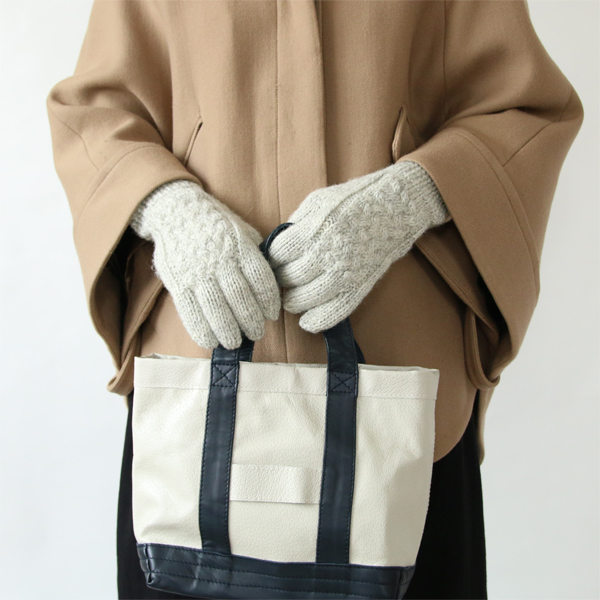
The strength of knit gloves lies in their cozy feel—they're warm from the moment you slip your hands in. Thanks to their natural stretch, they're easier to fit than leather gloves. They also look warm and can be worn cutely with casual outfits, which is another nice point.
Compared to leather, wind tends to pass more easily through the gaps between the stitches, so wearing them together with leather gloves in the depths of winter is one way to stay more comfortable.
■Pay attention to the liner material, which affects the fit
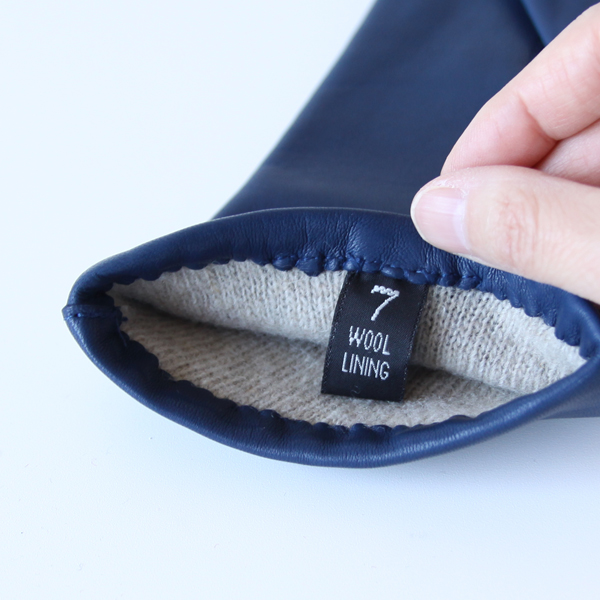
Especially with leather gloves, the inside that touches your hand directly is often fitted with a liner (lining). Leather has two sides—the grain side (front) and the flesh side (back)—and since gloves are made so that the grain side faces outward, a comfortable material is often used as the lining on the inside, where it touches your hand directly. Wool, cashmere, and other autumn-and-winter-appropriate fabrics are frequently used for liners. Since the feel against your skin when you put your hand in changes greatly depending on the liner material, it's important to check not only the outer material but also whether a liner is included, and if so, what material it's made of.
■How outseam and inseam construction change the impression and fit
Another thing worth checking when choosing leather gloves is how the seams are finished. Because of their structure, gloves are generally sewn all the way around to form the silhouette of five fingers, but the finished look differs greatly depending on whether the seams are placed on the outside or the inside of the glove. Gloves with the seams on the outside are called "outseam," while those with the seams on the inside are called "inseam."
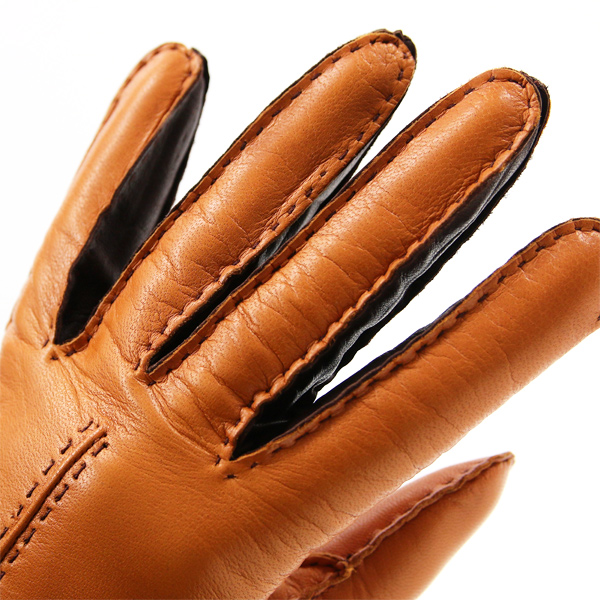
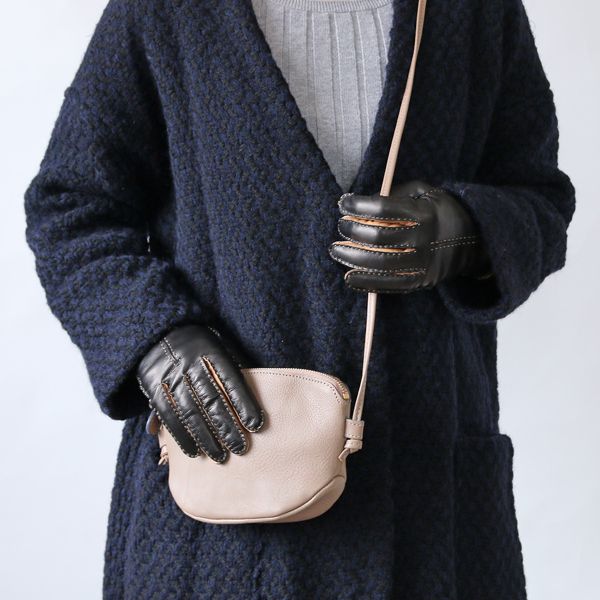
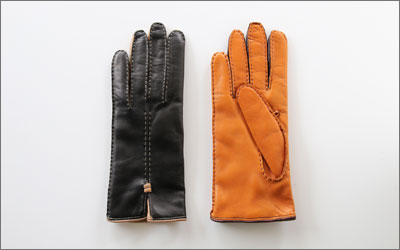
This is an outseam glove. It's made with the stitching visible on the outside. Since the seams and seam allowance sit on the outside, the stitching becomes a nice accent. Often, a thread of a different color from the fabric is deliberately used for sewing, letting you feel the craftsman's handiwork and sense the maker's playful spirit.

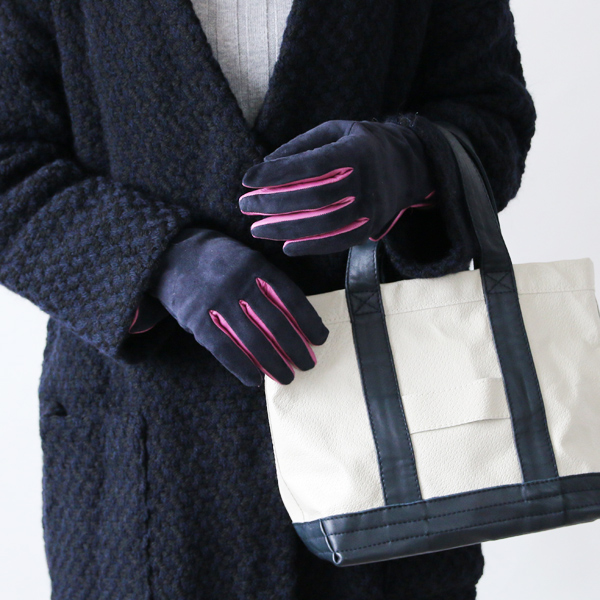
This one, on the other hand, is an inseam glove. As you can see, there's no visible stitching on the outside, giving it a dressier feel. Depending on the sewing method, when the seams are placed on the inside, the seam allowance is often tucked inside as well, which tends to make the parts where you insert your fingers relatively slim—another characteristic of inseam gloves. These are recommended for anyone who wants a snug fit and enjoys letting the leather gradually mold to their hand.
Fitting tips for comfortable wear
Along with the material, how you choose your size determines the fit. Compared to clothing like shirts, skirts, and pants, where you carefully check the length and width, the size range for gloves isn't especially wide. However, with gloves, a difference of just a few centimeters in palm size or finger length can change the fit considerably, so it's worth checking sizes with the same care you'd use for clothing.
■What's the difference between "free size" and "one size"?
This is something that's easy to overlook, but when a design is sold in only a single size, it's worth checking whether that size is labeled "free size" or "one size." The nuance behind each term is as follows:
Free size: a size intended to fit a wide range of people, regardless of height or build.
One size: This refers to sizing that has no size range and is sold as a single, fixed size.
This carries a meaning along these lines. In clothing, this term is applied to items like sweaters with no defined shoulder line and a relaxed body width, or wide pants with an elasticated waist—items designed with features that allow people of a wide range of sizes to wear them are called "free size." When it comes to gloves, examples include arm cover types with no fingertip section, or loosely knitted mitten types made with a low gauge.
Unless you're shopping at a specialty glove store, it's rare to find detailed size ranges such as S/M/L/LL—most gloves are sold in a single, average size. For five-finger gloves offered in "one size," it's best to check detailed measurements such as width and finger length.


As shown in this photo, arm warmers designed with an open end—so they can be used without restricting the length of the fingers or palm—fall into the "free size" category. Knitted versions in particular stretch to fit the hand to some degree, which is a nice point in that you can wear them without worrying too much about minor size differences.
This can also be a good option when you want to give gloves as a gift but are worried about getting the size right.
■Use "hand circumference" as a guide for finding a size that fits you
When a product isn't offered in free size but only in a single fixed size, it's especially natural to wonder whether that size will actually fit your hand. When you can't try gloves on, such as when shopping online, you'll need to check the size listing to see whether it will fit your hand. If detailed measurements are given—such as the full length of all five fingers and the width of the palm—it becomes easy to compare them with your own hand size. Don't be lazy about it: measure the length of your own fingers and compare them against the glove's stated size.
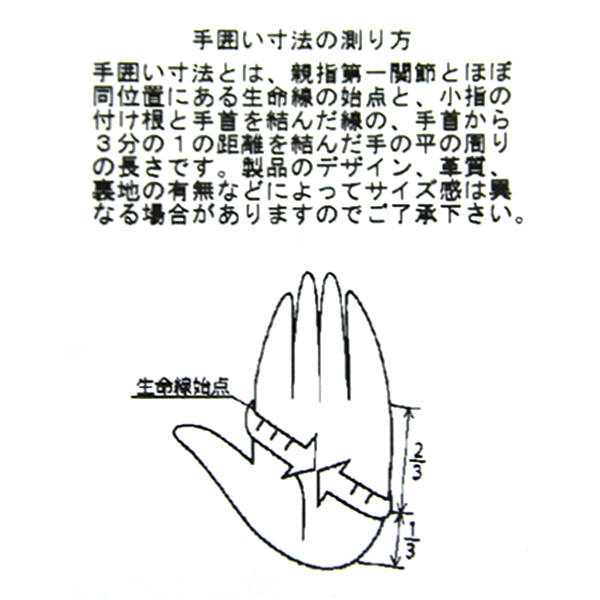
That said, it's rare for standard glove size listings to include the length of every individual finger; instead, sizes are often given as "hand circumference" and "overall length." Hand circumference is a measurement method unique to gloves, taken by wrapping the tape measure around the palm. As shown in the diagram, you measure around the line connecting the "starting point of the life line" and "the point one-third of the way from the wrist along the line connecting the base of the little finger and the wrist." Even a slight shift in measuring position can throw the result off by several centimeters, so measure carefully.
Because hand circumference takes into account not just the width of the palm but also its thickness, it's a more detailed measurement method than simply measuring the width of the hand. For example, if "the overall length is sufficient, but the hand circumference measurement is short," this means the glove is cut narrow relative to its length, and there's a good chance the palm area will feel tight when actually worn.
Maintenance for long-term use
Once you've chosen a favorite from among the many gloves out there, you'll naturally want to keep using it for a long time. As we've seen so far, gloves have all kinds of characteristics depending on their material, shape, and construction. The key to making gloves last is caring for them appropriately according to the material they're made from.

■Watch out for water with leather, and maintain it while keeping an eye on its condition
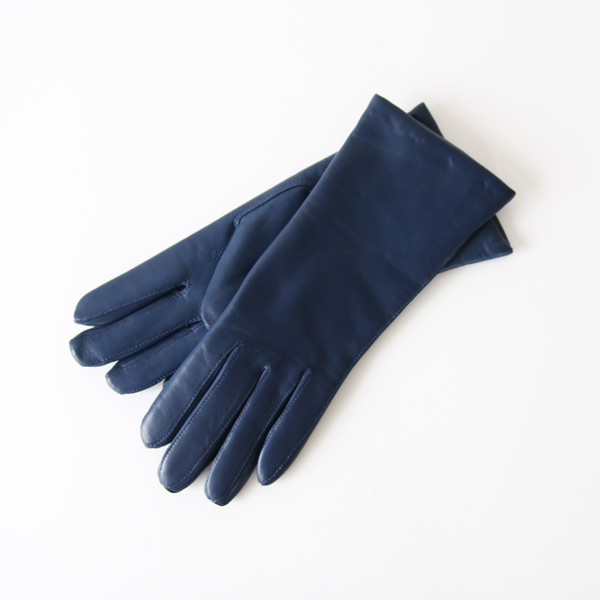
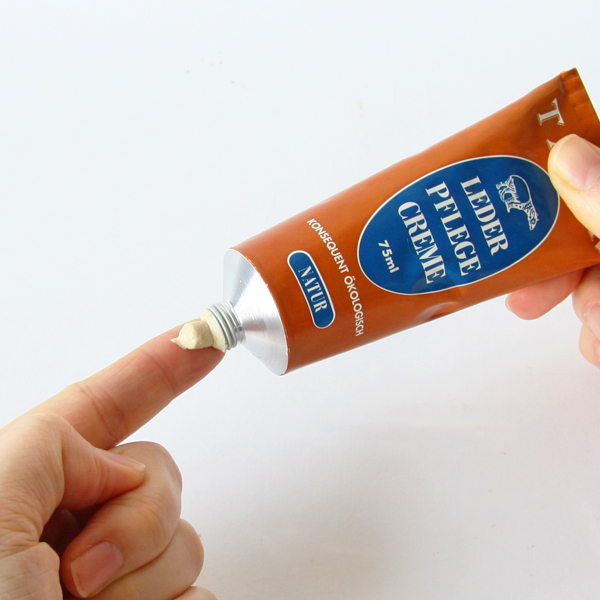
This isn't unique to gloves, but gloves made from natural leather need regular moisturizing, just like our own skin. That said, gloves don't need to have moisturizing cream applied all that often.
This is because the leather used for gloves in particular is often chosen for its softness and suppleness—selected from soft, pliable parts of the hide so it can move naturally with the hand—making it a much thinner, more delicate leather compared to what's used for bags or shoes. Over-moisturizing can actually cause the leather to stretch out or trap moisture. Moisturize appropriately when dryness becomes noticeable, and carry out care suited to the leather's particular characteristics on a regular basis.
Also, since leather is a material that's vulnerable to water, avoid wearing leather gloves on rainy days, and be careful not to let them come into contact with water while wearing them. This calls for particular care with matte finishes such as suede and nubuck, where areas that get wet tend to leave visible stains.
■For cashmere and wool, take steps to reduce pilling and friction

When the main material is an animal fiber like cashmere or wool, pilling is the issue to watch out for. As with ordinary knitwear, friction easily causes pilling, so the key is to avoid creating situations where the gloves rub against other things. Be especially careful if you're the type to unconsciously rub your hands together, or to rub them heavily against a bag handle or a handrail. If pilling does occur, don't pick it off with your fingers—cut it away with scissors instead, then smooth the direction of the fibers.
■What you can do to make the liner last longer
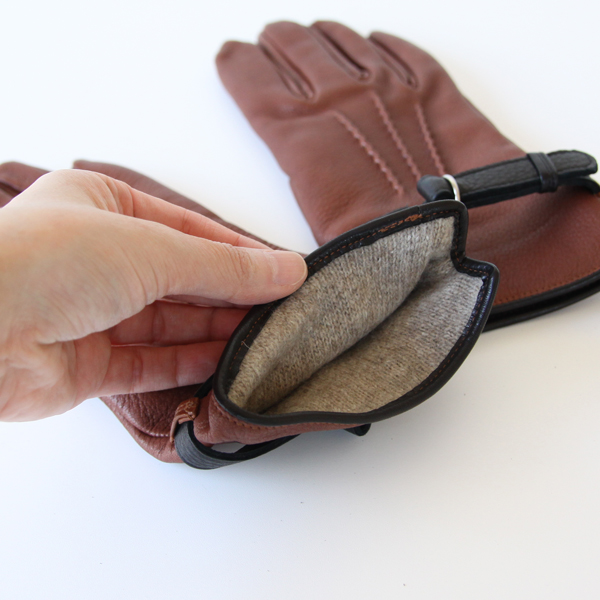
Leather gloves in particular often have a wool or cashmere liner on the inside, and the difference in durability between the two materials is worth paying attention to. In other words, even if the outer leather is still sturdy and looks like it could last a long time, it would be a shame to ruin an otherwise good pair of gloves because the inner liner has worn out and deteriorated. To keep the liner's deterioration to a minimum,
・Be mindful of accessories that can easily snag on the fabric.
・After applying hand cream, make sure it has fully dried before putting on your gloves.
・Take your gloves off in places where you tend to sweat, such as indoors or on the train.
These are the points to keep in mind. Women in particular often catch accessories such as rings with stones or bracelets with delicate metal fittings on the liner fabric, damaging it in the process. Conversely, if the liner fibers catch on an accessory, accidents can happen too—stones or fittings coming loose, or getting bent out of shape. It may seem like a bit of a hassle, but it's safest to avoid combinations of gloves and accessories that could put strain on both.
▽Looking for gloves? Browse them here
GUIDE »
CATEGORIES »
- + Gifts by recipient
- + Gifts by scene
- + Clothing
- + Bags / Backpacks
- + Wallets / Card cases
- + Jewelry
- + Shoes
- + Rainy day outfits
- + Kitchen
- + Home
- + Babies / Kids
- + Japanese products
Earn Miles


Payment & Security