.webp)


.webp)


.webp)


.webp)


Welcome to ZUTTO
Free shipping for newsletter subscribers (some areas excluded)
- トップページ/
- ZUTTO Journal/
- 選び方・使い方/
- New to bamboo pro...

Your First Bamboo Product: How Should You Use It?
This time, we're focusing on "bamboo." For us Japanese, bamboo is one of the most familiar materials around, yet we may rarely have the chance to dig deeper into what makes it so strong and useful as a material, or how it's been shaped into everyday tools in our lives. But materials that have remained in use for so long must have good reasons behind their longevity. Why has bamboo been loved across the ages? Why can it be transformed into so many different everyday items? Let's take a closer look at bamboo as a material and reconsider its strengths and advantages.
The Characteristics of Bamboo as a Plant

The Tale of the Bamboo Cutter, known as the story of Princess Kaguya, begins with the line, "Long ago, there was a man called the Bamboo Cutter." Setting aside the mysterious connection between this classical tale and bamboo—namely, why Princess Kaguya emerged from within a bamboo stalk—if we consider that the old man made his living by cutting bamboo, it's not hard to imagine that bamboo has provided people with something valuable since ancient times. Takeuma (bamboo stilts), taketombo (bamboo dragonflies), bamboo rulers—even now, in this digital age, if we pause to look around, we can still find "bamboo" as a material woven into the fabric of everyday life.
With these early experiences of bamboo in mind, it makes us curious about what characteristics bamboo actually has as a material. The first point worth noting about bamboo is that it's a mysterious entity, difficult to classify. When it's shaped into products, its color and texture take on a wood-like quality, so we tend to unconsciously think of bamboo as a type of wood. In fact, however, bamboo originally belongs to the grass family (Poaceae). If you look up "bamboo" in a dictionary, you'll find a description like "an evergreen, perennial plant of the grass family." Evergreen means it keeps green leaves all year round, and perennial means a single plant continues to live for more than a year—in other words, bamboo is "a plant that doesn't change color with the seasons or wither away within a single year."
While an ordinary tree's trunk grows thicker as the tree ages, bamboo's stalk—the part corresponding to a trunk—stops getting thicker beyond a certain point after just a few months of growth. Even in a magnificent bamboo grove, each stalk is typically only about 10 to 20 cm in diameter. Discussing plant classification in depth could take all day, so we'll skip the details here, but in terms of growth process, bamboo differs greatly from an ordinary tree. If it's not a tree, then is bamboo a grass? That debate, too, could go on forever—some say bamboo is neither tree nor grass, but simply "bamboo" in its own category. Isn't that fascinating?


Bamboo, neither tree nor grass, following its own unique path, also has a unique feature in its structure as a plant: it's connected underground by rhizomes—stems that run beneath the soil—giving it remarkably strong vitality. Have you ever heard a story like, "The bamboo in my hedge grew far more than I expected, so I cut it back, but it grew right back again"? This is precisely due to bamboo's structural characteristics. While an ordinary tree has a single trunk with its own individual root system in the ground, bamboo stalks are connected by underground stems, forming something like a family unit. So even if you cut the bamboo growing above ground, as long as the rhizome underground remains alive, the bamboo will grow back again.
If you have bamboo growing in your garden or around your house, managing it can be quite a challenge. However, this very tendency to grow straight upward and expand like a family has also given bamboo an association with prosperity and descendants thriving, which is why it has long been cherished as an auspicious plant.
The Characteristics of Bamboo as a Material

Take, for instance, the bamboo ruler. These days, we rarely have occasion to use a ruler at all, but a ruler's job comes down to two things: "drawing a straight line" and "measuring length." Back when the quality of plastic was not yet stable, rulers were typically made of bamboo. This is because bamboo undergoes very little change from heat or humidity, keeping its shape and dimensions stable with minimal expansion or contraction. Since it doesn't stretch or shrink depending on the environment and allows for precise measurement down to the millimeter, bamboo was the preferred choice.
A great example of bamboo's resistance to deterioration can be found in tea ceremony tools. Chashaku (tea scoops) and hishaku (water ladles) are just some of the bamboo implements commonly used in the world of tea, and there are many examples of tea utensils that have been passed down to the present day in their original form. A clear example is the chashaku passed down by Sen no Rikyu to his disciples. It's remarkable that the chashaku Sen no Rikyu carved from bamboo himself and used at tea gatherings remains in beautiful condition even now. Sen no Rikyu lived in the 16th century, meaning this piece has been passed down for over 400 years to the present day. While preservation conditions certainly matter, this is more than enough proof that bamboo is a material capable of being handed down across centuries.
What's more, since chashaku and hishaku fall into the category of what we'd now call kitchenware, hygiene is also a consideration. In this respect, bamboo is an excellent material with natural antibacterial properties. Just as woods like sugi (Japanese cedar) and hinoki (Japanese cypress) are used for ohitsu (rice containers) and cutting boards, bamboo has also long been valued for being usable in a hygienic manner.
Bamboo is a sustainable material that grows quickly within a short period of time, and it's also a sturdy material that can withstand long-term, hygienic use. As you can see, bamboo offers a wide range of such benefits.
Bamboo Products That Shine in the Kitchen and Living Room
Bamboo rulers, tea scoops (chashaku), tea whisks (chasen) — these are all bamboo products that make perfect sense once you think about them, but unfortunately they are becoming less and less a part of our modern daily lives. From here, let's look at modern items created to be useful in today's kitchens and living rooms. By examining everyday goods actually made from bamboo, you can get a real sense of the strengths of bamboo as a material.
【Chopsticks: embodying all of bamboo's virtues — durability, longevity, and hygiene】
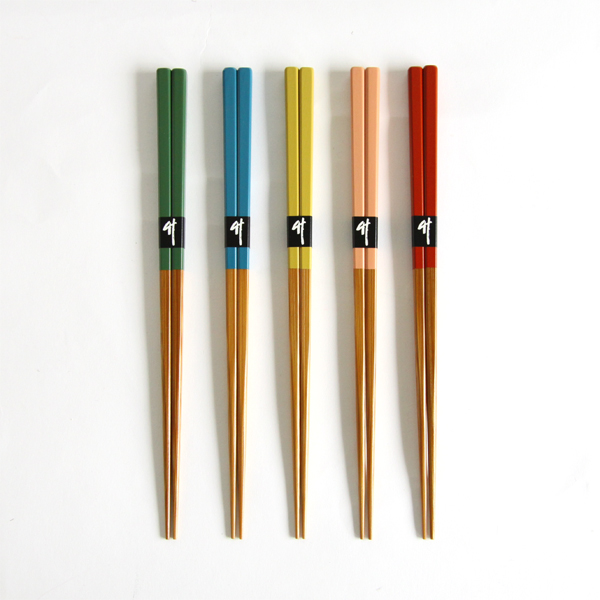
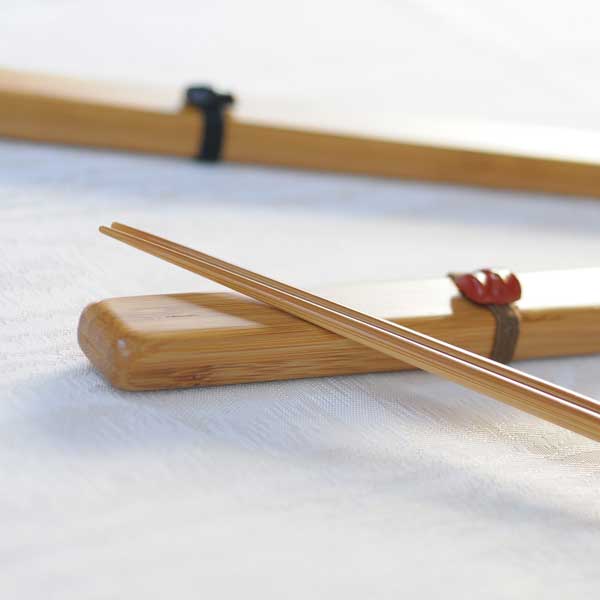
These are chopsticks made from bamboo. Chopsticks are typically made from wood or plastic, but over long use they can chip or lose their coating, which affects not just their appearance but also how they feel to use. Bamboo chopsticks, by contrast, are light and have slender tips, making them less slippery and gentler on the mouth — features that let you enjoy your food even more. Though delicate in appearance, they are sturdy, long-lasting, resistant to rot, and easy to handle — truly excellent chopsticks. The tips are extremely thin, giving a feel precise enough to pick up even a single bean without fail.
【Flower vases that reveal the possibilities of "bending" (mage)】

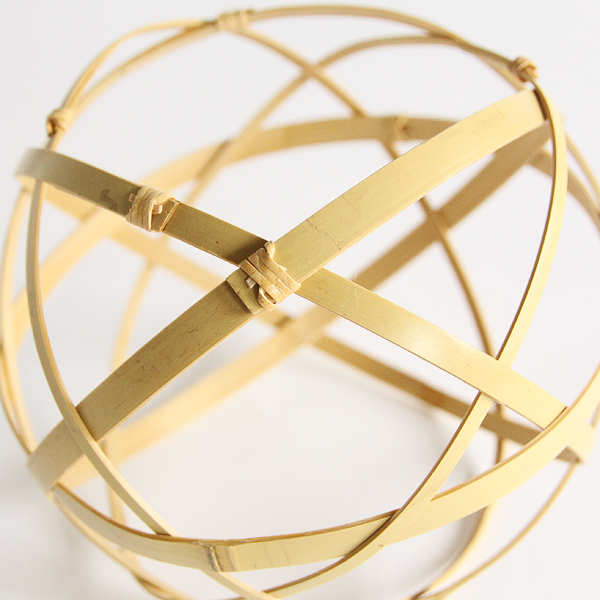
Next, we'd like to introduce this flower vase.
The design is simple: a glass vessel placed inside bamboo woven into the shape of a ball. The suppleness of the bamboo forms it into a round shape, giving off the air of a beautiful craft object. The basket is made of strips of bamboo cut along the grain of its fibers. What makes bamboo fascinating is that applying the craftsman's skill of "bending" (mage) to such a simple material makes three-dimensional creations like this possible. Kusudama — decorative balls still used today at celebratory events — were, before plastic versions became common, made from woven bamboo. This lets us feel the depth of Japanese culture, which has long treasured techniques like these.
【Baskets that showcase the art of weaving】

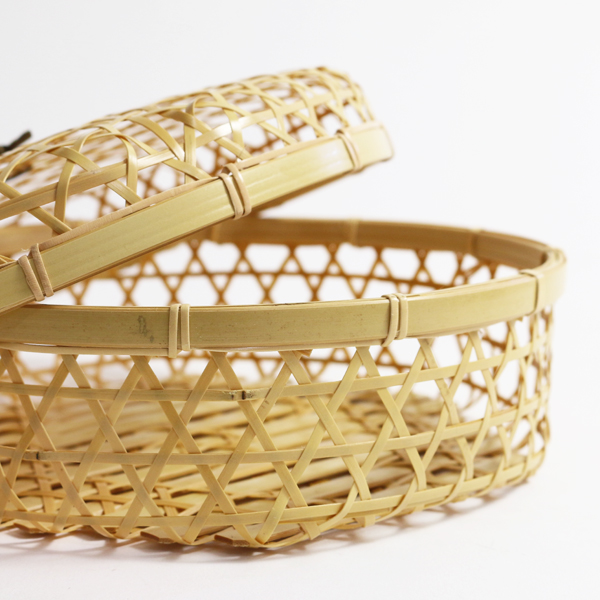
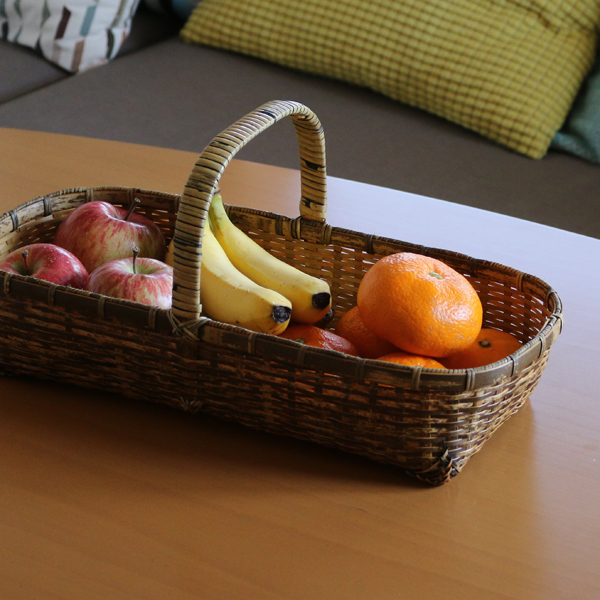
Taking the qualities of "suppleness" and "bending" even further is the technique of "weaving" (ami). Baskets of various kinds have been created not only in Japan but all over the world, and one type that we Japanese have long continued to make is the bamboo basket. As shown in the photo, bamboo baskets made using the outer skin of the bamboo resist breaking and bend well, have a smooth, glossy texture, and above all, convey the warmth of a natural material. Mesh materials exist in the modern world, but you can see that bamboo baskets, woven by hand with such regularity by skilled craftsmen, possess an entirely different character from those mass-produced goods.
【Interior items made of laminated bamboo that showcase its high workability】

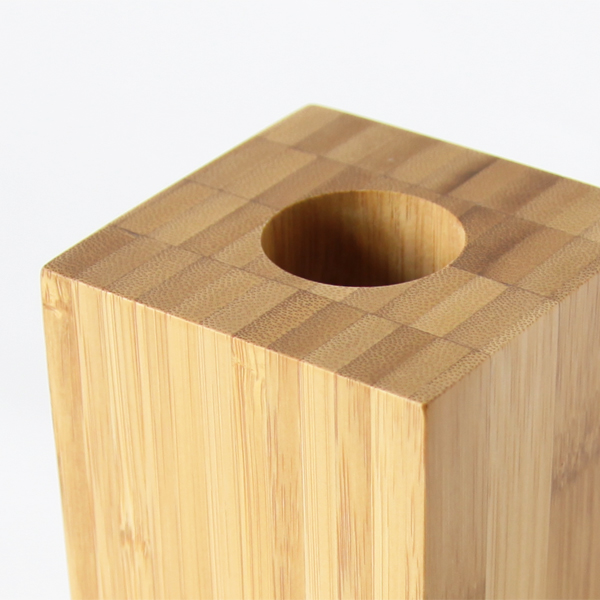
When we think of bamboo, we tend to picture a cylindrical stalk with nodes, but bamboo can also be used as a type of lumber and processed into various shapes. One such material is called shusei-zai, or laminated bamboo — a board-like material made by cutting bamboo into thin strips along the grain, planing them uniformly, and gluing them together one by one. This process makes the bamboo's fibers appear as a striped pattern, and the cross-section takes on a modern, block-like design. At first glance, it can be hard to tell that it's bamboo at all, but the sheen and texture of the surface are, indeed, distinctly bamboo. Thanks to its wa-modern (Japanese-modern) beauty, this material is used for interior items such as flower vases and small containers, as well as building materials like flooring and walls.
Bamboo Products Q&A
What causes the differences in bamboo's color?

What color comes to mind when you hear "the color of bamboo"? Depending on the person, there are many variations — a vivid green for some, a slightly muted khaki for others.
In Japan alone, there are actually as many as 600 varieties of bamboo, and one reason for the color differences is that the shade varies from species to species. The varieties we most often see are moso-chiku and madake, which have the typical bamboo green color. Other varieties exist too, such as kuro-chiku, which has a black stalk and green leaves.
Also, even the same bamboo can change color over time. A good example of this is susu-take, or smoked bamboo. This refers to bamboo that changed color after being smoked by the smoke of an irori (sunken hearth), back when bamboo was used as a building material for thatched roofs. Over the course of many years of exposure to smoke, the color changes to a reddish black, but since naturally produced susu-take has become quite rare these days, this coloring is sometimes achieved artificially by smoking the bamboo.
Why do bamboo "nodes" (fushi) form?
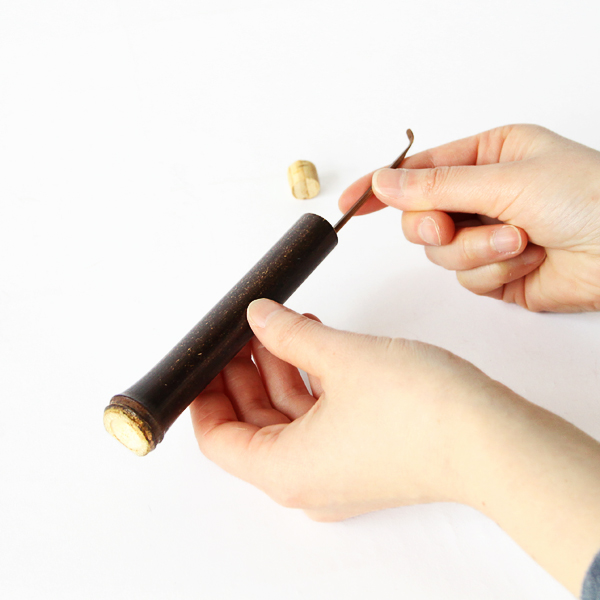
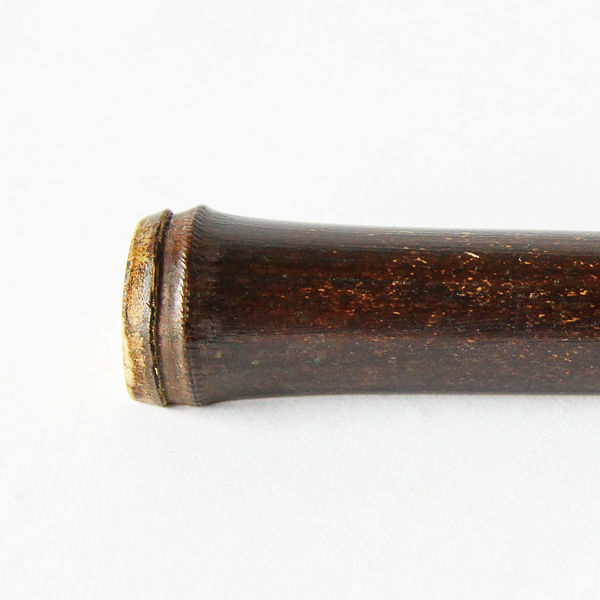
One distinctive feature of bamboo's structure is its "nodes" (fushi) — a structure rarely seen in other plants. As mentioned earlier, bamboo grows at an incredibly fast pace, and it's actually thanks to these nodes that such unparalleled growth speed is possible.
If you cut a takenoko (bamboo shoot), you'll see many horizontal lines inside — these are actually the nodes. In a bamboo shoot, the spacing between them looks very tight, but as it grows, they become the nodes of the mature bamboo as they are. This is because the number of nodes in bamboo never changes from the time it's a tiny shoot — if it has 60 nodes, for example, it will grow with those same 60 nodes throughout. Since each of these nodes grows rapidly, the bamboo as a whole is able to grow quickly. Additionally, as bamboo stretches upward to great heights, these nodes also serve to physically strengthen its hollow structure.
Bamboo's "nodes" (joints) play an important role in the plant's growth, and many products have been created that make creative use of this feature as a design element. Take this ear pick, for example. It makes use of the hollow space between nodes, cutting domestic Japanese bamboo into a tube-shaped case for the ear pick. With other materials, you'd need to pour material into a mold and let it harden, or hollow out the inside to create a cavity, but it's fascinating how this design takes advantage of bamboo's own natural node structure instead.
Caring for and Handling Bamboo Products
Basically, You Can Treat It the Same as Wooden Products
Generally speaking, natural materials like wood and bamboo are thought to require more delicate handling compared to metal or plastic. However, bamboo is inherently a flexible yet sturdy material. Basically, there's no problem treating it the same way you would other wooden products.
To prevent mold and decay, store in a well-ventilated place. Gently wipe away any moisture
Since bamboo is a plant belonging to the grass family, it's said to be prone to insect damage. Generally, most bamboo used in household items such as interior decor and kitchen goods undergoes oil removal and drying treatments during the manufacturing process. That said, if left wet or exposed to direct sunlight for extended periods, there's a risk of deterioration or damage, so be sure to store items in a well-ventilated place and gently wipe away any moisture.
Regarding the Care of Kitchen Items That Touch the Mouth
Since bamboo is fundamentally a sturdy and hygienic material, there's no need to be overly particular about care even for kitchen items that come into contact with the mouth. Just avoid hard brushes, scouring pads, and detergents containing abrasives. Along with this, avoid soaking, boiling water, dishwashers, and dish dryers.
▼About the Brand Featured This Time - Kochosai Kosuga

Kochosai Kosuga is a bamboo products brand founded in 1898. With a deep understanding of how bamboo has long been closely connected to Japanese life and culture, the brand creates bamboo products that enrich daily life. They continue making bamboo products as tools of living suited for the 21st century. Their products have also received numerous awards at world expositions.
Bamboo is a material that has long accompanied Japanese daily life—a gift from nature. Kochosai Kosuga aims to enrich living culture by crafting handicrafts and everyday tools from this material. The brand's appeal lies in its commitment to craftsmanship that never forgets the values and sensibilities that remain unchanged across the ages.
GUIDE »
CATEGORIES »
- + Gifts by recipient
- + Gifts by scene
- + Clothing
- + Bags / Backpacks
- + Wallets / Card cases
- + Jewelry
- + Shoes
- + Rainy day outfits
- + Kitchen
- + Home
- + Babies / Kids
- + Japanese products
Earn Miles


Payment & Security