.webp)


.webp)


.webp)


.webp)


Welcome to ZUTTO
Free shipping for newsletter subscribers (some areas excluded)
- トップページ/
- ZUTTO Journal/
- 選び方・使い方/
- Technical Experie...

Technique Experience Laboratory #3: Cool glass forms born from flame. A lampworking experience at HARIO LWF
In our Technique Experience Laboratory series, ZUTTO staff members try their hand at the process of making, and introduce the skilled craftsmanship behind each product. This time, we experienced lampworking (also known as burner work) at HARIO Lampwork Factory, a glass accessory brand whose cool, refreshing pieces make you long for summer skies. It's a technique in which high-temperature flame shapes delicate glass forms.

Working with fragile glass, the craftspeople achieve a level of precision that hardly seems possible by hand. Lampwork pieces, completed while wielding intense flame, are entirely the product of a craftsperson's handiwork. This time, through hands-on experience, we explore the appeal of handcrafted glass accessories.


This time we visited a gallery shop and workshop in Kodenmacho, Tokyo
Lampwork: melting and shaping glass
Before we introduce the experience itself, let us explain a little about lampworking. Lampworking is a technique in which glass is melted by the flame of a burner and then shaped. Glass, which has its origins around 4000 BC, is said to have been used to make ornamental items since its earliest stages. The way hard glass changes shape under the heat of the flame feels almost like magic. Because the form changes moment by moment, speed and accuracy are essential, and constant adjustment by the craftsperson is indispensable.
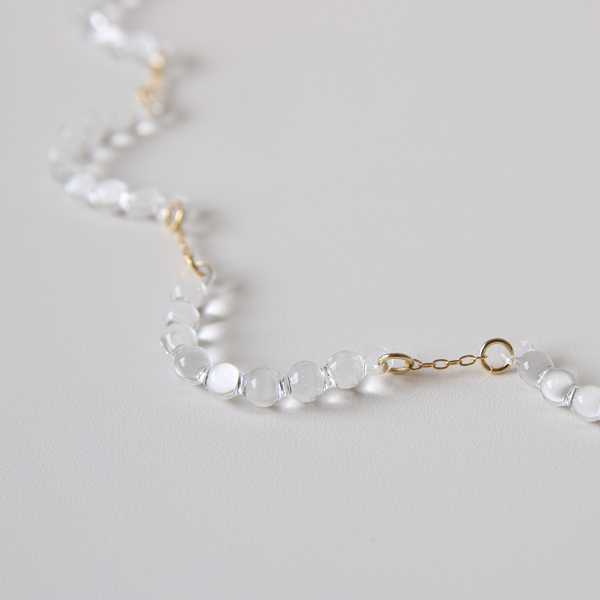
HARIO Lampwork Factory is a handmade brand from HARIO, a Japanese glass manufacturer founded in 1921. It creates glass items that can only be made through handwork. HARIO is well known for its kitchen and tableware items, such as coffee equipment and dishes, but originally, when the company was founded, craftspeople made scientific instruments and tableware one piece at a time by hand.
As demand for glass products grew, machine manufacturing became the main method of production in order to improve efficiency, and the amount of work done by craftspeople steadily decreased. This meant that the glasswork techniques passed down over generations were at risk of being lost, along with the ability to create new techniques and products. HARIO Lampwork Factory was born to keep handwork alive in the present day, and continues to make things that draw on that craftsmanship. Now that machine production has become the norm, glass accessories finished piece by piece by a craftsperson are truly precious glass products.

Small Circle Earrings, Straight Necklace
Staff try it out: a dialogue with glass
Now, let's get started on our lampworking experience, guided by a craftsperson.
Our guide this time was Fujieda-san, who is in her third year at HARIO Lampwork Factory. When we hear the word "craftsperson," we might often imagine a man, but every craftsperson at HARIO Lampwork Factory is a woman. She had a gentle manner, yet carried the composed, dignified air unique to skilled artisans.
The tools mainly used in lampworking are as follows.
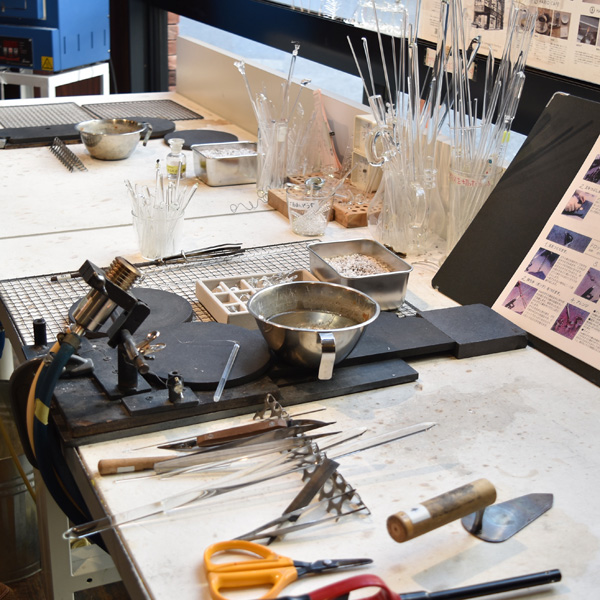
・Glass rods
These serve as the raw material for the accessory being made. They come in various thicknesses, chosen according to what is being created. They are also the tool used when fusing pieces of glass together or reshaping them.
*Heat-resistant glass, which can withstand rapid heating and cooling, is used. Because its coefficient of expansion is low, it is less likely to crack even when heated suddenly.
・Burner
Used to melt the glass. The temperature can be adjusted, and the amount and heat of the flame is varied depending on the stage of work.
・Tools for shaping
These include a spatula-like tool used to flatten the glass, and tweezers used to twist the tip. The craftsperson selects whichever tool is needed depending on the particular process.

Since the work involves high-temperature flame, protective glasses to shield the eyes are also essential
The general process is as follows:
1. Melt the glass rod in the flame to create a sphere, which serves as the base form.
2. Shape the sphere using various tools.
3. Cut the shaped glass away from the rod to complete the piece.
That's the basic flow. This time, we tried three different types of lampwork.
First lampwork piece: a leaf-shaped stirrer
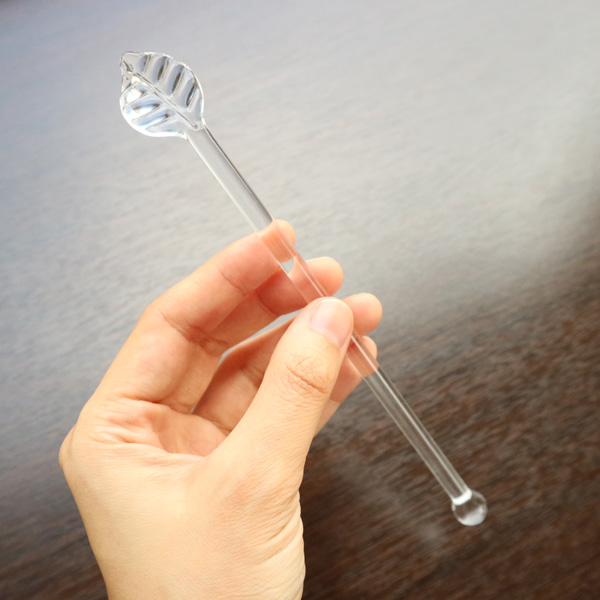
・Creating the sphere, the base form of the piece
This is a basic step used no matter what kind of glass piece is being made. The glass rod is melted in the burner's flame to create a sphere, which serves as the base form. During this process, the rod is rotated while being held at an angle, pointing downward toward the flame. As the glass melts, its own weight causes a sphere to form at the tip.

In less than a minute of heating, the hard glass begins to melt
Our staff member was overwhelmed watching the 2000-degree flame roar in front of them, melting the glass. Even without the hands feeling particularly hot, the intensity of the heat could be sensed in the staff member's expression as they focused closely on the glass. The process of the cool, refreshing glass changing shape within the high-temperature flame feels almost magical.
The rod is turned carefully until the leaf reaches the desired size. Turning the glass rod might sound simple, but maintaining a constant rotation speed is actually quite demanding.
・Shaping the sphere into a leaf form
Next, we'll shape the prototype into a leaf form. When the glass turns orange, that's proof it's been heated enough and has started to melt. We immediately take it out of the flame and quickly work it while the glass is still soft. For the leaf shape, we flatten the sphere and add leaf veins to it.
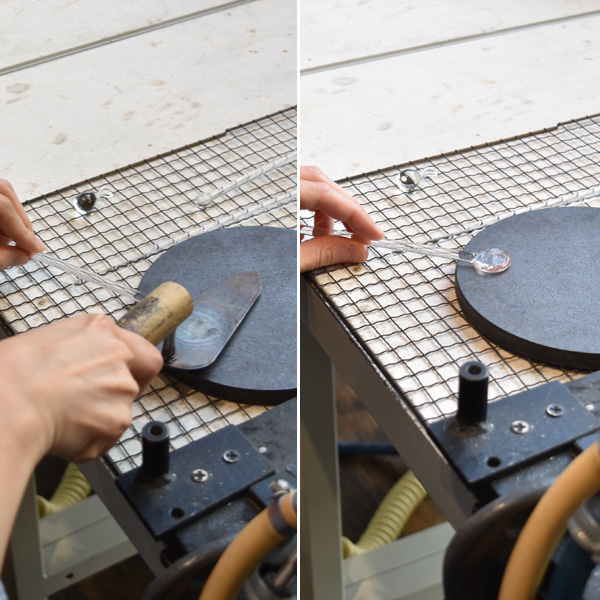

Flattening the sphere with a metal tool → Melting away the tool marks while forming the leaf veins
Heated glass changes shape just like mizuame (starch syrup). But that state only lasts a few seconds—simply taking it out of the flame returns it to hard glass. The staff member struggled against the glass, which transforms in an instant under the flame. Even when trying to heat only one part to add the veins, if the flame touched another area, the vein marks that had been carefully added would melt away, so the work had to proceed with great care.
・Final finishing touches
By pulling the tip where the veins had been added, a leaf point is formed, creating an oval-like shape. Adding a twist also gives the leaf a three-dimensional feel.
Once the shape is complete, the "slow cooling" process begins. Lowering the temperature of the burner's flame and cooling the glass gradually makes it less prone to cracking. The more glass is worked, the more distortion builds up, making it easier to break, so during this process the glass is carefully and gradually cooled to make it more durable. Since the first item made was a swizzle stick, it was complete in its glass rod form.

The finished pieces. Left: the sample piece provided, Right: the one made by the staff member
It took about 15 minutes from start to finish. The swizzle stick made by the staff member turned out charming with its own character, but the sample stick had much clearer, more defined leaf veins. This comes down to how quickly one can work after heating the glass, which really shows just how fast the speed required of a craftsperson truly is.
Trying Accessory-Making: A Teardrop Pendant Head
Having gotten a little used to lampworking through making the swizzle stick, it was now time to try accessory-making. This time, a thicker glass rod than the one used for the swizzle stick is used.
・Using the weight of the glass to form a teardrop shape
The process is similar to making the leaf-shaped swizzle stick: the glass rod is tilted to form the prototype shape. This time, since it's a larger accessory piece, the sphere that serves as the base is also made larger. If it gets too large, the glass threatens to fall from its own weight, making the balance more difficult than when spinning the earlier swizzle stick.
Also, what's a little different from the previous process is that gravity itself is used to form the teardrop shape.

The melted glass itself falls downward, naturally forming a teardrop shape
Once the desired size is reached, spinning the round, melted part downward causes the bottom to plump up, just like a real teardrop. This is truly a "glass teardrop," formed by the weight of the heated glass itself.
・Adding a loop for the necklace's leather cord
Here, two more glass rods come into play. To create a loop at the tip of the teardrop for threading the necklace's leather cord, a glass rod is first attached to the bottom of the teardrop to stabilize it. Then, a glass rod already prepared with a loop for the leather cord is joined to the tip of the teardrop.

After attaching a new glass rod to the bottom of the teardrop, a loop is added to the tip
However, if the joint between the tip of the teardrop and the loop is too thin, there's a chance the loop portion alone could break off. This kind of perspective is essential when creating glass accessories that are both delicately shaped and resistant to breaking. In fact, the piece the staff member made at the start was completed with Fujieda-san's help in making adjustments.


After threading a leather cord through it, it's complete. A simple necklace was created that lets the glass material shine
A Craftsperson's Gateway: Tears
And finally, the last piece we got to experience was a part from the Tears series, which ZUTTO also carries. It's a popular motif at ZUTTO, with a gentle atmosphere as if a teardrop's water droplet had been solidified into shape just as it is.
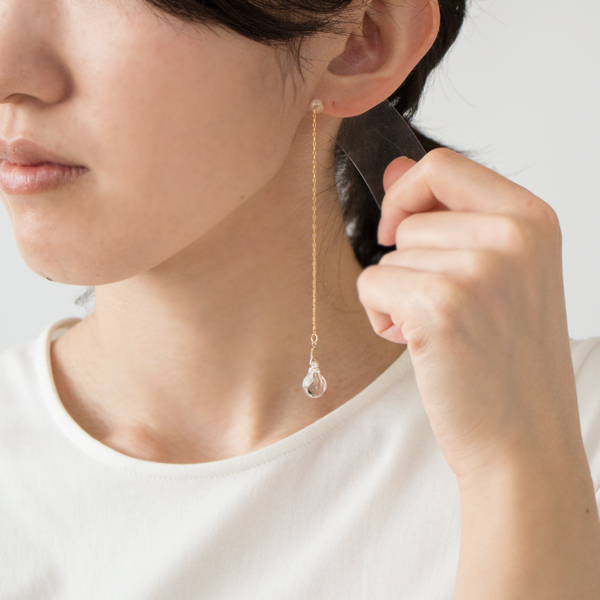
This is the smallest size we've experienced so far. An 8mm teardrop sphere is made from a 6mm glass rod. The process is simple: form the teardrop sphere, then create a hole for threading the chain. Drawing on the experience gained throughout the day, the staff member tried to tackle this as much as possible on her own.
・Forming the teardrop sphere
An 8mm sphere is formed from a 6mm glass rod. Care must be taken, since spinning it for even a little too long will make the sphere grow larger. Since this was an experience meant to convey the general flow, we proceeded without strictly measuring the size, but when craftspeople actually make these, they work while measuring the size carefully. Since the Tears motif is small, spinning it downward naturally creates a teardrop-like shape.
・Creating the hole for the chain
A new glass rod is prepared, and that glass is used to create the hole for threading the chain. Two glass rods are spun and brought closer together, forming two horns on the sphere before joining them together into a loop.

Here, the staff member struggled greatly. Since the sphere on which the horns grow is so small, it was difficult to determine the position in the first place, and the horns ended up growing from the center, making it very hard to form a loop, resulting in having to start over two or three times.

On the left is the sample Tears piece, on the right is the one made by the staff member. No matter how many times it was attempted, the horns turned out too thick or ended up in the center—a real struggle...
But even after trying many more times, it wasn't successful, and in the end, the piece had to be left unfinished this time.
Actually, the Tears piece we got to try making today is said to be the very first item that new craftspeople at HARIO Lampwork Factory learn to make. They repeat practice after practice before it becomes a sellable product, but since the size is fixed down to the millimeter, it apparently takes three to four months before a craftsperson can make an item good enough to sell. It gives us a glimpse of just how high a level of skill is demanded of these artisans.
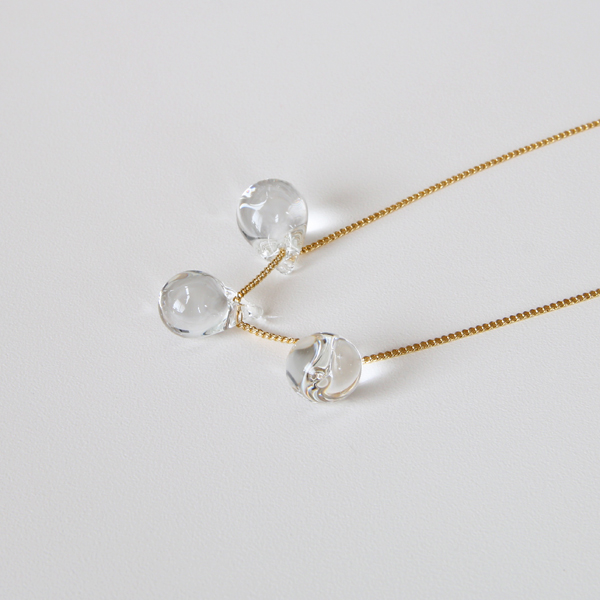
Even the tiny parts needed to attach the fittings, essential for any piece of jewelry, are made entirely of glass
After the Lampwork Experience
Having felt firsthand just how difficult lampwork is, our staff member also came to appreciate how meticulous the craftspeople's work truly is. "Working with glass that changes shape moment by moment is enough to fully occupy you just on its own, but for an actual product, the size matters too. This time we only got to try the lampwork itself without any measuring, but I can't even imagine doing it while measuring the size at the same time..." she said.
When we asked, we learned that Fujieda-san, who taught us today, graduated from the craft department of an art university. At HARIO Lampwork Factory, craftspeople apparently don't start from zero—having prior experience is a prerequisite. Lampwork, which demands both speed and precision, can only be accomplished by such seasoned artisans. This experience gave us a renewed appreciation that these are products made possible by human hands, not machine-based manufacturing.
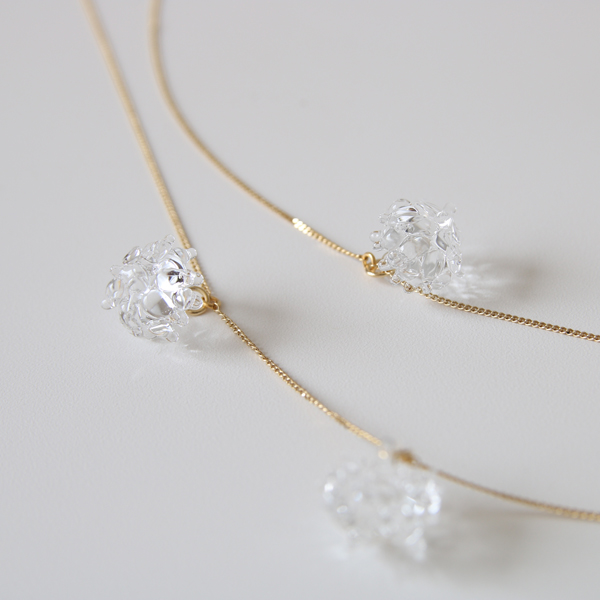
We also asked HARIO Lampwork Factory, who let us experience their craft today, to make custom-order items exclusively for ZUTTO. Being able to make such requests is only possible because of craftspeople who respond so flexibly. In fact, we're currently in discussions about another custom item. Our staff is looking forward to the day it's finished, even as we continue those discussions.
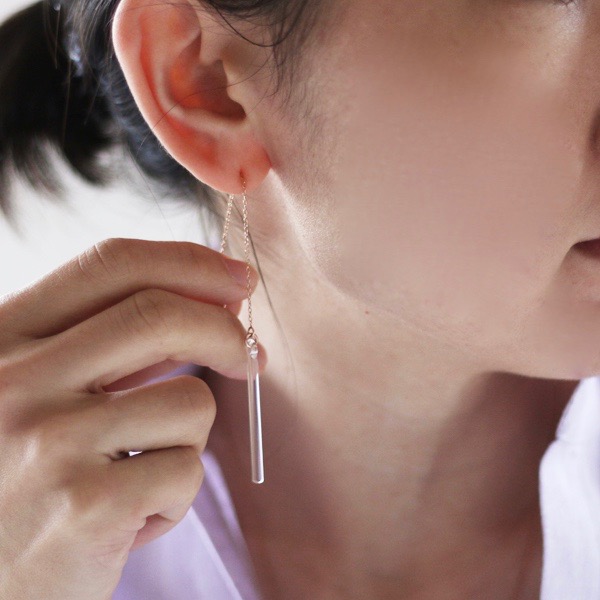
This is also a custom item made exclusively for ZUTTO, the Pierce Bar. It's a simple shape arrived at in pursuit of elegance

The Necklace Kanade, a favorite of our staff. It's fun to imagine what kind of person made it
These cool, refreshing glass accessories seem to await the arrival of hot summer days. Knowing that the craftspeople put their hearts into each and every piece, never compromising and continuing their careful craftsmanship, makes us feel even more attached to them.
▽Click here for the HARIO Lampwork Factory brand page

▽Click here for past issues of the Craft Experience Laboratory
#1 FALBE: Beaded Crochet That Catches and Sparkles in the Light

#2 REN: A Bag Shaped by Woven Leather, Mesh Leather That Holds Air

GUIDE »
CATEGORIES »
- + Gifts by recipient
- + Gifts by scene
- + Clothing
- + Bags / Backpacks
- + Wallets / Card cases
- + Jewelry
- + Shoes
- + Rainy day outfits
- + Kitchen
- + Home
- + Babies / Kids
- + Japanese products
Earn Miles


Payment & Security