.webp)


.webp)


.webp)


.webp)


- トップページ/
- ZUTTO Journal/
- 選び方・使い方/
- Your first piece ...

Your first piece of urushi (Japanese lacquer) ware—how should you use it?

Shungiku and rapeseed blossoms lined up in the vegetable section.
When you set a table with dishes made from seasonal vegetables,
there's that feeling of joy, almost a reluctance to eat, isn't there?
And always paired with that pleasure of food is the pleasure of the tableware itself.
This time, our theme is "shikki" (lacquerware).
We'll introduce how to choose lacquerware—something people think they know but often don't—
along with how to care for it.


What comes to mind first when you hear the word "lacquerware"?
A bowl in black or vermilion with a glossy, smooth surface,
a sweets container or hand mirror decorated with elegant painted designs.
Many people probably picture the ozoni soup eaten at New Year's.
Shikki, as the name suggests, refers to tableware finished with urushi,
but to begin with, tableware is made up of two elements.
These are the "kiji," the base material that forms the shape of the piece, and the "coating," the finish applied over it.
Kiji: natural woods such as mizume-zakura (birch cherry) or keyaki (zelkova), or synthetic resin, among others
Coating: urushi, urethane, and so on

Everything shown in this photo is lacquerware.
You can see how varied the sizes, shapes, colors, and grain patterns are.
ZUTTO carries several lacquerware brands,
but this time we'll focus mainly on three brands that specialize in soup bowls.

A brand rooted in Yamanaka lacquerware, a traditional craft of Ishikawa Prefecture.
Kihachi Kobo is the oldest workshop in the Yamanaka lacquerware tradition, founded in 1882
by Kihachi II, an upper-coat lacquer artisan, as a producer and wholesaler in the region,
and its charm lies in modern, beautifully thin-turned forms.
A brand that began as a woodworking shop, making full use of advanced lathe-turning techniques.
Like Kihachi Kobo, it is a Yamanaka lacquerware brand.
Its keyword is "fueki ryuko."
Viewing the unchanging traditional techniques of Yamanaka lacquerware as "fueki" (the unchanging),
and designs born from a sensibility that lives in the present as "ryuko" (the ever-changing),
they fuse these two elements to create pieces that fit seamlessly into modern life.
A bowl-specialty brand created by Shitsurindo, a lacquerware maker
in Sabae City, Fukui Prefecture, with a history spanning more than 200 years.
Returning to the very fundamentals of what a bowl is meant to do,
this brand was born from a desire to make products
that can be used continuously in everyday life, and is known for its colorful bowls.

First, let's open the box of the Long Life Soup Bowl
from Kihachi Kobo.
When you open the decorative box bearing the "Kihachi" logo,
you'll find a bowl carefully wrapped in thin paper.


When it comes to urushi, this is the color that comes to mind.
The contrast between black and vermilion catches the eye.
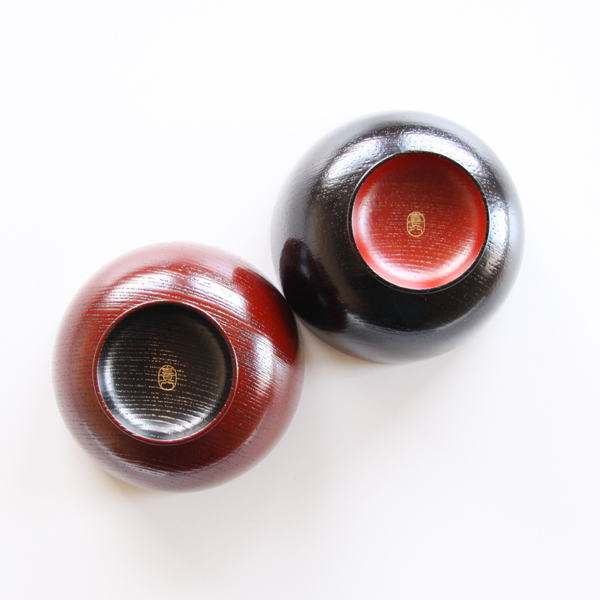
This Long Life Soup Bowl deliberately skips the undercoat layer;
black and vermilion are carefully layered on, and the final coat of urushi is brushed on by hand,
producing a soft, moist texture.
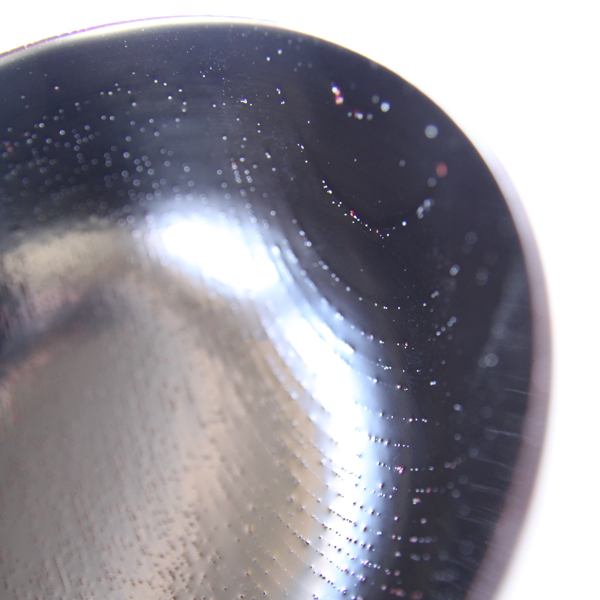
The kiji is keyaki, and you can see a hint of the wood grain
peeking through the lacquered surface.
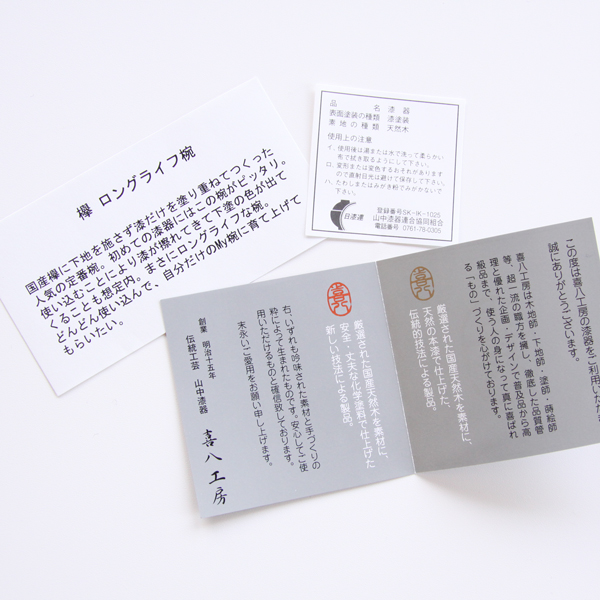
The instruction sheet included in the Long Life Soup Bowl's box says:
"As you use it, the lacquer will wear down and the undercoat color may start to show through—that's expected.
This is truly a long-life bowl. We hope you'll use it more and more and let it grow into your very own bowl."
This is the message printed there.
Since it's designed with long-term use in mind,
the choice to skip the undercoat and apply the lacquer carefully by hand
reflects a dedication to changes that aren't visible when new
but emerge only through years of use.

There's another piece from Kihachi Kobo
with a somewhat different character, so let's take a look at that next.

On the left in the photo is the "Long Life Soup Bowl" from before, and on the right is the "Guinomi Modern."
With its adorable size, as if the soup bowl had been shrunk down into a miniature version,
it works well not only as a sake cup but also as a flower vase or small storage container.
This "Guinomi Modern" uses the same keyaki
as the "Long Life Soup Bowl" for its kiji, but the surface finish is different.
This is called "fuki-urushi finish"—after applying urushi to the wood,
the process of wiping it off with a cloth and letting it dry
is repeated several times to achieve the finish.
By wiping away the lacquer, the natural beauty of the wood grain is allowed to show through.

ZUTTO carries two versions: "Natural" and "Fuki-urushi."
Comparing the two, you can see the texture of the untreated kiji versus
the unique sheen and grain visibility that comes with the fuki-urushi finish.

If you're drawn to the character that's unique to fuki-urushi,
distinct from the layered "black" and "vermilion" finishes,
we also recommend the look and feel of
"MATEVARI Fukiurushi" from Gato Mikio Shoten.
"MATEVARI Fukiurushi" is characterized by smooth curves
produced through lathe-turning—the kind you'll want to rub your cheek against.

The three types of bowls—sakura (cherry), kaede (maple), and nara (oak)—
each have subtly different grain shapes, colors, and thicknesses,
giving each a different impression despite sharing the same shape and finish.
Sakura has a soft, rounded grain,
while kaede is characterized by its suppleness.
Nara, among the three, stands out for its bold, thick grain, the most powerful-looking of the three.
It's remarkable how different the impression can be
depending on which wood is used for the kiji, even with the same finish.

And taking it a step further, adding an element of playful color to the fuki-urushi finish
is "Owan ya Uchida," a brand that could be said to have transformed the traditional image of lacquer bowls.
Domestically produced mizume-zakura (Japanese cherry birch) wood is hollowed out, then layered with colored urushi (Japanese lacquer) and fuki-urushi (wiped lacquer) finishes,
and the distinctive feature is that the coloring is applied just lightly enough for the wood grain to still show through.
These bowls, with their vivid colors and sense of transparency,
are coated with just the number of layers of urushi needed to withstand daily use,
crafted with care so that they can become products that many people will want to pick up and use.

Since they can be stacked and stored stably, they're easy to use in daily life.
This kind of thoughtful design
reflects the brand's commitment to making the piece easy to use in everyday life while still carrying on traditional craft techniques.
Colors come in six variations—black, red, gray, navy, yellow, and green—
so it's also a nice idea for each member of the family to choose their favorite color.
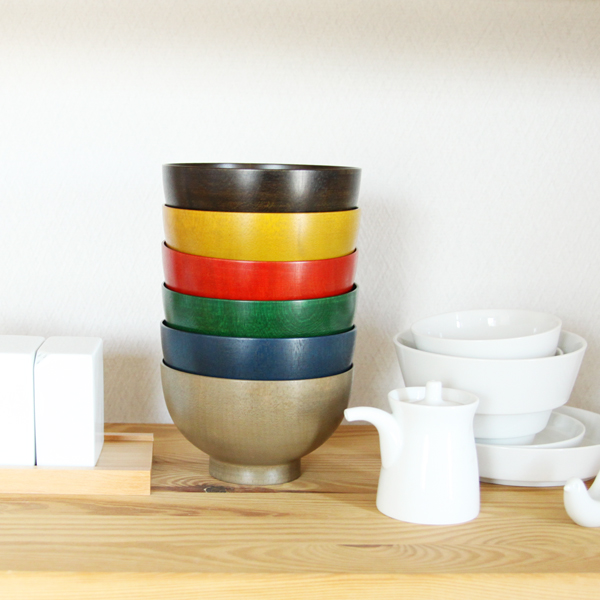

Once you've found your favorite piece of lacquerware,
what you'll naturally want to know next is how to use and care for it day to day.
We've put together a summary centered on the maintenance methods
we once learned from Wajima Kirimoto, a maker known for its captivating urushi "nuri" (lacquering) technique.
・Use water or a detergent diluted with lukewarm water,
and wash with a sponge.
You can care for it the same way you would
wash an everyday glass or piece of pottery—no special treatment needed.
・If hard objects such as glass,
or anything with a sharp point comes into contact with the surface, it can damage the coating.
Washing it separately from pointed forks or glassware
will reduce the risk of scratches.
・After washing, don't leave it sitting wet for a long time.
Gently wipe away the moisture with a towel or cloth.
If water droplets are left on the surface,
the chlorine contained in tap water can remain behind,
and on deeply colored lacquerware, whitish marks tend to stand out.
---Is it okay to put hot soup in it? (On heat resistance)
As long as it's a temperature you'd normally eat food at, it's fine.
With lacquerware made from natural wood, the bowl itself won't get too hot to hold.
That said, avoid pouring in something that has just come to a boil.
(A sudden change in temperature can cause the surface of the urushi to discolor.)
---What about the microwave, dishwasher, and refrigerator?
For lacquerware made from natural wood and urushi,
avoid using a dishwasher, dryer, or microwave.
Sudden impact or drying can damage the piece.
The inside of a refrigerator is dry, so we don't recommend leaving it in there for long periods.
However, it's fine to place a serving of food in it temporarily
just until the meal is about to begin.
For instance, it's fine to hold something as hot as you'd be able to put in your mouth,
but something freshly boiled is too much for it.
Being sensitive to dryness and sudden changes in temperature—
doesn't that sound just like our own skin?
Urushi hardens best in an environment with 70–80% humidity and a temperature of 25 degrees Celsius.
Being kept in a dry environment is, for lacquerware, the hardest and saddest thing of all.
Using it every day and washing it every day
ultimately gives the urushi the moisture it needs,
which turns out to be the best maintenance of all.
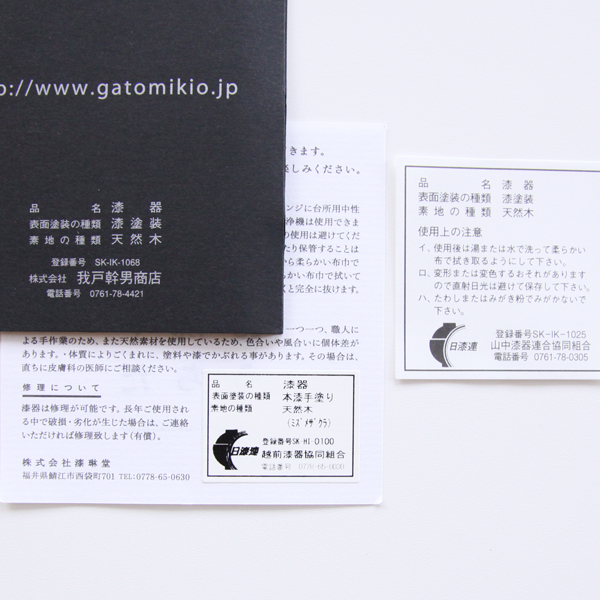
Depending on the material used for the piece's base and the way the finish was applied,
the points to be careful about can vary.
Following the care instructions included with the piece is the safest way to go.


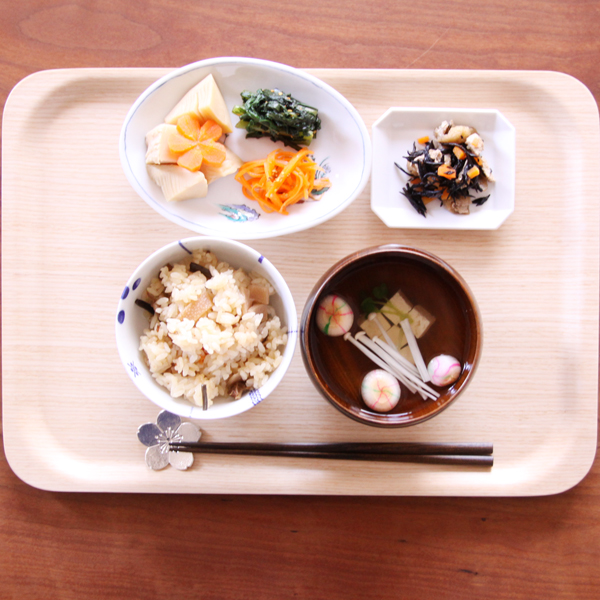
We tried using a lacquer soup bowl at our spring dinner table.
Today's menu is...
・Takikomi gohan (mixed rice)
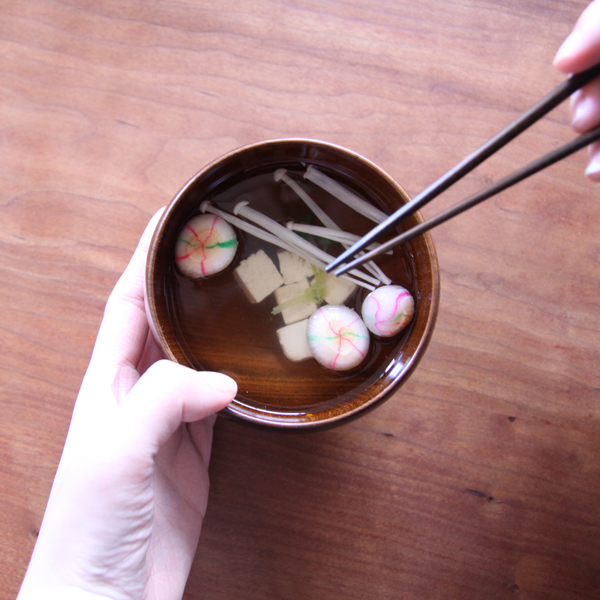
・Clear soup with temari-fu (ball-shaped wheat gluten) and enoki mushrooms
・Simmered bamboo shoots
・Carrot salad with a hint of ginger
・Spring greens with sesame dressing
・Simmered hijiki seaweed
The basic Japanese meal format is ichiju-sansai—one soup, three side dishes—
and of course, we want to enjoy our soup in a favorite soup bowl.

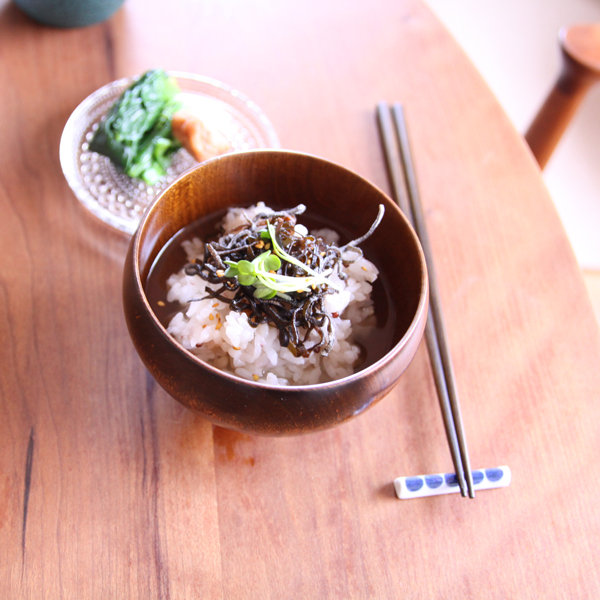
And in a scene like a bowl of ochazuke,
the soup bowl can also take center stage at the table.
The photo shows dashi ochazuke with shio kombu.
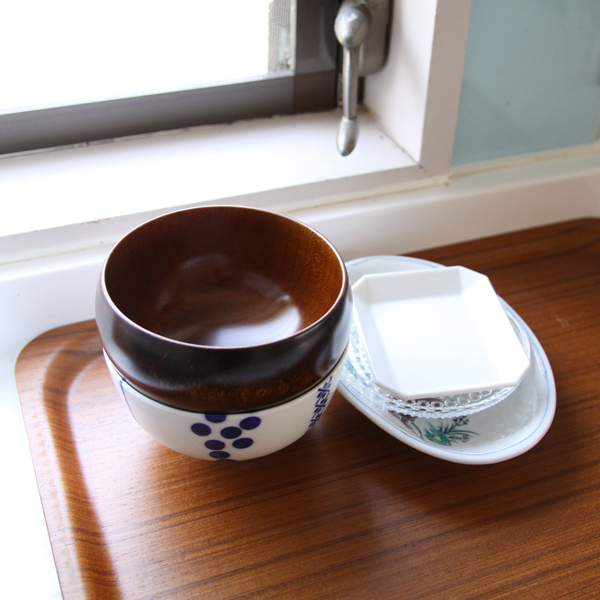
We've added a Kastehelmi plate topped with condiments,
and it turns out this modern lacquerware pairs surprisingly well with Western tableware.

A Simple Dashi Ochazuke Recipe
Ingredients
・White rice
・Dashi stock
・Shio kombu (salted kelp)
・White sesame seeds
How to Enjoy Ochazuke
・Put the rice in a bowl, top with shio kombu, sprinkle with sesame seeds, and bring to the table.
・Pour in the dashi stock and enjoy while it's hot.
・For extra flavor, try adding umeboshi, pickles, or condiments to taste.

Lacquerware can seem intimidating and hard to handle,
but once you understand the differences in materials and finishes, and how to use it, it's really nothing difficult.
Beyond the soup bowl introduced here, there are plenty of other items finished with urushi,
including chopsticks, small plates, coffee cups, and interior pieces.
If you have a piece of lacquerware sitting unused somewhere—say, a gift from a wedding—
it might be a good idea to simply give it a try.
Getting to know urushi through a single item like a soup bowl,
and living alongside lacquerware you can love and use for years to come, sounds truly wonderful.

◇Featured Lacquerware
・Kihachi Kobo
・Gato Mikio Shoten
・Owan-ya Uchida
◇Spring Menu Edition
・Inban Hana Chawan Set, Hanakazari
・Choju Giga Oval Small Plate
・Fuki-Urushi Oval Chopsticks
・TY Square Plate, White
・Chopstick Rest, Hanabana
・Wood Tray
◇Dashi Ochazuke Edition
・Kastehelmi Plate 10cm
・G-Shape Soy Sauce Bottle, White
・Inban Chopstick Rest
・Teapot, Round Cylinder, S (Iron)
GUIDE »
CATEGORIES »
- + Gifts by recipient
- + Gifts by scene
- + Clothing
- + Bags / Backpacks
- + Wallets / Card cases
- + Jewelry
- + Shoes
- + Rainy day outfits
- + Kitchen
- + Home
- + Babies / Kids
- + Japanese products
Earn Miles


Payment & Security