.webp)


.webp)


.webp)


.webp)


- トップページ/
- ZUTTO Journal/
- 選び方・使い方/
- Getting Acquainte...

Tick-tock, tick-tock.
A wristwatch might seem like a mechanical, cold object, but strangely enough, watching the second hand steadily advance makes it feel almost like a living creature—something rather endearing.
This time, we'd like to introduce a "hand-wound" wristwatch. It may seem intimidating at first, as if it requires special skill to handle, but as long as you're mindful of a few daily habits, it needs no battery replacement and can become a companion you'll cherish for a long, long time.
A Watch You Grow With

This original watch collection was born from a collaboration between William Kroll, designer of the British menswear brand TENDER (a brand deeply trusted for its craftsmanship), who oversaw the design, and Japanese artisans skilled in reviving antique watches. GSTP (General Service Time Piece) is the name that was engraved on the back of pocket watches, alongside the Broad Arrow (the mark of the British military), when the British Army commissioned Burlington, Omega, CYMA, and other companies to produce military pocket watches between 1939 and 1945. The name GS/TP comes from this history, meaning a watch issued by the military.
The lineup is full of details that delight watch enthusiasts—dials whose colors are designed to deepen with the passing years, and the plump, richly textured "frog back" case back—and includes both quartz and mechanical (hand-wound) models. This time, we'll be focusing specifically on the hand-wound wristwatches.
What Is a Hand-Wound Watch?

Wristwatches are broadly divided into two categories: "mechanical" and "quartz." Mechanical watches are further divided into two types: "hand-wound" and "automatic."
A hand-wound watch, as the name suggests, is powered by turning the crown yourself to wind the mainspring. An automatic watch, on the other hand, winds the mainspring through the rotation of gears driven by the natural movement of your arm.
Quartz watches are the type that require periodic battery replacement. Today, when people think of a wristwatch, they tend to picture one that runs on a battery, but quartz watches were only invented in 1969—before that, "wristwatch" was synonymous with "mechanical watch." Incidentally, it was a Japanese manufacturer that first brought quartz-movement wristwatches into practical use. It's easy to understand why this sent shockwaves through watchmakers around the world: quartz watches kept running without needing to be wound, and offered overwhelming accuracy along with high mass-producibility.
Against this backdrop, quartz watches quickly became the norm—but at the same time, one could say that the status and artistic, connoisseur appeal of deliberately choosing a mechanical watch has only grown.
The GS/TP Wristwatch
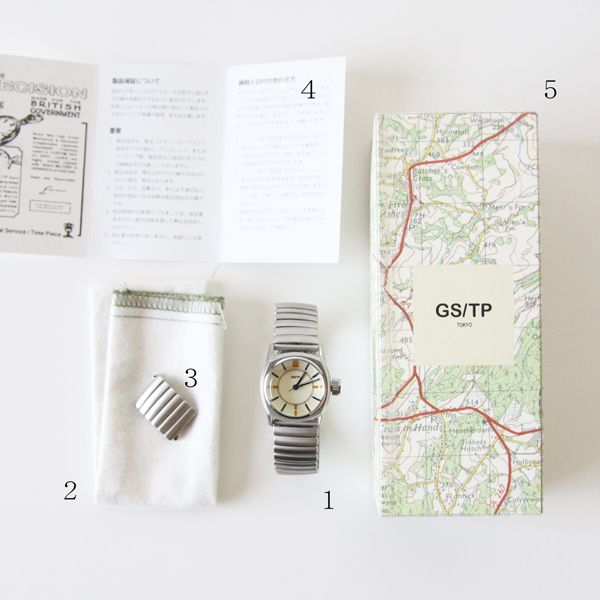
Open the package, and… here's what's inside.
1: The Watch Itself (Hand-Wound White Dial MMD01C)
The through-hole lugs, cushion case, and "bubble back"—commonly known as the frog back—all draw their design inspiration from early aviation instrument watches. The plump, rounded crystal gives it a wonderfully retro feel.
2: A Simple Fabric Pouch
3: Adjustable Strap Parts
This model's strap can be adjusted by hand, without any tools. You spread the spring apart and slide it along the groove—once you get the hang of it, adjusting becomes easy.
4: Warranty Card (Also Serving as Instruction Manual)
The free warranty period for manufacturing defects is 6 months.
5: The Package
It's decorated with a map once used by the British military. There are two color variations, and your order will arrive in one of them.
*Please note that the current packaging is as described above; however, early shipments did not include the fabric pouch, and the strap arrived as one continuous piece. Thank you for your understanding.
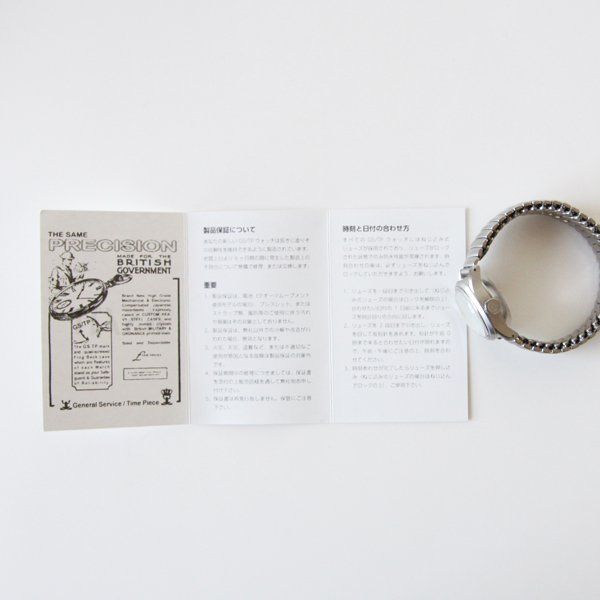
The warranty card, which doubles as an instruction manual, includes simple explanations of how to set the time and how to wind the crown, so you can make adjustments following along with it.
The Real Pleasure of Hand-Winding

① Pull Out the Crown
Pull the crown out to the right.
*Watches with a date display often have a crown that pulls out in two stages, but the model introduced here has no date display. The crown only pulls out to one stage, so please be careful not to force it any further.
② Set the Time
Turn the crown to move the hands and set the time. As a general rule, turn it clockwise. Once you've set the current time, push the crown back in to return it to its original position.

A hand-wound watch works by manually winding the mainspring, and using the energy released as it unwinds to move the hands. Because of this, the act of winding the mainspring is really what defines the pleasure of owning a hand-wound watch.
As shown in the photo, turn the crown a full rotation from top to bottom (counterclockwise), then from bottom to top. Repeat this motion, and you'll gradually feel more resistance until, at a certain point, it becomes impossible to wind further with the same force. Once you reach that point, winding is complete.
*Be careful not to force it any further beyond that point, as doing so can cause the watch to malfunction.
It's recommended that you wind a hand-wound watch once a day, at roughly the same time. Making it part of your morning routine before heading out is a good way to avoid forgetting.

Once you've wound the mainspring, the second hand will start ticking along. After confirming that the hands are moving properly, go ahead and put the watch on.
GS/TP is a men's brand, but it looks wonderfully attractive when worn by women too. Since this extension belt requires no special tools, you can freely adjust the size whenever you like, making it suitable for both men and women.

Everyday Care

◇The case back of the watch
This is the part that touches your skin directly, so especially in summer, when you sweat more, dirt from sweat and dust tends to build up. This can lead to rust that stains your clothing or irritates your skin, so please wipe it carefully with a soft cloth.
◇The band (strap)
Use a soft, small brush to gently work dirt out of the gaps in the band. (A stiff brush may cause scratches, so please test it on an inconspicuous spot first before cleaning.)
◇The crown
After long-term use, dirt can accumulate around the crown and make it harder to operate, so please turn the crown freely from time to time to keep it clear.


The world of wristwatches runs remarkably deep, and what we've introduced here is really just the tip of the iceberg. Even so, the basic way of using one is quite simple. Once you get used to the habit of winding it by hand and keeping it moving each day, there's nothing difficult about it at all.
We live in an age when a single iPhone lets you know the exact time no matter where in the world you are. And yet, choosing a mechanical watch—especially a hand-wound one—and taking care of it with intention is, in its own way, a wonderfully stylish choice.
The joy of gradually turning it into a vintage piece over time. This is a watch that teaches you that kind of pleasure.

Recommended Back Issues of "ZUTTO no Yomimono"
>>> Caring for Glasses: Things You Might Not Know
>>> Winter Shoe Care
GUIDE »
CATEGORIES »
- + Gifts by recipient
- + Gifts by scene
- + Clothing
- + Bags / Backpacks
- + Wallets / Card cases
- + Jewelry
- + Shoes
- + Rainy day outfits
- + Kitchen
- + Home
- + Babies / Kids
- + Japanese products
Earn Miles


Payment & Security