.webp)


.webp)


.webp)


.webp)


- トップページ/
- ZUTTO Journal/
- 選び方・使い方/
- Want to Know More...

Want to know more? The story of gamaguchi
A clasp that opens with a satisfying pop,
and a charming little snap sound as its signature charm point.
This time, we're taking a look at gamaguchi (snap-clasp purses).
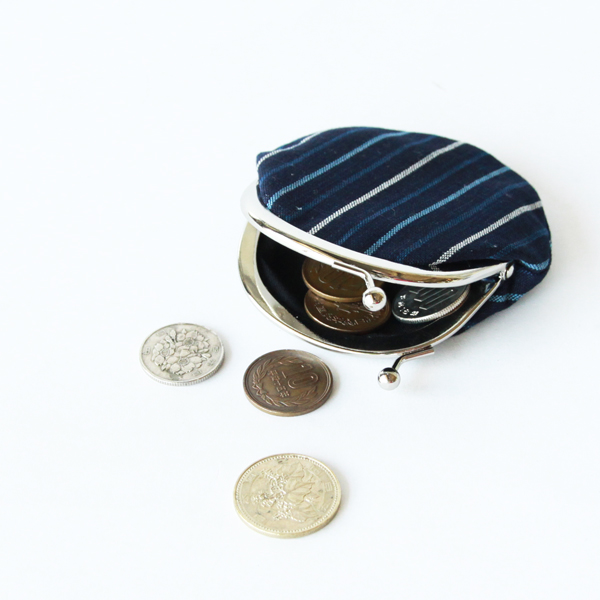
Gamaguchi have a somewhat nostalgic, old-fashioned charm about them.
You might remember your grandmother in the countryside using one…
or perhaps you've seen one paired with a kimono for a traditional outfit…
It's easy to picture them as a very "Japanese" item.
But if you look into the history of the gamaguchi, you'll find something surprising:
it was actually an import that arrived in Japan during the Meiji era.
The original form of the gamaguchi was a bag used in Europe.
Think of the kind of ornately decorated mini bag
a noblewoman might have carried to a ball.
During the Meiji Restoration, a wide range of Western culture was brought into Japan,
from clothing and everyday items to food,
and people's lives underwent remarkable changes.
New Western culture was introduced alongside
the culture that had long existed in Japan,
and at first the old and new clashed, eventually developing into imitation and fusion.
Since we often see gamaguchi made with Japanese-patterned chirimen (crepe fabric) or traditional woven textiles,
it's easy to think of them as a symbol of "Japanese-ness,"
but they were originally one piece of foreign culture.
The name "gamaguchi" comes from the way the clasp opens wide,
just like the mouth of a gama (toad), and it's a name people have grown fond of over time.
When it first arrived in Japan, though, it was called things like "seiyo dooran (Western pouch)" or "gama kinchaku."
It seems it went by names like that at first.
A "dooran" was a simple drawstring pouch used to carry things like medicine, seals, or coins.
In its early days in Japan, the gamaguchi wasn't the everyday item it is now,
but was apparently quite expensive. Since techniques for working with metal were limited at the time,
it seems that craftsmen who worked on women's kanzashi (hair ornaments) and obi fittings would work brass by hand
to produce them one piece at a time.
It took a bit longer for the gamaguchi to become a popular item among ordinary people.
By the time small-denomination paper currency was issued and people began carrying billfolds,
metalworking techniques had also improved, making it possible to stably produce
gamaguchi with clasps similar in shape to those we see today.
The roots of the image of gamaguchi as coin purses trace back to this period.
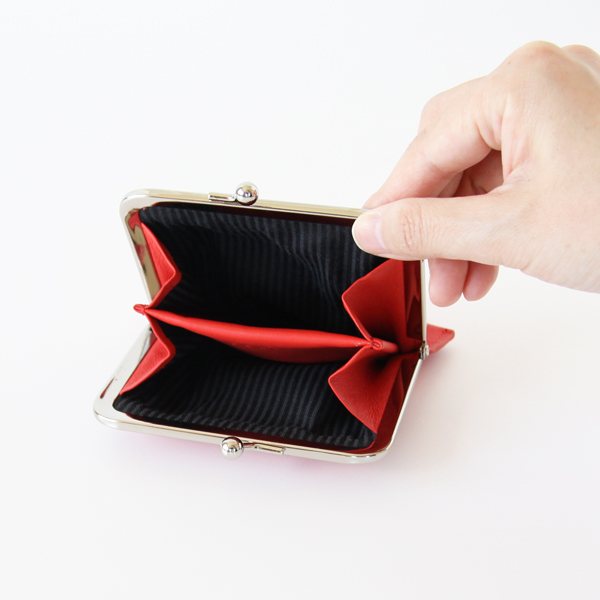
When you think of gamaguchi, a coin purse is what comes to mind first.
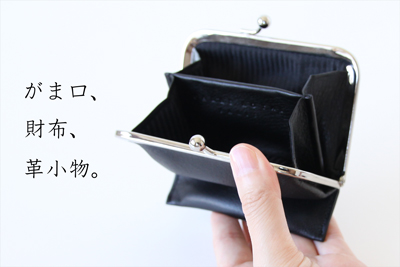
The Auteuil Small Coin Purse
comes in a nicely balanced size of 11×11cm, neither too small nor too large.
With one divider in the middle,
you can keep coins on one side and a few folded bills on the other,
so this Small Coin Purse alone might be all you need when heading out.
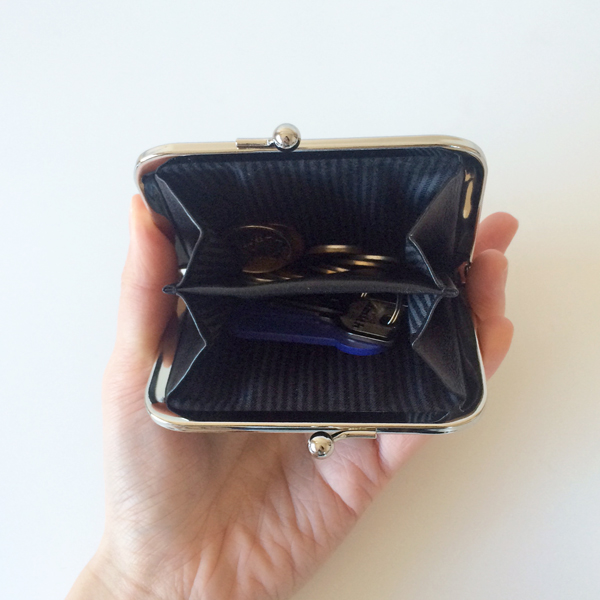
There are other clever uses too, such as:
・"Earrings or rings + a necklace" → as an accessory case
If you toss a necklace in a pouch together with other accessories,
the necklace's chain can get tangled into a knotted mess…
But if you make use of the divider inside a gamaguchi, that won't happen.
Since the gamaguchi's mouth opens wide, it's perfect for storing small accessories.
・"Earphones, lip balm, tickets…" → a dedicated spot for easy-to-lose items
If you just tuck them into a pants pocket or bag pocket for the moment,
you can never find them when you actually need them.
A gamaguchi is great for holding these kinds of small items too.
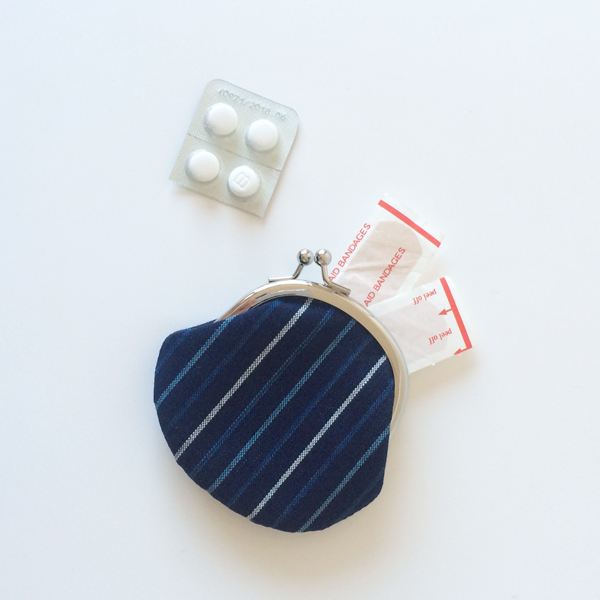
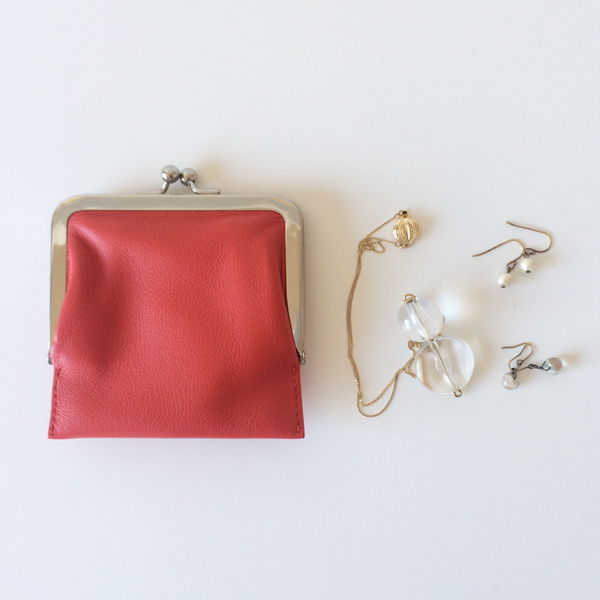
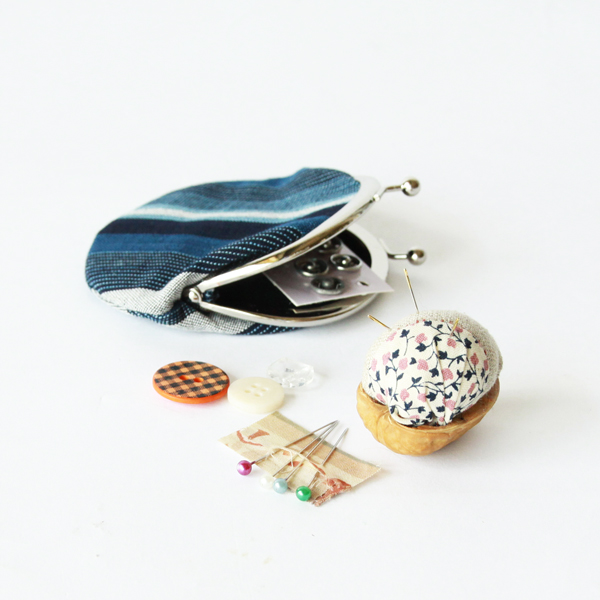
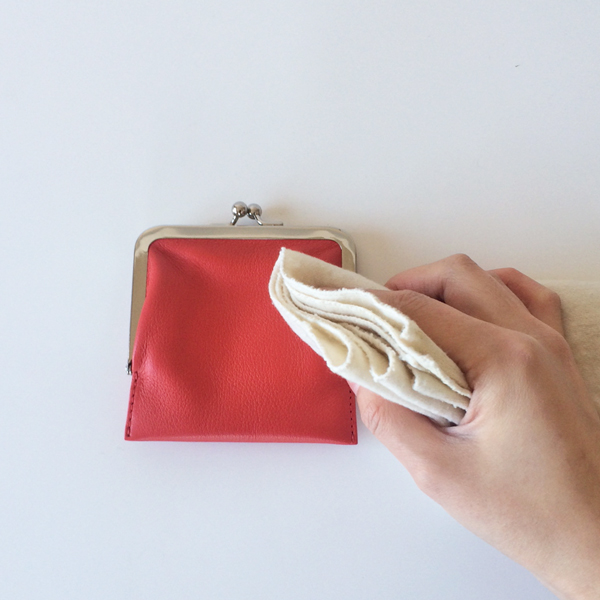
Since a gamaguchi is often used as a coin purse,
you'll gradually notice things like hand grime on the outside and dirt building up inside.
Be sure to care for it according to what material it's made of.
・Leather gamaguchi
For leather gamaguchi, just like with ordinary leather goods,
maintain them using leather-specific cream or wax.
Leather develops more shine the more you polish it,
so be sure to give it a careful polish.
In particular, be careful around the sides of the clasp that move when opening and closing it,
since dust and grime tend to accumulate there.
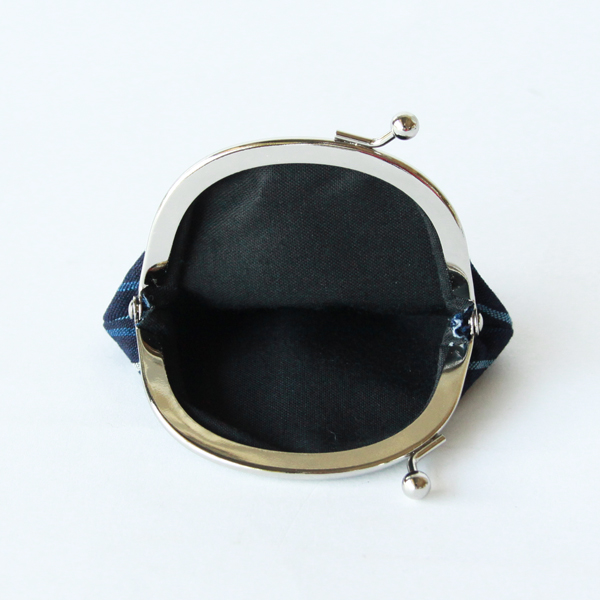
・Fabric gamaguchi
When hand grime bothers you on a fabric gamaguchi,
you might really want to wash it clean,
but as a rule, gamaguchi can't be fully submerged and washed in water.
This is because adhesive is used to join the metal clasp to the body of the purse.
In many cases, the clasp is fixed in place with adhesive, and paper cord is packed into the gap between the body and the clasp
to fill in the space, so you need to be careful.
If the purse is made of fabric both inside and out, you can either wash just the fabric portion by hand,
or dampen a cloth with water mixed with fabric detergent or stain remover, wring it out well,
and gently dab at any areas of dirt to blot it away.
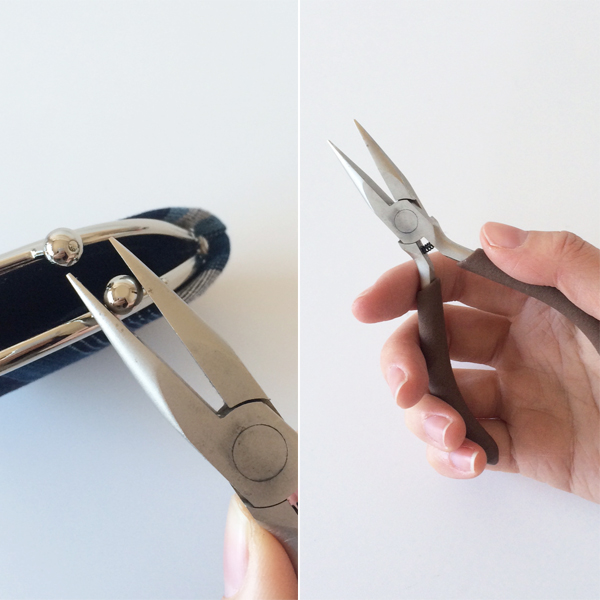
With a gamaguchi, opening and closing it many times can cause the clasp to loosen,
and the pressure holding the lid shut may weaken.
Of course, you'll want to keep enjoying that satisfying "snap" sound for as long as possible.
When the clasp becomes loose, try adjusting it yourself.
Use pliers like the ones shown in the photo.
A small pair meant for crafts or DIY work will do just fine.
Adjust by gently pressing the ball-shaped parts on the left and right sides of the clasp inward.
To avoid scratching the clasp,
place a piece of cloth or paper wherever the pliers make contact.
Pressing too hard all at once can cause damage, or
make the clasp too stiff,
so be careful to apply pressure little by little while checking your progress.
Even a single item like the gamaguchi
is filled with such a rich history and story.
The gamaguchi is a lovely, palm-sized item.
We hope you'll find one you love.
Recommended back issues of "ZUTTO no Yomimono"
>>> Eyeglass care you might not know about
>>> Winter shoe care
GUIDE »
CATEGORIES »
- + Gifts by recipient
- + Gifts by scene
- + Clothing
- + Bags / Backpacks
- + Wallets / Card cases
- + Jewelry
- + Shoes
- + Rainy day outfits
- + Kitchen
- + Home
- + Babies / Kids
- + Japanese products
Earn Miles


Payment & Security