.webp)


.webp)


.webp)


.webp)


Welcome to ZUTTO
Free shipping for newsletter subscribers (some areas excluded)
My page
Information
- トップページ/
- ZUTTO Journal/
- お手入れ・エイジング/
- Bring the Warmth ...

Bring the warmth of wood to your table, with Takahashi Kogei's wooden plates
A table set with wooden plates and cups gives off a mysterious sense of warmth.
Even if not everything is made of wood, it catches the eye and leaves you feeling at ease.
But when it comes to wooden tableware that comes into contact with water and oil, don't you feel it seems
too difficult for everyday use?
For those who have never used wooden dishes because they're unsure of how to handle them or what precautions to take,
we'd love to recommend Takahashi Kogei's wooden plates and cups.

First, let us tell you why we recommend wooden plates and cups.
Because wood has low thermal conductivity, even when you put
hot or cold things into a plate or cup, that heat or cold isn't
transmitted directly to the hand holding it—instead, you feel just the right amount
of warmth or coolness. In other words, it's "easy to hold."

What's more, the smooth, satiny texture of the wood grain feels
pleasant to the touch, giving a sensation almost as if it's clinging to
your hand. Especially when holding a cup, this sensation seems to bring
a certain kind of "reassurance."
On top of that, "lightness" is another factor that makes wooden plates easy to use.
Takahashi Kogei's pieces, in particular, achieve their thinness through
lathe-turning techniques. While wooden plates often give an impression of
being thick and chunky, Takahashi Kogei's pieces have a sleek, elegant
impression whether held or set down.

One of the practical advantages of wooden tableware is that it's
"resistant to breaking." Of course, if dropped from a height or subjected to
strong impact, it can still break, but
compared to glass or ceramics, it's a much less fragile material.
For this reason, wooden tableware is recommended for babies just starting
solid foods, or for young children whose parents feel uneasy
about using ceramic dishes just yet.
Not only is the texture soft and easy to hold, but
its appearance also has a comforting quality, so we especially recommend it
for those who aren't fond of plastic children's plates.
It also pairs well with adult dishware, so it's nice to have
matching pieces for the whole family.


Now, a bit about the brand Takahashi Kogei.
Born in Asahikawa, Hokkaido, a region blessed with abundant nature,
Takahashi Kogei is a brand specializing in lathe-turned wooden
tableware.
Using quality Hokkaido materials such as shina (Japanese linden) and itayakaede (sugar maple),
they craft items that are simple and functional while making the most of
the material's characteristics—and, further still, items made with care to
bring a warm atmosphere to the table.
The KAMI series showcases Takahashi Kogei's lathe-turning
techniques at their finest.
Made from Hokkaido-grown sen (Japanese ash) wood, the thickness of the rim
at the mouth is only about 2mm.
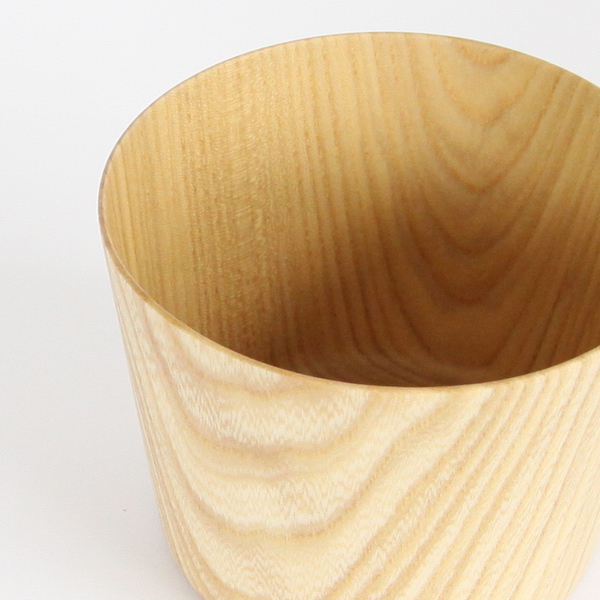
Held up to the light, it becomes almost translucent, as if made of paper—
which is exactly why it was named KAMI (meaning "paper" in Japanese).
It's a magnificent finish that makes you admire the craftsmanship
that can achieve such thinness in wooden tableware.
The feel against your lips when drinking is also excellent, offering a
quality quite different from glass or ceramics.

When it comes to wooden plates and cups,
you might assume there are restrictions on
what you can put on or in them.
Even among wooden plates, the way they should be handled
and the precautions needed vary depending on the finishing process,
so first, let us explain the different types.
(1) Polyurethane coating (for tableware)
(2) Oil finish
(3) Raw wood (unfinished)

For (1), the polyurethane coating, this corresponds to Takahashi Kogei's
Cara series.
This is a finish that coats the tableware so that water and food oils
don't soak into it, making it easy to use for everyday purposes
without needing much special care.

For (2), the oil finish, this corresponds to Takahashi Kogei's
Kakudo series.
Here, oil is worked into the raw wood so that it
penetrates and forms an oil film, preventing further water or
oil from soaking in.
For (3), raw wood (unfinished), this means the wood is left completely untreated.
ZUTTO does not currently carry this type.
While you can enjoy the natural feel of the wood itself,
it's very delicate, and using it daily—placing food on it,
washing it, drying it, and using it again—
is difficult with this material.
(It's prone to cracking and warping.)
Returning to Takahashi Kogei, since both the Cara series and the
Kakudo series feature either polyurethane coating
or an oil finish,
both can be used in everyday life.
On the plates, you can serve curry, meat sauce,
or sautéed chicken without worry,
and in the cups, there's no problem pouring in
deeply colored beverages like coffee or tea.
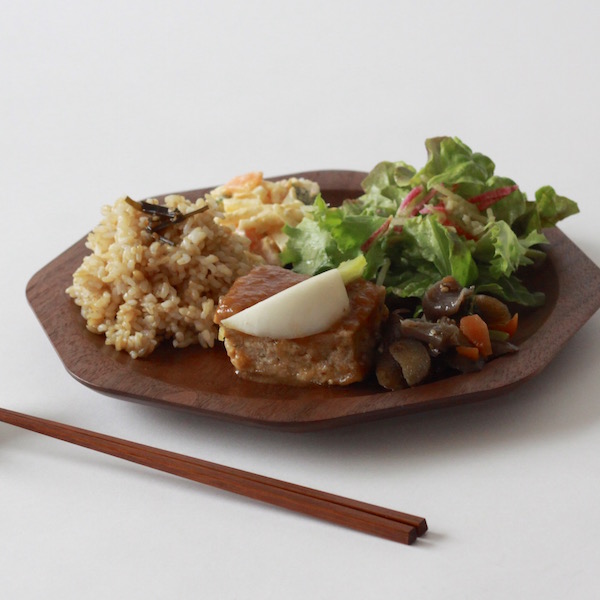


We also recommend using the oil-finished Kakudo series
for baked bread or rice balls (onigiri).
Since the wood absorbs moisture, it helps preserve the crispness of
toast and the crackly texture of the nori seaweed wrapped around
onigiri to some degree.

Takahashi Kogei's wooden plates and cups
can be used every day, but
since wood is, after all, a living, breathing material,
there are a few things to keep in mind.
・Don't leave oily foods on the plate for a long time
・Don't soak in water for a long time
In other words, please wash the item as soon as possible after use.
Prolonged contact with oil or water can lead to stains, and
in the case of water, it can also cause warping or cracking.
・When washing, please use a neutral detergent on a
soft sponge and wash by hand, just as you would with other tableware.
We don't recommend using a dish brush, as it may
cause scratches.
(Please avoid using a dishwasher.)
・Do not store the item in a place exposed to direct sunlight.
This can cause warping, cracking, splitting, or deformation.
Takahashi Kogei's Kakudo series
has oil worked into the wood, but as you use it,
the oil film gradually diminishes. If you notice the wood surface
feeling rough, please care for it regularly.

1. (If the roughness is severe)
lightly sand the surface with sandpaper of around 400 grit.
2. Put a small amount of olive oil, egoma (perilla) oil, walnut oil, or similar oil
onto a soft cloth and spread it little by little
over the plate. (Olive oil was used in the photo above.)
3. Once you've finished applying the oil, let it sit for a while,
then wipe it dry before putting it away.
With an oil finish, there's a sense of
"growing your own plate," which should make you feel even more attached to it.
It takes a little effort, but it's a joy to see
the wood surface become moisturized and beautiful.
Just as you'd apply cream to your own skin, care for your wood as well.
Wooden plates and cups aren't difficult to use in daily life,
as long as you're a bit careful when washing them.
With their simple design and natural color tones,
they also pair well with ceramic tableware and mugs.
The atmosphere they create on the dining table is wonderful, and your everyday meals
should take on a fresh, new impression.
Feel free to bring them along at home, or on picnics and outdoor outings.

Recommended Back Issues of "ZUTTO no Yomimono"
>>> Everything You Should Know About Cotton
GUIDE »
CATEGORIES »
- + Gifts by recipient
- + Gifts by scene
- + Clothing
- + Bags / Backpacks
- + Wallets / Card cases
- + Jewelry
- + Shoes
- + Rainy day outfits
- + Kitchen
- + Home
- + Babies / Kids
- + Japanese products
Earn Miles


Payment & Security