

.jpg)
























.jpg)

.jpg)

.jpg)












- トップページ/
- ZUTTO Journal/
- お手入れ・エイジング/
- The aging of LE T...

The aging of LE TRAVAILLEUR GALLICE, worn and cultivated over time.
Workwear—the object of admiration for those who love secondhand clothing and vintage pieces.
At shops lined with decades-old secondhand garments, time flows at an unhurried pace, and you find yourself wanting to carefully examine every detail as you choose. A vintage piece selected this way becomes something like a treasure—an embodiment of your own taste and sensibility. Because it's an item filled with attachment, it's one you can go on cherishing forever.
There is one piece of workwear at ZUTTO that gives you the feeling of discovering old stock quietly waiting to meet the person who will love it. That is the French workwear from LE TRAVAILLEUR GALLICE.

In this article, we'll take a detailed look at the aging process and appeal of LE TRAVAILLEUR GALLICE. Growing a jacket with such a rich history from scratch is sure to become a wonderful experience.
* * *
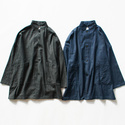
Available in 3 colors. We offer both men's and women's sizes.
>> BLEU DE TRAVAIL (eggplant navy)
Table of Contents)
・What is LE TRAVAILLEUR GALLICE?
- The oldest heritage brand proud to be 100% made in France
・3 reasons why moleskin is so rare
- A layered satin weave that protected wearers from sparks
- Was the costly VAT dye a source of pride for workers?
- The traditional looms that are disappearing
・Aging of the moleskin jacket
- What's the difference between a new piece and one worn for 3 years?
- A treasured piece estimated to date from the 1950s–60s

◆ What is LE TRAVAILLEUR GALLICE
Read as "Le Travailleur Gallice," this brand is the oldest heritage brand still maintaining 100% made-in-France production today.
Breaking down the French, the brand name comes from "LE TRAVAILLEUR = worker" and "GALLICE = France (from the Latin root behind the French language)." True to its name, "France's worker," the brand has represented the dawn of French workwear since it was founded more than 120 years ago, supporting the daily lives of workers ever since. Among the fabrics favored by French workers of that era was one called "moleskin," known for its extremely fine nap and distinctive sheen that somewhat resembles the fur of a mole.

Today, that same moleskin is by no means inexpensive, owing to its labor-intensive production process. Fabric made in France has become extremely high-end.
Just as denim symbolizes America, moleskin can be said to symbolize France. And yet, due to industrial decline and the effects of World War II, "genuine French-made moleskin" has become a rare thing indeed.
Late 1800s to around 1950: Moleskin
From around 1950 onward (due to industrial decline and the effects of WW2): Inexpensive fabrics such as cotton twill
Genuine moleskin is a fabric that's disappearing. And yet, the more it's worn, the more character it takes on—it ages much like denim, offering an appealing fabric full of the joy of ownership and the pleasure of cultivating it over time.
This raises a question. Given how appealing this fabric is, why did denim survive while moleskin workwear declined?
This time, we had the chance to speak in detail with Mr. T of the distributor for LE TRAVAILLEUR GALLICE, who is well-versed in French workwear, about the brand's appeal and the history of French workwear. We'll share that conversation here, along with the answer to this question.

▲Each garment comes with a LE TRAVAILLEUR GALLICE sticker, like a certificate of authenticity. The size and color are stamped on it—a stylish touch, right down to the smallest detail.
[Reason moleskin is rare, #1]
A layered satin weave that protected wearers from sparks
ZUTTO staff
"While researching moleskin, I kept coming across the term 'satin weave,' and I wondered—satin weave in workwear? It seems like such an odd combination. I always associate satin weave with scarves, suits, and other formal dress wear."
Distributor, Mr. T
"That's right. The French moleskin used in LE TRAVAILLEUR GALLICE is woven using what's called a 'weft-faced satin weave (or backed satin weave)'. In English, this is called 'satin weave.' It's an elegant fabric known for the sheen and smoothness typically seen in formal wear. It really is an idea that would be almost unthinkable for workwear today."

▲Satin fabric
Agency representative, Mr. T
"One reason moleskin uses a satin weave is that it's a weaving method that allows for thickness. Compared to a standard plain weave, satin weave increases the density of the warp threads by floating the weft threads over them, making it possible to weave a sturdier, thicker fabric. Since moleskin was often used in places like ironworks, it may be that fabric density and thickness were emphasized as protection against flying sparks.
On the other hand, many people have probably experienced threads snagging and popping out of satin fabric from just a slight catch of a fingernail. This is because the many floating weft threads create raised areas that are vulnerable to friction and prone to catching.
That said, moleskin is workwear. It has to be a tough tool for workers. For this reason, moleskin uses a technique called "layered satin weave" (kasane-shusu), which reduces thread floating without sacrificing the shine and smoothness characteristic of satin. This mitigates satin's weaknesses—snagging and low friction resistance—while producing a more durable fabric."

Agency representative, Mr. T
"As for that distinctive sheen, it may also reflect a certain pride—so that stylish French workers could work with confidence. Weaving moleskin with the layered satin technique takes a great deal of time and effort, so the number of producers has dropped sharply compared to the early days. There are still a few fabric makers in France that handle moleskin today, but most of them no longer weave the fabric in-house. In other words, moleskin woven from scratch in France is now extremely rare.
The reality is that much of what's labeled 'Made in France' moleskin is actually fabric woven overseas and then dyed in France."
【Why moleskin is rare, part 2】
Was expensive VAT dyeing a point of pride for workers?
ZUTTO Staff
"I see…. So the number of moleskin fabrics actually woven in France has dropped, which has driven up its rarity and value."
Agency representative, Mr. T
"That's not the only thing raising its rarity, actually—the dyeing method plays a role too.
The VAT dyeing used on LE TRAVAILLEUR GALLICE moleskin is exceptionally colorfast. Depending on the color, it can be difficult to dye and requires advanced technique, so the dyeing costs run high, and it's not a method used very often.
At the time, however, French workers held a strong belief that a jacket that faded easily was of inferior quality. Because of this, VAT dyeing was used on high-quality moleskin. A jacket that kept its vivid color indefinitely was something workers took great pride in."

▲The one on top is new, the one below has been worn and loved for three years.When we think of denim aging, we usually picture color fading, but VAT-dyed moleskin is a bit different. Rather than fading, the color deepens with wear compared to when it's new, which also brings out the soft sheen of moleskin's characteristic fine nap even more.
【Why moleskin is rare, part 3】
The old-fashioned looms that are disappearing
Agency representative, Mr. T
"Weaving a traditional French jacket at a traditional French fabric mill, dyeing it there, and having it finished into a product by French hands—these steps, which were once taken for granted, have become extremely difficult to carry out today."
ZUTTO Staff
"So the amount of moleskin actually woven in France has decreased compared to the early days. And with dyeing costs so high on top of that, it takes a tremendous amount of time and effort to produce nowadays."
Agency representative, Mr. T
"In terms of workwear, one reason moleskin has declined may also be the rise of cheaper fabrics woven on machines that can rival moleskin's durability. It's not just about how much time and effort moleskin weaving requires—shifts in demand and events like wars have also caused the old-fashioned looms to disappear. As a result, there are almost no opportunities today to enjoy, as a brand-new item, the kind of jacket that workers of the past were once so proud of.
Amid all this, LE TRAVAILLEUR GALLICE continues its craftsmanship in partnership with a long-established fabric maker founded in 1867 that has supported the history of French workwear, in order to recreate the kind of jacket that was once a prized possession for French workers. Many of the moleskin jackets currently circulating in the vintage market and fetching high prices likely use fabric from this same long-established maker. Being able to casually enjoy, as a brand-new item, fabric supplied by the very same supplier as back then is a truly precious and romantic story, wouldn't you say?"
Now that we understand just how rare and valuable moleskin is, let's actually take a look at how a LE TRAVAILLEUR GALLICE moleskin jacket ages over time.
◆Aging of the moleskin jacket
The "TRADITIONAL WORKER" series carried by ZUTTO is a model that holds the typical details of French moleskin while also carrying Gallice's own distinctive worldview.

▲Left: brand new, right: worn for 3 years, borrowed from Mr. T of the distributor
This colorway is "BLEU DE TRAVAIL," the traditional blue of French workwear. At LE TRAVAILLEUR GALLICE, it takes on a truly beautiful eggplant-navy hue, which is extremely popular. Blue doesn't show dirt easily, and around the world it has long been chosen as a color for the work clothes of laborers in factories and elsewhere. In America there was indigo blue denim, and in France there was French blue moleskin.The fact that the beautiful color still holds even after years of wear is thanks to VAT dyeing.

▲Left: brand new, right: worn for 3 years
You can see how the well-worn piece has developed a striking texture around the stitching, thanks to "puckering" (the gathering that occurs along seams). Speaking of thread, LE TRAVAILLEUR GALLICE's stitching also reveals its "good old days" character. Take a look at this video first.
▲LE TRAVAILLEUR GALLICE's stitching is done by craftsmen who work with their own hands.
This shows the garments being sewn using an old chain-stitch machine called a "BRAS DEPORTÉ." Because such time-honored machinery is used, the result has real character, and the stitching evokes memories of models from the 1970s.


▲Left: brand new, right: worn for 3 years
When we actually touched the well-worn piece, the texture of the fabric had transformed into a softness that felt like an entirely different material. The new piece gives an impression of moleskin as a sturdy, crisp fabric, but the one worn for 3 years has gained more suppleness, taking on a moist texture that clings gently to the skin. It's a change that makes you look forward to wearing it even more.
According to Mr. T, "After 3 years, the surface expression has become quite rich, but for Gallice's sturdy fabric, this is really still just the beginning." Gallice's moleskin is still dyed using the VAT dyeing method today, making it an item of extremely high colorfastness. There are plenty of jackets whose color fades with aging, but here the color has deepened and gained richness—a point well worth paying attention to.

▲Left: brand new, right: worn for 3 years
The pockets have a mountain-shaped hem. This is a detail seen in models from before the 1970s, a design that gathers together the details from an era when workwear was beautiful simply as workwear.

▲Left: brand new, right: worn for 3 years
The rounded collar shape is a representative detail of French work jackets, and the collar of LE TRAVAILLEUR GALLICE preserves that atmosphere while also having a three-dimensional shape with a raised stand.
This apparently becomes a key point for expanding styling options when actually worn. Whether left open at the front or buttoned up, both look sharp—a distinctive design that still lets you feel the flavor of good old French workwear.

▲Left: brand new, right: worn for 3 years
On the parts of the sleeves that rub often, fine fuzz has appeared. This kind of aging is simply irresistible.
When we asked about care, "I don't worry about washing at all. When it gets dirty, I just wash it thoroughly. I think that's the right approach—just like the workers back then did." was the answer we received. Being able to wear it in such a tough, carefree way is one of the true pleasures of wearing workwear. If you imagine the daily lives of the workers back then, they surely wore this jacket to work every day, washing it roughly whenever it got dirty and drying it, over and over again. LE TRAVAILLEUR GALLICE makes sturdy French workwear that can withstand exactly that kind of use.
◆We were also shown a treasured piece, estimated to be from the 1950s–60s

This, believe it or not, is a LE TRAVAILLEUR GALLICE jacket said to have been made sometime in the 1950s–60s. We borrowed this precious vintage piece from the distributor's own collection.

Although this model was made roughly 60 to 70 years ago, when placed side by side with the new one, as you can see, trying to spot the different details is almost like a game of "spot the difference." The one obvious change is the softness of the fabric—a wearing feel that molds to the body limply, like well broken-in leather. The toughness of a garment that has been worn for decades and yet still holds its shape neatly and beautifully is, in a word, remarkable.

Looking at the inner pocket, you can see the LE TRAVAILLEUR GALLICE logo, its design unchanged from then to now. It really shows just how much they have cherished their time-honored tradition.

The buttonholes must have been opened and closed hundreds—or perhaps thousands—of times. Yet they still keep their neat shape and function properly.

Mended here and there for small frays along the way. The soft texture of fabric that must have been lovingly worn for years, and a charm that remains undiminished even after more than 70 years. Being able to prove that a garment is still going strong—worn hard, with small frays mended along the way—is a testament to the craftsmanship of a long-established, time-honored brand. If you'd like to purchase a piece now and grow it into your own one-of-a-kind vintage, or if you want to own an item that will last a lifetime, why not choose LE TRAVAILLEUR GALLICE?
◆The appeal of LE TRAVAILLEUR GALLICE, as told by a longtime wearer (from T, the agency representative)
I think French workwear has a charm all its own, quite different from American workwear.
Take moleskin, for example—it was created from a perspective quite different from that of sturdy, no-nonsense American denim. You can see differences arising from the main industries of each country at the time, as well as differences in the functions demanded of workwear. It's also fascinating how certain details changed with the times, reflecting the background of each era.
▼Brand featured in this article

GUIDE »
CATEGORIES »
- + Gifts by recipient
- + Gifts by scene
- + Clothing
- + Bags / Backpacks
- + Wallets / Card cases
- + Jewelry
- + Shoes
- + Rainy day outfits
- + Kitchen
- + Home
- + Babies / Kids
- + Japanese products
Earn Miles


Payment & Security