.webp)


.webp)


.webp)


.webp)


Welcome to ZUTTO
Free shipping for newsletter subscribers (some areas excluded)
- トップページ/
- ZUTTO Journal/
- お手入れ・エイジング/
- A Goodness You On...

The goodness you only understand after wearing them in—the aging of PRAS canvas sneakers

One day, we happened to notice one of our staff members' feet, and our eyes were drawn to her softened canvas sneakers. Somehow nostalgic in appearance, yet made of a dependable fabric. These sneakers, which seemed to have become a part of her feet, no longer had the pristine beauty of something new—but they had a charm that caught the heart all the same. There's a certain goodness in a shoe that only becomes clear once you've truly worn it and made it your own. This time, we take a closer look at that appeal through the aging of PRAS, a shoe brand our staff member fell in love with at first sight and has been wearing ever since.
PRAS: Japanese shoes that face materials and craftsmanship with sincerity
PRAS shoes carry a simple, minimal impression. PRAS is a shoe brand made in Kurume, Fukuoka—home to MOONSTAR, a long-established Japanese shoe manufacturer. The brand sends the shoemaking techniques passed down through generations in Kurume out into the world.

PRAS continues to take on new challenges each season. The brand's name itself carries the idea of creation born from adding Kurume and Kojima together—a "plus" of the two.


Comfort? Looks? What makes these shoes so easy to love
PRAS has many devoted fans among the ZUTTO staff. So among the countless canvas sneakers out there, why did our staff choose PRAS? (Answer: ZUTTO staff member M)
The first time I saw PRAS sneakers, I was captivated by their natural feel and the shell motif on the toe.

I think natural-looking sneakers like this can be found at all sorts of price points, but this SHELLCAP series really struck me as a pair "where you can feel the craftsman's dedication" in every detail. There's a certain ruggedness beneath the natural look that I really love.
Yes. Whether you look at them or actually wear them, there's nothing about them that feels lacking, nothing that feels uncomfortable. I think that comes from the sincerity the brand has poured into its craftsmanship. I own several pairs of overseas-made canvas sneakers too, and after wearing them a long time, they inevitably get stains that won't come out, or lose their shape—which can become part of their charm, but a dirty, worn-out sneaker only really works with casual outfits, and it can be hard to coordinate. With PRAS sneakers, though, you can wash them thoroughly with water (*1), so even in the unbleached natural color, they stay relatively clean.
That's right. Being washable is a huge point. The canvas sneakers I used to own had their upper and sole glued together and wrapped with tape, so the tape would peel away as my feet moved. Anything that's simply glued together can't be washed. I imagine a lot of people can relate to that. PRAS sneakers are made using a special construction method called "vulcanized construction" (*2), in which unvulcanized rubber is sandwiched between the shoe's upper and sole to bond them together—a method used by only a handful of manufacturers in Japan—which is why they can be washed thoroughly with water.

Because they're so simple, I often find they're easy to match with clothes and easy to use in general. Whenever I'm packing just one pair of sneakers for a business trip, these are the ones I grab. What surprised me most, though, is that they don't tire my feet even after wearing them for a long time.
This is just my personal impression, but I think a big part of it is that PRAS sneakers are made in Japan, using a last shaped for Japanese feet. They're made with a somewhat wider width and higher instep, giving a natural arch that fits comfortably along the foot. Because the material has flexibility, the rubber sole moves naturally along with the foot (*3). I really want people to experience this sense of comfort and security for themselves!
I've worn mine for a year now, and they're still holding up really well. They've gradually molded to my feet, but overall I'm struck by just how sturdy the canvas is. Apparently, the more you wear them and wash them, the tighter the weave of the canvas becomes, making them even more durable. They've been a great help on days when I know I'll be walking a lot, or during busy periods at work that involve a lot of walking. I'm looking forward to seeing how they continue to age.
(*1) Because you can wash them vigorously without worry. Kojima canvas that tightens up and molds to your feet
The canvas used for the upper is Kojima canvas (cotton sailcloth), made in Kurashiki, Okayama Prefecture. Okayama and Kurashiki have long been known for cotton cultivation, and today the region produces roughly 70% of Japan's domestic canvas, making it a major production area for the fabric. This breathable, durable canvas—which develops character the more you wear it—is a PRAS original. Calculating for its use as sneaker uppers, the thread density is set slightly lower than that of standard No. 10 canvas, resulting in an optimal fabric thickness. Since it's canvas, washing it once it gets dirty from wear tightens the weave, and the shoes tend to last comparatively longer than if you kept wearing them without ever washing them.
(*2) The enemy of canvas sneakers—why the sole doesn't peel off even after long use
The main reason PRAS sneakers can be used for so long is that they're made using the vulcanized construction method. In Japanese, this is called "kaoryu-gama seihou" (vulcanized pot method), referring to the technique used to bond the upper and sole of a sneaker. Uncured raw rubber is molded onto the upper and sole, then placed in a special kiln where high heat and pressure are applied while sulfur and other vulcanizing agents cause the rubber to harden and fuse together. This process allows the canvas upper and rubber sole—two completely different materials—to be bonded together with remarkable strength.
(*3) A rubber outsole that moves with your foot
Rubber that has gone through the time-consuming vulcanized construction process comes to possess its true characteristics—stretching and then properly returning to shape, bouncing back, and bending flexibly. This results in an excellent fit for the foot, smooth push-off with each step, and a sole that resists peeling away. In addition, rubber tape is wrapped around the seam where the sneaker body meets the rubber sole for reinforcement, giving it outstanding durability against lateral movement as well.
A Low-Cut Sneaker, Two Years On: SHELLCAP LOW KINARI/OFF
・Years of use: About two full years
・Frequency of use: About once a week, worn regularly on days off
・Condition: The shoes have softened up considerably and molded to the feet, but they haven't lost their shape. There's no peeling on the tape applied at the seam between the upper and the sole, either.
BEFORE

AFTER


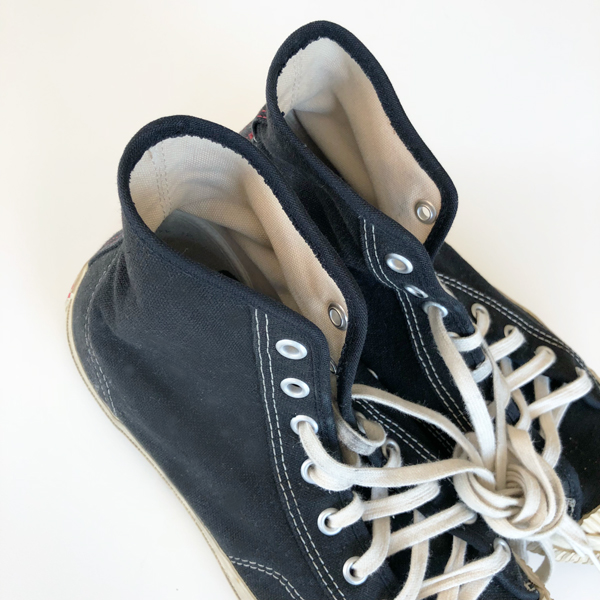
A High-Cut Sneaker After One Year of Use
※This item has been discontinued
・Years of use: A little over one year
・Frequency of use: One to two times a week. Every day when traveling for work!
・Condition: Since I walk a lot, the canvas has softened up quite a bit and molded to my feet. The ankle area has also creased in response to movement.


Which Size Should I Choose for PRAS?
"Which size PRAS sneaker would fit me?"This is a question we frequently receive from customers.
"PRAS sneakers are basically made to fit Japanese feet, so if you want a snug fit, we recommend going half a size down (0.5cm) from the size you'd normally choose for imported canvas sneakers when it comes to lace-up styles. For slip-on styles, we suggest matching to your actual foot length." (From our customer service team)
【Reference Fittings】
・Staff A: Somewhat wide feet, otherwise average
Imported sneakers: 24.5cm (larger if worn loose)
Pumps or leather shoes: 24cm
PRAS (lace-up): Size 23: About 23–24cm fits perfectly. Since thick socks make them too tight, I often wear them with thin socks or tights.
・Staff B: Average width and instep
Imported sneakers: Usually 23.5cm
Pumps or leather shoes: 23cm
PRAS (lace-up): Size 23: About 23–24cm feels a bit large, but I adjust the fit with the laces.
Doing Laundry on a Sunny Day
Finally, let's talk about care. This time, we had a staff member show us their usual routine for washing their sneakers.

I don't really do anything too elaborate for care, honestly. If they get caught in the rain or get especially dirty, I'll wipe the rubber parts with something like a rag, but when I'm tired I sometimes just leave it as is (laughs). As for washing, I do a thorough cleaning all at once whenever the seasons change. The nice thing about sneakers is that they look good even without a lot of fuss.
Nothing in particular! I think it's probably the same as everyone else—scrub them well with laundry detergent, and use a brush for any stubborn dirt. That said, if detergent or moisture is left behind, it can easily cause stains, so I make sure to rinse and spin-dry thoroughly. For spin-drying, I run them in the washing machine for about three minutes. Of course, that's assuming any sand or dirt has already been properly removed.

You can't wring out shoes, so it's more like getting a sense that some of the moisture has been removed. But since I don't always wash my shoes on a perfectly clear day, that function can come in handy at times like that. At first, I used to stuff a rag inside the shoes to prevent them from losing shape and to help them dry faster, but I ended up liking the softened, worn-in look, so now I just let them dry as they are. I dry them in the shade so they don't fade in the sun!

Editor's Note — What Sneakers Reveal
We've introduced the aging process of PRAS sneakers, which our staff love wearing and which frequently make an appearance in the coordinated outfits on ZUTTO's product pages. Although PRAS releases new colors and minor updates every year, the basic shape has remained largely unchanged. This is proof of just how complete a design these sneakers already are. Style and comfort might seem like they don't go together at first glance, but looking at a well-worn, softened pair of sneakers that someone has loved using, you can somehow see the person's character coming through—and that in itself feels stylish and appealing. They say fatigue tends to build up in spring, and these are surely sneakers that will serve you well for relaxed, unpretentious footwear during that season.
▽Related Reading

GUIDE »
CONTENTS »
CATEGORIES »
- + Gifts by recipient
- + Gifts by scene
- + Clothing
- + Bags / Backpacks
- + Wallets / Card cases
- + Jewelry
- + Shoes
- + Rainy day outfits
- + Kitchen
- + Home
- + Babies / Kids
- + Japanese products
Earn Miles


Payment & Security