.webp)


.webp)


.webp)


.webp)


Welcome to ZUTTO
Free shipping for newsletter subscribers (some areas excluded)
- トップページ/
- ZUTTO Journal/
- お手入れ・エイジング/
- Comparing How Two...

Comparing How Two People Use It: Odate Kogeisha's "Koban Bento Box" Edition
In this installment of our "Comparing How It Feels to Use" series, we're taking a look at Odate Kogeisha's "Koban Bento," which two ZUTTO staff members use and love. With its charmingly round shape, this bento box is a magewappa (bentwood box) made from Akita cedar that has weathered the harsh cold of the Tohoku region. In an age overflowing with things, what we choose to wear or own is entirely up to us—but there must be a reason when two people choose the very same item. We spoke with two staff members who both use the same magewappa bento box to find out what they have in common in how they use it, and where they differ.

Two Different People, Each Choosing the Same "Magewappa"

Introducing the Users
・Editorial staff U:
Three years of using magewappa. Loves traditional Japanese cookware and tableware.
・Customer service staff M:
One year of using magewappa. Loves eating but is still learning to cook. Lives far from the office and endures a crowded train every day.
U: It started when I saw a staff member using a magewappa bento box. It was love at first sight. Before that, I'd been using a microwave-safe plastic bento box, but I loved the beauty of it as a traditional Japanese container, and how the rice looked especially delicious in it.
M: For me too, the look was a major point. Since I love eating, I'd always been curious about magewappa, but I avoided it, thinking "it seems like it would be hard to use." But since it's something I'd use every day, and I wanted to enjoy cooking more, I took the plunge and got a small-sized one a year ago. You have the medium size, right, U?
U: Yes, I chose the medium size thinking it would give me some extra room to fill it. There are all kinds of magewappa—round ones, long slender ones—but Odate Kogeisha's magewappa are simple and easy to use. I also like that they fit easily into a bag.
M: True, they really are simple! And yet beautiful too. Knowing that skilled Japanese craftsmen carefully make each one from high-quality Akita cedar makes me want to use it for a long time and take good care of it. It makes sense that, with proper care, they're said to last more than ten years.

What the Way They Pack Reveals About How Each Uses It
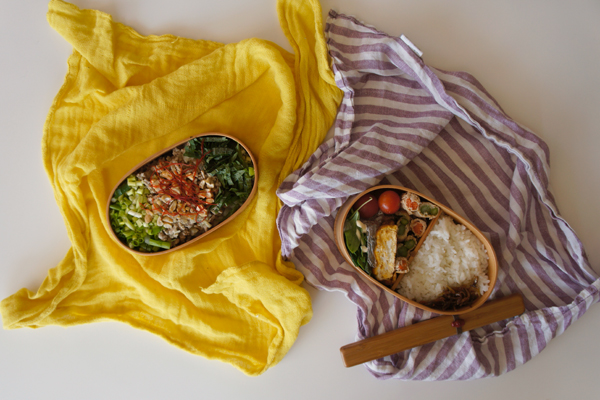
Right away, we asked to take a look at the bento boxes they'd brought with them. Both were a bit shy, saying, "It's not really something worth showing off..." but comparing them side by side, it's fascinating how different the impressions are, even though it's the same bento box.
Staff U: Colorful, and prefers to keep the rice separate from the side dishes

Staff U says that what she packs in her magewappa naturally tends to end up being Japanese food. She basically uses the included divider, putting white rice on one half and side dishes on the other. The side dishes are meat, fish, and vegetables that she prepares in advance over the weekend. "The good thing about the medium size is that it lets me pack with some room to spare. I can fit plenty of side dishes, and the rice stays nice and fluffy while I carry it."
Staff M: A believer in one-dish rice bowls

Staff M says, "I'm not particularly good at cooking, but I love how using a magewappa makes a bento look put-together." Packed tightly into her small magewappa is a soboro rice bowl made with her favorite green curry paste. "I chose the small size because I find something romantic about a bento packed so full it looks like it's about to burst. I like packing it tightly like a rice bowl, or filling it with leftovers from dinner. It's a classic, but I often make chicken soboro rice bowls too."
"What Changed Before and After You Started Using Magewappa?"
M: I started making bento more often. It's also progress that on my way home, I now think about what to have for lunch the next day and plan the menu.
U: My menu changed too. Before, I sometimes brought bread instead of rice for lunch, but now it's overwhelmingly rice. Since I pack lots of side dishes, I think my diet has become more balanced too. Rice really does look delicious in it, and I find myself looking forward to lunchtime.
"Do You Match Your Bento Wrap to the Overall Look?"

U: The one I use is a kitchen cloth that ZUTTO used to carry, from fog linen work(フォグリネンワーク). I also have one in a different pattern for when I need to wash the other, and I rotate between the two. I bought it specifically as a bento wrap, so I've probably been using it for about three years now.
M: You can tell it's been used for a long time—it's got that soft, worn look that's really cute. Your chopstick case is natural too, and it fits the vibe perfectly.
U: It's the urushi (Japanese lacquer) chopstick set from Kohchosai Kosuga. I guess I end up matching everything else to the bento box too, choosing gentle, natural materials.
M: I matched mine to the bento box too. Until now I'd been bringing my lunch in a Tupperware container, so I used a large patterned handkerchief-like cloth I'd had since my school days, but somehow it didn't feel right with this bento box. I happened to find a kaya-fabric (mosquito-net cloth) dish towel at a general store and bought it as a wrap, and it turned out to actually be the Hana FukinIt turned out to belong to the same series! It gets soft and pliable every time you wash it, and it's really easy to tie. Another staff member also uses this hana-fukin for her bento, and it's quite popular. The color I use isn't carried at ZUTTO, but I'm thinking of buying more in other colors as spares to rotate with.
"How much liquid can you put in it?"
M: I don't really pay special attention to it. On a crowded commuter train my bag sometimes ends up upside down, so when I'm worried I'll put things in a Ziploc bag. But I don't think I've ever had a leak. Maybe it's because I don't tend to pack things that are very juicy.
U: I'll go ahead and pack things like nikujaga (simmered meat and potatoes) or teriyaki-style dishes. Since it has a urethane coating, unlike plain shiraki (unfinished wood) magewappa, there's less worry about stains. If I'm feeling uneasy, wrapping it in plastic wrap might help too.
"Doesn't it bother you that you can't microwave it?"
U & M: It doesn't bother us at all!
U: One reason it doesn't bother me even without reheating is that with a magewappa bento, it really comes down to "being able to enjoy delicious rice." Thanks to the natural moisture-absorbing properties of Akita cedar, the rice doesn't get soggy even after time has passed, so you can enjoy it fluffy and delicious. Once I discovered how good that is, not being able to reheat it stopped bothering me.
M: It makes me think back to my school days, when I could enjoy a bento even without microwaving it. My mother must have made bentos that tasted good even when cold. It's true that being able to microwave it might be more convenient, but once you get to know the good qualities of these old-fashioned, traditionally made magewappa, you develop a real fondness and attachment to them. It makes you want to research side dishes that taste good even when cold!
"Attention to how you pack it"
M: I pack the rice in firmly, starting from the edge of the bento box. I put both the rice and the side dishes in at an angle. I like a bento that's packed full, and that's actually one reason I chose the small size.
U: Since I have the medium size, there's a bit more room, so I use a divider to split the box in half between rice and side dishes. I make sure to put in the firmer side dishes first, and I'm careful not to leave any gaps.
M: The nice thing is that it looks delicious even without much effort, but precisely because it's a favorite of mine, I can't help but develop my own particular habits (laughs).
Time that objects speak of. An aging comparison
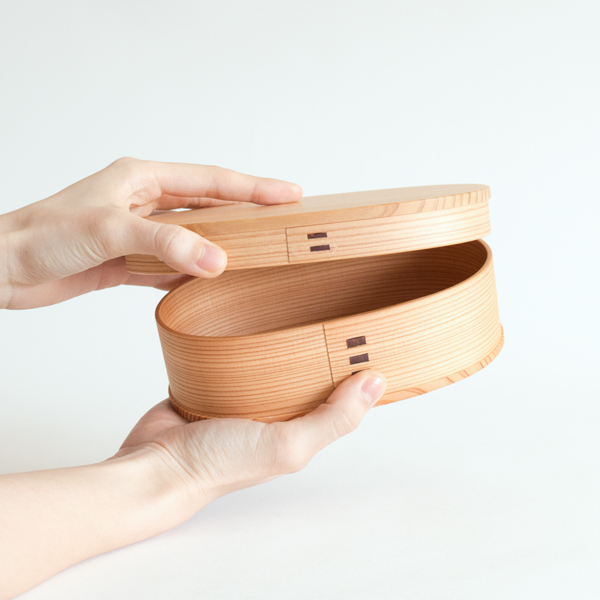
These bento boxes are made of natural materials. Do they change in character as you use them over time? We compared whether there's a difference between when you first start using one and now, and looked at how the two magewappa—used for different lengths of time by the two staff members—differ from each other.

(Left: medium size): used about 3 times a week for around 3 years
(Right: small size): used about 2 to 3 times a week for around 1 year
U: (lining up the magewappa side by side) Looking at them like this, even the one used for 3 years is in pretty good shape. I think the difference in the color of the lid's wood is just individual variation from when they were purchased.
M: No stains or dirt either. It makes sense that people say if you use it carefully, it can last 10 years. What about the smell of the wood? The one I've used for a year still has a bit of that ohitsu (wooden rice tub)-like scent.
U: For mine, it faded after about a year. The urethane coating still looks great too—it's been 3 years, but it doesn't look much different from when it was new.
Things fellow enthusiasts secretly want to ask each other: "How do you handle this?"
① Doesn't the loose-fitting lid bother you?
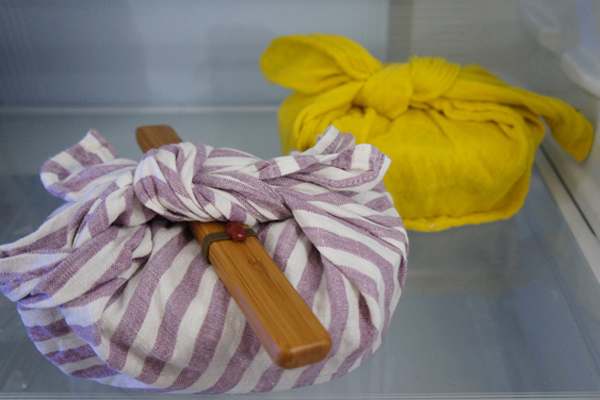
U: If you're used to Tupperware or plastic bento boxes that close tightly, it might bother you. But once you actually start using one, it stops being an issue. If you tie it up firmly with a bento wrapping cloth, it doesn't wobble at all.
M: It doesn't bother me either. If you put a rubber band around it and wrap it up, it won't accidentally come open.
② Is there a menu item that might surprise people?
M: For example, when I want to bring curry, I'll sometimes use it just like an ohitsu. I'll pack only plain white rice in the magewappa and bring the curry separately in a Tupperware-style container. I love that the rice stays delicious right up until lunchtime.
U: That's a great idea! For me, I tend to make the most of the classic feel of magewappa, so I go with standard Japanese dishes a lot.
③ Do you refrigerate it while waiting for lunch, or not?
U: I do refrigerate it—year-round, I make sure to keep it in the fridge so it doesn't spoil.
M: I refrigerate mine too. For people who don't like cold rice, it might help to take it out and let it return to room temperature about an hour before eating.
④ What's your daily care routine after eating?
M: Care is easy, too. Unlike shiraki, it has a urethane coating, so you can use detergent. You wash yours right after eating too, don't you, U?
U: Yes, I always make a point of washing it right away. After washing, I wipe off the moisture with a paper towel and then leave it in a place with good airflow. Once lunch break is over, there's always someone's magewappa drying somewhere.
M: I've heard that leaving it soaking in water isn't good. Wash it right after use and dry it right away—I think that's the key to keeping this magewappa bento looking good and lasting a long time.

△ Can be washed with detergent.

△Gently wipe it off and place it somewhere with good airflow. By evening, it will be completely dry.
There's always a reason why something comes to be loved and passed down by so many people. In an age where everything around us has been made convenient, traditional crafts that might at first seem inconvenient may actually be "tools" that remind us what true richness in daily life really means.
Brand Introduction: Otate Kogeisha

Magewappa (bentwood ware) is well known as a traditional craft of Akita Prefecture. Its history is said to date back to the Nara period, when woodcutters first made bent vessels from cedar wood. The process begins by thinly shaving natural Akita cedar, prized for its elasticity and beautiful grain, then soaking it in hot water to soften it before bending it into shape and stitching the seams with strips of yamazakura (wild cherry) bark. In order to pass down to the present day the traditional techniques that were once part of everyday life, Otate's magewappa makers have continued to create items that fit naturally into daily use, and their work has remained in constant use ever since. In 1980 (Showa 55), it was designated a national traditional craft.
>> Discover Otate Kogeisha's products here
>> Discover the highly durable, urushi (Japanese lacquer)-coated magewappa here
*Because each piece of Otate Kogeisha's magewappa is carefully handcrafted by artisans one at a time, production may take some time. Even when an item is temporarily out of stock, new stock arrives regularly, so please look forward to the next restock.
▽Past issues of "Comparing How Two People Use It." can be found here
Part 1: PATRICK STEPHAN "3-Way Leather Pochette" Edition
GUIDE »
CONTENTS »
CATEGORIES »
- + Gifts by recipient
- + Gifts by scene
- + Clothing
- + Bags / Backpacks
- + Wallets / Card cases
- + Jewelry
- + Shoes
- + Rainy day outfits
- + Kitchen
- + Home
- + Babies / Kids
- + Japanese products
Earn Miles


Payment & Security