


.webp)


.webp)


.webp)


.webp)


Welcome to ZUTTO
Free shipping for newsletter subscribers (some areas excluded)
- トップページ/
- ZUTTO Journal/
- ブランドストーリー/
- A specially order...

A specially ordered hinoki (Japanese cypress) kagami mochi that can also transform into a snowman. An interior piece to enjoy from the Christmas season onward.
Preparing for the New Year alongside decorating for Christmas and getting presents ready might be something uniquely Japanese.
One part of preparing for the New Year is putting up New Year decorations. There are many kinds—kagami mochi, kadomatsu, shimenawa, and more—but how many households actually put them up properly every year?

Made from domestic wood with a smooth, pleasant grain, this is a kagami mochi you can cherish year after year, watching it develop its own unique character over time through changes in color and small marks that belong only to your family. Allow us to introduce the "Hinoki Kagami Mochi."

A ZUTTO exclusive. The ever-popular "Hinoki Kagami Mochi," which also transforms into a snowman.

This piece is made by Sonobe Sangyo, a maker known for its careful craftsmanship using domestic wood. Created through repeated consultation, the "Hinoki Kagami Mochi" is a specially ordered item sold exclusively at ZUTTO.
Originally it served only as a kagami mochi, but so that it could be displayed for a longer season, a walnut bucket was created, turning it into an interior piece that can also be displayed as a snowman. Place the bucket on top instead of the daidai (bitter orange), and it transforms into an adorable snowman.


You can display it not only during the short New Year period but starting from the Christmas season as well, and thanks to its natural wood tones, it doesn't feel overly wintry—making it a charming piece of decor to display all year round.

The set includes the kagami mochi, daidai, pedestal, and the bucket as well.
What is kagami mochi? What does displaying it mean?
Many New Year decorations and customs—kadomatsu, shimenawa, osechi, otoshidama, and more—are connected to deities. Kagami mochi is thought of as an offering to Toshigami-sama, the deity of agriculture, and carries the meaning of receiving good fortune and strength from this deity while wishing for a year of good health.
That said, real kagami mochi often grows moldy before kagami-biraki (the ceremonial breaking of the mochi), or dries out so much that it's hard to know how to eat it—making it something people hesitate to try. Some consider the plastic-container kagami mochi sold at supermarkets for its convenience, but often hold back because it can look a bit too simple.

While this hinoki kagami mochi we've created cannot be eaten, it can be enjoyed as a seasonal piece of decor, and offers a chance to rediscover and experience the meaning behind New Year decorations. If you have children, it's also a wonderful opportunity to learn about Japanese customs and culture together.
Enjoy the scent of hinoki, and admire the charm of the mochi
This is the Hinoki Kagami Mochi.

The set consists of two mochi pieces, a daidai (bitter orange), and a pedestal.
It uses domestic wood selected by Sonobe Sangyo, with different types of wood used for each part.
Mochi: hinoki
Daidai: keyaki (zelkova)
Daidai leaf: honoki (Japanese bigleaf magnolia)
Pedestal: sakura (cherry)
The mochi itself is left unfinished, with a smooth texture that feels just like real mochi. Unfinished wood tends to pick up dirt more easily, but we wanted people to be able to enjoy the beauty and scent of the wood, so we finished it naturally without any urethane coating.
And the bucket used when displaying it as a snowman is made of walnut. (The daidai, leaf, and bucket are finished with urethane coating.)

The oval shape unique to kagami mochi looks wonderfully unique and endearing once turned into a snowman. For families with small children, sticking on eyes, a nose, and a mouth might make it even more fun.
▼Please also watch the video. The sound it makes when stacked is charming, like building blocks.
When you open the box, the lovely scent of hinoki brings a real sense of calm. Even the cushioning material inside is made of hinoki chips, so be sure to enjoy the fragrance first thing when you open the box.

The hinoki used for the mochi parts is a tree found only in Japan, Taiwan, and parts of China. In Japan, it has long been used as a sacred wood at shrines and temples, including Horyu-ji and Ise Jingu.
It resists moisture and water well and is quite durable. It also has insect-repelling properties and helps prevent the growth of bacteria, making it well suited as a material for decorations that spend long stretches of the year in storage.

The mochi pieces are bowl-shaped in different sizes, so they can be nested together for storage. Once the display season is over, simply place them back in the box they arrived in and put them away until next year.
Thanks to Sonobe's idea, the pedestal is octagonal, which softens the traditionally "Japanese" feel—so it fits nicely not only alongside Japanese-style New Year accessories, but also on Scandinavian-style sideboards or shelves displaying your favorite miscellaneous items. And since there's no risk of it being mistaken for food, it's also a great choice for households with pets.

Making mochi the same way you make a bowl: A mini interview with Sonobe Sangyo.
This "hinoki (Japanese cypress) kagami mochi" was made specially for ZUTTO by Sonobe Sangyo as a custom order, so it isn't sold anywhere else. Since we have this chance, let's talk a bit about this kagami mochi and the brand behind it.
We spoke with Kotaro Sonobe of Sonobe Sangyo Co., Ltd. He kindly accepted ZUTTO's request for a custom order, and worked together with the craftsmen to bring this wooden kagami mochi to life.

△SONOBE brand wooden bowls, "Meiboku Wan"
Sonobe: "Yes, the process is almost the same as making bowls. We cut logs into boards, then cut the boards into blocks sized for a single piece of mochi, and after a drying process, carve them into the shape of a wooden kagami mochi. This carving work is called 'kijibiki' (wood-lathe turning) — the wood is set on a lathe, spun at high speed, and shaped by pressing a blade against it."


"As for the difference in shape, since there's no koudai (the ring-shaped foot at the base of a bowl), this hinoki kagami mochi ends up looking like a small soup bowl.
That said, soup bowls and wooden bowls are tools meant to hold food, so if the wood is left bare after carving, it absorbs moisture from the food and cracks, becoming unusable after just a few uses. That's why bowls need to be coated with urethane lacquer, treated so they won't absorb moisture and won't easily get dirty.
In the case of this hinoki kagami mochi, though, it's meant to be displayed rather than used, so we didn't apply any coating. We left it unfinished so people could enjoy the scent of the wood — something that could quietly become part of everyday life."

As you can see, the shape of this mochi piece is based on the shape of the bowls made by Sonobe Sangyo, but while checking the finished product, one of our staff members murmured, "It's cute — it looks like a Yukimi Daifuku..." Indeed, the slightly flattened shape does resemble that ice cream mochi, doubling its nostalgic charm and cuteness.
Sonobe: "Yes, we use the hinoki wood shavings left over from our work process as cushioning material. Among the waste we produce, there isn't a single scrap of wood that gets thrown out as 'burnable wood waste.' For example, even if a piece of timber has large knots or stains and can't be used for a product, we burn it into charcoal, which our blacksmiths then use to forge the blades our craftsmen use in their work."

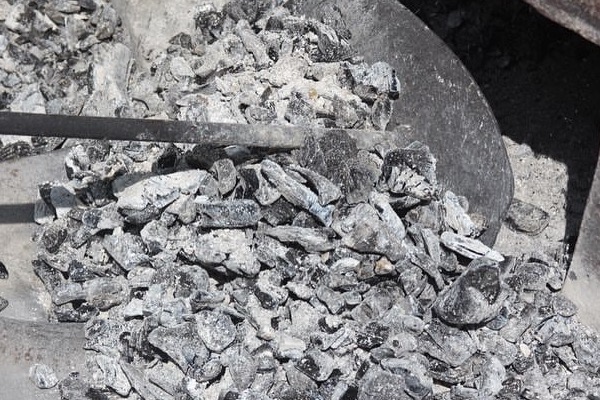
△The ash left over after forging the blades is scattered on the fields, nourishing the vegetables.
"Also, the large volume of wood shavings we produce is used as fuel for the smoke-drying room where the timber is dried, or becomes bedding for the horses and other animals at a ranch, also here in Odawara. That bedding then turns into compost, which is spread on the fields again, nourishing citrus trees like mikan. It's all part of a cycle."

"'Using wood considerately' means using it up fully, without waste. It's about returning to nature the trees that nature raised, for the sake of the trees and plants of the next generation. I suppose people would call this 'eco' nowadays, but originally, it wasn't so much about being eco-friendly — rather than simply treating it as industrial waste, this was just the way that makes everyone happy: good for drying the wood, good for making things, good for the animals, good for the trees still growing."

"This hinoki cushioning material we used this time wasn't originally about being eco-friendly either — the idea was simply for our customers to enjoy the scent of hinoki a little more, so that they might feel a bit happier. 'Using wood considerately' means using it up fully, in a reasonable way. This is exactly what connects to our brand identity: 'Without strain, without waste, until it returns to the soil.'"
Sonobe: "At Sonobe Sangyo, we do use some wood from overseas, but we have a strong desire to use domestic wood. That's because we want to revive and protect Japan's 'dead forests.' Japan's forests were originally rich in broadleaf trees, but because so much cedar and hinoki were planted during and after the war for use as building materials, the forests are now mostly coniferous. After that, cheap imported timber took away the demand for domestic wood, and these forests became places nobody paid attention to anymore — in other words, dead forests. Forests become neglected and overgrown if they aren't managed and cared for, so it's necessary to keep a cycle going of using wood and replanting it."

"Using Japanese wood helps protect these forests of Japan. First, as a single product, we hope a customer will pick it up thinking, 'I'd like to try using this.' And ideally, that feeling of wanting to try it will, without anyone even noticing, end up benefiting Japan's forests. In that way, as part of the movement to protect the forests, we will keep on using Japanese wood."
▽ [Custom Order] Hinoki Kagami Mochi — product page here

GUIDE »
CONTENTS »
CATEGORIES »
- + Gifts by recipient
- + Gifts by scene
- + Clothing
- + Bags / Backpacks
- + Wallets / Card cases
- + Jewelry
- + Shoes
- + Rainy day outfits
- + Kitchen
- + Home
- + Babies / Kids
- + Japanese products
Earn Miles


Payment & Security




