Welcome to ZUTTO
Free shipping for newsletter subscribers (some areas excluded)
- トップページ/
- ZUTTO Journal/
- ブランドストーリー/
- # Interview: The ...

Visiting Miyamoto Kogei in Hirosaki City, Aomori Prefecture, the birthplace of yamabudo baskets.
This time we visited Miyamoto Kogei in Hirosaki City, Aomori Prefecture. The workshop handles basketwork such as akebi baskets and yamabudo (wild grape) baskets, and has long been carried by ZUTTO, remaining one of our most popular makers. Wanting to learn more about the secrets behind the made-to-order yamabudo baskets they began offering a few years ago, we were given the opportunity to visit and report on their production site.

It takes about three hours from Tokyo to Shin-Aomori by shinkansen, and then another 30 minutes by local train to reach Hirosaki City.

Around the station there are business hotels and souvenir shops, making it compact yet convenient. Walking about 15 minutes, Miyamoto Kogei comes into view.

The first floor is a shop, and the second floor is the workshop. As we passed through the noren curtain, we were greeted by Takeda-san, who handles sales and serves as the point of contact for Miyamoto Kogei. He immediately began explaining how yamabudo baskets are made.
How are yamabudo baskets made?
Only natural materials are used in Miyamoto Kogei's yamabudo baskets. The materials are basically procured within Aomori Prefecture, with yamabudo harvested from nearby Mount Iwaki purchased for use.

This is Mount Iwaki. The mountain is clearly visible from within Hirosaki City.
1. Harvesting
While akebi vines creep along the ground, yamabudo bark actually wraps around trees. Only the outer bark is shaved off and collected, and Miyamoto Kogei purchases it directly, keeping in close communication with the harvesters. Harvesting is only possible during a one-month window from June to July. What is brought back is dried on the roofs of Miyamoto Kogei's warehouse and buildings.

It's not unusual for yamabudo trees to grow more than 30 meters tall. The bark wrapped around them is harvested as high up and as long as possible.

This is akebi vine. Long, richly colored akebi unique to Mount Iwaki is hung to dry here.

Yamabudo bark is stored in bundles like this. Not all of the bark can be used—like an assortment box, bundles contain yamabudo bark in various conditions all mixed together.
2. Preparing the bark
A distinctive feature of Miyamoto Kogei's yamabudo baskets is that a single craftsperson takes the dried bark all the way through to completion. The process begins by soaking the bark in water to remove any warping and soften it.

A space for holding water on the way to the workshop. The bark is placed here to soften it to a certain degree.

The softened bark is kept inside plastic so that it doesn't dry out before the next step.
3. Bark stretching / tanning
From here, the work turns to actually shaping the natural yamabudo bark into a basket, and this is where the craftsperson's skill truly shines. "Kawa-biki" (bark stretching) refers to examining the condition of the bark and stretching it to remove any warping, working it into the width needed for use. This process is repeated again and again to produce better material.

Though it may look like a modest task, this step is crucial in determining the finished quality of the basket. We were told that the craftsperson spends several days at a time working through material for just a few baskets.

Bark that had been slightly bent just moments ago becomes perfectly straight once stretched like this. Finding pieces that are long and free of knots is also quite a challenge.

4. Weaving
The baskets are woven using a wooden mold. Since the material is woven while wet, the craftsperson weaves carefully, taking into account how the weave will shrink once it dries."Unlike industrial products, natural materials aren't so accommodating. That's exactly where a craftsperson's skill comes into play."

Weaving the bottom section while carefully measuring the size.

Wetting the material

The wooden mold for the basket being made is set in place, and weaving begins from here.
5. The body is complete
Once woven, paper is stuffed inside and the basket is thoroughly dried. A kamenoko tawashi (turtle-shaped scrub brush) is then used to remove any loose fibers.

This basket had just been completed. We were told it will soon be delivered to ZUTTO.

"Just scrubbing it with the tawashi brings out a beautiful shine right away!" says Takeda-san.
6. Finishing / attaching the handle
Depending on the item, a handle is attached to finish the piece. For the wrapped handles of the yamabudo basket bags, akebi is used as the core material. Here you can see akebi of matching thickness prepared in advance for the basket. This careful preparation is what produces such beautiful handles.

The core material for the handles, beautifully matched in size. It's said that you can tell just how much skill and effort went into a piece by looking at its handle.

The wrapped handle of a Miyamoto Kogei basket. The yamabudo wound around the core material is used without any waste, resulting in a beautiful finish.
The basket, completed this way, is delivered to customers through ZUTTO.

Completed
We were given a brief look into the craftsperson's production site.
The second floor of the shop serves as the workshop, and this time we were shown the actual production process. When we visited, there were four artisans, two of whom were making yamabudou (wild grape vine) pieces. Each had their own space with yamabudou bark or akebi vine, working away in quiet concentration.

This artisan makes the 2-bu width yamabudou baskets carried by ZUTTO. Takeda-san, who guided us through the workshop, introduced him by saying, "He's an artisan who makes baskets of truly wonderful quality," a testament to his solid skill and careful work.

Here you can see an akebi basket being made. Unlike yamabudou, akebi must be woven all at once after being soaked in water, so it's a race against time.

The way vines and bark are stored reveals something of each artisan's personality.

A variety of wooden molds were kept in storage. The artisans go through trial and error to shape these natural materials as evenly and beautifully as possible.
Questions for Takeda-san of Miyamoto Kogei about yamabudou
Takeda-san: To begin with, there's the fundamental issue that the amount of yamabudou bark that can be harvested is decreasing year by year. This is due to changes in the natural environment, a decline in the number of harvesters, and an aging population. Yamabudou in particular requires venturing deep into the mountains, through thickets of miscanthus grass and trees taller than a person, and even then there's no guarantee you'll find any—you might come back empty-handed. In the end, many people decide it's better, in terms of both physical strain and money, to work a part-time job in town instead, and they give up harvesting altogether. Right now we're just barely managing to secure enough for the year, even if the amount is small, but I really don't know what will happen going forward...
Also, if you look closely at our (Miyamoto Kogei's) yamabudou baskets, you'll notice they're straight, free of knots, and evenly finished—but finding material of this quality is quite a struggle in itself.
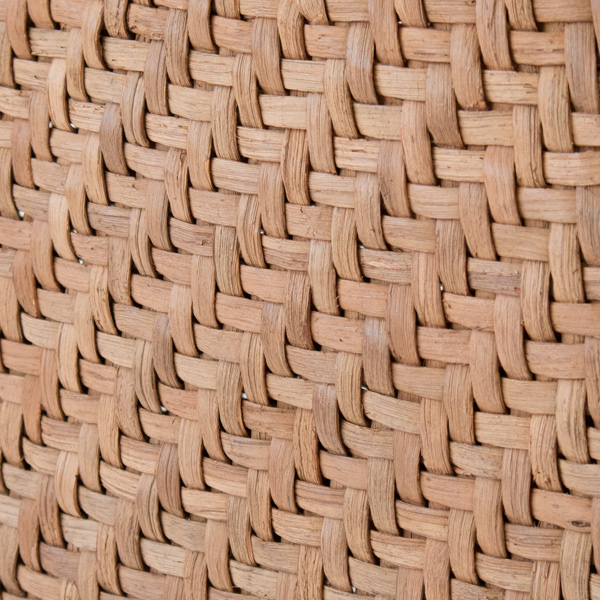
If you look at the stored materials, you can see for yourself that, being natural, some pieces are bent or have knots. When you're aiming to make a beautiful basket, the question becomes how many good pieces you can get out of a single bundle... The ajiro weave—our most popular style, woven with thin strips—is especially affected by the evenness of the surface, which makes a real difference in the finished piece. Compared to using thick bark, weaving a basket of the same size with thin bark naturally requires a greater length of material, which makes it all the more precious.


Of course, the aging of our craftspeople is another factor. Besides the four who come to work at the workshop, there are others who, for various reasons, work from home. One is an apple farmer who weaves baskets on the side during the farm's off-season, using the skills he's built up.
The person who makes our "hanamusubi" (flower knot) pieces lives quite far away and puts a great deal of care and time into the work. At this level of craftsmanship, real perseverance is required to complete a piece. The artisans' attention to detail goes far beyond what we ourselves could fully appreciate—they work with incredible precision.
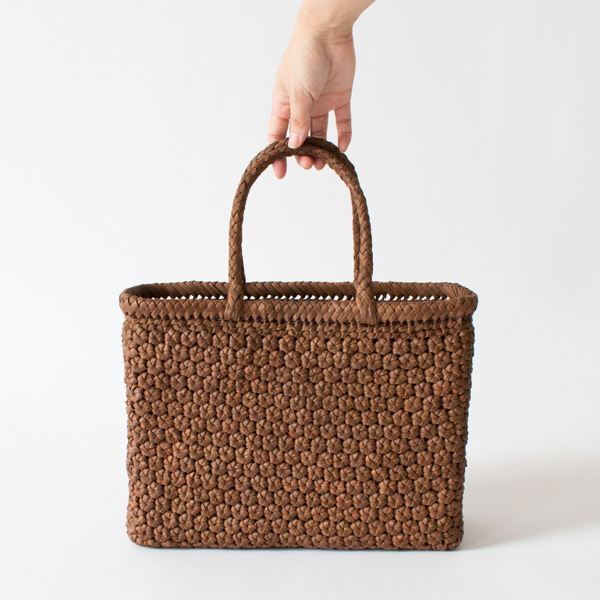
The finished pieces are truly wonderful, so if you love yamabudou, we really hope you'll pick one up and see for yourself.
Takeda-san: Among customers who actually pick up yamabudou pieces in the shop, the mid-range sizes (M to L) are the most popular. I'd say they're the classic, best-selling choice.

Yamabudou Basket Bag with Leather Handle (3-bu width, M)
For handles, the makite (wrapped handle) has long been a favorite, and we push it as well. It requires skill and effort, from shaping the core to wrapping it evenly at the right thickness, but ours are made to a truly high standard of finish and are hard to break. We sometimes get requests to add a makite handle to a basket someone bought elsewhere—having a well-made handle really transforms the whole piece.

A makite handle that resists wear at the base
Lately, this "gunite" style handle has also become popular. It's not quite as strong as the makite, but ours are built to be sturdy. Compared to other shops, I think the difference is quite clear.

This is a part where the artisans' skill really shows, so we at Miyamoto Kogei offer it with confidence. We aim for handles that are well-balanced and comfortable to hold. Since it's the part you touch most when using the basket, we believe that a sturdy, beautifully made handle directly affects how satisfied you'll be with the piece.
Takeda-san: Polishing it with a kamenoko (tortoise-shaped scrub brush) and rubbing it well with your hands. This is essential for beautiful aging. It brings out a shine and lets the piece develop a lovely patina over time. To keep using it for years, I'd recommend checking your basket regularly and sending it in for repair when needed. Also, a paper bag is the best way to store it, I think. A moderate level of dryness is fine, but high humidity is not, since it can cause mold. Since it's a natural material, it's fine to leave it out on display, but dust can accumulate, so a paper bag is recommended. Also, please avoid storing it in direct sunlight, as it can cause the basket to fade to a whitish color.
During the season, if cracks or splinters appear, it's fine to just trim them off with scissors—when the season is over, send it to Miyamoto Kogei and they'll repair it for you. If you send it in before it gets too bad, there's less risk of it snagging your clothes, and the repair itself is simpler too. Since our top priority is having customers use these for a long time, Miyamoto Kogei offers repairs at a much lower cost than other makers. Please feel free to consult with us through ZUTTO first.

Takeda-san's own wallet is made of yamabudo (wild grape vine). "After several years of use, it's developed this much black luster. Domestic leather really is high quality. The white parts come from a naturally occurring substance, and occasionally there's leather that doesn't turn black—but since it's a natural material, we ask for your understanding on that point."

This is a yamabudo handbag, estimated to be 50 years old, kept at the shop. It's on display as a sample rather than being used frequently, but it has an even richer luster than the wallet mentioned earlier.
Takeda-san: Thank you. Regarding Miyamoto Kogei's yamabudo baskets, if you touch the ajiro-ami (checkerboard weave) pieces, you'll notice they're quite sturdy, with almost no risk of deformation. The hana-musubi (flower-knot weave) baskets are a bit softer than the ajiro-ami ones, so when not in use, I think it's a good idea to stuff them with paper padding to help them keep their shape. That said, I also think it's charming when they soften up a bit with use, taking on the character of the person using them. A customer once showed me a hana-musubi basket that had taken on a somewhat softened texture from being pressed while in use, and that too had a nicely worn-in, appealing quality. I think it's best to just use them freely and often.

【Made to Order】Yamabudo Basket Bag, Six-Strip Hana-musubi Weave, with Leather Handle
Takeda-san: I haven't come across many myself, but you can tell right away just by looking at the materials used. I've even encountered baskets where I had to wonder, "Is this really yamabudo?" There seem to be items labeled as Chinese-made yamabudo baskets that are actually nothing more than rattan work with color painted onto the surface.
Also, even among items that do use yamabudo bark, those made with niban-kawa (second-grade bark) come in at a noticeably lower price than those using ichiban-kawa (first-grade bark). Since niban-kawa is the material left over after the best-quality bark has already been stripped away, the impression it gives is quite different. (The yamabudo baskets by Miyamoto Kogei featured on ZUTTO can only be made using ichiban-kawa.) Without good-quality domestic bark, it's difficult to achieve the kind of luster that's characteristic of true yamabudo.
*Aside from the baskets that can only be made with ichiban-kawa, the remaining material is put to use in flower vessels and small items, and in rougher, mold-free styles, so that nothing goes to waste.
*Niban-kawa refers to what remains after the best portions of the same bark have been selected out—bark with knots, rough surface texture, or noticeable bends and curves is called niban-te (second-grade).

And then there's the silhouette, where skill really shows. A beautiful, undistorted form is the concentrated result of a high level of craftsmanship.
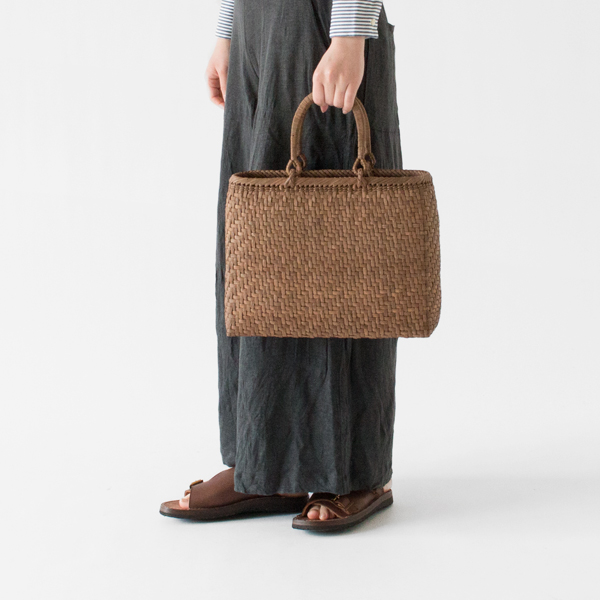
Yamabudo Basket Bag (2-bu Width, L Size)
Yamabudo baskets are said to last three generations—a true lifetime piece. That's why I think it's best to choose one you're fully satisfied with, the kind of item you'd want to pass down not just to yourself, but to your beloved children and even grandchildren.
GUIDE »
CONTENTS »
CATEGORIES »
- + Gifts by recipient
- + Gifts by scene
- + Clothing
- + Bags / Backpacks
- + Wallets / Card cases
- + Jewelry
- + Shoes
- + Rainy day outfits
- + Kitchen
- + Home
- + Babies / Kids
- + Japanese products
Earn Miles


Payment & Security