.webp)


.webp)


.webp)


.webp)


Welcome to ZUTTO
Free shipping for newsletter subscribers (some areas excluded)
- トップページ/
- ZUTTO Journal/
- ブランドストーリー/
- [Exclusive] Tops ...

【Special Order】Tops from FACTORY, a brand whose unique "fabric-making" is its true charm. In pursuit of manufacturing where FACT becomes STORY.
FACTORY is a Japanese wear brand that ZUTTO has carried for a long time. What began as a small select shop boutique gradually evolved into a brand that makes its own fabrics, applies its own dyeing, and tailors them into finished garments.
The first batch of items for fall/winter 2023 has arrived, and along with introducing them, we're also unveiling special-order pieces made exclusively for ZUTTO.

ZUTTO's 23AW (Fall/Winter) Project: Japanese Garment Making
This season's special-order project isn't limited to a single brand—we plan to introduce wear from several Japanese brands through December. First, let's hear from our project lead about the intent behind it.
"As the trend of questioning cheap wear choices that lose their place after just one season in fashion grows stronger, I wanted to once again convey, even in the realm of fashion, that what ZUTTO has always aimed for—both now and in the past—is things you'll want to use and love for a long time.
Among Japanese garment makers, the brands that hold conviction and confidence in every process involved in manufacturing—materials, dyeing methods, sewing, and more—may lack the convenience of fast fashion, but instead they use truly good fabrics and incorporate ingenuity that leads to long-lasting wear.
To convey that there is meaning and background behind these items you'll want to keep wearing for a long time, this fall and winter we're shining a spotlight on the appeal of Japanese garment making and have prepared many ZUTTO special-order items. We've lined up pieces made with carefully chosen materials—the kind people say are 'hard to find these days'—and garments created through one-of-a-kind manufacturing methods, so we hope you'll feel the significance of continuing to cherish and wear these pieces. Please look forward to it."
That's what they had to say.
This has gotten a bit long, but the first installment of this project is the FACTORY special-order shirt we're introducing today.

Garment making built around the idea that "FACT IS OUR STORY."

Let's start with an introduction to the brand FACTORY.
As mentioned earlier, the brand shifted course from a select shop to one that handles its own garment making in 1983. What began with a single sewing machine in a factory built behind the store has now grown into a creative operation that handles planning, material development, manufacturing, and production entirely in-house.

When I first heard the brand name, I took "FACTORY" at face value—as in an actual factory. But doesn't the image become much richer once you learn it actually comes from "FACT IS OUR STORY"?
The meaning behind this is that rather than making things based on "what we believe to be good," the brand creates garments trusting only what they've actually seen with their own eyes and touched with their own hands (=FACT). That is the story of this brand.
Indeed, FACTORY's passion for material-making is immeasurable—they discovered cotton in Peru, over 15,000km from Japan, traveled in search of Belgian linen that had been thoroughly rained on, weathered by wind, and bathed in sunlight, and even built a factory in a foreign land just to stably produce the Mongolian wool they fell in love with.
FACTORY's appeal truly lies in its original fabric-making.

FACTORY's fall/winter items draw inspiration for their colors and dyeing methods from "Small Town III," a work by Austrian painter Egon Schiele. (Due to copyright restrictions, we can't post the painting itself, so if you're curious, please look it up.)
The composition features rows of small, colorful houses packed tightly side by side, and to capture the distinctive brushwork and sense of texture seen in Egon Schiele's paintings, the garments express this through "mura-zome" (uneven dyeing).
【Also Available in a Special-Order Color】A Blousing Blouse You Can Enjoy in Two Silhouettes.


This blouse has a blousing design that creates a soft, balloon-like silhouette when you cinch the hem to your liking, paired with cute, loosely fitting dolman sleeves. The body width uses fabric generously, and while the material is thick, it still has a nice drape. The rounded silhouette also looks beautiful from the side, and its design pairs easily with a wide range of items—from simple denim to wide pants and skirts.

We had this blousing blouse specially made as a special order using "Omi-zarashi fabric in mura-zome (uneven dyeing) black." Mura-zome is a distinctive dyeing method where the pattern comes out differently on each individual piece. We asked FACTORY to explain exactly how this method works.

▲Omi-zarashi (Omi bleached cloth) / Mura-zome black
"We used a dyeing method close to 'kago-zome' (basket dyeing), which is used to dye yukata and similar garments. In practice, instead of an actual basket, we scrunch a single blouse into a tube-shaped bag, and the way the fabric folds over creates an uneven, mura-like pattern.
With actual kago-zome, a strong pattern tends to emerge across the whole piece, but this time, rather than a distinct pattern, we wanted to capture the kind of 'unevenness' seen in Egon Schiele's work, so we devised this method to avoid creating too clear a pattern."

▲Indeed, it's not a pattern but "unevenness," isn't it?
"Depending on the stiffness of the fabric and how tightly woven it is, we don't always get the unevenness we're aiming for. With softer fabrics, sometimes the whole thing ends up dyed completely black—it's unpredictable. I think this is a method that's only possible because we do it by hand."
"The Omizarashi fabric we used has just the right amount of stiffness, so it dyes nicely, but even so, there were a few pieces that came out entirely black instead of showing the unevenness. Since the way the unevenness appears differs from piece to piece, I hope customers will feel like each one is truly their own, one-of-a-kind piece."

▲The varying patterns of unevenness are something only hand-dyeing can produce.
Omizarashi, mentioned in our conversation with the people at FACTORY, refers to fabric made using a technique passed down for generations in the Koto region of Shiga Prefecture, where artisans painstakingly work each bolt of fabric by hand, kneading and loosening it. The fabric is boiled in lye made from burned plant ash, which softens it and serves as a bleaching process that makes it easier to dye.
By repeating the cycle of sun-drying and boiling while kneading the fabric, fine, characterful wrinkles and puckering develop, creating a distinctive texture with the high-density, crisp feel of antique fabric.
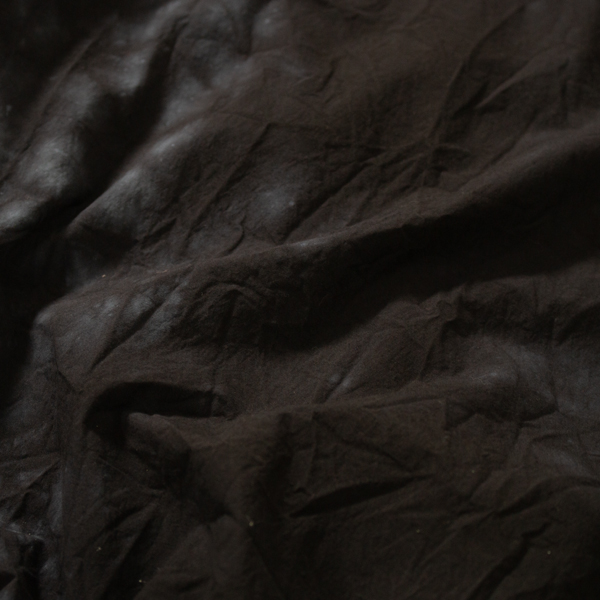
The special-order piece completed by combining uneven dyeing with Omizarashi fabric has a sharp, cool atmosphere reminiscent of a clear night sky. The blouse itself has a soft, rounded silhouette, so the contrast between the two makes for a wonderfully interesting piece.
While the special-order piece has a crisp texture, the "White" and "Apricot" versions in cotton flannel offer a fluffy, soft, and warm flannel material.

▲White
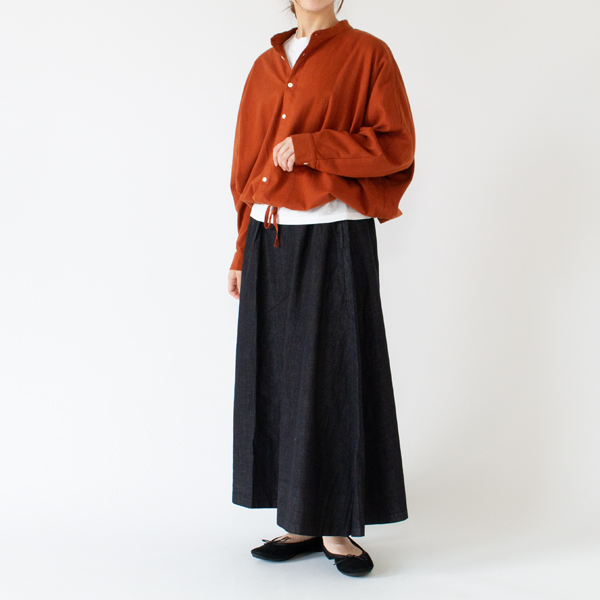
▲Apricot
This is a shirt thick enough to wear as an alternative to a cardigan, making it handy during seasonal transitions. We also recommend wearing it open over a T-shirt.
A Balloon-Sleeve Sweatshirt with a Relaxed, Grown-Up Feel


This piece features distinctive paneled sleeves, with a silhouette carefully designed around soft, gentle curves. It has a casual quality reminiscent of vintage clothing, making it a sweatshirt that adults will want to wear. Though called a sweatshirt, it's not made of brushed-back fleece, so it can be worn just as versatilely as a long-sleeve T-shirt.

The sleeves are long, meant to be scrunched up when worn, but the overall length is not too long, keeping the look clean. This length is great for those who dislike the bulkiness of tucking a hem into their bottoms. It's also a top that looks great worn with a belt.
It comes in 3 colors, but the one to watch is "Sulfur Khaki."

This season's theme of "unevenness" is fully expressed through sulfur dyeing. With this method, which develops color through oxidation, the fabric gradually changes texture the more you wear it, developing fading and wear patterns like denim. The more you wear it, the more it becomes uniquely yours, giving you something to look forward to as you continue wearing it for years to come.

Sulfur Khaki, with its distinctive paneled seams and joined seam allowances.

Black is the No. 1 easiest to style. Try pairing it with relaxed pants in a similar mood, or with a patterned skirt for contrast.

Apricot, a rich autumn hue, isn't flashy yet still adds a pop of color, making it an approachable warm tone for those who tend to reach for darker colors.
▼Here is the FACTORY wear collection page

GUIDE »
CONTENTS »
CATEGORIES »
- + Gifts by recipient
- + Gifts by scene
- + Clothing
- + Bags / Backpacks
- + Wallets / Card cases
- + Jewelry
- + Shoes
- + Rainy day outfits
- + Kitchen
- + Home
- + Babies / Kids
- + Japanese products
Earn Miles


Payment & Security