.webp)


.webp)


.webp)


.webp)


Welcome to ZUTTO
Free shipping for newsletter subscribers (some areas excluded)
- トップページ/
- ZUTTO Journal/
- ブランドストーリー/
- Bringing vintage ...

Vintage aesthetics, brought into the present. From HAVERSACK comes a specially ordered gurkha pants made from a lustrous gabardine fabric.
What resides in vintage clothing, in garments with history. Unlike the uniformity of manufacturing pursued for efficiency and productivity, these are pieces designed with an eye toward being worn for decades, with details attached as a kind of built-in function, and an expression of depth that only deepens with the passing of years. As people's lifestyles change, the way clothing exists changes with them—yet perhaps the appeal of vintage lies in possessing some beautiful quality that never changes.
HAVERSACK, which started in 2001, cites "vintage" as one of its keywords. Sublimating the somewhat conceptual appeal mentioned above into contemporary clothing, it is a brand that, despite originating in Japan, has continued to earn high acclaim across Europe—in the UK, Italy, and France. At ZUTTO, we introduce Japanese brands under the theme "Japanese clothes-making," and this time we are featuring HAVERSACK. We asked them to make gurkha pants—now a staple of military-inspired items—using a specially ordered fabric, and spoke with Muramatsu-san, who has been with the brand since shortly after its launch.

Taking cues from vintage aesthetics, questioning and creating timeless clothing
HAVERSACK began when Norihide Koji-san, who would become the brand's designer, was working in a job introducing overseas brand products to Japan, and began to think, "There do exist things in this world that continue to be loved, unchanged, for years on end."

"Designs of high completeness that aren't swayed by trends, that remain timeless. I want to work on clothes that can become vintage—ones you won't tire of wearing over a long period."
Born from that intention, HAVERSACK develops its collections as contemporary real clothes, drawing on universal keywords such as vintage, military, work, uniform, and tailored, but always through its own unique perspective. Unconstrained by era or trend, it presents clothing that lets people express their individuality through a variety of styling.

Muramatsu-san:
"Aside from items like skirts, basically the only thing we change is the sizing. Since the brand originally started as menswear, we don't think of menswear and womenswear as separate categories—the dimensional differences and shapes stay the same as the men's items. We don't make special changes to the construction for women, so I think it's a line where you can enjoy the beauty and coolness inherent to menswear just as it is."
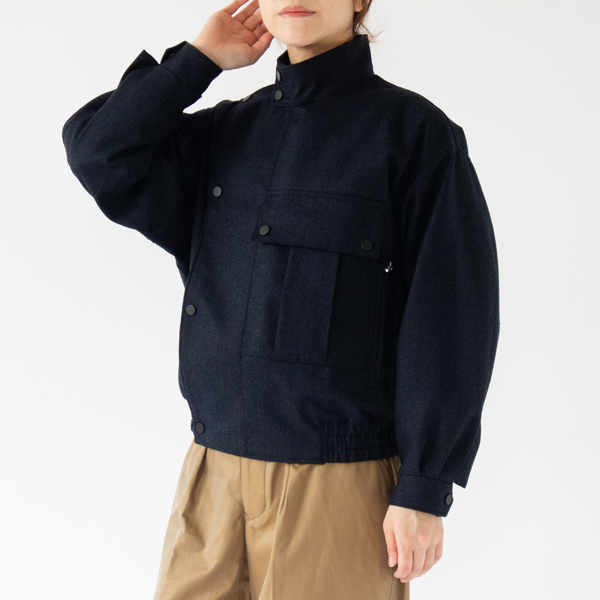
This season's new arrival: Army Serge Melton Motorcycle JAC
The origins of gurkha pants, now a staple of military-inspired items
Among the many classic items rooted in military uniforms, gurkha pants are one such example. It's said their origin traces back to the pants worn by the Gurkha soldiers—soldiers from Nepal, which had conflicts with Britain in the early 19th century.
At the time, though the British army far outnumbered and outresourced the Gurkha soldiers, the Gurkhas—drawing on their knowledge of the terrain and the endurance cultivated in their homeland—once drove the British forces back. Britain ultimately won, but came to hold the fighting strength of the Gurkha soldiers in such high regard that a treaty was signed for them to serve as part of Britain's military forces.

Muramatsu-san:
"Gurkha pants have many distinctive details, such as a buckle-fastened waist, a high-waisted design with a deep rise, and pleats. That said, nowadays the term 'gurkha pants' has come to be used broadly for anything with a buckle fastening and high waist."
What are HAVERSACK's gurkha pants?

"It's been in the collection since the brand's launch, and while I wouldn't say every single season, we handle it quite regularly—if it's not in spring/summer then it's in autumn/winter, and if not in autumn/winter then in spring/summer. All told, there must be close to 10 variations."
"That's right. Now it's certainly become established as a staple item, but at that time there were hardly any brands treating it as everyday clothing, I think. Rather than something that was part of a broader trend at the time, it existed as an authentic piece, and we had a sense that it would be interesting to bring it down into everyday life. I feel the brand's stance of developing somewhat unusual items has been there from the beginning.

The original gurkha pants had a slightly more elaborate construction: the flap on the inside of the pants was longer, with pieces attached on both left and right sides, and the design involved passing the flap through a hole and fastening both sides with buckles. The very first gurkha pants the brand made were built this way, but we received feedback from customers saying it was "hard to take on and off" and "inconvenient when using the restroom" (laughs). When translated into everyday wear, the difficulty of putting them on and taking them off became a real drawback.

With ease of wear in mind, we moved the flap to one side and simplified the construction.
"Yes. The way they're worn has also changed a lot. Around 2001, few people tucked their shirts in. Gurkha pants are characterized by the design at the waist, and since tucking in makes the silhouette look beautiful, we recommended it—but not many people wore them that way at the time. High-waisted bottoms themselves were rare to begin with; it was more of a low-rise era."

"Yes. You could say it's a simplified construction as far as gurkha pants go, but that's because we want people to wear them as everyday clothing. Also, thanks to the way the front and back darts are placed, I think these pants offer a really beautiful silhouette when worn. Around the waist they fit snugly and compactly, and the silhouette falls straight from the hip line down to the hem—it's really beautiful. While many gurkha pants have a strong taper, this silhouette lets you wear them in a more dressy way."

The specially ordered gurkha pants are "pants with a lustrous finish."
"The fabric used for this special order made for ZUTTO is a compact gabardine fabric made with 60-count two-ply yarn. It uses high-quality long-staple Indian cotton, and it's woven very densely. Also, gabardine (twill weave), rather than plain weave, gives it a sense of luxury, I think. Another feature is its lustrous sheen."

"Since we use differently colored threads for the warp and weft, the fabric's expression changes depending on the viewing angle and how the light hits it. It's woven with two different colored threads, khaki and brown, which is called kōshoku (mixed weave). The parts that look a bit green are the khaki threads.
When it comes to how fabric is woven and dyed, there are two methods: weaving already-dyed thread, or dyeing the woven cloth afterward. This fabric is woven from dyed thread. Dyeing the woven cloth is said to be simpler and more economical with less waste, but fabric woven from pre-dyed thread resists fading better. It doesn't change drastically with wear—rather, it becomes more familiar and settled over time. And since the fabric isn't made with any coating applied, its character doesn't change dramatically after just one wash."
"Yes, some fabrics are coated just to make the finish look good for the moment. Maybe it's easiest to picture it like when a dry cleaner starches a shirt—that kind of finish comes off quickly. When cost is prioritized to keep the price down, that kind of processing sometimes gets used. But with this fabric, there's no coating, so you can enjoy the natural texture and character of the fabric itself. That's why the change over time is gradual."

At first, the fabric has the crispness befitting dress pants, and it gradually becomes more supple over time. Since it has a water-repellent finish, it's also easy to choose on rainy days.

"That's right. I think it's easiest to see if you look at the inside. The seam allowances are finished with piping so they don't show. The fineness of the stitching is another distinctive feature. That fineness is said to be characteristically European. HAVERSACK often draws on European sensibilities, and coarser stitching tends to give more of an American impression. It's not that one is better or worse—it's just a difference in taste."


The vertical piece at the center back is said to be a remnant of old-fashioned men's dress pants, which were designed so they could be re-tailored as they were worn over time. (Due to the construction, it can't actually be used for that purpose.)
"Details like this can surprisingly change the whole impression of a garment. If something has a European taste but coarse stitching, it ends up feeling a bit mismatched. It's not that being made in Japan automatically means careful craftsmanship—of course there are carefully made items produced overseas too. Paying close attention to these small details is, I think, what our approach to making things is all about."
・・・・・・・・
This season, besides these specially ordered pants, we're also carrying a wide range of items including shirts, dresses, and outerwear.

A denim shirt that can be worn two ways. (7.5OZ Light Denim Regular Collar Shirt)

Gurkha pants with a double buckle, carrying an even stronger military element. (Herringbone Gurkha Pants)

A one-piece dress with beautiful drape, made using a generous amount of fabric. (High Count Typewriter Gathered Long One-Piece)

A bold design that lets you change the length by folding up the hem. It's an outer garment with a fun gimmick. (High Density Dry Taffeta Anorak Parka)
Clothes that have been cherished for many years, or passed down from one person to another, are also vintage. Why not pick up a piece from HAVERSACK as a garment that could become tomorrow's vintage?
▼【Special Order】Compact Gabardine Gurkha Wide Pants product page here

See the full HAVERSACK product lineup here >>
▼Back Issues of the "Japanese Clothes-Making" Feature
Vol.1 A one-of-a-kind "fabric-making" process. FACTORY's Specially Ordered Unevenly Dyed Blouse >>
Vol.2 Unraveling Jackman's signature series, the long-beloved Waffle Midneck. >>
GUIDE »
CONTENTS »
CATEGORIES »
- + Gifts by recipient
- + Gifts by scene
- + Clothing
- + Bags / Backpacks
- + Wallets / Card cases
- + Jewelry
- + Shoes
- + Rainy day outfits
- + Kitchen
- + Home
- + Babies / Kids
- + Japanese products
Earn Miles


Payment & Security