.webp)


.webp)


.webp)


.webp)


Welcome to ZUTTO
Free shipping for newsletter subscribers (some areas excluded)
My page
Information
- トップページ/
- ZUTTO Journal/
- ブランドストーリー/
- # Vintage Jewelry...

Vintage jewelry that grows more charming with time. Exploring the appeal of I.Ronni Kappos
This time, we introduce jewelry by I.Ronni Kappos. Unique color combinations and geometric designs reminiscent of modern architecture. By combining circular and linear parts, the pieces create a rhythmic quality alongside a warm, nostalgic atmosphere—an entirely free-spirited mood.
What shapes this distinctive atmosphere are rare vintage beads. The fascination of vintage items lies in how they gain character through the accumulation of history, and I.Ronni Kappos jewelry creates new value by reassembling numerous vintage parts. Let's unravel the appeal of I.Ronni Kappos jewelry.


Before delving into the story of I.Ronni Kappos, let's touch briefly on the history of beads. If you drill a hole through a material that nature has produced—stone, shell, and so on—it becomes a bead, and once threaded onto a cord, it becomes an ornament. Because it's such a simple act, the definition of "bead" is broad, and perhaps this is precisely why beads have such a long history.
Ball-shaped parts with a hole through them are called beads, and even today there are countless varieties in different shapes, materials, and colors. The origin of natural material beads remains unclear, but it's thought that their roots lie in the region spanning from Africa to Egypt. Shell beads dating back roughly 75,000 years were discovered in South Africa, and some argue these are the oldest examples in existence. Before this shell bead discovery, the oldest known beads in Africa were thought to date back about 45,000 years. As for beadwork (beads woven together), mammoth ivory beads roughly 25,000 years old have been excavated in Russia.
Meanwhile, Europe has also produced countless beautiful beads. Glass beads, with their elegant presence, are especially beautiful. Glass beads are said to have existed since ancient Egypt, and around 200-300 BC, glass beads under 5mm in diameter were actively produced in India. Afterward, the mainstream of glass manufacturing shifted to Europe, where it remains today. Regions known for producing beads as craftwork include Venice in Italy, the Czech Republic, and France. Among Japanese bead makers, there are also specialist manufacturers of delicate, small glass beads.


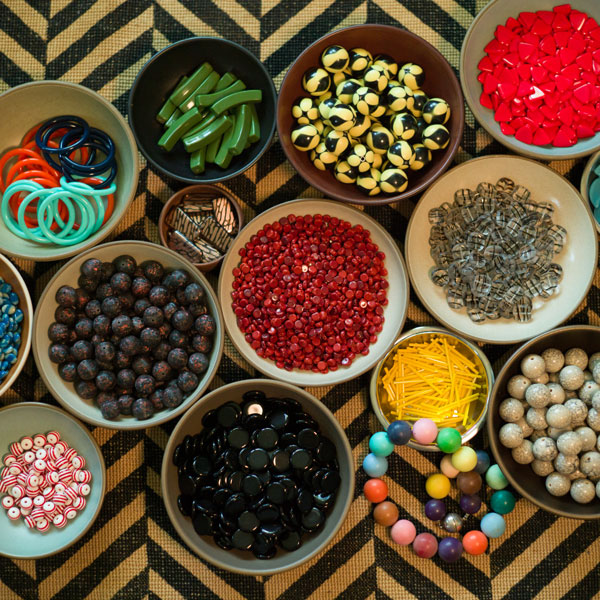
Born in Pasadena, California, and currently living in Los Angeles, I.Ronni Kappos is both a designer and a craftswoman who handles every stage of jewelry-making herself. Influenced by her grandmother, a painter, she developed an interest in creative pursuits such as music and art from an early age, and went on to study art history and architecture. Her twin sister, Marina, is also a celebrated pop artist active around the world. Given that art such as paintings and sculpture, along with interior design that shapes a comfortable living space, was always close at hand in her upbringing—works of creation always in pursuit of beauty—it's easy to imagine how her aesthetic sensibility was naturally cultivated.
What set her on the path to jewelry design was an encounter with vintage beads during a trip she took as a student. A case filled to the brim with deadstock beads must have stirred her creativity much like discovering a treasure chest. She began creating jewelry using vintage German beads in 2002. With deep respect for techniques that could only be achieved at that time, she honors these precious vintage parts, pouring great passion into engaging in dialogue with each individual material, and breathing new life into them with a modern style.


I.Ronni Kappos jewelry, drawing inspiration from modern art and architecture, feels like art itself. The pieces are made primarily with vintage beads produced through the sophisticated techniques of the 1920s-30s, crafted entirely by the designer's own hands. Some pieces incorporate parts once used by major European fashion houses of that era, adding an even greater sense of rarity. It's easy to understand why her work drew attention during the renewal of the San Francisco MoMA. Let's take a closer look at the distinctive vintage parts I.Ronni Kappos uses.
【Vintage German Beads】

Beads manufactured between the 1920s and 1940s used materials, pigments, and molds that are no longer obtainable today. Apparently, craftsmen would draw out colors by hand, adding trace amounts of metal to the glass. Companies that produced these beads by hand in the Bohemian region, including what was then East Germany, shuttered not long after World War II. In an era without computers, everything relied on manual skill. Each individual bead, shaped by a craftsman's intuition and years of accumulated experience, carries a rich expressiveness and a deep, nostalgic color—making them highly prized and rare.
The material known as "Lucite" in particular has been supplanted by cheap, mass-producible plastic today, and since the molds and pigments used at the time can no longer be reproduced, it's especially rare.
【24K Gold-Coated Beads】

It was dipped into molten 24k gold, coating the vintage German bead entirely. Since it's difficult to bond gold directly to materials like glass, beads were once coated first with a base metal and then given a further gold coating—a labor-intensive process that is now becoming increasingly rare. Gathering up pieces from this accumulated history and elevating them into new designs to create an entirely new formal beauty—this too is one of I.Ronni Kappos's signature design approaches.

Left: after aging
Right: brand new
What might be called the defining characteristic of these beads is that their texture visibly changes with age and use. As mentioned above, the gold coating goes through multiple steps—first applying a base layer over the bead itself, then layering gold on top—so over time, the texture of that base layer gradually begins to show through. In the photo example, you can see how the once-brilliant gold texture has partially given way to the base layer's character in places, transforming into a subdued, almost smoked-looking finish. The speed of this aging process and the way the sheen changes vary depending on the type of bead and how the wearer uses it.
【14k Gold Filled】

When it comes to enjoying jewelry for years to come, the material of the metal fittings deserves particular attention. No matter how beautiful the main motif may be, if the fittings that connect and support it become worn or if their surface coating peels away, the overall impression drops significantly.
14k gold filled differs from thin gold plating in that a layer of gold—1/20 the weight of the base metal—is heat-bonded onto it. Because this gold layer is thick, it typically doesn't peel away. Though some fading may occur with continued use, developing an antique-like patina is part of its charm.
【Nylon Cord】

As a material for connecting the vintage beads introduced so far, I.Ronni Kappos distinctively uses nylon cord. It's especially favored for necklaces. By softly linking vivid glass beads or radiant gold-coated beads together with this nylon cord, a formal beauty unique to I.Ronni Kappos is born.
Compared to common materials like metal chains or leather cords, the thin line might seem fragile and worrisome at first glance. However, the nylon cord chosen is strong enough to be reliably used for jewelry, and with careful use, it can be enjoyed for a long time without significant wear. In fact, staff members who wear I.Ronni Kappos necklaces daily seem to feel confident about using them as everyday pieces without concern on this point.

I.Ronni Kappos single-handedly oversees everything from collecting vintage beads to jewelry design and production. She continues to create new jewelry collections each season, and it's said that her wellspring of design ideas never runs dry. Working with beads—a material already completed once by artisans' hands—she delights people's eyes with ever-new variations, all while remaining true to an identity distinctly her own. Where does the secret lie in reconciling this "newness" with this "universality"?

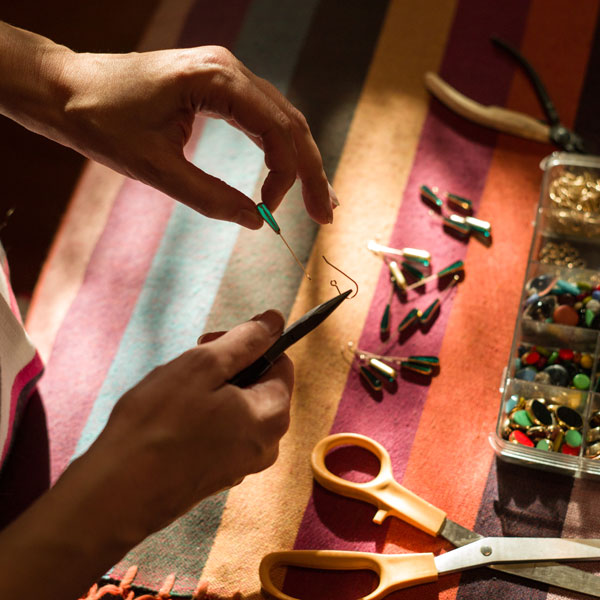
The foundation of I.Ronni Kappos's jewelry collections is, without question, vintage beads, but the components used to connect the beads are almost always either "14k gold filled" or "nylon cord." Using what could be called an almost austerely limited set of components, she generates countless design variations simply by how she arranges the beads that take center stage. For example, a button-like disc-shaped bead might become a dynamic dangling earring when strung on a 14k gold-filled pin, or a picturesque necklace when strung together like prayer beads on nylon cord—the same bead transformed through different uses of components.
This use of components gives rise to a distinctive sense of "movement" and "sway." Colorful beads carefully linked together with nylon cord move fleetingly at the neckline, while delicate earrings crafted with pin work let vintage lucite sway gently at the ear. Both are constructed through extremely meticulous handwork, leaving a beautiful impression at a woman's ears and neckline.
Because of this dedication to how components are used, the jewelry she creates centers mainly on two categories—"earrings" and "necklaces"—with no rings or brooches in her lineup. How far can the possibilities of beads be drawn out within such a simple range of items? This seems to be the very core of her approach to making things.


Alongside these technical elements, a gender-neutral perspective toward making things also seems to characterize I.Ronni Kappos's jewelry design. Terms like "beads" or "jewelry" tend to carry a strongly feminine impression, evoking beautiful adornment. Yet the boldness of connecting beads using only a limited set of components, along with the monochrome color schemes that frequently appear alongside colorful designs, resist easy categorization as either feminine or masculine—they are, instead, neutral.
She scoops up the stories held within beads created by someone from an unknown era long past, and reconstructs them anew. Geometric, yet never cold—overflowing instead with the warmth and affection that comes from having endured the passage of history. This design sense, which gives rise to jewelry that feels almost like a talisman, seems to be underpinned by a deep knowledge of modern design cultivated since childhood. There is no trace here of the so-called "feminine" imagery typically associated with jewelry; rather, the many pieces she creates may fulfill a more fundamental human longing—the desire to wear beautiful design itself.

I.Ronni Kappos's jewelry breathes new life into vintage beads—a material already complete in itself—by selecting them and reconstructing them anew. Built from the many design sources described above, along with the worldview that I.Ronni Kappos herself has crafted, each collection becomes truly one of a kind. And with every season, the new pieces that arrive are nothing short of innovative. This season brings new work in which I.Ronni Kappos's signature modern design meets a rustic simplicity that makes you want to wear it like a talisman—the two qualities balanced in exquisite harmony.

Necklace 1562 features a design with three striking beads arranged at the top. Colored in black, brown, and a white with a faint marbled pattern, it conveys a calm, understated charm along with a certain nostalgic gentleness. The design, where circles and curves overlap, can be seen both as evoking 20th-century modern art and as resembling primitive ornaments shaped by a deep accumulation of history. This means the piece can look entirely different depending on what you pair it with. Worn with a tight-fitting knit or cut-and-sew top, it takes on an urban air; layered over a one-piece dress in natural fabrics like cotton or linen, it shifts toward an ethnic or bohemian impression with a distinctly different flavor.

A design whose beautiful geometric pattern feels like a distillation of modern design itself. Vintage beads of various sizes and colors are strung together on pins, and the way beads in red, blue, and black sway at the ears creates a silhouette that is truly one of a kind. The rhythmic color combinations, reminiscent of pop art in a way, are also unique, and choosing what to wear them with is sure to be part of the fun.

Necklace 1584, where the presence of large vintage beads creates a beauty with a distinctly mode feel. There is a rhythm of shapes—circles, squares, straight lines, curves—paired with a rhythm of colors—black, yellow, pink. What makes this necklace so intriguing is how these two rhythms combine to create a visual rhythm all their own. It becomes an accessory with its own story, as if your clothing were a canvas upon which a piece of modern art unfolds. Because each individual bead carries such presence, you can keep your top very simple, or, surprisingly, pair it with a patterned shirt or a chiffon blouse without things feeling cluttered—it all comes together elegantly.

A design where beads in three striking colors—red, orange, and blue—sway memorably. The geometric design skillfully draws out the contrast between straight lines and curves, giving off just the right presence at the neckline of a simple knit or cut-and-sew top. What's interesting is how the translucent beads change in impression depending on the color of the clothing you pair them with. With its gender-neutral design reminiscent of modern art, it's perfect for those who want a bit of an accent at the neckline but wish to step beyond feminine pendants and necklaces into something different.

Necklace 1563, a striking design featuring a string of ball-shaped beads. Five beads mottled with black on white, paired with just a single bead in a red-to-black tone, create an asymmetrical design that hints at I.Ronni Kappos's characteristic playfulness. Beaded jewelry made of large, connected motifs can easily seem too conspicuous simply because of its size, but this Necklace 1563, thanks to its modern color palette and asymmetrical design, is surprisingly easy to blend into any outfit.


Since each and every bead made with vintage beads is precious, the most important thing is to avoid damage and deterioration. With proper care on top of that, you can enjoy these pieces for a long time to come.
【Product Characteristics to Keep in Mind】
・Even beads of the same type used by I.Ronni Kappos vary in character, making every single material one of a kind. Vintage beads manufactured roughly 100 years ago show individual differences in shape and color from piece to piece.
・Parts made with gold, such as 14k gold-filled parts and 24k coated beads, will fade in color over time with use. We hope you'll appreciate this development of an antique-like patina as one of the charms of the piece.
【Care Instructions for Long-Term Use】
・Hair styling products and cosmetics that come into contact with the beads can cause deterioration. Put on your jewelry only after you've finished your makeup and hair.
・For everyday care, simply polish gently with a soft cloth.
(Please avoid cleaning agents that contain abrasives, as they may damage the texture of the beads.)
・If you're concerned about dirt on the nylon cord, wipe it down with a cloth dampened with water and wrung out well.
▶︎Vintage jewelry that gains character through the hands of its wearer. See the full list of I.Ronni Kappos items

GUIDE »
CATEGORIES »
- + Gifts by recipient
- + Gifts by scene
- + Clothing
- + Bags / Backpacks
- + Wallets / Card cases
- + Jewelry
- + Shoes
- + Rainy day outfits
- + Kitchen
- + Home
- + Babies / Kids
- + Japanese products
Earn Miles


Payment & Security