.webp)


.webp)


.webp)


.webp)


Welcome to ZUTTO
Free shipping for newsletter subscribers (some areas excluded)
- トップページ/
- ZUTTO Journal/
- ブランドストーリー/
- Showing off color...

Showcasing color: what is cellulose acetate? ZUTTO's original hair accessories
Those with long hair often find themselves quickly tying it back for work, or choosing hair accessories to match their outfit. At ZUTTO, we've created original hair accessories with careful attention paid to the material itself.
A beauty that makes you want to wear it every day.
A durability that gives it the reliability to be used for years to come.
With these thoughts in mind, we arrived at a material called cellulose acetate. For this collection of hair accessories, we sourced raw material from Italy and asked a specialized craftsman in Japan to shape it into forms built to last.

What is cellulose acetate?
The term "cellulose acetate" may not be familiar to many, but perhaps saying "the material used for eyeglass frames" will ring a bell. Cellulose acetate refers to a fibrous material made by reacting cotton and high-purity pulp with acetic acid, and it's also known as acetate resin. There are many types of acetate, but cellulose acetate made from plant fibers is prized for its excellent transparency and, thanks to its viscous quality, its resistance to breaking or cracking. It produces such beautifully deep and rich coloring that it's sometimes called "plastic jewelry."

The difference in transparency is easy to see when held up to light. On the left is an acrylic sheet, and on the right is cellulose acetate.
Among makers of cellulose acetate, Italy's Mazzucchelli is known for producing what is considered the world's finest quality. Having continued production across generations since 1849, Mazzucchelli's cellulose acetate is finished with a beauty that overflows with Italian color sensibility. Its high quality is reflected in the fact that more than half of the self-frame eyeglasses released by global fashion brands use Mazzucchelli's acetate sheets.
▼A look inside Mazzucchelli. Source: Kissou Co., Ltd.
This original hair accessory collection was also made using Mazzucchelli's acetate sheets as its raw material. The actual manufacturing of the hair accessories was carried out by Avance Co., Ltd., a company that has worked with acrylic sheets and brass processing for generations. Here, we'll introduce the process—from molding and cutting to assembly—that went into creating these hair accessories.
How the acetate accessories come to life
At Avance, we were first shown the cellulose acetate before it's processed. At the manufacturing site, the sight of rows of colorful acrylic sheets lined up is enough to fill you with excitement just from looking at it. Before processing, cellulose acetate also takes the form of flat acetate sheets.


1. Cutting
The process begins with cutting this sheet. A sheet of acetate roughly the size of a tatami mat is cut according to the shape of the finished motif. This task is carried out by a specialized cutting machine based on data input into a computer.


A blade shaped like the tip of a pencil smoothly cuts through the material. But cutting isn't simply a matter of following the outline—since this hair accessory requires a beveled edge along its sides, the angle of the blade is adjusted to create the bevel as well.
2. Bending
Next comes the bending process. The hair clip we made for this collection has a gentle curve to it. This curve is created by placing the acetate on an iron plate to soften it, then sandwiching it in a handmade mold crafted by the craftsman and slowly bending it into shape. It's surprising to learn this is done by hand rather than by machine.

3. Polishing
Once the other parts have been made in the same way, the polishing process begins. This polishing step is essential to creating that gleaming, beautiful coloring cellulose acetate is known for. Polishing itself is divided into several stages, each one carefully building toward a lustrous finish.
Polishing is done using a machine called a rotary barrel, which looks something like a piece of farm equipment. Inside are abrasive chips; the product is placed among them, and as the barrel rotates round and round, it polishes the product.


The process starts with what's called rough polishing, which removes sharp edges and rounds off the sides. The product is placed in the coarser abrasive shown on the left and polished, but because this abrasive is quite strong, it leaves the acetate surface rough. So next, the product is placed among smaller abrasive chips to smooth out the roughness left by the rough polishing, creating a finer texture (intermediate polishing).
Finally, a polishing compound is used to bring out the shine (finish polishing). If the surface is still rough after intermediate polishing, no amount of polishing time afterward will produce a glossy finish—so each stage, from rough polishing through to finish polishing, is critical.
By repeating this process, the product gradually takes on a rounded shape with a growing luster. After about a week of continuous rotation, the polishing in the rotary barrel is finally complete.

Once the necessary metal fittings have been attached to the product, the final step is a process called buffing. Here, a flannel wheel like the one shown above is spun, and each individual piece is pressed against it to bring out a polished shine. It's only through this investment of time and effort that the accessory's glossy finish is finally achieved.
For everyday wear: hair accessories made with care
And so, the cellulose acetate hair accessories are complete. What stands out most about them is their glossy shine and rich, tasteful coloring.
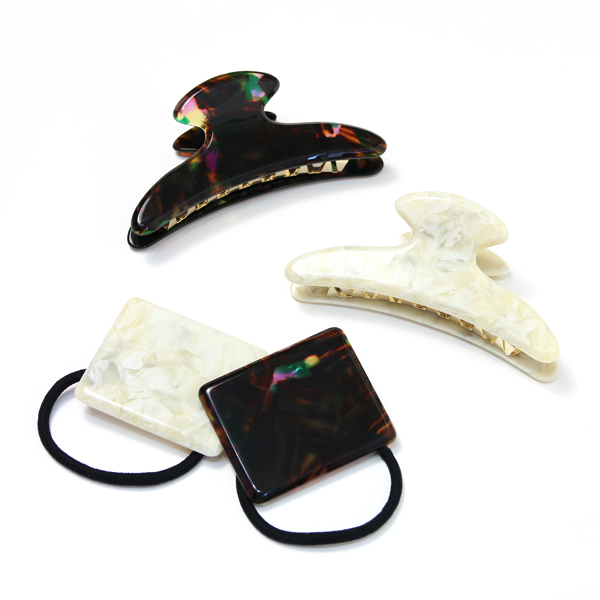
This time, ZUTTO has created a set of 2 hair ties and a hair clip.
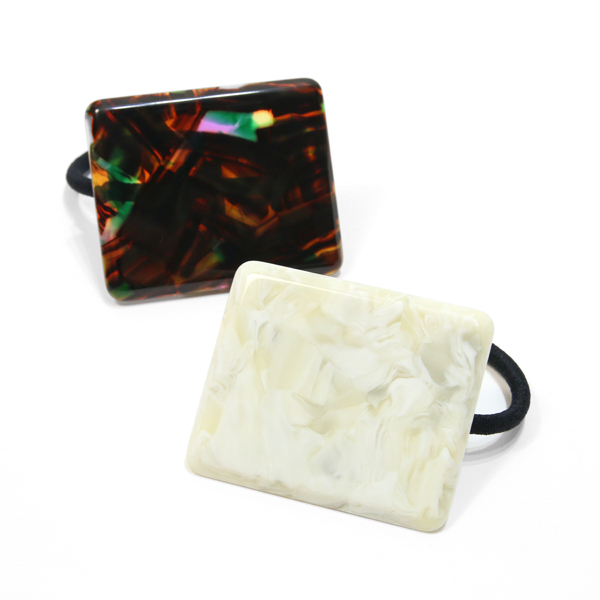
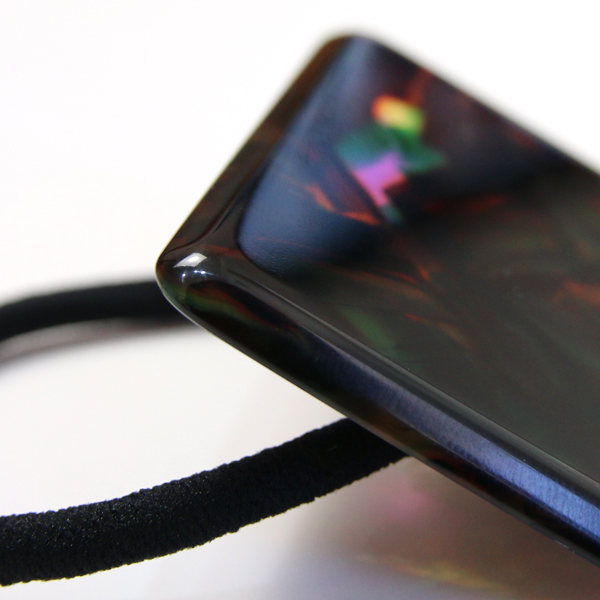
The hair tie, with its striking flat shape measuring approximately 6cm wide by 5cm tall, comes in a set of two colors: MIX and WHITE. Within a single hair tie, various colors intertwine while still conveying a glossy texture—a finish that truly captures the appeal of cellulose acetate. The sides are clearly beveled at an angle, and this careful attention to detail down to the smallest points is a testament to the craftsmanship of a specialized manufacturer.
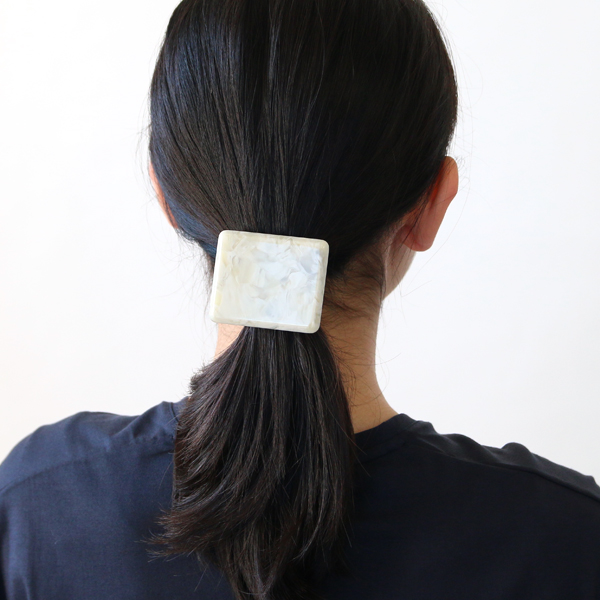
Since just wearing one instantly catches the eye, this hair tie is perfect for when you want to pay attention to your look even from behind. The design isn't too flashy, making it an accessory that pairs well with casual outfits as well as with a more polished dress.
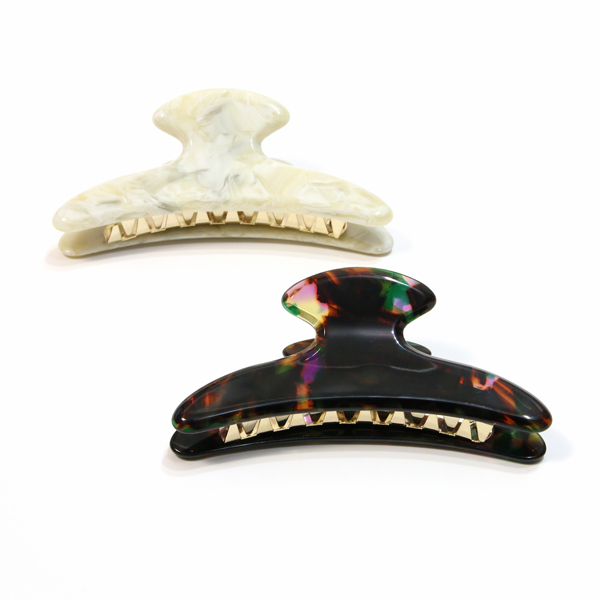
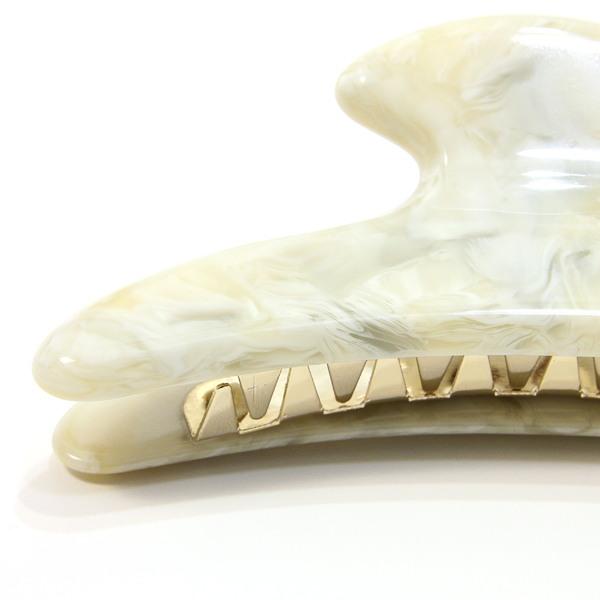
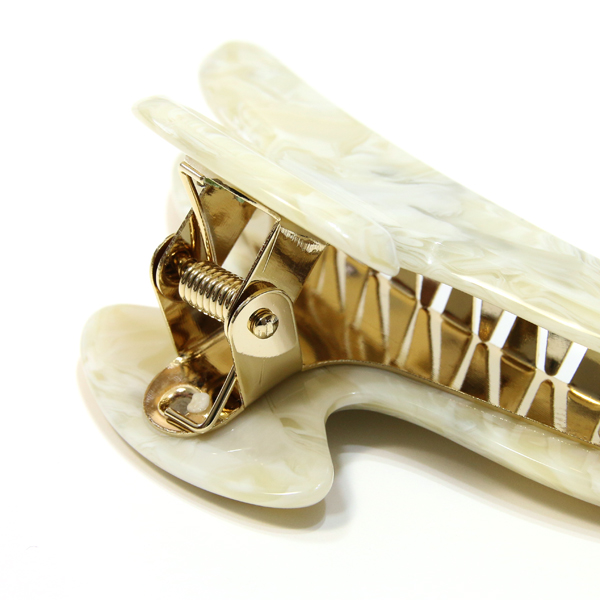
The hair clip is also available in the two colors MIX and WHITE. The balance between the gold hardware and the coloring of the cellulose acetate is a perfect match. With ample thickness and a maximum width of about 11cm, it securely holds even long hair, giving it a stable, reliable feel.
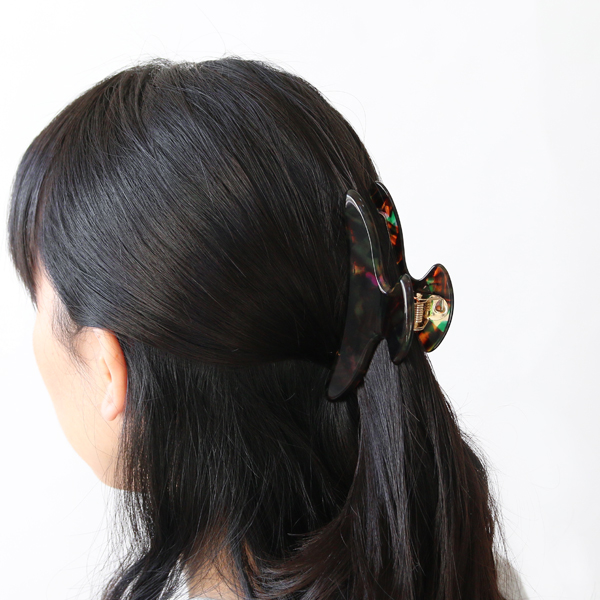
The great thing about a hair clip is that you can quickly put your hair up whenever the mood strikes. It works beautifully for a half-up style, and can be used in many ways as an accent for arranged hair.

Both the hair ties and the hair clip come packaged in ZUTTO's original paper box for delivery. They also make a wonderful gift for birthdays, Christmas, and other special occasions.
A Note on Caring for Your Acetate Accessories
■About Care
Cellulose acetate accessories are relatively durable and resistant to breaking. While no special care is required, oils from your hair or hands may accumulate on the parts you touch, so we recommend wiping the item with a soft cloth after use.
■About Storage
Since the hardware is originally made of iron, leaving it in contact with water for extended periods can cause rust. Please avoid placing it in a bathroom or kitchen with high moisture, and if it does get wet, wipe it dry promptly.
■About Repairs
If the spring or other parts of the hair clip's hardware should come loose during use, repair may be possible in some cases, so please contact Customer Support. Please also note that while the elastic band of the hair tie is a relatively long-lasting material, it will gradually stretch with use over time. (The elastic band itself is not eligible for repair.)
ZUTTO Customer Support: support@zutto.co.jp
▼Click here for the ZUTTO brand page

GUIDE »
CONTENTS »
CATEGORIES »
- + Gifts by recipient
- + Gifts by scene
- + Clothing
- + Bags / Backpacks
- + Wallets / Card cases
- + Jewelry
- + Shoes
- + Rainy day outfits
- + Kitchen
- + Home
- + Babies / Kids
- + Japanese products
Earn Miles


Payment & Security