.webp)


.webp)


.webp)


.webp)


Welcome to ZUTTO
Free shipping for newsletter subscribers (some areas excluded)
- トップページ/
- ZUTTO Journal/
- ブランドストーリー/
- For those who lov...

For those who cherish "everyday life." TAMPICO's unpretentious bags, made for tossing things in and using freely
One of the joys of a beloved everyday item is watching how it settles into your life over time, growing more familiar with use. While some things we use with careful attention, others we use without a second thought, and the way we handle them varies. When something is used every day, it may look worn or even dirty to some eyes, but that's exactly the proof of use—and a mark that makes it truly yours.
TAMPICO is a bag brand born in France. When you hear "France," you might picture stylish Parisiennes, but France is also a land of rich nature, thriving agriculture, and renowned wine production. Perhaps it's only natural that such an unpretentious design would emerge from a country shaped by vast natural landscapes and a slower flow of time.

Effortless and easy to use for years, yet simply beautiful. What is it about TAMPICO's bags—imbued with this French aesthetic—that draws us in, and where do its roots lie? This time, we spoke with Yoshikawa-san and Iwasa-san of Stamps, TAMPICO's official distributor in Japan, to explore the appeal of TAMPICO bags.
A bag filled with French sensibility

"TAMPICO's bags are the work of Nicole, our designer and owner," Yoshikawa-san and Iwasa-san told us with warm smiles. The two of them welcomed us to the exhibition, where we were greeted by row upon row of TAMPICO bags. Each one differs slightly in shape, yet every bag carries a simple yet confident presence.

TAMPICO's history spans a little over twenty years, but tracing its origins further back, we arrive at J.MARTIN TREPOINTES, a leather workshop founded in 1928 in Mussidan, a small town on the outskirts of Bordeaux in southern France. The brand name TAMPICO comes from "TAN," referring to tannin tanning, and "PICO," the French term for the zigzag-shaped leather strip seen on the soles of shoes made using the Welt construction method.
The beauty of accumulated time
The passage of years can sometimes bring to mind the idea of deterioration, but in France, this notion is viewed quite differently. It connects to how people themselves age—French women don't see the wrinkles that come with age as something to be ashamed of; rather, these are considered a mark of beauty.
"This is a good example of what I mean," said Yoshikawa-san, showing us a storage bag.

These storage bags (small pouches), characterized by their softly worn surface, are actually used in everyday life, we were told, and are made from the same canvas fabric as TAMPICO bags. Even when a bag's purpose is simply storage, its beauty is something that can only come from being used over time. It seems to embody TAMPICO's philosophy of "everyday use." Disposable items can be convenient at times, but when you consider using something for years and seeing it daily in your life, durability—and beauty—become essential points for the French. Rather than viewing objects merely as tools, finding beauty in the changes that come from continued use may well be a distinctly French sense of aesthetics.
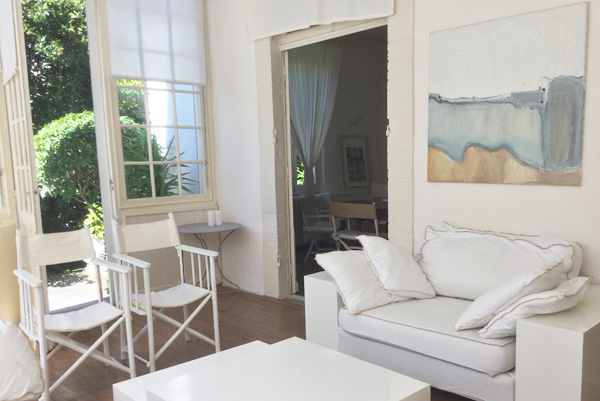
Designer and owner Nicole-san's holiday house, where she spends relaxed weekends with her family. The painting hanging above the sofa is one she herself painted, having studied painting at art school.
A beginning rooted in the shoe welt

A charming leather charm engraved with the brand logo.
TAMPICO's beginnings trace back to a family business making shoe "welts" (the thin leather strip stitched between the upper and outsole)—the very source of the brand's name. The leather-stitching techniques cultivated through that family business live on in TAMPICO's bag-making today, and thanks to that same lineage, the brand uses high-quality leather. The production process, too, continues to be carried out by Nicole-san's family, with each member playing their own role.
Yoshikawa-san:
They don't easily share the finer details of production or materials, but when you talk with them, you can really feel the love Nicole-san pours into TAMPICO bags. The workshop is located in Mussidan, the town on the outskirts of France where they actually make the bags—and it's also an area where workshops of several renowned brands are gathered. As for the process, Nicole-san first creates the image for a bag, and then her partner, Didier-san, draws up the pattern and makes an actual sample. Their daughter Julie-san has also inherited her mother's artistic talent, and some designs have actually taken shape from her ideas.
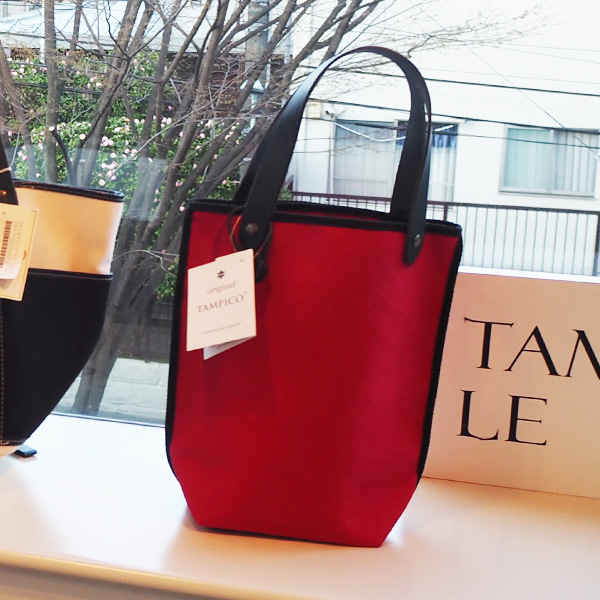
A model whose shape was actually designed by Nicole-san's daughter, Julie-san—aptly named DINOSAURES! The playful spirit of Nicole-san's family seems to come through even in the product name.
As a tool for everyday life
TAMPICO bags are designed to be filled up and used without hesitation. Rather than a bag to be kept pristine "for the sake of style," it serves as an eco bag for carrying vegetables bought at the market, a travel bag for essentials on a trip away, or even, at times, an interior piece for storing things. For people living their lives in France, TAMPICO bags are the reliable companions that stand by them at every turn.
For example, take the bag called "BEACH BAG."

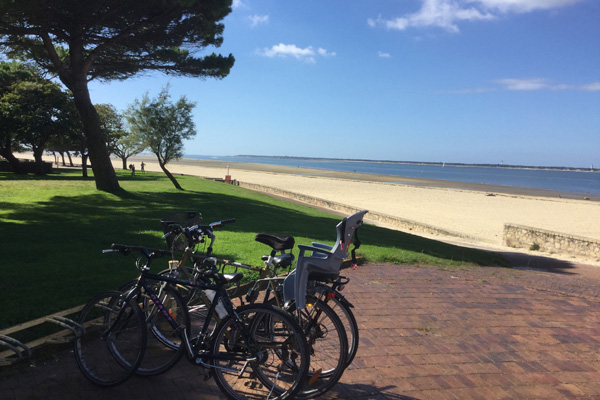
As its name suggests, this bag was born as a bag to bring to the beach. Arcachon, famous as a French summer resort town, is where Nicole spent her youth, and today her family has a "weekend house" there as a holiday home. It's said that many people who live in Bordeaux, well known as a wine-producing region, spend their vacations in Arcachon. The single road leading from the parking lot to the sea apparently stretches on for several kilometers. Unlike Japan, France has no such thing as a beach house rental stand. When heading to a beach like that, you need to carry so many things in your hands—swimsuits, a change of clothes, towels, drinks, and more. Since this is a bag meant for enjoying time at the beach, it was designed to be large-capacity, sturdy, and easy to carry, while still achieving a chic, French sense of style even in how it looks when carried.

Yoshikawa:
Even if a bag's only purpose is to carry your belongings, an eco-bag from a shopping center just can't achieve that distinctly French sense of style. Every item they choose, every everyday object they use, is made with more than just function in mind—beauty is considered right down to how it looks when you actually carry it. And then there's the sense that they make things for their own use, which is a mindset that's quite different from the Japanese one. Rather than trying to appeal to as many people as possible, they make bags that are easy for themselves to use. I think that clear-eyed simplicity is exactly what makes the functionality and design stand out even more. That's precisely why the bag sizes are based on their own lifestyle, which makes them a bit large for everyday use in Japan. That's why we often offer sizes in Japan that are one size smaller.
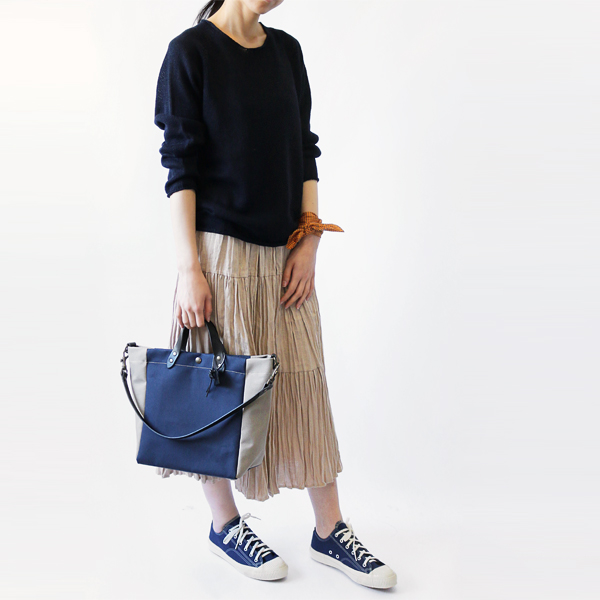
The sizes we carry in Japan are actually a bit smaller than the sizes actually used in France. "Even so, they're not really that “SMALL” after all," Yoshikawa says with a smile.
Bag: SMALL MINI BEACH BAG, Skirt: Linen Tiered Skirt, Sneakers: SHELLCAP LOW AI/OFF WHITE, Scarf: 【Custom Order】Scarf 43×43
Giving Form to a Flash of Inspiration
Given that background to "BEACH BAG," we asked about the other bags too, and received an answer that seemed to reveal the personality of Nicole, who is also an abstract painter.

At Nicole's home, abstract paintings that she herself has painted line the walls.
Yoshikawa:
Not every bag name has a deeper meaning (laughs). Some are named after cities, like MANHATTAN or BROADWAY, but they're not imbued with any special significance—I think it's more a matter of a flash of inspiration. Nicole doesn't say much about that side of things. There's probably something in her that goes beyond words. I also think that intuitive sensibility comes through in the color choices. Every time I visit their showroom, there are new colors. When we select items to bring into Japan, we tend to choose relatively basic colors, but when you actually go there in person, there are plenty of bags with much more vivid, bold coloring.
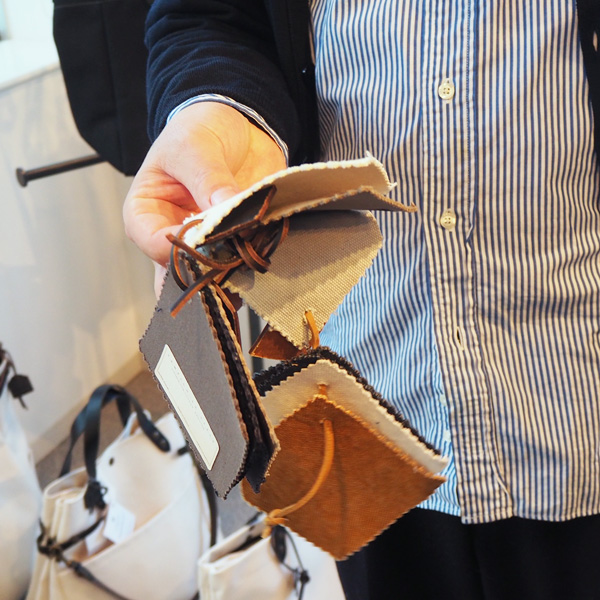
She showed us several fabric samples. Apparently, the color of the thin leather cord used to bundle the samples together is sometimes also used for the handles over there.
A ”Stylish” Size, and Durability Built for Long Use
Sizing That Reveals the Differences Between Japan and France

Bag: ZANZIBAR BAG S, Top: Striped Cut-and-Sew BREST P BLUE/ROUGE, Shoes: Bit Loafers, Suede, Beige
Our staff member who conducted this interview is herself a devoted user of a TAMPICO bag, and the first thing she noticed was that it was "big." That was actually one of the things she liked about it, and once you hear about Nicole's everyday lifestyle, as described earlier, it makes perfect sense. This time, when we asked further about that characteristic, we were in for a surprise.
Yoshikawa:
Actually, 80% of the TAMPICO bags that come to Japan are made to a Japan-original specification. If we brought over the sizes used in France exactly as they are, they'd end up too big here, given the difference in body size. Honestly, even I was surprised when I saw the actual product in person after having only seen it in the catalog (laughs). The "BEACH BAG" I mentioned earlier is the same way—the original size they actually use themselves is one size larger than this SMALL.
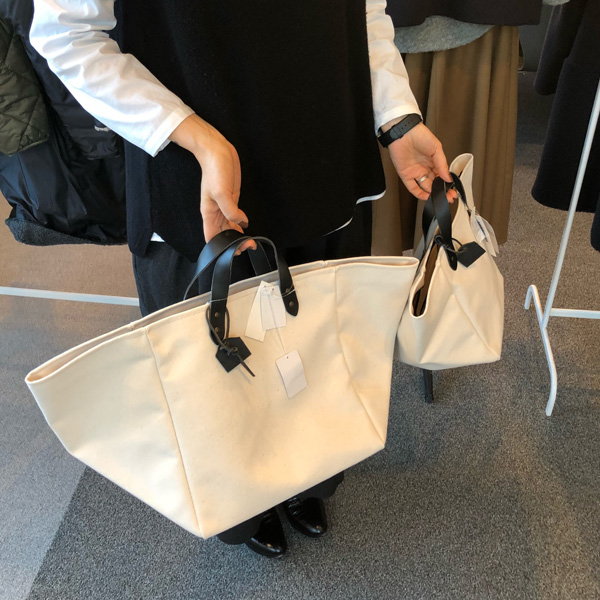
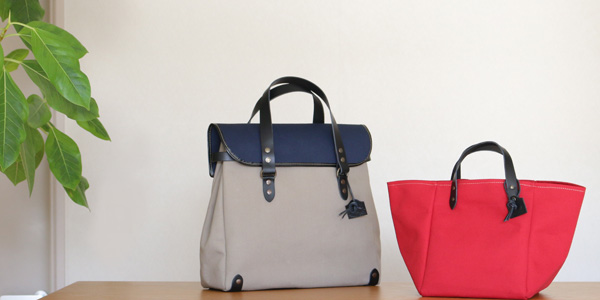
The PETIT PANIER XS (right), which ZUTTO also carries. Compared to the original size (left), the difference is quite striking.

Yoshikawa:
What suits French women's "stylish" look is a larger size. If it's too small, it inevitably ends up looking more "cute" than stylish. They really care about the overall look and the aesthetic sense you get when you're actually holding the bag. I think that sense of style is exactly what makes TAMPICO so appealing. Even when choosing shapes and colors to bring into Japan, we try to select bags that convey that same sense of style and beauty.
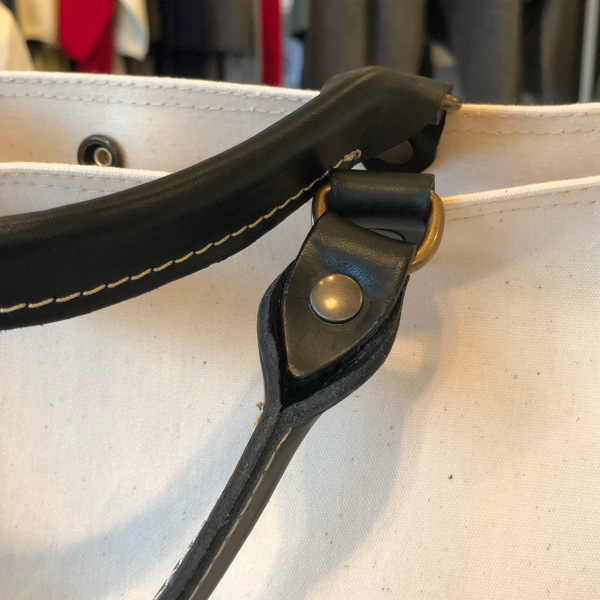
Black leather, a familiar sight in Japan. Apparently, they deliberately bring in items in black leather so people can appreciate "the beauty of a well-made tool."
Built With Long-Term Use in Mind
Precisely because these are meant for everyday use, Nicole's dedication shows through in their durability. As our staff member, who uses one herself, can attest, if you actually touch a TAMPICO bag, you'll notice how thick and substantial the fabric feels. The secret lies in bonding two layers of cotton together. This technique dramatically increases the strength of the fabric.

At a glance it's hard to tell, but if you try it with a fabric sample, it really is two layers stitched together.
Iwasa-san:
Just the other day, we received a repair request for a TAMPICO bag purchased 10 years ago. The customer said the handle had come off, so we accepted it for repair here in Japan. Looking at the bag, it certainly showed signs of wear, but the cotton wasn't torn anywhere—it was truly just the handle that had come loose. After the repair, it seemed the customer would be able to keep using it without any problems. I think it's made with durability firmly in mind, considering it will be used for a long time.
What you learn from using it
This time, we actually had our staff show us a BAG MANHATTAN (*a product no longer carried at ZUTTO) they had used for a year, alongside a PETIT PANIER XS they had just started using, and asked them about care and how they use their bags.
【BAG MANHATTAN (approx. 1 year of use)】
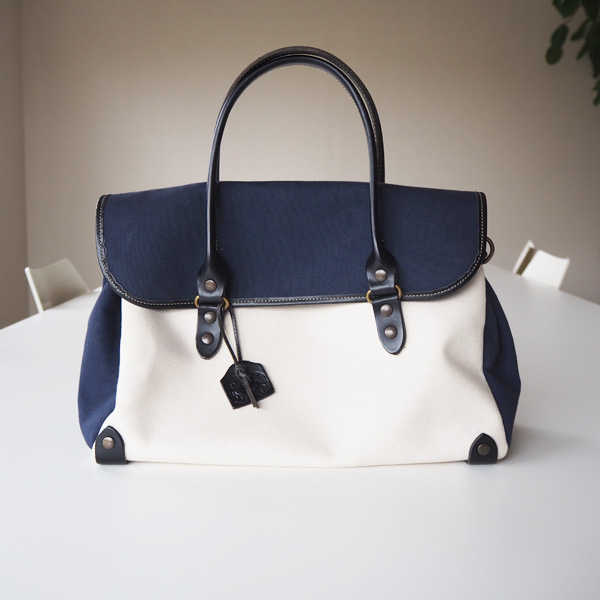
◇Frequency of use: 1–2 times a week, carrying a relatively heavy load such as documents and plastic bottles.
Iwasa-san:
That's right—this one has an inner base as well, so it's more durable and less prone to losing its shape. The BROADWAY BAG also has an inner base in the same way, so it's a good choice for anyone who wants to use it for work, or who often carries heavy items.
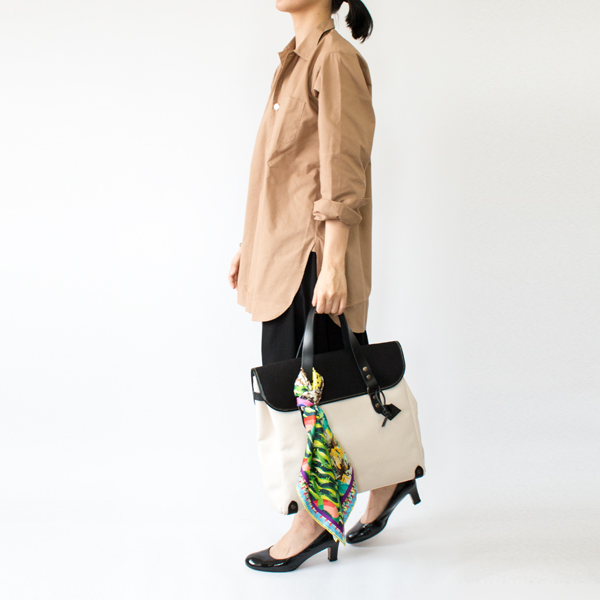
Bag: BROADWAY BAG, Scarf: MANTERO silk scarf (70×70), Shirt: OVER SIZE PULLOVER shirt, Pants: bamboo cotton sarouel pants
Iwasa-san:
That's right. Rather than leaving it in the closet, using it a lot is itself a kind of care. With the leather too, the oils from your hands work into it each time you use it, making it softer. If dust bothers you in certain spots, simply brushing it lightly with a clothes brush is enough.
【PETIT PANIER XS (approx. 1 month of use)】
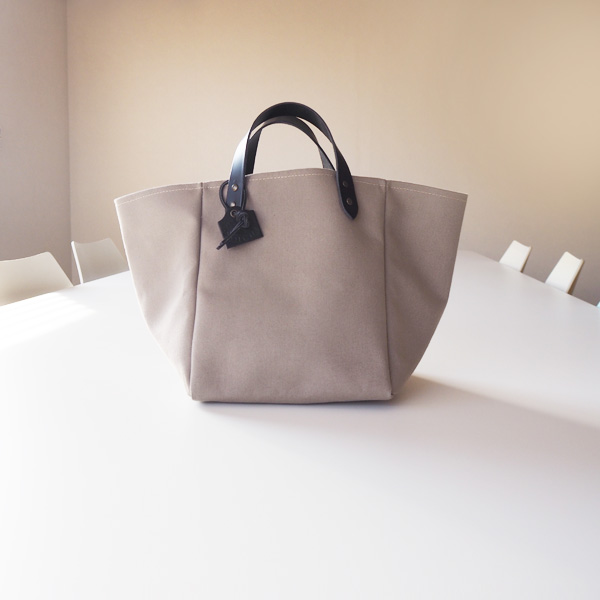
◇Frequency of use: 2–3 times a week, also carrying relatively bulky items such as a lunch box and a camera.
Iwasa-san:
In order to preserve the natural texture of the materials, neither the canvas nor the leather is given a waterproof finish, so we don't recommend using waterproof spray. This is because the fabric is made of two layers bonded together with adhesive, and the moisture from a waterproof spray could cause the adhesive to peel, letting air in underneath. This can make the surface lift or leave a dark, discolored appearance. Light stains can sometimes be removed with an eraser, and regular brushing can help prevent dirt from setting in. We hope you'll embrace using the bag freely in daily life without worrying too much about stains—that, too, is part of what makes TAMPICO what it is.
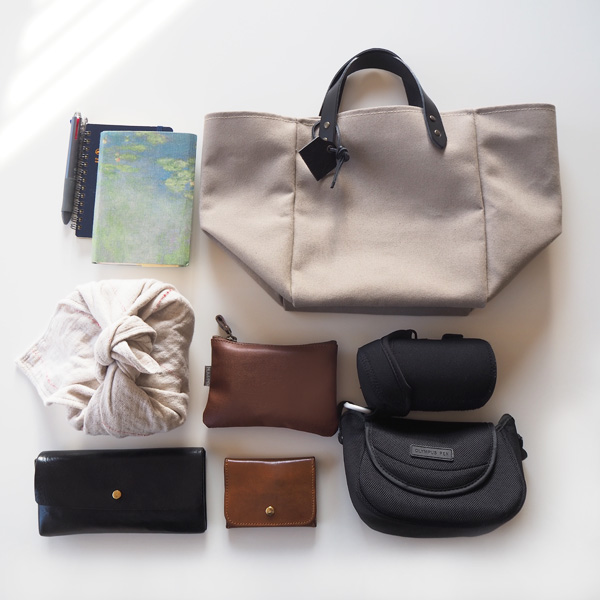
It has enough capacity to hold your wallet and lunch box, and even a compact mirrorless camera.
Yoshikawa-san:
Originally, this PANIER shape was used in Nicole's home in more of a role like a cushion basket. Of course, it looked just as good as a piece of interior decor, blending naturally into the space. What's more, the sofa in their home was also upholstered in TAMPICO's canvas fabric, and I felt the roots of TAMPICO in the way it arose so naturally out of their everyday life. The way "being solidly and properly made as an object" and "a refined, quintessentially French simplicity" come together so beautifully—it's a brand that truly embodies French aesthetics.

Through this interview, we came to feel, in so many details, the philosophy at the very foundation of TAMPICO's creator, Nicole—the idea that "making things with the future in mind" means "a style built to last." Rather than the pretty, delicate image often associated with Paris, what came to mind instead was the character of Nicole's family, who combine an easygoing side with a stoic dedication to craftsmanship, along with the lush, natural scenery of the French countryside where they grew up. TAMPICO, filled with French "cool," is a bag whose ease of use you won't forget once you've held it in your hands.
▽Click here for the TAMPICO brand page
GUIDE »
CONTENTS »
CATEGORIES »
- + Gifts by recipient
- + Gifts by scene
- + Clothing
- + Bags / Backpacks
- + Wallets / Card cases
- + Jewelry
- + Shoes
- + Rainy day outfits
- + Kitchen
- + Home
- + Babies / Kids
- + Japanese products
Earn Miles


Payment & Security