.webp)


.webp)


.webp)


.webp)


- トップページ/
- ZUTTO Journal/
- ブランドストーリー/
- MAITO, a Dedicati...
MAITO's Dedication to Natural Materials - An Interview with Maito Komuro
This feature introduces the appeal of MAITO, a Made in Japan brand specializing in natural plant-dyed textiles.
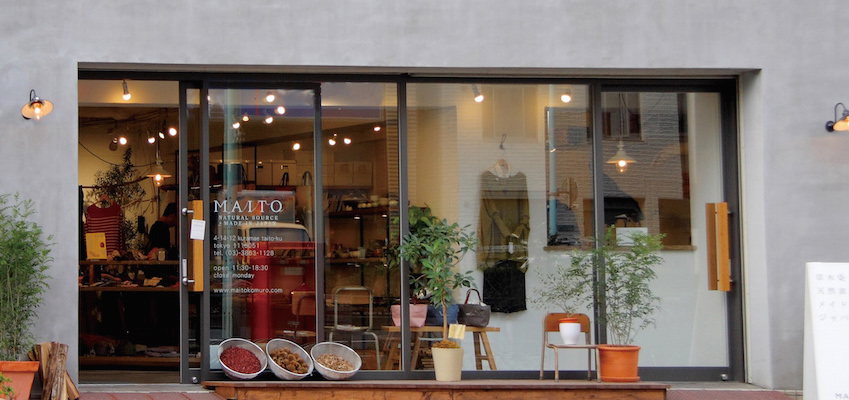
This time, we visited Kuramae, an area in eastern Tokyo where new craft brands have recently been gathering together,
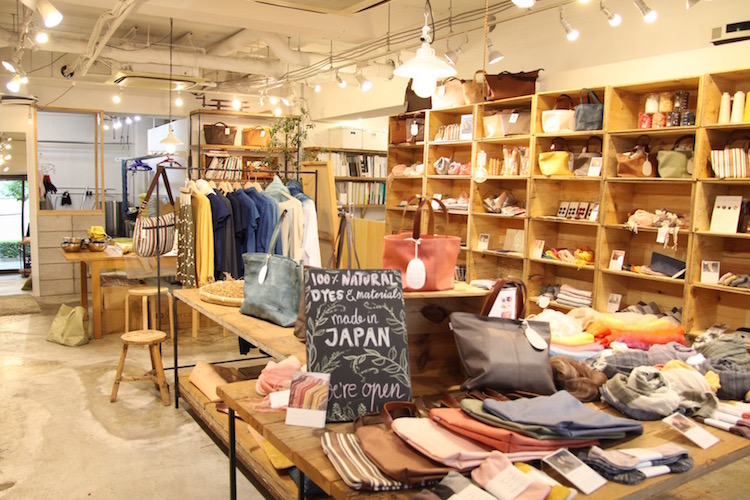
to see MAITO's atelier shop. Stepping inside, you find a naturally atmospheric space where clothing, scarves,
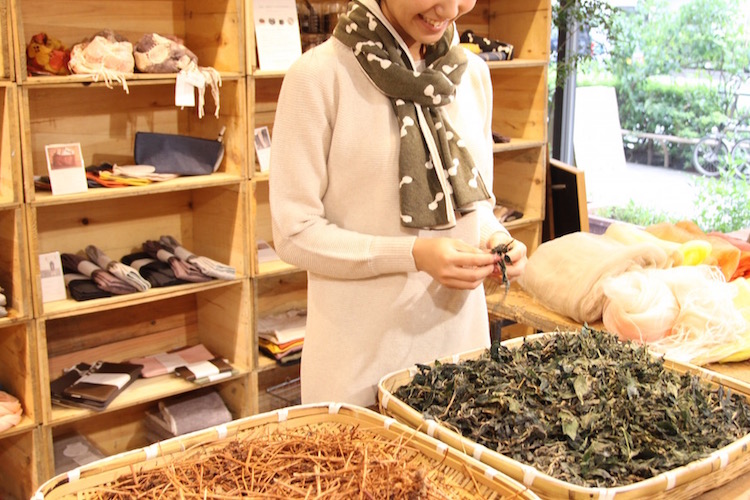
and socks dyed in a variety of colors sit alongside branches, nuts, and leaves—the raw materials of dyeing—arranged with hardly any room to spare.
In the back, there's a workspace with a large kettle and table used for dyeing workshops and prototyping.
In this calm setting, we asked about MAITO.
---------------------------
MAITO
Based on thread-making, we create products with a concept centered on natural materials and being Made in Japan.
The materials are simple and entirely natural. Natural materials can pill, and can also become misshapen over time.
The colors of kusakizome (plant dyeing) can rub off or fade. But as you live with these items day by day and wear them in,
a texture and coloring emerge that fit your body, and affection for them gradually grows.
We aim to create items that stay close to people—items that age alongside the person who cherishes them, nurturing a spirit of everyday living.
---------------------------
— Please tell us how you came to walk the path of dyeing.
In high school, when I thought about my future path, I wanted to enter the world of craftsmanship,
so I enrolled in the crafts department of an art university.
There, I explored what material I wanted to pursue—clay, urushi (Japanese lacquer), glass,
or metal—but in the end, I realized once again that I wanted to deepen my involvement with
the world of dyeing that I had watched since childhood.
So I trained under my father at home. Through that training, I came to the realization that
dyeing alone wasn't enough going forward—that turning things into actual products was what would convey the appeal of kusakizome.
— Turning things into products?
Yes. In the era when people wore kimono, simply dyeing patterns and colors onto fabric was enough to make clothing,
but for Western-style clothes, the fabric needs to be given three-dimensional shape. With that in mind, alongside university,
I also attended Bunka Fashion College.
However, dyeing alone was already demanding, and taking on pattern-making and sewing myself as well proved to be
too much, so I gave that up. Instead, I loaded dyed thread into my car and traveled around
visiting craftspeople in production areas, working toward what I wanted to achieve. It was through the craftspeople I met that way that the products we have today came into being.

— In an age when it's easy to stay in touch by phone or email, why did you choose to load thread into your car
and visit craftspeople in production areas directly?
I believe you can't understand things without seeing the actual site with your own eyes.
Also, by getting to know factories and craftspeople directly,
the whole process of making things flows much better,
so I place great importance on that.
The same holds true for technique. When I first tried to make
a whole-garment knit using MAITO thread,
the whole-garment machine was extremely difficult to adjust—it's a machine
that reportedly only about ten people in Japan can properly operate—
and I couldn't handle it well either, so
at a factory in Wakayama, I set up a simple bed next to the machine
and slept there at the factory, checking the machine's condition every night until I mastered it.
— Since these are colors from natural materials, does the way the color turns out change from year to year?
It differs from year to year, and also by region and the age of the tree,
as well as by which part is harvested (branch, root, or bud).
So even if you try to produce the same shade every year, it doesn't work out that way—
which is both the difficult part and the interesting part.
Modern chemical dyes offer the strength of producing a wide variety of bright, consistent colors
that stay fixed no matter how many times you wash the fabric.
Being inexpensive and easy to work with, chemical dyes may seem like
a good material from a maker's perspective, but at times, dyes made
from heavy metals or chemical substances are far from
appealing for the people who use them or for nature itself.
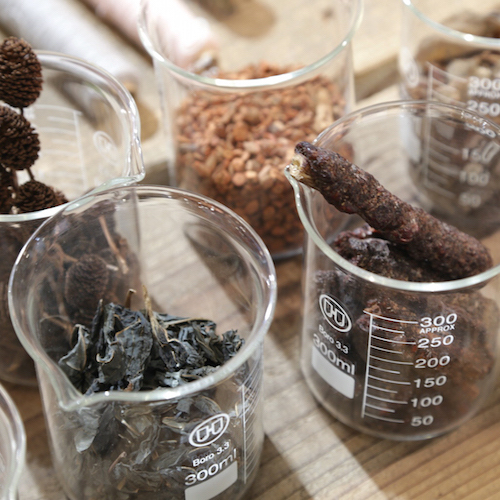
— The colors of kusakizome are truly a once-in-a-lifetime encounter, aren't they.
I think that's exactly what makes kusakizome so wonderful and interesting.
The fact that each piece is different means that kusakizome carries
a story within it.
Is it just pink, or is it cherry blossom pink?
Having a backstory behind a color is a wonderful thing, I think.
I think people in the past perceived color differently.
There was probably a sense of longing toward color as well.
Wanting to wear red rouge, or color signifying one's social status—
that kind of way of perceiving color is really wonderful.
I believe the colors produced by natural things carry a certain power.
— It's true, Japanese people do seem sensitive to color.
It's both a cultural thing and something influenced by having four distinct seasons.
The fact that the colors of the mountains change through spring, summer, autumn, and winter is rare and, I think, a fortunate thing.
How a color appears also changes depending on the sunlight.
Because of the kimono culture, I think Japan became more skilled
at the technique of dyeing rather than shaping color through form.
In Europe, since it was about dresses, people enjoyed color through form, which is why
design evolved so much there. That's why, in Japan, the techniques for dyeing and
producing patterns have continued to be passed down to this day.
— So you're exploring techniques that make the most of the strengths of kusakizome
while covering for its drawbacks.
"Top dyeing," where raw cotton is dyed before spinning, is exactly a technique for covering that drawback.
The fact that the color is weak—meaning it changes over time—can be something to enjoy
if you're already familiar with kusakizome, but for those encountering kusakizome products for the first time,
it can be a high hurdle, so I was always thinking about whether there might be a solution.
Dyeing repeatedly, layer after layer, to create a deep color, then stripping color from the surface afterward to raise the tone—
...which makes the aizome (dyed plant) colors stronger, but this inevitably makes things more expensive.
After much deliberation, the solution we arrived at was "dyeing from the top."

Raw cotton dyed using the top-dyeing method
—Does dyeing from cotton give the color any particular characteristics?
When you spin thread from dyed cotton, various colors mix together within a single strand of thread.
When you knit with it, the resulting product has a rich, layered expression.
Compared to conventional kusakizome (plant dyeing), the color sets better and is less prone to change,
so it has practical functionality as well.
—What kind of land is suited to dyeing?
Dyeing can be done anywhere, but what matters most is the water.
Tokyo's water is hard and contains chlorine, so it isn't well suited.
Even for bringing out the color of cherry blossoms, dyeing in Akizuki, Fukuoka
produces far more beautiful results than dyeing in Tokyo. Akizuki has three water sources.
There's a weakly alkaline water rich in calcium, a hard water
containing magnesium, and an ultra-soft water—three types in all, which are
well suited to dyeing. The mountain spring water is drawn through pipes,
and every month the local residents go to clean the water source,
making repairs and cutting the grass.

—What are the difficult aspects of this work?
Connecting one technique with another is the hard part.
Bringing together the technique of kusakizome with the techniques needed to make the finished product
—that's what's difficult. You have to learn the rules of each, and go through verification and experimentation,
which usually takes about a year.
Even the WHOLEGARMENT took four to five years.
So we're always moving forward with various experiments and new attempts
in parallel.
(It's precisely because you love it that you can keep taking on these challenges, isn't it.)
That's right, I do love it.
I consult with the craftsmen about the best way to achieve something
through kusakizome, and for the difficult parts, I study them myself.
It's a constant repetition of research.
Right now, I'm gradually able to do the things I've wanted to do,
and next I'd like to try embroidery, so I've been working on
thread-making and adjusting the embroidery machine.
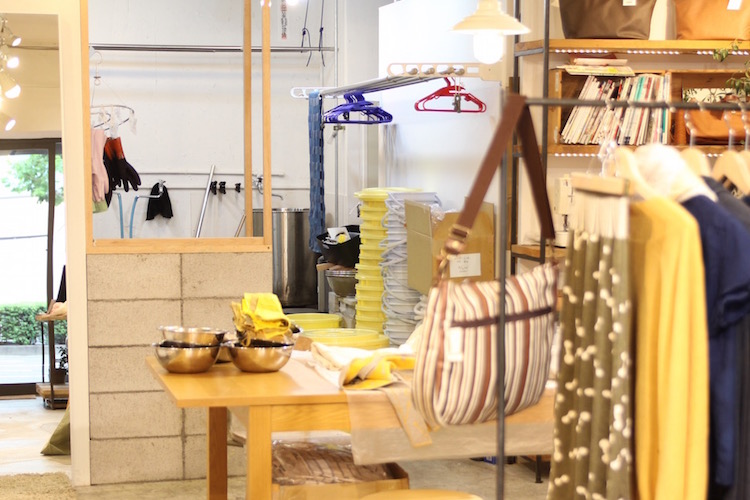
At the back of the Kuramae shop is a space for "dyeing."
—There's no compromise here.
I want to create new things.
By doing what no one else is doing, I hope the craftsmen's skills
will improve too, and that their world will expand.
I also hope it can become a chance for the younger generation
in each craftsman's region to take an interest in this work.
If we don't work to increase the number of successors, the craftsmen
we rely on will eventually disappear.
If that were ever to happen, we're even considering taking on those techniques ourselves.
—We often hear about the shortage of successors in Japanese craftsmanship too.
I think location plays a part in this.
Just as coming to Tokyo lets you encounter and learn about all sorts of things,
it would be great if regional techniques could also be learned in Tokyo.
(There's no need for these traditions to be passed down only by people living in that particular region, is there.)
Even though many people are interested, the fact that it's limited to a specific place
means that many people don't get the chance to learn about it or study it—
that's certainly true.
These days, you don't have to travel all the way there
to eat delicious food or
buy things. When you think about it that way,
having an environment where you can learn from anywhere would be
a real blessing for those who are interested.
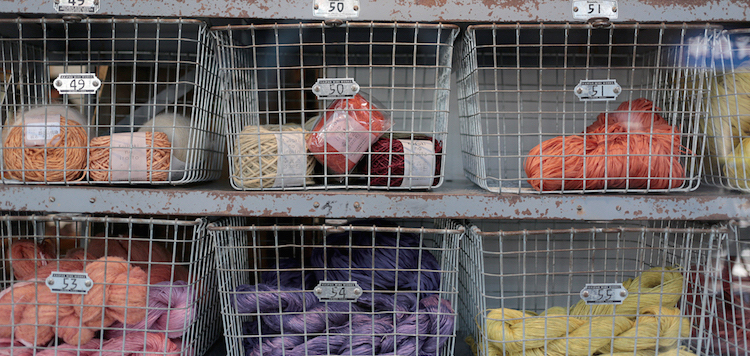
—What kind of people would you like to use MAITO products?
Including people who don't know about kusakizome, I'd like many people
to experience the real thing.
Natural materials can be inconvenient or take extra effort at times,
but that's exactly why people come to treasure them,
and it becomes an opportunity to learn about the material itself.
I feel that this kind of experience nurtures the heart of everyday living.
—Please tell us about your dreams for the future.
I have many dreams.
One is that I'd like to dye things overseas.
Since the water differs from place to place, and the materials you can gather differ too,
I'd like to try dyeing in all kinds of places.
When you source materials locally and dye with local water, the way the color comes out is different,
and I think the impression the color gives under that region's sky would be different too.
Another dream, as a Japanese person, is to build a factory
in order to preserve this technique in Japan.
That's why I'd like our own factory to be somewhere
around here in Kuramae. I want many people to see it,
to meet people who want to take part, and to connect it to the future.
I remember that the first time I visited the MAITO shop, the space,
lined with clothes dyed in so many different colors, felt remarkably calm.
Even with so many colors on display, they were gentle on the eyes, and I could
feel how different kusakizome is from chemical dyes.
This interview was a good opportunity to understand once again that it is precisely because Mr. Komuro
has thoroughly studied and researched natural materials
that these products came into being.
It also seemed to me that Mr. Komuro's commitment isn't limited to making MAITO products—
he also thinks about the craftsmen, the regions, and the natural environment behind them,
and his sense of moving toward the future seemed, somehow, to come through
in the gentle texture of the kusakizome itself.


The Knit JQ Muffler is made with jacquard weaving that beautifully traces
motifs reminiscent of embroidery. With a cotton feel as soft as a towel,
it also has a lovely texture where you can feel a slight unevenness
between the motif areas and the base areas.
The motifs, made of circles and straight lines like little nuts or droplets,
blend naturally into the base color while still providing just the right accent.
The base color and motif color are reversed on the front and back,
making it a lovely reversible piece that looks wonderful on either side.
Wrapped twice around the neck, it's just the right length.


Kusakizome (plant-dyed) Flat-Knit Leggings
Because they're flat-knit, they don't bunch up when worn, giving a clean, streamlined silhouette.
The natural look of the knit fabric also makes these leggings easy to coordinate with other pieces.
Pairing them with a skirt or dress isn't just a stylish choice—it also helps keep you warm.

Kusakizome (plant-dyed) Leg Warmers
On days when there's a slight chill in the air, a pair of leg warmers you can slip on quickly comes in handy for keeping your legs warm.
The vertical knit pattern is a key feature of these leg warmers.
Wear them over tights when bare legs feel too cold, or pull them up to cover your heels while indoors—
they also work well as arm warmers, not just for the legs.
Adjust the scrunched-up volume to your liking and enjoy styling them your own way.
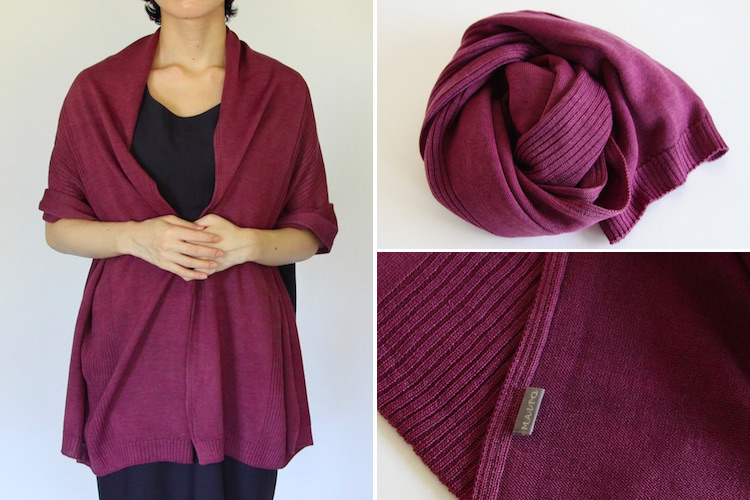
Kusakizome (plant-dyed) WT Rib Snood, Murasakiko
This simple, lightweight snood can be worn as a scarf or shawl by anyone, regardless of gender,
and works as a versatile piece suited to both casual and formal occasions, making it a wonderful gift as well.
Wrap it around your neck as a windbreak, or—since it's generously sized—spread it out over your lap,
or drape it over your shoulders to keep your body warm.
GUIDE »
CATEGORIES »
- + Gifts by recipient
- + Gifts by scene
- + Clothing
- + Bags / Backpacks
- + Wallets / Card cases
- + Jewelry
- + Shoes
- + Rainy day outfits
- + Kitchen
- + Home
- + Babies / Kids
- + Japanese products
Earn Miles


Payment & Security