Welcome to ZUTTO
Free shipping for newsletter subscribers (some areas excluded)
- トップページ/
- ZUTTO Journal/
- 選び方・使い方/
- Your First Basket...

Your first basket bag. Revisiting materials, then selecting by size and use
―The case of Staff H―
Vitamin-colored tops, cool glass or silver accessories, a loose-fitting linen dress. There are countless ways to dress for summer, but the summery feeling a basket bag brings is truly one of a kind. Here, a staff member who has long had her eye on basket bags but never actually owned one has decided that this year, she'll finally get her first one. Since we're at it, let's take a look together at the basket bags she's been eyeing.
Contents
Why basket bags now?

First, we asked Staff H why basket bags are on her mind "right now."
Her key points were:
・It should pair easily with spring and summer clothes
・She wants to enjoy her everyday coordinates from a different angle
That's what she told us.
When we had her line up all the basket bags she'd been eyeing, they ranged widely in size and material. Let's go through them one by one, alongside her as she deliberates over which she likes best.
Revisiting materials
When we simply say "basket bag," there are actually many different materials involved. Let's briefly go over the characteristics of each.

The basket bags carried at ZUTTO are made mainly from the following four materials.
・Akebi:
A plant found in Honshu, Shikoku, and Kyushu in Japan. Akebi baskets are woven from akebi vines that have been sun-dried for about a week and then soaked in water for several more days, resulting in a tightly woven, very sturdy finish.
・Raffia:
A palm-family plant common in tropical regions. Its high flexibility allows for delicate processing, and the beauty of its woven appearance is one of its charms.
・Ashi (reed):
A grass-family plant, a type of aquatic reed. Because the material itself hardens over time, it has long been used as a sturdy, lightweight material for things like sudare (bamboo blinds). It has a firm, solid feel to the touch and is resistant to losing its shape.
・Tou (rattan):
Also known as rattan, a palm-family plant that grows wild in the jungles of Southeast Asia's tropical rainforest regions. It is flexible and durable while also being lightweight, and the graceful curves made possible by its flexibility are one of its charms.
Each material has its own texture and place of origin, but they all share one thing in common: a dislike of humidity. For more on care, please also see this article.
>>Living with natural materials. Raising a hand-woven basket bag
Choosing by size

Left: Rattan handbag with bamboo handle (rattan flap), right: Akebi basket (tsudobari hora weave, wrapped handle) paired with Inner bag (L/Black)
Size is always something to consider with bags. A compact size feels light and summery, and since it's such a different material from the rest of an outfit, even a small bag makes a great accent.
Basket S/NAVY/TOINO ABEL (Material: reed)


A size that fits a wallet, phone, and even a paperback book.
This basket bag from TOINO ABEL is based on a traditional basket design unique to Portugal, hand-woven one at a time. All materials used are sourced within Portugal—vegetable-tanned leather (cowhide) for the handles and willow branches to secure them—so the entire piece is made from natural materials.
Rattan handbag with bamboo handle/CANDRIA TOMMASO (Material: rattan)

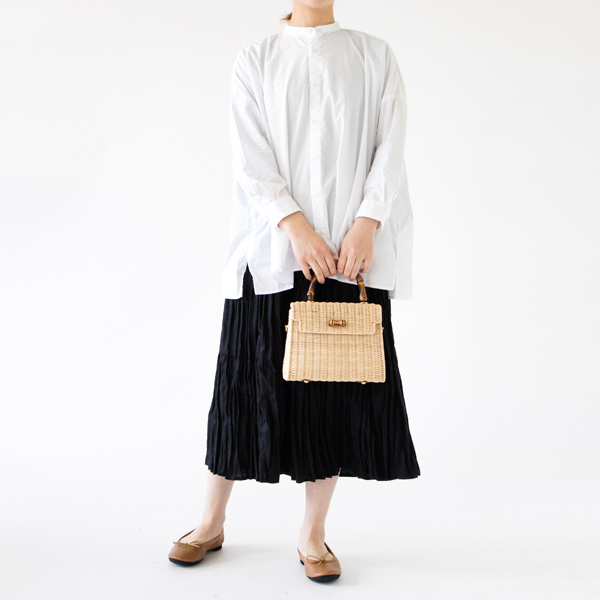
Shirt: FARMS SHIRT (WHITE is discontinued), Skirt: Linen Tiered Skirt (BLACK)
The rattan handbag with bamboo handle suits both casual looks and dressier styles alike. In 1974, CANDRIA TOMMASO opened a workshop in the town of Moriano, in Italy's Marche region, crafting distinctive handmade furniture and baskets from willow twigs and bamboo. Moriano, a hill town with a flourishing history dating back to medieval times, is known both within Italy and abroad as a center for rattan-weaving craftsmanship.
Basket bags generally tend to be small to medium in size, but if you carry a lot of belongings, choosing a larger one is a good idea. If you usually carry large items like documents along with lots of small things, we recommend a bag that's fairly spacious and also flexible.
Border Raffia Bag / Sans Arcidet (Material: raffia)


Top: Brushed Jersey Pullover (PEACOCK BLUE)
Madagascar is an island in the Indian Ocean off Africa's east coast. Famous for the Avenue of the Baobabs that appears in the picture book "The Little Prince," this island is also known for its raffia, which is used in this bag by Sans Arcidet. The raffia used here is top-quality material taken from the leaves of raffia palms growing in a nature park in the Majunga region on Madagascar's west coast—the raffia palm's home region. Each bag is handmade individually by skilled craftspeople.
Akebi Basket (Tsumadobari Horaami, Rolled Handle) / Miyamoto Kogei (Material: akebi vine)


Skirt: Linen Tiered Skirt (YELLOW)
This akebi basket bag is made entirely by hand, without relying on machinery at any stage. Crafted by a long-established workshop founded in Taisho 9 (1920) in Hirosaki, Aomori Prefecture, this basket bag lets you feel not only the charm of natural materials but also the vanishing handcraft tradition of Japanese artisans. It doesn't have much flexibility, so it isn't well suited to carrying a lot of belongings or documents, but if you find compact basket bags a bit lacking, this larger size is recommended.
Choosing by Occasion
For everyday use, a bag for walks. Striped Raffia Bag / Sans Arcidet

This is the mini tote-sized bag by Sans Arcidet introduced earlier. The fringe and bold stripes give it a summery feel.
A reassuringly big size with the gentle touch of linen: Raffia Tote Bag / Vlas Blomme

Sandals: M Sandal HYACINTH LEATHER NUT
This tote bag is from Vlas Blomme, whose name means "flax flower" in Flemish, the language of Belgium's Flanders region. The lining uses "Work Linen" fabric—100% Kortrijk linen woven softly with thick-gauge thread.
Also handy as an inner bag: Karina Clutch Bag / HELEN KAMINSKI

HELEN KAMINSKI is a designer based in Sydney, Australia. Known for a wide range of hats, her hand-woven bags are also popular. This clutch bag is likewise made of raffia, using raffia sourced from Madagascar.
So, which one did our staff choose?
After much deliberation, out of the seven options, Staff H chose the "Striped Raffia Bag."

Even on clear days during the rainy season, the sun has been dazzling enough to feel like summer is already here. Before the height of summer arrives, it might be a good time to choose your companion for the season.
▼See our basket bag category here

GUIDE »
CONTENTS »
CATEGORIES »
- + Gifts by recipient
- + Gifts by scene
- + Clothing
- + Bags / Backpacks
- + Wallets / Card cases
- + Jewelry
- + Shoes
- + Rainy day outfits
- + Kitchen
- + Home
- + Babies / Kids
- + Japanese products
Earn Miles


Payment & Security