


.webp)


.webp)


.webp)


.webp)


Welcome to ZUTTO
Free shipping for newsletter subscribers (some areas excluded)
- トップページ/
- ZUTTO Journal/
- 選び方・使い方/
- For celebratory o...

For celebratory occasions or entertaining guests, choose meimeizara according to how each person will use them.
Compared to rice bowls, soup bowls, or plates for a main dish, they're not strictly essential—but having a few smaller plates on hand tends to come in handy more often than you'd expect. That's what we're introducing today: meimeizara (individual serving plates). These versatile little plates are useful in countless ways, and keeping a set you love and have chosen with care means you're ready whenever the moment calls for them—whether it's conveying a spirit of hospitality when serving tea and sweets to guests, or adding a touch of flair when portioning out dishes at the table.
This time, we're putting the spotlight on these unsung heroes that often get pushed to the bottom of the shopping list. From plates suited to celebratory occasions to those that earn their keep in everyday life, we'll introduce the appeal of meimeizara in a range of sizes.
.jpg)
So, what exactly is a meimeizara?
As the name suggests, meimeizara (めいめい, meaning "each person" or "individually") are plates meant to be enjoyed however each person likes to use them.
For serving sweets, for portioning out dishes, as a holder for condiments, even as a tray for accessories—the possibilities are limited only by imagination. Their size, small enough to fit comfortably in one hand, is exactly why owning even just one opens up so many opportunities for use.
ー Table of Contents
What kinds of plates are called meimeizara?
Choosing meimeizara by size, and how to use them
・7cm diameter – For serving pickles, fruit, or snacks with drinks
・9cm diameter – As a holder for soy sauce, ponzu, and other condiments
・10cm diameter – A versatile choice for everyday use as a Japanese-style individual plate
・14–14.5cm diameter – Perfect for plating sweets
・15cm diameter – For serving simmered dishes and other saucy side dishes
・18cm diameter – Also works well for portioning out dishes eaten with a knife
・20cm diameter – For plating breakfast, or as a one-plate lunch
A few unexpected ways to use meimeizara
・As stylish storage for accessories
・As a soap tray, using a plate resistant to stains
What kinds of plates are called meimeizara?
The image that most readily comes to mind is a meimeizara used to serve tea sweets to guests.

There's no strict rule about size, but small plates large enough to be used for portioning out food are often called meimeizara. In practice, that generally means plates around 15cm across.
That raises a question: if a meimeizara is essentially a type of kozara (small plate), why call it by this particular name? One theory holds that the term "meimeizara" is reserved for plates of especially fine quality. Meimeizara come into their own mainly on celebratory occasions or when entertaining guests—settings where, as most people know, proper manners matter. And somehow, calling a plate a "meimeizara" rather than simply a "kozara" gives it a more formal, more elegant ring. No one seems to know exactly why this impression of refinement persists, but perhaps it's fitting for a language as full of indirect, roundabout expressions as Japanese.

Because there's no precise definition of what makes a meimeizara, they come in Japanese and Western styles, in all kinds of materials, and in whatever shape suits them. The one thing you can say for certain about any meimeizara is that it's a plate with a certain refinement.

Kodaizara / KOSEN
▲Even a plate shaped like an auspicious plum blossom can be a meimeizara. Despite its modern pattern, this is a piece of traditional iro-nabeshima ware.
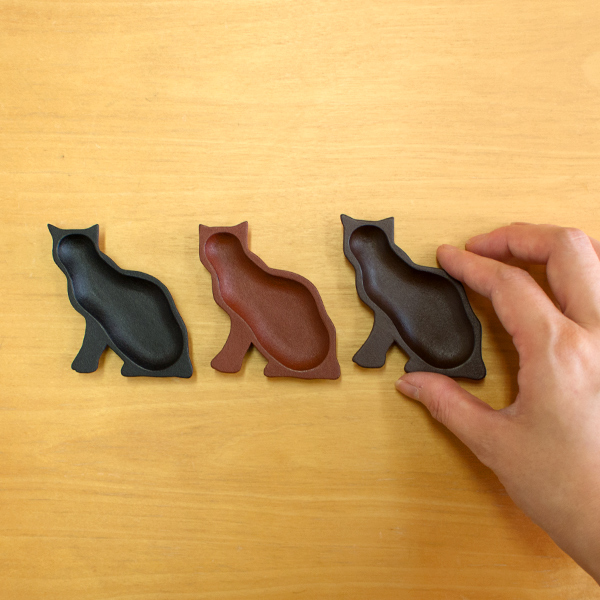
Mamemame-zara Neko / Wajima Kirimoto
▲There are even meimeizara shaped like cats. Their small size also makes them a nice spot to set down your earrings.
Choosing meimeizara by size, and how to use them
Meimeizara lend themselves to all sorts of uses and occasions. You already know they're good for serving tea sweets—but what other uses are there? Here are some suggestions for how to use them, organized by size.
GOSU Kozuke (Small Bowl) Set of 5 / GOSU

Let's start with a small 7cm meimeizara. With enough depth to work well as a kozuke (small serving dish), the GOSU Kozuke (Small Bowl) Set of 5 is best suited to serving pickles, fruit, or snacks to enjoy with drinks. Here's a sense of the scale.

The depth is well suited to holding foods with a bit of liquid, so this piece tends to see more use for plating dishes than as an individual serving plate for portioning out food from a shared platter. Given its compact size—small enough to sit on top of a larger plate—and the fact that it comes as a set of 5 in varying shades, it would also work nicely for serving vegetable sticks alongside a different dip in each one.
Being small, they don't feel crowded even when lined up together, which makes them handy when you want to serve several condiments at once. The brand name GOSU comes from gosu, the blue pigment that has long been used in sometsuke and other porcelain ware. Making the most of this beautiful gradation of blue, the lighter shades set off pale-colored ingredients and Japanese dishes, while the deeper shades pair well with vivid ingredients and Western dishes alike—suiting a wide range of menus.

Every piece of GOSU ware is made using a technique called "dami." A special dami brush is loaded generously with gosu pigment, and the artisan works carefully across the surface, using their fingertips to control the amount of dripping paint as they go. Achieving a beautiful finish on the highly absorbent unglazed clay body is an extraordinarily demanding skill. Take a moment to appreciate the beauty of that blue.
3-sun Round Plate, Set of 4, Ami (Net) / HORITSUKE

This flat 9cm mei-mei plate (individual serving plate) is perfect for holding pickles, soy sauce, ponzu, and other saucy condiments. As the brand name HORITSUKE (meaning "carved") suggests, this is tableware with beautifully carved shading. The round, small dish shape is decorated with a pattern based on the auspicious "net" motif, and by redesigning a classic form that has long been used in everyday life, the makers have also placed importance on usability.
Seto ware, with a history of 1300 years, is pottery that has long been cherished by the Japanese people, and it is said to have inherited such advanced techniques that "there is no ceramic Seto cannot make." Fitting for HORITSUKE, which has spent many years crafting the molds that form the basis of tableware in Seto, this plate appears simple at first glance, yet expresses its own individuality without being too flashy.

Since the pattern is created solely through shading on white, the colors of condiments stand out beautifully. It suits both Japanese and Western ingredients well, but in terms of Japanese food, the green of wasabi and the yellow of takuan (pickled radish) both pop brightly, making the dish look even more delicious than usual.

Set of 5 Mei-Mei Plates, 3-sun Round, Sometsuke Gourd Pattern / Kamide Choemon Gama
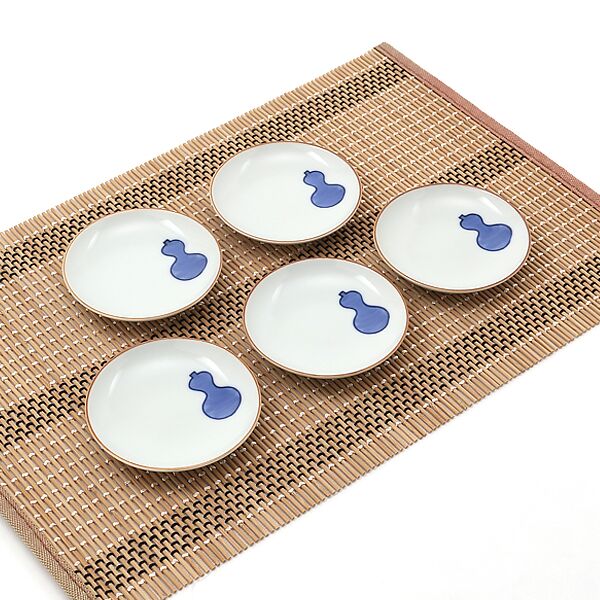
This mei-mei plate is an overall versatile choice for serving Japanese food. It's easy to use for pickles, small side dishes, or condiments, and its size makes it just right both as an individual serving plate and as a small platter. When food is placed on it, the hand-drawn gourd, arranged in an exquisite position, seems to peek out from beside the dish, giving it a charming, endearing quality that makes you want to reach for it as your go-to serving plate.
Because the gourds are hand-painted, each one differs slightly in shape and shading of color. As you use them over the years, even though the pattern looks the same at first glance, you may find yourself thinking, "this one is my daughter's, this one is my husband's," and each becomes a favorite piece in its own right. It's wonderful that tableware infused with the warmth of human hands can be enjoyed in this way.

The gourd, with its shape that widens toward the bottom, has long been used as an auspicious symbol in charms for warding off misfortune and praying for good health, making it perfect for celebratory occasions. When guests come over, you might fill these plates with sushi and set them out to enjoy while chatting. Or at a lively celebration, you might divide up dishes among these plates. This is a wonderful mei-mei plate that suits scenes filled with smiles.
What is called a 4.5-sun plate in Japan is roughly this size. With its larger size, it's also easily chosen as an individual serving plate.
Giyaman Tou 4.5-sun Plate / Kaneko Kohei Seitosho

This auspicious dish spreads out just like a chrysanthemum flower. Some of you may have seen desserts served on it at a cafe before!
And that's no coincidence—this plate, with its glass-like transparency and the deep richness reminiscent of urushi (Japanese lacquer) ware, is said to be a masterpiece born from the pursuit of beauty. It has been sold not only in Japan but also by well-known brands overseas, and has even been used at a party at the Palace of Versailles, making it an extremely popular piece of tableware.
For this reason, the Giyaman Tou 4.5-sun plate is a beautiful choice for serving both Japanese and Western food. The rim is slightly raised, making the shape convenient for serving or dividing up saucy dishes. True to its nature as a mei-mei plate, it's ideal for serving tea sweets, and it's the kind of plate you'll want to casually pull out for your afternoon snack too—one that plays an active role in everyday life.


▲If you'd like to gather a matching set for the family, we recommend a set item. Thanks to its popularity, the Giyaman Tou series comes in a wide range of sizes, from small bowls to large bowls and dessert sets. A table set with matching designs for a sense of unity is lovely too.
PRIME 4.5-sun Plate / ZOA

This is an elegant plate that fully embraces a Japanese aesthetic. It's a painted plate entirely hand-drawn by a decorating artisan, with brushwork that conveys a sense of narrative and depth, giving it a special impression through the warmth typical of Japanese-style tableware and even the subtle variations in the pattern, making each piece truly one of a kind.
Given the porcelain's characteristic resistance to oil stains, the depth of the dish, and the easy-to-hold shape of the rim, this plate seems well suited for dividing up saucy side dishes. The rim is shaped so your thumb can easily hook onto it, and since the pattern is painted on, you can enjoy the look of the dish even after food has been placed on it. With its Japanese atmosphere, this plate might also work well as a decorative piece in a Japanese-style room, displayed alongside a vase.

Revival Namasu Plate / Risougama

Because namasu plates have depth, they make it easy to serve dishes with sauce, such as simmered foods. And thanks to their size, which is just right for a mei-mei plate, in the past every household had enough for each family member, and they were frequently used as individual plates for sharing assembled dishes.
.jpg)
The designs, featuring large blooming flowers or charming swimming medaka fish, evoke a bountiful table. When such gorgeous plates are lined up at the table, the atmosphere truly becomes more festive, so they come in especially handy for celebrations and enjoyable gatherings.
This is a plate with many everyday uses, not just for guests—perfect for simmered dishes like nikujaga (meat and potato stew) or oden, for tall ingredients like chicken drumettes, or for serving portions from a hot pot. Besides using it as a serving plate, if you live as a couple, its size also seems well suited to filling it with enough for two people to share.

Asa no Ito Plate S, Pair Set / Hasami-Hakusan Toki

A simple, everyday dish with a rim that looks as though it's been wrapped in linen thread. Despite its distinctive design, it never competes with the food for attention—the calm sepia-toned linen pattern and the crisp indigo linen pattern both work to make whatever you serve on it look even more beautiful.
It's a good size for serving larger dishes for sharing, and it's also just the right size for desserts or a breakfast plate.
Umanome Zara (Horse-Eye Plate) / HORITSUKE
.jpg)
A dish finished with a bold, substantial design created by carving the pattern with a chisel. It has real impact, and its one-of-a-kind look—impossible to categorize as either Japanese- or Western-style—makes any dish placed on it look even more delicious.
With a plate like this Umanome Zara, placing something relatively small on it—toast, cake, roast beef—really brings out the pattern on the rim, making the food look even more appetizing. Here's a sense of the size.
.jpg)
Being flat, it's well suited to foods you cut with a knife, like steak or pancakes. This Umanome Zara also makes a lovely spot for larger accessories, such as bangles or wristwatches.
Kakudo Dish / Takahashi Kougei

Individual dishes come in all kinds of materials—ceramic, porcelain, glass—but this one is wooden, with a stylish, slightly unconventional non-round design. It's on the larger side for an individual dish, but that size is exactly right for serving something with real volume, like steak, or Western dishes like pasta that take up more space.
If you're serving something on this Western-style walnut dish, it's lovely for bread, salad, or a breakfast plate of fried eggs and bacon. Whatever you put on it looks like something served at a stylish café, and it also pairs nicely with the GOSU dish introduced above for a one-plate lunch.

A Few Unusual Ways to Use an Individual Dish
Here are a few unconventional ways to use an individual dish. Serving food isn't the only use for these dishes—their size makes all kinds of uses possible. Why not try some of these ideas?

Its outstanding stability and just-right size make it perfect for holding accessories. Without needing a dedicated case or earring stand for storage, you can simply set your pieces on an individual dish you like, giving you more freedom to choose a design that suits your interior. Especially with your favorite accessories, isn't it more satisfying to display them openly rather than hide them away in a box? Doing so can deepen your attachment to them.


If your individual dish is flat, it might work well as a coaster. This KAMI Petri dish can be stacked and nested, and if you turn the larger size upside down, it can also serve as a lid. Besides using it as a small plate, it works just as well as a coaster. It's also lovely for displaying a small decorative item, or for storing small odds and ends.
Paired with the KAMI Glass Free from the same series, you could also fill it with spices or sugar cubes and set it out on the table or in the kitchen.


Porcelain or ceramic dishes, which resist stains and are easy to clean, also make good soap trays. Bringing a design like this into your interior can turn your bathroom into something a bit unique and special. Coming up with new ways to use it might just be part of the fun of owning an individual dish.
This time we used KAHLER's URSULA Oval Plate, size 180. It's the smallest size, but it still has real presence.
Since an individual dish isn't the main dish at the table, choosing one can easily get pushed to the bottom of the list—but once you discover all the different ways to use it, its appeal becomes much clearer. Spring, with its many celebratory occasions, is a season when you'll find yourself reaching for one often to serve and share food, so it's worth having one on hand. We hope you find a favorite individual dish you'll enjoy using for years to come.
GUIDE »
CONTENTS »
CATEGORIES »
- + Gifts by recipient
- + Gifts by scene
- + Clothing
- + Bags / Backpacks
- + Wallets / Card cases
- + Jewelry
- + Shoes
- + Rainy day outfits
- + Kitchen
- + Home
- + Babies / Kids
- + Japanese products
Earn Miles


Payment & Security




