


.webp)


.webp)


.webp)


.webp)


Welcome to ZUTTO
Free shipping for newsletter subscribers (some areas excluded)
- トップページ/
- ZUTTO Journal/
- 選び方・使い方/
- The season for de...

The season for delicious new tea has arrived. Here we introduce how to choose tea utensils according to your lifestyle.
It's now mid-May, the season of shincha (new tea). Even convenient tea bags and instant tea that can be enjoyed anytime, anywhere, take a break during this special time. There are a few tools worth having on hand to fully savor the fresh, raw tea that comes around only once a year. From yunomi (teacups) to kyusu (teapots) and chazutsu (tea caddies), it might be worth paying a little extra attention to your tools in order to enjoy delicious tea in the best and most careful way possible. At ZUTTO, we offer artisan-crafted tea utensils that let you fully enjoy shincha, available only during this fleeting season.
– Table of Contents
・When is the season for shincha?
・How is shincha different from regular tea?
・How to keep enjoying delicious shincha for as long as possible
・Recommended sets for those who want to enjoy tea easily
・Recommended individual pieces for those who are starting to get particular about their tea
・Tea utensils for those who want to enjoy tea in an even more authentic, delicious way
・For those wanting to add more yunomi as family or friends increase
When is the season for shincha?

Now, let's talk about tea. Since tea is grown in many regions across the country, the timing varies by area, but tea leaves generally begin to unfurl from early April through mid-May. The 88th day counted from Risshun (the first day of spring) is called "hachijuhachiya," and because the number eight, which spreads outward, is considered auspicious when doubled, this day is regarded as a lucky one. Since this timing coincides with the shincha season (early April to mid-May), the day has become synonymous with new tea. There is also a tradition that drinking shincha on this day will bring good health and freedom from illness for the entire year.
How is shincha different from regular tea?
Shincha is rich in nutrients because it is made from young leaves that have absorbed abundant nourishment over the winter months, harvested and processed into tea leaves while still fresh.

The component responsible for making tea taste delicious is called "theanine." Theanine has the property of converting into catechin, a bitter-tasting compound, the longer the leaves are exposed to sunlight. Since shincha is made from young leaves picked and processed right away, it is said to contain the highest levels of this savory theanine compound. Because shincha is rich in theanine yet relatively low in the bitter compounds catechin and caffeine, it has a fresh, crisp taste with a pleasant sweetness—one of its defining characteristics.
Theanine is also said to have a relaxing effect, making shincha the perfect drink to enjoy during spring, a season often filled with stress from changes in environment.
How to Store Shincha
It's best to enjoy shincha within about a month of purchase. Once opened, the tea leaves begin to deteriorate right away, so it's a good idea to keep the following points in mind.
・Do not refrigerate (the temperature difference from taking it in and out will cause the leaves to deteriorate)
・Keep away from air and light (this affects both the flavor and the color of the tea)
With that in mind, what's actually most important for enjoying tea is the "chazutsu" (tea caddy). Once you've gone to the trouble of getting good tea leaves, it's worth using a proper tea caddy wisely so you can enjoy them at their best for as long as possible.

This tea caddy, with its dignified and composed presence, is truly reliable. Fujiki Denshiro Shoten, which boasts a 200-year history, has continued to produce high-quality kabazaiku (cherry bark craft) across six generations since its founding at the end of the Edo period. Each caddy is carefully handcrafted by skilled artisans, keeping the tea leaves inside in optimal condition at all times. The natural properties of the mountain cherry bark also allow for just the right amount of airflow, protecting against both excess moisture and dryness, so you can enjoy delicious tea at home for a long time.

This is the chazutsu (medium-length) Shimofuriawa, which makes the most of the bark's natural texture. While the surface isn't polished to a shine, it has the warmth and strength of wood, along with the raw beauty of the material as it is—if you listen closely, you might almost hear the wood breathing. It's a fine piece that reflects the artisan's careful handiwork, from its design, which fits naturally into modern life despite being rooted in traditional technique, to the seams of the caddy and the snug, perfect fit when the inner lid is closed.
For those who want to enjoy tea easily, choose a set.
For those who usually use tea bags but have recently become interested in loose tea leaves, a set that includes a kyusu and yunomi is very convenient. Among these, two-cup sets are popular for enjoying after-dinner tea with family or a partner, since they add a sense of coordination and make the wait for the tea to steep more enjoyable to look at. For those busy with work and housework, it's also a good idea to pay attention to how easy the set is to wash.

This kyusu features a distinctly Japanese motif, yet has a charm reminiscent of Scandinavian tableware, making it a perfect fit for modern life. The Akatsubaki Chanomi Set combines an adorable design with fine materials and artisan craftsmanship. The red used at Zohogama is known as "Zohogama Red," made using extremely rare bengara (red iron oxide pigment).
Bengara red is a pigment that takes a thousand days of slow, careful grinding and three years to complete, gradually deepening into a rich red color over time after firing. It is said that the longer you take to grind it, the more beautiful the red becomes, and this red pigment—finally completed after an almost unimaginable thousand-day preparation process—has been called the "phantom bengara," considered precious since the early Showa era. Among these, the bengara of Zochingama is an especially rare and valuable red that never appears on the market, and this Akatsubaki tea set is made using that red generously and luxuriously. Part of the joy of using this set is watching it age with use, developing a richer, more nuanced color over time.
Not only does it use bengara, but the spout of the teapot and the rim of the teacups are also finished with gold accents, giving it a wonderfully luxurious finish. Handmade, it carries a warmth that mass production can't replicate—this is the first thing that recommends it from a design standpoint.


It comes with a convenient built-in tea strainer for everyday use. The strainer is removable, so if washing it feels like a hassle, you might try using an easily available tea pack from the supermarket instead.
For those who want simplicity and modernity in their design, we recommend the Hakusan Toki set, with its sturdy, embracing forms based on black and white.

Not flashy, yet not ordinary either—a design that never grows tiresome with use. Hakusan Toki values this approach, along with a commitment to rewarding that attachment. Founded in 1779, Hakusan Toki has spent over 200 years pursuing designs that fit naturally into Japanese daily life and are loved for the long term, earning over 100 Good Design Awards and Long Life Design Awards along the way. This dobin (earthenware teapot) is one of the pieces that received a Good Design Award, characterized by its stable, well-balanced form. The original design dates back to the 1970s, and this long-selling set, cherished for so many years, truly embodies a design that never grows old.
The strainer section uses the traditional built-in style. It has holes of a fineness suited to ordinary Japanese tea, so fine tea leaf particles do come through when pouring—but it's precisely because of this built-in strainer teapot that the auspicious "chabashira" (a tea stem standing upright in the cup, considered a sign of good luck) can occur. This teapot lets you enjoy Japanese tea in its most authentic, time-honored form. The tea leaves unfurl leisurely inside the dobin, letting you savor a mellow, delicious cup. What's more, the lid opening is wide, making it easy to add hot water or tea leaves.

The major visual difference between a dobin and a kyusu is the handle. As you can see, a dobin has an arched handle that lifts from the top of the body, while a kyusu has a handle attached to the side. If you dig into the details, there are differences in materials and origins as well, but since both can be used to brew tea, many people nowadays choose based on appearance or how it feels to hold. Because the handle sits on top, dobin often come in larger capacities.

The kumidashi (small handleless teacup) has a plump, rounded form. It's just right for holding with one hand, and its wide rim lets the tea's aroma rise well, so you can fully enjoy the fragrance of the leaves.
The sets available aren't limited to a teapot and teacups—there is also a tea canister and teacup set that takes good care of the tea leaves.

This set pairs the high-quality kabazaiku (cherry bark work) tea canister introduced above with two teacups and coasters. Made by making the most of the bark's natural texture, the tea canister is like a garden tree that has lived for decades—an object that, before you know it, becomes something dear to have around, loved across generations. Backed by 200 years of tradition, the craftsmanship and design sense behind it are truly the work of master artisans. The teacups have an endearing, plump, rounded curve, and their rim—not perfectly uniform, but gently uneven—conveys a sense of warmth and thoughtfulness. Holding one, you'll feel how well it settles into your hand.


It's not part of a set, but if you'd like to pair something with this tea canister and teacup set, there's a teapot that fits perfectly.

With its gentle curves and a rare celadon glaze made from 100% natural celadon stone, this dobin has a beautiful pale blue color. Placed alongside the tea canister and teacup set's lovely colors, its jade tone stands out all the more. Jade is a deep green, semi-transparent gem, and its color is one of Japan's traditional hues—one that brings a sense of calm. With a generous capacity of about 500ml, this dobin lets larger tea leaves unfurl easily, allowing you to brew delicious tea skillfully. Its size makes it useful when you want to brew a large amount, but the deep strainer also extracts the tea leaves' flavor well even when brewing smaller amounts.


For those seeking even more delicious tea, choose based on design and material.
If you want to choose a teapot or yunomi individually with real care, we recommend selecting one with a design beautiful enough to serve as interior decor, or a material sturdy enough that you'll want to use it often. In the deep and fascinating world of tea, which has many devoted enthusiasts, some people enjoy switching between different teaware to bring out the subtle differences in aroma and flavor between various types of tea leaves. Of course, different tea leaves produce different flavors, but did you know that changing your teaware can also change the flavor of the tea itself? It seems like a good idea to try using different teapots based on design and material to fully savor your tea.

Imono (cast iron ware) has a long history in Japan. This teapot has a texture that fully conveys its sturdiness as a tool, a satisfying weight in the hand, and a character that deepens the more you use it—it has a profound charm all its own. The reason we recommend it for everyday use, even for beginners, is how easy it is to care for.

Cast iron is very durable, giving you the peace of mind that comes from knowing it's less likely to break than ceramic or porcelain. Because it's made from iron, the Chushin-no-Kobo teapot has a bit of heft to it, but that also makes it more stable when set down. Another advantage of cast iron is its excellent heat retention. Once warmed, it stays warm throughout, which of course means the tea inside stays hot as well. Since it isn't a vacuum-insulated design, its heat retention naturally falls short of that type, but it still holds warmth longer than ceramic or porcelain ware.

A key feature is that the interior is coated with enamel. With a tetsubin (cast iron kettle), there's always a worry that it will rust quickly if left with moisture on it, but with smooth enamel coating, that concern disappears. That's why this teapot is a great option for those who want to try a tetsubin but aren't confident about doing regular maintenance. It's an item that's less likely to break than ceramic teapots, yet easier to use casually than a tetsubin.

The distinctly Japanese look of a tetsubin pairs especially well with Japanese food. Taking a little extra time and care to brew tea in this teapot, relaxing, and enjoying a meal—these moments bring a sense of luxury even to an otherwise unremarkable daily routine.
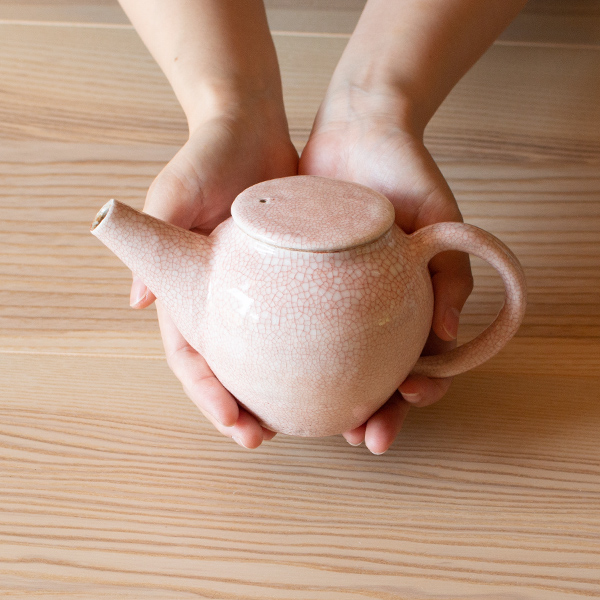
Compared to Kutani, Kyoyaki, Aritayaki, Shigaraki, and Bizen, "Minoyaki" doesn't have a single defining style of its own—but even among Minoyaki kilns, Zoshingama is a workshop that insists on craftsmanship and hand-painted decoration that goes beyond inexpensive mass production, along with techniques like shu kannyu (vermilion crackle glaze). This pot, too, was made with the aim of creating tableware that brings a lively, festive touch to the everyday table, and it features the legendary bengara (iron oxide pigment) called "Zoshin no Aka" mentioned above, applied using the kannyu (crackle glaze) technique.
Kannyu refers to the fine crack-like patterns that appear on the surface (glaze) of pottery or porcelain during firing, caused by the difference in shrinkage rates between the clay body and the glaze. There are two types of kannyu: "direct kannyu," which forms as the piece cools after being taken out of the kiln, and "aged kannyu," which develops naturally over time. This piece features direct kannyu created during the manufacturing process, and pieces with kannyu have a distinctive character that makes them feel as though they've been cherished and used with care for many years.

The rustic feel of the clay combined with the stunning kannyu gives it the air of a work of art. It's a beautiful pot even just on display, but because the bengara pigment develops into an even more beautiful, vivid red with use, it's also teaware that becomes more enjoyable the more you use it.

Next is an Azumaya teapot in charcoal-gray, with no flashy decoration—just a plump, rounded body, a small pursed-lip spout, and a handle shaped like a tanuki's tail. It brings to mind the tanuki from the folktale Bunbuku Chagama.

This shape incorporates clever design touches that even out the flavor and let you enjoy delicious tea down to the very last drop. First, the round, plump shape allows the tea leaves to unfurl properly. The lid fits the body of the teapot snugly, so there's no worry about tea spilling out around the lid when pouring. The teapot has a built-in tea strainer, and if you look inside, you'll be surprised at how fine the holes are. This delicate construction prevents the tea leaves from clogging the strainer, ensuring a delicious cup every time. Together, this strainer and the spout let you pour out every last drop, so you can enjoy delicious tea without any waste.

The material is a shudei (vermilion clay) body coated with a mixture of gosu (cobalt blue pigment) and manganese, then fired in an oxidizing atmosphere to give the teapot's surface its black color. Fired without glaze, the surface absorbs the aroma of the tea, and another feature of this teapot is that the tea it brews becomes richer in flavor and fragrance the more you use it.

If you want to go a little further, trying a tetsubin is also a great option. Using a tetsubin changes the water's hardness to a level well suited to Japanese tea. This soft, mellow quality of the water balances the umami and astringency of Japanese tea, making it taste even better.

Iwachu's Nambu tekki (Nambu ironware), built to last for 10, even 20 years. Nambu tekki is said to have originated from the "chanoyu" (tea ceremony) culture that was popular among feudal lords during the Edo period. The tetsubin is arguably its most iconic form. When used to boil water, iron naturally dissolves into it, making it an easy way to get more iron in your diet. Since it comes with a tea strainer, you can also use it as a teapot by adding tea leaves with the strainer, or as a kanbin for warming sake.
For those worried about rust with a tetsubin, we also introduce care instructions.
For those who take tea seriously, here are tools to make every cup even more delicious.
For those who already have a favorite set of tea tools, there are still more tools that can bring even greater enjoyment to tea. What matters most for brewing delicious tea is "temperature." The ideal temperature varies depending on the type of tea leaf, but unlike Chinese tea or black tea, which are brewed with high-temperature water, Japanese teas rich in sweetness and umami—such as gyokuro or high-grade sencha—are said to taste best when brewed at a low temperature of around 50 to 70°C. Here are the tools that help bring water to just that right temperature.
▼Chakai (tea serving pitcher)

If you want to enjoy tea the proper way, you should never pour freshly boiled water straight into the teapot. Instead, let it cool to a lower temperature before adding it to the pot, so the tea's umami can be drawn out slowly. This chakai, shaped like a small pitcher, is perfect for that cooling step. Its excellent pour makes it easy to add water carefully and precisely into the teapot. Named "sea of tea," this romantically titled tool has uses beyond simply cooling water.

Tea brewed in a teapot tends to become stronger toward the end of the pour, making it difficult to achieve a consistent flavor throughout. To solve this, the brewed tea is transferred once into the chakai. There, it blends together to an even strength, allowing everyone to enjoy the same delicious taste. Holding about 430ml, it's a reassuringly practical tea tool.
▼Kiritate Yuzamashi (Water Cooler)

Depending on the season, pouring hot water into a yuzamashi (water cooler) will lower its temperature by about 10 to 15 degrees in roughly 10 seconds. This small extra step seems to bring a little more ease of mind. This particular piece is fired without glaze, but because it's made from finely textured clay fired at a high temperature, it doesn't absorb water, so you can use it without worrying about lingering odors.
Taking the extra step of pouring water cooled in a yuzamashi or yunomi into the hōhin filled with tea leaves makes your everyday tea taste even better. It's said that brewing for a shorter time works well with hotter water, while a longer brewing time draws out more umami when using cooler water. Once the tea reaches a temperature comfortable enough to hold, pour it into a yunomi and enjoy its rich, flavorful taste.

▼Iriko Chaki (Hōhin and Nesting Bowls)

If you'd like to have a matching set, there's a handleless teapot (hōhin) along with a set of two nesting bowls, large and small, made by the same brand, Nankei Seitōen. Since the hōhin has no handle, you hold it directly and feel the warmth of the water as you brew, savoring that quiet moment of preparing tea. Its shape is designed for slowly enjoying tea at low temperatures, so please be careful not to use boiling water that could burn your hands.
The inside of this hōhin is left unglazed. The fine unevenness of the interior surface gently softens the tea's astringency, giving it a mellower, more delicious flavor.

The inside of the nesting bowls, on the other hand, is coated with a milky white glaze. This lets you clearly see the color of the tea, making it a set you can enjoy visually as well.

These nesting bowls fit neatly inside the hōhin, making it easy to bring along for tea time on the balcony or at the park. Since it doesn't take up much space to store, this is a set you can rely on for everyday use as well.
If you're looking to choose just a yunomi (teacup), here are some options.

Left: Sencha Bowl, Gold and Silver Design, Autumn Grasses, Right: Sencha Bowl, Gold and Silver Design, Flowers and Grasses
With colors as soft and gentle as a Japanese painting, and curves that seem to capture the very movement of the brush, these are small teacups holding about 100ml—a modest size that highlights their refined elegance. Painted in pink with hints of pale green and brown, along with touches of gold and silver, these sencha bowls from Nishikawa Teizaburo Shoten transform simple, natural flowers and grasses into a slightly more elegant scene.
Kiyomizu-yaki is one of Kyoto's representative traditional crafts, originally named after the kilns located near Kiyomizu-zaka, the slope leading up to Kiyomizu-dera Temple. While many of Japan's famous ceramics are shaped by the natural conditions of their region—such as local clay and water—Kiyomizu-yaki has instead been shaped over a thousand years by the aesthetic sensibilities and culture of Kyoto, the ancient capital where people from all walks of life gathered. This gives it a distinctive quality that reflects the uniquely Japanese spirit of wabi-sabi.
Since its founding, Nishikawa Teizaburo Shoten has been a long-established maker that has introduced Kiyomizu-yaki not only within Japan but widely across Europe, particularly in Paris and the Netherlands. While such international activity may not be unusual today, its achievements at the time led to its founder becoming the first chairman of the National Federation of Small and Medium Trading Companies of Kyoto, leaving his name in history as one of the pioneers in exporting Kyoto's traditional crafts. Kiyomizu-yaki, cherished in Kyoto—Japan's ancient capital—continues to attract attention around the world, both then and now.

The wares created by Nishikawa Teizaburo Shoten evoke the beautiful scenery of Japan, drawing on the concept of "snow, moon, and flowers." Through the delicate layering of glazes, the refined skill of clear-eyed craftsmanship, unwavering tradition, and a playful Kyoto spirit that delights in elegance, these pieces express all of this within the form of tableware.

This yunomi comes from Kamany, a brand launched in 2011 by Ikutōen, a tsuboya-yaki kiln in Naha, Okinawa, with a history of over 300 years. The name of this cup, "Basanai," comes from the Okinawan dialect word for "banana," and its design boldly carves out the generous, sweeping veins of a banana leaf using a chisel.

This carving technique is called "sen-bori" (line carving), one of the signature techniques of Tsuboya-yaki. It's a display of the craftsman's intuition and skill, drawing freehand without any preliminary sketch, at just the right moment when the slip or glaze has dried to the perfect state before firing. This is a technique that Ikutoen excels at, resulting in bold, vivid designs that capture the atmosphere of Okinawa.
The area has all the right conditions for making pottery—good quality clay, access to water, proximity to the port for transporting firewood, and hills suited for climbing kilns. Rooted in this land that has been passed down through generations, potters here continue to carry on the wisdom of their predecessors while making ware suited to the needs of each era. As the image of "yachimun"—pottery made in Okinawa in a distinctly Okinawan style—has become more widespread, the term "Tsuboya-yaki" has somehow been heard less often. Even so, more than a dozen kilns still operate in the Tsuboya district today, and Ikutoen, the maker of Kamany, is one of them.

Left: Kannai (Kaminari, meaning "thunder"), Right: Basanai (Banana)
Owning a favorite tool makes life feel richer. "Take your time choosing, and buy something good." Choosing items in person is wonderful, of course, but many people find that shopping at an online store brings its own kind of excitement—the anticipation of waiting for it to arrive can heighten the feeling of wanting to cherish it once it finally does.
This time, we've introduced you to just the entrance of the deep world of tea. Whether you take the extra step to bring out the best flavor in your tea leaves, or rely on the power of good tools, either way, we hope you can enjoy it at your own pace, in whatever way suits your lifestyle. Shincha season comes only once a year. If you happen to spot some shincha in town or at a shop, we hope you'll give it a try.
GUIDE »
CONTENTS »
CATEGORIES »
- + Gifts by recipient
- + Gifts by scene
- + Clothing
- + Bags / Backpacks
- + Wallets / Card cases
- + Jewelry
- + Shoes
- + Rainy day outfits
- + Kitchen
- + Home
- + Babies / Kids
- + Japanese products
Earn Miles


Payment & Security




