.webp)


.webp)


.webp)


.webp)


Welcome to ZUTTO
Free shipping for newsletter subscribers (some areas excluded)
- トップページ/
- ZUTTO Journal/
- 選び方・使い方/
- Tools for a Well-...

Tools for Everyday Life in Japan, for a Sense of Order
"To put in order"
What comes to mind when you hear this phrase?
Tidying a room, putting one's appearance in order.
In our busy modern lives, it can sometimes be difficult to keep things "in order."
This time, we'd like to introduce some Japanese everyday tools that help bring order to the things around you.

Suwada Seisakusho was founded in Taisho 15 (1926) in Sanjo, Niigata Prefecture, one of the world's leading centers for blade craftsmanship.
Sanjo is well known for its kaji (blacksmithing) tradition, and this history is said to date back to a period beginning in Kan'ei 2 (1625) and lasting three years.
Otani Seibei, a magistrate stationed in Sanjo, sought to help farmers who were suffering from repeated river flooding.
It is said that he invited nail-forging craftsmen from Edo and encouraged farmers to learn the technique of making wakugi (traditional Japanese nails) as a side occupation, marking the beginning of this tradition.
At first, wakugi were made as a side业务 for farming households, but by around Keian 2 (1649), craftsmen who devoted themselves solely to blacksmithing began to appear.
Around Kanbun 1 (1661), new manufacturing techniques were introduced from the Aizu region,
and production expanded from nails to sickles, saws, and kitchen knives, giving rise to full-time blacksmiths.
As the number of full-time blacksmiths increased and blades such as sickles came to be produced in large quantities,
merchants specializing in metalwork eventually emerged.
Suwada Seisakusho was born in this town of Sanjo.
Its founder, Shukuzaburo Kobayashi, began the company in response to the demand for housing reconstruction following the Great Kanto Earthquake (1923),
making "kuikiri" (nail nippers) for carpenters as his starting point.
Among the many kinds of blades, the company specialized in the kuikiri type—blades whose two edges meet perfectly to cut through an object—
and has remained committed, since its founding, to a thorough manufacturing process that begins with careful selection of materials and continues through to completion.
In this region blessed with fine materials and skilled craftsmen, where many workshops have fallen by the wayside over time,
Suwada Seisakusho has preserved its traditional techniques while continuing to refine and evolve them.
--------------------------------------------
What we'd like to introduce from SUWADA is, of course, their nail clippers.
Every one of their nail clippers can be used on both fingernails and toenails.
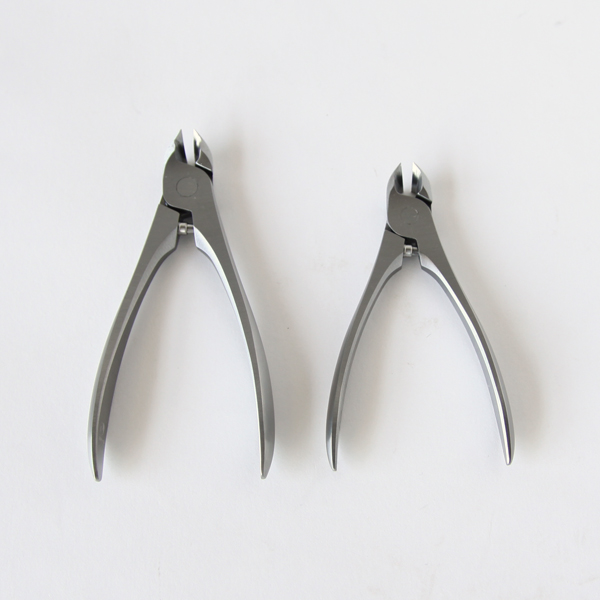
Left: Nail Clipper CLASSIC (L) Right: Nail Clipper CLASSIC (S)

With the look of a pair of nippers, they truly give the impression of an authentic "tool for daily living."
The blade curves to match the shape of the nail, making it possible to care for misshapen or ingrown nails as well.
Each one is sharpened individually through the skilled technique of a craftsman, giving the blade edge remarkable sharpness.
Because the two blades meet perfectly, the cut is clean and crisp, and clipped nail fragments
won't go flying off in every direction.
This is a masterpiece that has received the Good Design Award, and its clean, uncluttered appearance and reliably sharp cutting edge
leave nails so smooth after cutting that a nail file is said to be almost unnecessary.

All of the nail clippers come with a case.
If you feel the cutting edge starting to dull, you can send it back to the maker to be re-sharpened.
Many customers apparently send theirs in for maintenance roughly every five to six years.
As long as the blade hasn't worn away entirely, or developed holes from accidentally cutting something other than nails,
re-sharpening is possible.
We're told that even nail clippers from 30 or 40 years ago have been sent back for this kind of restoration.
Used with care, these nail clippers can truly become a lifelong companion.
At ZUTTO, we offer the CLASSIC in both S and L sizes, as well as a Baby size.
The L size is the regular size, while the S size is a bit smaller,
making it a good choice for those trying a nipper-style nail clipper for the first time.
Since the blade tip is sharp enough that even a light graze could hurt delicate skin,
the Baby size has its blade tip rounded off.

It trims nail tips smoothly,
so babies won't accidentally scratch their own skin with their nails.
Of course, the sharpness is exactly the same across all sizes,
so adults can use them too.
*The CLASSIC S and the Baby size share the same overall length and weight; the Baby size's blade edge is about 3mm shorter.
Just as we regularly visit the hair salon,
it might be nice to feel a touch of professional craftsmanship in our nail care as well.
Even the time we spend without much thought in our daily lives
can feel richer when we have tools like these on hand.

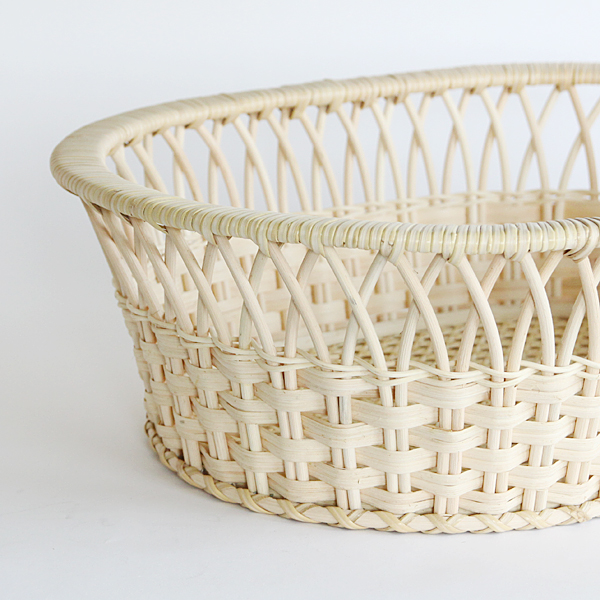
The oldest to (rattan) craftwork in Japan is said to date back over 1,000 years,
but it wasn't until the Meiji era that it began to spread as everyday household goods.
As rattan crafts grew popular in daily life, rattan imported from Southeast Asia became easier to obtain,
spread widely, and as a result, Japan's own rattan craft tradition declined sharply.
As Western-style chair culture spread and rattan furniture manufacturing techniques were brought over from China,
the making of rattan chairs became widespread.
To (rattan) is a palm-family plant native to Southeast Asia, known for being lightweight, durable, and flexible.
Tsuruya Shoten uses high-quality hand-split kawato (rattan skin) crafted by artisans in Chiba,
incorporating traditional techniques of bending, weaving, and winding long passed down in Yamagata,
to create a line of rattan crafts adapted to modern living.
--------------------------------------------
When you place one of Tsuruya Shoten's rattan baskets nearby, a soft, gentle scent of rattan drifts through the air.
It's a tool that fits naturally into a calm, settled way of life—the kind that makes you want to take a deep breath and appreciate that it's truly a domestically made rattan basket.

You can sense the delicate handwork throughout.
Every step of "bending," "winding," and "weaving" the rattan is done entirely by hand.
Although natural materials are used, some slight cracking in the material is unavoidable, but
Baskets crafted carefully by hand, one by one, by artisans
have an overwhelming presence compared to overseas-made products.
ZUTTO offers three types of baskets: square, round, and oval.
When it comes to how to use baskets,
in the living room, you can roll up rugs and blankets and store them neatly,
and they're also great for keeping bath towels organized on shelves.
For households with children, they can also serve as tidying-up baskets.

Simply tossing things in casually looks especially stylish.
Even placed in the living room, it won't disrupt the atmosphere.
Above all, when it comes to items placed near your children, made-in-Japan quality offers peace of mind, doesn't it?

Since solid wood is used as the material, you can enjoy the natural look of the wood at first.
As you use it, it gradually transforms into an amber color, becoming something you grow more attached to over time.

The size makes you want to use it as a laundry basket in the bathroom as well.
Tsuruya Shoten's rattan baskets, made with a commitment to domestic production.
Not only do they help organize scattered "things,"
but the careful craftsmanship and design that seem to set the whole atmosphere of your home in order
may just be the true appeal of this basket.

Takaoka, Toyama Prefecture, where Nousaku was born, developed as a town of commerce and industry
after Maeda Toshinaga, lord of the Kaga domain, founded the town of Takaoka in Keicho 14 (1609).
Two years after the town's founding,
Maeda invited seven imoji (casters) to what is now known as Kanaya-machi,
and this marked the beginning of the long history of Takaoka copperware.
In Taisho 5 (1916), Nousaku began manufacturing Buddhist altar fittings in Takaoka,
using casting techniques that had been passed down there for 400 years.
Casting is a manufacturing method in which molten metal is poured into molds to shape it into various forms.
Making the most of the qualities of natural materials, Nousaku handles not only Buddhist altar fittings but also
tea ceremony utensils, flower vases, tableware, and interior items.
That dignified appearance is also the result of advanced casting techniques and meticulous finishing.


Tin is a precious metal ranking just below gold and silver, and it has the properties of resisting oxidation and having strong antibacterial effects,
while also having none of the odor typical of metals.
It could be called the ideal material for everyday tools.
--------------------------------------------
This time, we're introducing Nousaku's tin sewing tools.
Cool to the touch, they truly feel like proper "tools."
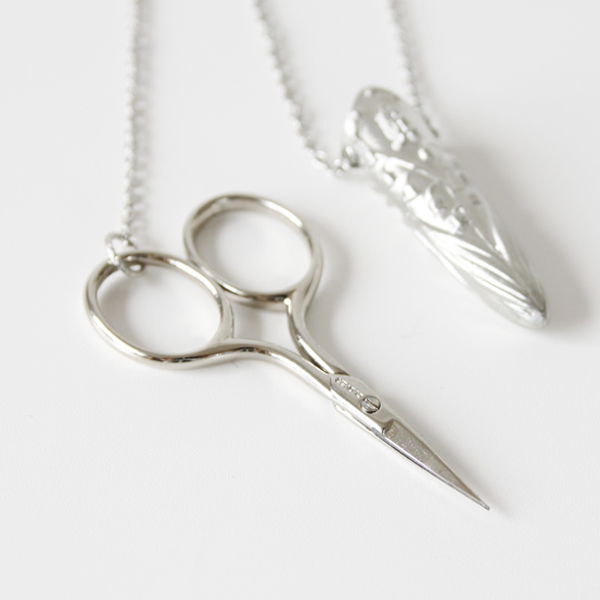
Suzuran Scissor Case
This scissor case, adorned with a delicate lily-of-the-valley (suzuran) pattern,
is a piece that combines a crisp, refined look with the charm of suzuran.

Suzuran Needle Case
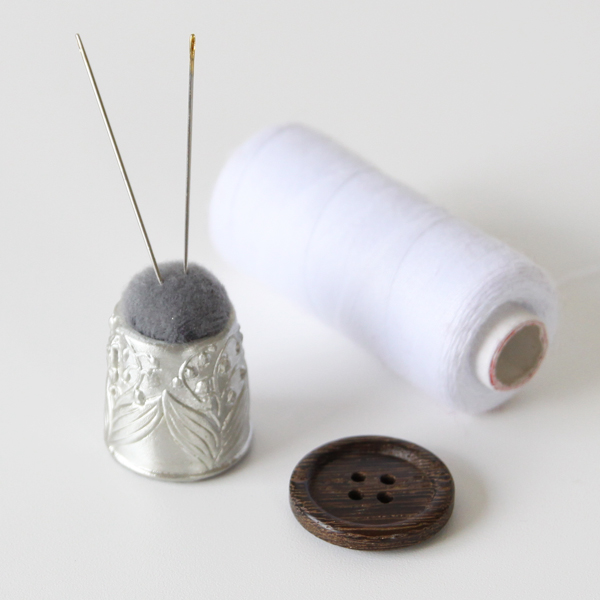
Suzuran Pincushion
A needle case for storing small, fine needles.
We also offer pincushions that make the most of tin's substantial weight and presence.
For instance, when the thread on your favorite clothes comes undone,
rather than a cluttered sewing box, if you have solid tin sewing goods tucked in one corner of the box,
with their substantial, reassuring weight,
perhaps even an unexpected moment of mending can become a lovely little occasion.
▽Related Content


Yosegi-zaiku (marquetry woodwork) is a craft that combines various types of wood, using differences in their color tones to create patterns.
It has a history of about 200 years.
Its history runs so deep that even the trophy for the Hakone Ekiden, the New Year's relay race that captivates TV audiences, is made using this yosegi-zaiku technique.
The origins of this craft date back to the mid-17th century, during the middle of the Edo period.
It's said that the technique originally developed in Shizuoka Prefecture, and the most widely accepted theory is that it was devised by artisans gathered from across the country to build Sengen Shrine.
In the latter half of the Edo period, a man named Ishikawa Nihei brought this technique back to Hakone,
where it merged with Hakone's existing crafting techniques—wooden crafts had already flourished there under the name "Hakone-zaiku"—and this fusion, which gave rise to a new style of craftsmanship, marked the beginning of yosegi-zaiku as we know it.
This yosegi-zaiku was designated a national traditional craft in Showa 59 (1984).
Tsuyuki Mokkojo was founded in Odawara in Taisho 15 (1926).
It is currently run by third-generation Kiyokatsu-san and fourth-generation Kiyotaka-san.
It began when the founder, Tsuyuki Seikichi, who was born in the town of Hakone, studied under Nisaburo, grandson of Ishikawa Nihei—the founder of yosegi-zaiku—before becoming independent.
While carrying on tradition, Tsuyuki Mokkojo has never hesitated to venture into new territory,
and its work has even been adopted for the interiors of popular hotels in Hakone.
It continues to create new yosegi-zaiku pieces that blend seamlessly into modern life.
--------------------------------------------
This time, we're introducing the Gosu (small lidded box) from Tsuyuki Mokkojo.
The pattern unique to yosegi-zaiku and the compact diamond shape make it truly charming.
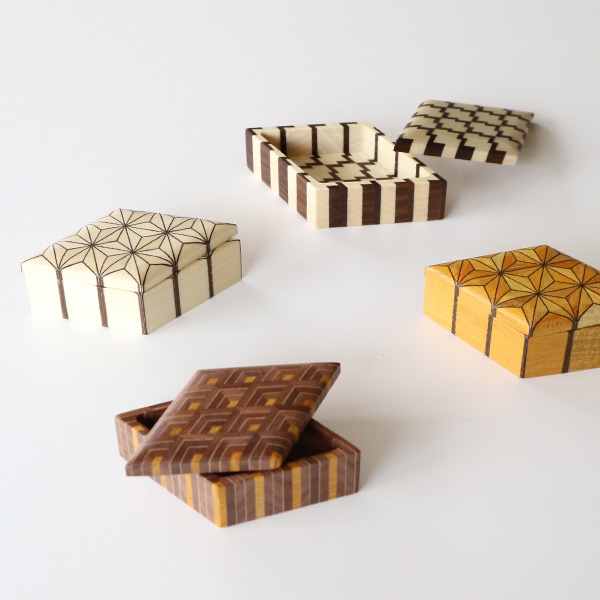
It's well suited for storing small items such as accessories.
Use it to hold treasured rings and accessories.
It also makes a perfect gift.
These beautiful yosegi-zaiku patterns actually carry meanings of their own.
Asa no ha (hemp leaf)
Because hemp grows quickly and sturdily,
this pattern is said to have been widely used on ubugi (a baby's first clothing) as a wish for a child's healthy growth.
Seigaiha (blue ocean waves)
A pattern of endlessly spreading waves that evokes the vast ocean,
it is an auspicious design imbued with wishes for eternity and peace.
Matsukawabishi (pine bark diamond)
A pattern in which small diamonds are layered slightly above and below a large diamond shape.
It is said to have been a favored design since the Nara period.

A small case that carries these classic Japanese patterns within its design.
Its smooth, beautiful yosegi zaiku (wood mosaic marquetry) becomes a little treasure box,
and with each use, it will gain more luster, becoming a truly one-of-a-kind piece.


GUIDE »
CATEGORIES »
- + Gifts by recipient
- + Gifts by scene
- + Clothing
- + Bags / Backpacks
- + Wallets / Card cases
- + Jewelry
- + Shoes
- + Rainy day outfits
- + Kitchen
- + Home
- + Babies / Kids
- + Japanese products
Earn Miles


Payment & Security