.webp)


.webp)


.webp)


.webp)


- トップページ/
- ZUTTO Journal/
- お手入れ・エイジング/
- Material Care Enc...

Material Care Encyclopedia「Bamboo」
Table of Contents)
・How to Care for Bamboo Products
・Tips for Making Bamboo Products Last Longer
・Storage Methods and Moisture Prevention
・Introducing Items That Help With Care

Characteristics of Bamboo
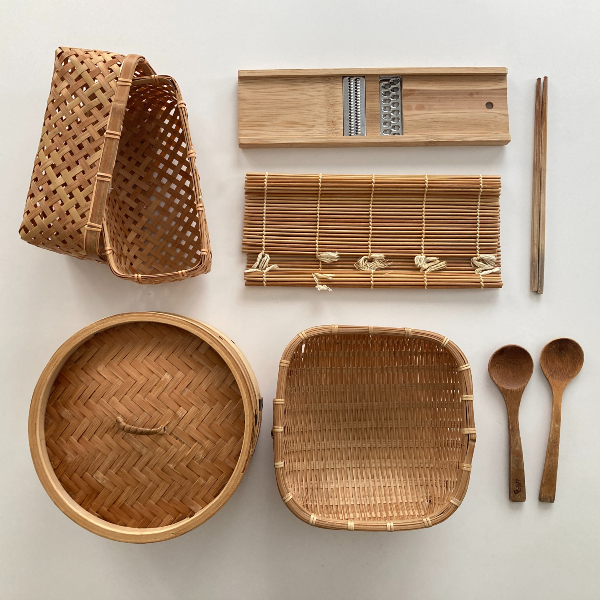
Bamboo grows quickly and sustainably, and thanks to its durability, lightness, and hygienic qualities that hold up over long-term use, it has long been a material closely tied to daily life in Japan. It is used in kitchen tools of all kinds—colanders, cooking chopsticks, and lids for seiro steamers, for example, have all traditionally been woven from bamboo. Bamboo offers the reassurance of not breaking when dropped, and it develops a rich amber color with use, making it enjoyable to use over the long term. It has also recently drawn attention as an environmentally friendly material.
In Japanese kitchens of the past, bamboo baskets and colanders were common, but as plastic and stainless steel have taken their place, kitchen tools made from bamboo have become less common. Still, the way bamboo develops character with use is a quality no other material can offer.
How to Care for Bamboo Products
Caring for bamboo products isn't especially difficult. Because bamboo fibers are fine, be sure to wash items thoroughly after use. You can use neutral detergent to clean them, but afterward just make sure to wipe away moisture and dry them completely. Depending on whether the surface is coated and on the intended use, some items may require special maintenance, so if the product comes with instructions, please follow the recommended care.
Care by Product Type

▲Madake Mutsume Basket Set of 3
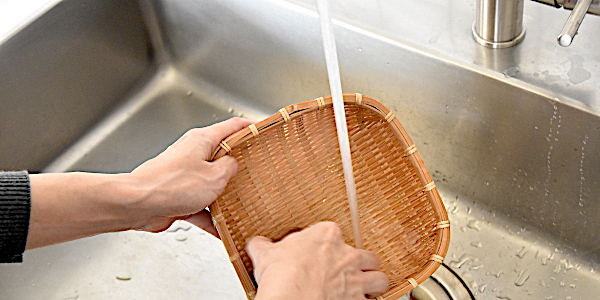

For bamboo products with a fine woven mesh like this, use a scrub brush or similar tool to properly clear out any debris caught in the gaps. Leftover grime and moisture can lead to mold and dark stains, so be sure to wash thoroughly, then dry the item completely before storing it.

After washing, it's important to dry the item thoroughly. Do not use a dryer—instead, let it dry completely in a well-ventilated spot.

Also, with chopsticks and cutlery, moisture and grime that seep into gaps in the fibers where the coating has worn away can cause dark discoloration or mold. Once an item has darkened, it cannot be restored to its original state, so washing and drying it properly is essential.

For items made of laminated bamboo board used in interior decor, simply wiping with a soft cloth is enough. For woven baskets with texture or mesh patterns, we recommend brushing off dust with a brush.


Dust and grime that get caught in the fine mesh of bamboo storage baskets can also be removed using a soft brush, a fine-bristled brush, or an air duster made for cleaning office equipment.

If you notice frayed splinters, don't pull on them—always cut them off with scissors. Also, if the mesh becomes unraveled due to some impact, since bamboo is a sturdy material, you can reinforce the weave with yarn or ribbon-like strips of fabric, allowing you to keep using the item for a long time.

Bamboo products with a glossy or colored surface may be coated. Compared to unfinished bamboo, they resist moisture and grime penetration better, but you should still avoid soaking them in water for long periods. As with unfinished bamboo products, it's important to dry them thoroughly after washing.
Tips for Making Bamboo Products Last Longer
Applying oil to bamboo products can help prevent cracking. In addition to oil made specifically for bamboo, you can also use cooking oils such as flaxseed oil or perilla oil for care. (Salad oil and olive oil can also be used, but since they don't dry as readily, be sure to wipe off any excess thoroughly.) Take a small amount of oil on a soft cloth, apply it thinly to the bamboo surface, and polish. After application, wipe away any excess oil and let the item dry completely before storing.

1. Remove dirt.
Gently wipe the surface of the bamboo product with a dry, soft cloth to remove dust and grime. If the bamboo product is damp, let it dry completely before beginning this process.

2. Apply oil to the surface.
Using a clean cloth or sponge, apply a small amount of protective oil evenly to the bamboo product. Take a little oil at a time and spread it carefully along the grain of the bamboo fibers.

3. Wipe off excess oil.
After applying the oil, use another clean cloth to remove any excess.

5. Let it dry.
Afterward, let the item dry thoroughly in a well-ventilated spot.

Storage Methods and Moisture Prevention
Bamboo is a material sensitive to moisture. For items you won't use for a long stretch of time—summer basket bags or interior decor pieces, for instance—we recommend wrapping them in breathable cloth or paper and storing them somewhere cool and well-ventilated. Silica gel packets or dehumidifiers are also useful for managing moisture.

If Mold Appears
If mold is found on bamboo products, the first step is to remove it with a soft, dry cloth. If the mold has already spread, it's effective to use alcohol or a specialized mold remover. Alcohol is unlikely to damage bamboo products and has the power to effectively sterilize mold.
If Insect Damage Appears
Since bamboo is grown without the use of pesticides, insects can occasionally appear. Because insects hiding inside bamboo are difficult to detect beforehand, it's important to take prompt pest-control measures as soon as signs of insect damage are noticed.
If you find insect damage, use an insect repellent to eliminate them, then ensure good ventilation to prevent recurrence. It also helps to slowly pour hot water (60°C or above) over the affected area several times (excluding items that are difficult to wash with water).

Introducing Helpful Items
For the care and storage of bamboo products, useful items include soft-bristled brushes, soft dry cloths, silica gel or dehumidifying agents, neutral detergent, specialized protective oil (wax), and insect repellent.

Brushes made with horsehair have soft bristles, making them convenient for cleaning interior baskets with a lot of open weave. Nylon brushes are also fine to use, but in that case, be sure to choose one with soft bristles.

While towels and other familiar soft cloths can be used, their pile can catch on rough or splintered bamboo surfaces, so a short-napped cloth or cotton flannel is recommended.

Natural camphor made solely from kusunoki (camphor tree) grown in Kyushu has an insect-repelling effect simply by placing it alongside your basket.
Brands Working with Bamboo

Japanese Bamboo Craft
Items our staff have loved and used for years. Items that have been cherished by all kinds of people. Items we've actually tried ourselves and can genuinely recommend with confidence. And materials that are gentle on the environment and safe to use. The careful craftsmanship you can feel the moment you pick them up. And a beautiful design that makes you want to keep them close, always.
As a select shop, we introduce tools that have long been used in Japan.

Kohchosai Kosuga is a bamboo product brand founded in 1898.
Bamboo is a material that has been close to Japanese life since ancient times, a gift from nature. Kohchosai Kosuga deeply understands bamboo, and creates crafts and everyday tools with the aim of enriching daily life and culture. The appeal of Kohchosai Kosuga lies in its commitment to craftsmanship that never forgets the values and sensibilities that remain unchanged across the ages.

TEORI is a brand born in Kurashiki City, Okayama Prefecture, an area rich in bamboo groves.
Bamboo grows to maturity within just a few years and requires no replanting. Wanting to make use of bamboo as an environmentally friendly material and create products that benefit the environment, the "Bamboo Laminate Project" was launched together with six designers connected to Okayama.
Through this project, the team tackled the various challenges involved in working with bamboo laminate, taking the time to fully understand the material's characteristics. The result was TEORI's interior goods and furniture, which achieve a balance of originality, functionality, cost, and beauty. While continuing to create beautiful bamboo products suited to modern life, TEORI aims to make effective use of bamboo material and build a society based on bamboo's cycle of renewal.

Minamikaze Kougei was founded in 1979 in Beppu City, Oita Prefecture, and now produces its goods in Hiji Town, located to the north of Beppu. With a desire to approach bamboo craft through a new system focused on higher quality craftsmanship and fair pricing, Minamikaze Kougei handles everything in-house, from sourcing materials to manufacturing and sales. Rather than treating bamboo craft purely as a traditional art form, Minamikaze Kougei creates easy-to-use bamboo items meant for everyday life. Few companies in the production area handle everything from material sourcing to manufacturing and sales under one roof, but Minamikaze Kougei goes even further, managing the mountains where the bamboo grows and supplying materials to individual craftspeople—carrying Beppu bamboo craft into the future from a fresh perspective.

In the Kiso region of Nagano Prefecture, where old-growth trees still flourish today, Yamaichi creates wooden products using high-quality hinoki (Japanese cypress) and sawara (Japanese false cypress). In pursuit of items that are a pleasure to have simply because they are made of wood, and work that only wood can accomplish, Yamaichi handles everything from traditional products such as ohitsu (wooden rice containers) and teoke (wooden buckets) to items like cutting boards that fit naturally into modern life.
GUIDE »
CATEGORIES »
- + Gifts by recipient
- + Gifts by scene
- + Clothing
- + Bags / Backpacks
- + Wallets / Card cases
- + Jewelry
- + Shoes
- + Rainy day outfits
- + Kitchen
- + Home
- + Babies / Kids
- + Japanese products
Earn Miles


Payment & Security