
.jpg)


.jpg)

.jpg)
.jpg)

- トップページ/
- ZUTTO Journal/
- お手入れ・エイジング/
- Your first copper...

Trying Copper for the First Time: How Do You Use It?
Copper is a material we think we know, but don't really.
When it comes to copper items in everyday life, the ten-yen coin is probably the first thing that comes to mind.
Beyond that, though… not many other examples
spring to mind right away.
In an age when so many different materials are available, copper—which requires regular care—
may feel like an unfamiliar material to many of us.
And yet, as a material humankind has used since prehistoric times,
copper's qualities are just as useful in modern life, and if handled properly,
it can become something you keep with you for a long time.
With that in mind, let's dive right into the appeal of copper.
What's Different About Copper Products?

Copper's greatest characteristic is its thermal conductivity.
Once placed over a flame, heat spreads through it almost instantly.
Even among metals, an iron frying pan, for example, takes some time
for the heat to spread throughout, but copper heats up far faster than iron,
aluminum, or stainless steel—
the difference in speed is quite dramatic.
That's why, for cookware and anything else that needs to be
heated over a flame, using copper can save you time.
What's more, since the heat spreads evenly,
when you place a pot over a flame, heat instantly spreads across the entire bottom of the pot,
allowing you to cook without uneven hot spots.
And it's not just heating—if you put ice in a copper cup,
it cools down instantly, chilling the entire cup.

Another strength of copper products is their high antibacterial property.
Copper compounds have disinfectant properties, and are known to help suppress
the growth of microorganisms and bacteria.
This is why copper is used in sewer piping,
and why flowers are said to last longer in copper vases.
Just as iron cookware is said to release iron into food,
copper similarly releases copper ions,
which are thought to have a disinfectant effect.
We naturally want anything that touches our mouths or hands to be hygienic.
Copper answers that wish as well.
Copper and Discoloration
Now, rust is something that comes with the territory when it comes to metal.
Copper is more rust-resistant than aluminum or iron, but
just as a ten-yen coin gradually turns black with everyday use,
copper discolors as it comes into contact with oxygen in the air.


For copper cookware that comes into contact with food,
it is generally recommended that the surface touching the food be coated with tin or silver.
This prevents rust from forming, and also keeps the smell of copper
from transferring to the food.
Even so, rust gradually appears over time.
In particular, a green rust known as rokusho (verdigris) can form.
The copper Statue of Liberty is now green, and
that color, too, is the result of verdigris.
Verdigris, which appears due to moisture and carbon dioxide, is a form of rust,
but it is also a natural phenomenon in which a surface film forms to keep
corrosion from progressing further into the copper underneath.
Given that rust does form, you might think copper is
difficult to handle—but simply by caring for it and handling it properly,
you can prevent rust from forming.
The deep reddish-brown color and the durability that lets it remain
usable even as time passes are qualities unique to copper.
With just a little care,
copper products will stay with you for years to come.
Getting the Most Out of a Copper Pot
Thanks to its excellent thermal conductivity, copper offers high practicality as cookware.
A copper pot is perhaps the first thing
many people think of trying.

This is a tamagoyaki pan from Nakamura Doki Seisakusho, a maker that has crafted copperware for generations.
It comes in two different shapes, Kansai-style and Kanto-style,
so you can choose the pan that suits your cooking style.
The copper tamagoyaki pans made by Nakamura Doki Seisakusho are
known as a pan favored by cooking professionals as well.

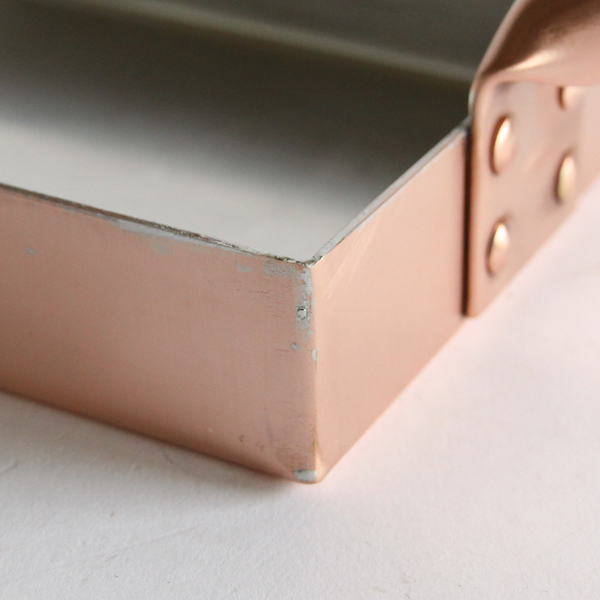
The reason chefs choose it comes down to a design that makes the most of copper's thermal conductivity.
Ingredients like eggs, which heat through quickly and can easily burn
if you're not careful, are said to pair well with pans made of a material
like copper, where heat spreads quickly and evenly.
When placed on a stove, the Nakamura Doki Seisakusho tamagoyaki pan
is just the right size, and heat spreads through it instantly.
The handle is also angled to make flipping the egg easier,
and the copper joints are kept to a minimum,
all in the pursuit of achieving the most delicious tamagoyaki possible—
a design built with meticulous attention to detail.
There are a few points to keep in mind when using a copper pot.
◇Usage Tip 1: Seasoning with Oil
When you first start using the pot, begin by seasoning it with oil.
This creates an oil film on the surface of the pot,
and should always be done to prevent food from sticking and burning.

First, Season the Pot with Oil
1) Pour cooking oil into the pot, filling it to about 70% of its depth as a guide.
2) Heat the pot over low to medium heat.
The oil's surface should waver gently, with small bubbles
forming here and there—that's the right level of heat.
Please be careful with the heat, as the tin lining on the inside can melt if the temperature gets too high.
3) Let it simmer like this for 4 to 5 minutes. While it's on the heat,
please don't take your eyes off the pot.
4) Turn off the heat and let it cool slightly.
Pour the oil into an oil pot or similar container for storage.
Wipe the surface of the pot with kitchen paper, working oil into the metal.
The pot can be used in this state.
※Please be careful, as the pot will be extremely hot after heating.
◇Tips for Use 2: Heat Level and Oil Conditioning
Because copper conducts heat so quickly, the entire pot heats up almost instantly.
As a basic rule, use low to medium heat.
Also, even after the initial seasoning process,
for about the first month of use, in order to build up a sufficient oil film,
we recommend warming the pot over low heat, adding a generous amount of oil and letting it soak in,
then wiping away the excess oil with kitchen paper
before cooking (this is called "oil returning," or aburagaeshi).

The bottom of the pot. Its color changes even after just one use
◇Tips for Use 3: Care and Storage
1) Wash with a soft sponge immediately after use.
Use hot water when washing, and avoid using detergent
so as to preserve the oil film.
※Leaving food in the pot can cause rust,
so please wash it as soon as possible.
※Please do not use scouring pads or cleanser, as they may cause scratches.
2) After washing, place the pot over heat to dry off any moisture.
Then, soak a piece of kitchen paper with oil and rub it into the inside and
outside of the pot to help prevent rust.
3) Store the pot in a place with as little humidity as possible.
Wrapping it in newspaper can help protect it against moisture.
Not only in cookware, but also in tableware and interior items,
incorporating copper can transform the atmosphere of a room.

Takaoka dōki (Takaoka copperware) has been made in Takaoka, Toyama Prefecture, for over 400 years.
Takaoka's history as a metalworking center began in the Edo period, when the Kaga domain invited casters to the area,
and the city is said to be a renowned center of copperware production, accounting for about 90% of Japan's domestic output, including Buddhist altar fittings.
tone is a copperware brand from Orii Chakushokusho, a workshop in Takaoka that has spent many years specializing in the coloring of copperware.
Amid growing concern over the decline of Japan's traditional industries, including Takaoka copperware,
tone was launched with the aim of creating original work that makes full use of the workshop's own techniques.


Although tone is made of copper,
its design is crafted to suit modern living, and it's distinguished by its unique coloring.
By using special chemicals to corrode the copper, the metal's natural colors are drawn out,
resulting in shades known as seidoiro (bronze color), niiro, sentokuiro, nabechoiro, shudoiro, and yakiseidoiro.
The key point is that these are not colors applied on top of the copper, but the natural colors of the copper itself.
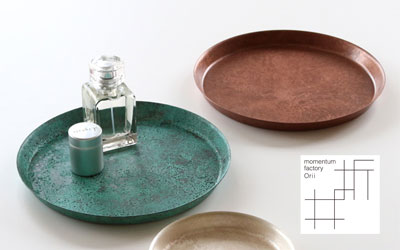
The tray series is a recommended way to change the atmosphere of a room.
Available in three distinct colors—silver, copper pink, and green—each piece features the uneven coloring unique to copper on its surface.
Even though it's a metal, it has a character quite different from aluminum or stainless steel.
It can be used in many ways: for holding keys by the entryway, holding condiments at the table,
or storing accessories in the bedroom.

Like the tamagoyaki pan from Nakamura Dōkiseisakusho, tone items also
have tin or silver plating on the inside.
The tumbler is one item that's easy to incorporate into daily life.
Thanks to copper's excellent heat conductivity, the temperature of a drink spreads evenly throughout the tumbler,
so it keeps cold drinks with ice in them refreshingly cold.
Its ease of use also makes it a popular gift.


As its name suggests, the on the wall mini flower vase
can be hung directly on a wall.
This model comes with a glass tube, which is used to hold the flowers.
Its flat, simple design is calculated to blend naturally into a wall,
so that when flowers are arranged, they appear to grow straight out of the copper plate.
It's an item that adds a subtle accent
to spaces like the living room, entryway, or bathroom.


The clock (wall clock) is another item that adds an accent to a room.
It has a simple design with no dial face, just hands attached to a copper plate, and the copper gives off a subdued gleam.
The color and uneven texture of the copper surrounding the clock leave a truly one-of-a-kind impression.
This clock catches the eye the moment you enter a room,
maintaining a solid presence while quietly marking the passage of time.
◇Tips for Using Copper Interior Items and Tableware
Copper items don't do well with humidity or moisture.
For interior items, we recommend using them
in a well-ventilated location.
For care, we recommend regularly dusting with a duster and wiping with a dry cloth.
If storing for a long period, first wipe with a cloth that has been dampened with water and then wrung out firmly,
then wipe dry with a dry cloth, and make sure the item is completely dry before storing it.
When storing, wrapping the item in a paper box or cloth will help prevent moisture from building up.
Copper tableware is plated with tin or silver,
so it's less prone to rust, but please wash it with water
as soon as possible after use. (Dish soap may also be used.)
After washing, wipe with a dry cloth and make sure it's fully dry before storing.
Even if it hasn't come into contact with water, over time
moisture in the air will gradually affect it, causing its color to change.
Please enjoy watching these changes as one of the characteristics of copper items.

GUIDE »
CATEGORIES »
- + Gifts by recipient
- + Gifts by scene
- + Clothing
- + Bags / Backpacks
- + Wallets / Card cases
- + Jewelry
- + Shoes
- + Rainy day outfits
- + Kitchen
- + Home
- + Babies / Kids
- + Japanese products
Earn Miles


Payment & Security